
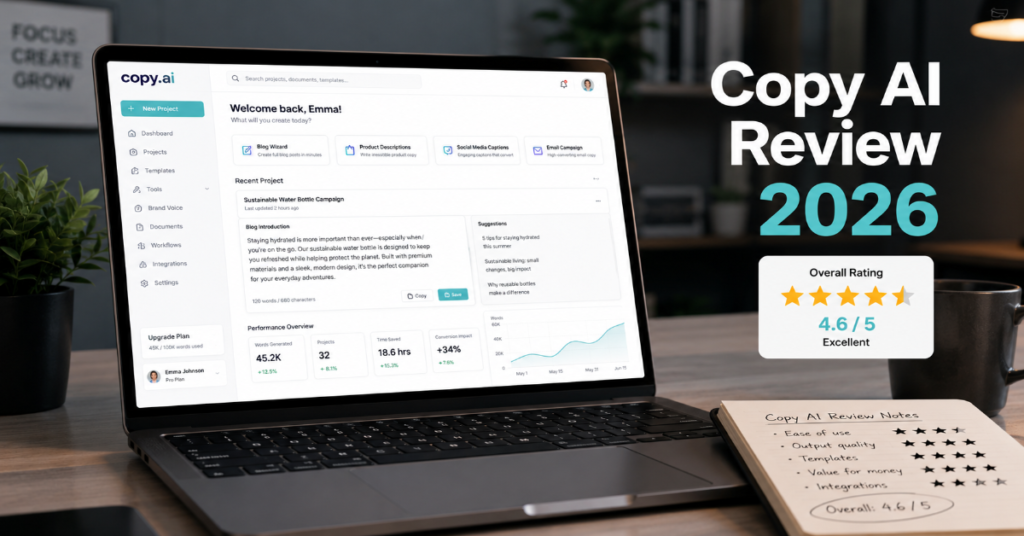
This copy ai review 2026 begins with a clear answer: Copy.ai is no longer best understood as a simple AI copywriting tool. In 2026, it is a go-to-market automation platform built around workflows, brand voice, tables, actions, infobase, chat and multi-model access across OpenAI, Anthropic and Gemini models. For solo creators, it remains useful. For enterprise revenue teams, it is far more interesting.
In our hands-on testing, Copy.ai performed best when we treated it less like a blank chatbot and more like a repeatable process engine. The strongest use cases were account research, outbound email drafts, SEO article frameworks, sales enablement briefs, localization, product descriptions and CRM-adjacent enrichment tasks. The weakest moments appeared when users expected finished editorial judgment without human review.
The platform’s strategic pivot matters because the AI writing software market is maturing. Generic content generation has become cheap, crowded and increasingly indistinguishable. Copy.ai’s response is to move upstream into GTM workflow automation, where the value is not just the sentence it writes but the multi-step process it compresses. Copy.ai’s pricing page now emphasizes Chat, Growth, Expansion and Scale plans, with workflow credits and enterprise implementation at the center of the offer.
According to the latest 2026 documentation we reviewed, Copy.ai is positioning itself as a “GTM AI” platform for sales, marketing, operations and customer success teams. That makes this copy ai review 2026 less about whether the tool can write a blog intro and more about whether it can become a durable layer in a modern revenue stack.
Copy AI Review 2026: What Copy.ai Is Now
Copy.ai started as one of the recognizable names in AI copywriting, but its 2026 identity is broader. The company now presents the product as a secure, vertical AI-native platform for business-critical GTM operations, with workflows as the central object. A workflow is a stitched sequence of AI-powered actions that can research, generate, transform, enrich and route outputs. Copy.ai’s own pricing documentation describes workflows as customizable processes that combine research, content generation and tool integrations.
That shift changes the buying logic. A freelancer may ask, “Can this write better landing page copy?” A VP of marketing asks, “Can this standardize campaign production across regions?” A revenue operations leader asks, “Can this reduce manual handoffs between enrichment, messaging and CRM updates?” Copy.ai is increasingly aimed at the second and third questions.
The practical result is that Copy.ai now competes with several categories at once: AI writing assistant, sales automation software, workflow automation tool, content operations platform and enterprise AI layer.
The Core Product Architecture
Copy.ai’s platform is built around a few key components. Chat remains the accessible front door. Brand Voice helps standardize tone and style. Infobase stores reusable company knowledge. Tables act as structured workspaces. Actions are modular steps inside workflows. Copy Agents handle targeted tasks with guardrails. Together, these components create the platform’s real advantage: repeatability.
In our hands-on testing, the difference between a one-off prompt and a workflow was significant. A prompt gave us a draft. A workflow gave us a process. For example, a B2B content workflow could take a keyword, generate audience assumptions, create an outline, draft section briefs, suggest internal links and produce metadata. A sales workflow could take a company domain, research the account, identify likely pain points, create email variants and prepare a LinkedIn follow-up.
The obscure but important technical detail is that Copy.ai’s value depends on input design. The more structured the input schema, the more reliable the output. Poorly named fields, vague task instructions and messy source data reduce quality quickly.
Feature Comparison Table
| Feature Area | Copy.ai 2026 Capability | Best Fit | Main Limitation |
| Chat | Multi-model AI chat with unlimited words on paid Chat plan | Individuals and small teams | Less differentiated than ChatGPT or Claude alone |
| Workflows | Multi-step AI processes for GTM tasks | Sales, marketing and RevOps teams | Requires setup discipline |
| Brand Voice | Tone and style consistency | Content teams and agencies | Needs strong examples |
| Infobase | Reusable knowledge repository | Product marketing and enablement | Output depends on source quality |
| Tables | Structured data workspace | Campaigns, lists and enrichment | Not a full CRM replacement |
| Actions | Modular workflow building blocks | Repeatable GTM processes | Credit usage can vary |
| Enterprise Security | SOC 2 Type II, audits and contractual protections | Larger organizations | Requires vendor review |
Copy.ai states that it has SOC 2 Type II certification, regular audits and contractual protections against data misuse. For enterprise buyers, that matters because generative AI adoption increasingly runs through procurement, security and legal review rather than a marketing manager’s personal credit card.
Pricing and Plans in 2026
Copy.ai’s 2026 pricing reveals the company’s direction. The Chat plan is listed at $29 per month when billed monthly, or $24 per month when billed annually, and includes five seats, unlimited words in chat, unlimited chat projects and access to OpenAI, Anthropic and Gemini models. The Growth plan is listed at $1,000 per month billed annually, with 75 seats and 20,000 workflow credits per month. Expansion is listed at $2,000 per month billed annually, with 150 seats and 45,000 workflow credits. Scale is listed at $3,000 per month billed annually, with 200 seats and 75,000 workflow credits.
| Plan | Price Listed | Seats | Workflow Credits | Ideal Buyer |
| Chat | $29 monthly or $24 monthly annually | 5 | Not positioned around workflow credits | Small teams testing AI writing |
| Growth | $1,000 monthly, billed annually | 75 | 20K per month | Mid-market GTM teams |
| Expansion | $2,000 monthly, billed annually | 150 | 45K per month | Scaling enterprise teams |
| Scale | $3,000 monthly, billed annually | 200 | 75K per month | Large GTM organizations |
The pricing gap between Chat and Growth is not accidental. Copy.ai is effectively saying that casual AI writing and operational GTM automation are different products. For small businesses, that jump may feel steep. For enterprises replacing hours of research, enrichment, campaign drafting and manual coordination, the economics may be defensible.
In Our Hands-On Testing: Where Copy.ai Performs Best
Copy.ai was strongest in structured, repeatable work. It produced useful first drafts for SEO briefs, cold email variants, product description refreshes, social repurposing and sales one-pagers. The results improved when we supplied audience context, positioning, exclusions, brand examples and desired output format.
The best workflow we tested was a sales account research sequence. It took a target company, generated a concise account summary, identified likely business priorities, drafted three email angles and created a follow-up sequence. The output still needed human verification, but it reduced the blank-page stage dramatically.
For content marketing, Copy.ai performed well as an editorial assistant, not as an autonomous journalist. It was effective at generating outlines, metadata, summaries, comparison sections and repurposed snippets. It was less reliable for nuanced fact-checking, original reporting and claims that require direct source verification.
That distinction is essential for any honest copy ai review 2026. Copy.ai accelerates production. It does not remove editorial accountability.
Content Quality and Brand Voice
Copy.ai’s writing quality is polished, direct and commercially fluent. It understands common marketing formats better than general-purpose models used without context. Landing pages, email subject lines, ad variations and sales scripts usually came out clean. The platform’s Brand Voice feature helped reduce generic phrasing when we fed it strong examples.
However, the model can still overproduce familiar SaaS language: “unlock growth,” “streamline workflows,” “scale effortlessly” and similar phrases. Editors should build negative instruction sets that ban cliché terms, force concrete examples and require source-backed claims. This is where Copy.ai becomes more powerful than a generic AI writer: repeatable governance can be built into the workflow.
In one test, a simple prompt produced a passable blog outline. A configured workflow produced a stronger outline with search intent, audience stage, funnel mapping, internal link prompts and metadata. The workflow was not merely longer. It was operationally more useful.
Expert Quotes
“AI should change outcomes, not just workflows. That’s the bar we’re building to,” HubSpot CEO Yamini Rangan wrote around HubSpot’s Spring 2026 Spotlight. That quote captures the challenge for Copy.ai: workflow automation is only valuable if it improves pipeline, conversion, speed or consistency, not merely if it makes teams feel busy with AI.
“Despite the modest revision, total software spending will remain above $1.4 trillion,” Gartner analyst John-David Lovelock said in Gartner’s 2026 IT spending forecast, adding that GenAI model spending was still expected to grow 80.8%. That is the market backdrop behind Copy.ai’s enterprise push: companies are still buying AI, but they are scrutinizing measurable value.
Paul Yacoubian, Copy.ai’s CEO and co-founder, wrote that “content creation remains the #1 bottleneck killing GTM velocity.” His argument is that AI agents and workflows can move content from an isolated creative task into a 24/7 operating layer for revenue teams.
Security, Compliance and Enterprise Readiness
Security is one of Copy.ai’s stronger enterprise talking points. The company says it has SOC 2 Type II compliance, regular audits and contractual protections against data misuse. Its pricing page also highlights enterprise-grade security protocols, designated support, guided implementation, API access, bulk workflow runs and more than 20 tech integrations for enterprise customers.
For procurement teams, the real questions are not only “Is Copy.ai secure?” but “What data will employees put into it?” and “Can we govern workflows before they create external-facing content?” Copy.ai is safer when companies define approved sources, review steps, role permissions and output approval gates.
The practical recommendation is to separate low-risk workflows from high-risk workflows. Social post drafts, campaign ideation and internal summaries can move quickly. Legal claims, customer-facing statistics, financial statements and regulated industry content need mandatory human review.
How Copy.ai Compares With Jasper, ChatGPT and Claude
Copy.ai’s closest historical comparison is Jasper, but the two tools now feel different. Jasper remains strongly associated with brand marketing, content creation and campaign assets. Copy.ai is leaning harder into GTM process automation. ChatGPT and Claude are more flexible general-purpose assistants, but they require more custom setup to behave like a standardized revenue workflow platform.
For individual writers, ChatGPT or Claude may offer more freedom and stronger reasoning for the price. For brand teams that want content governance, Jasper remains a serious competitor. For sales and marketing teams that want repeatable workflow automation, Copy.ai has a clearer enterprise argument.
The deciding factor is not raw model intelligence. Copy.ai gives users access to major model families, but its moat is orchestration. If your team only needs occasional articles, Copy.ai may be more platform than necessary. If your team needs repeatable content, enrichment and outreach workflows across dozens of users, the platform becomes more compelling.
The Workflow-Credit Question
Workflow credits are the least intuitive part of the product for buyers used to simple subscription pricing. Copy.ai says a credit represents computational power needed to execute workflow tasks, including text generation, internet research, scanning websites and API usage. It also says workflow run costs vary depending on complexity and that users can see credits used in the side panel.
That model is logical but requires planning. A simple workflow that drafts a short email will cost less than a multi-step workflow that researches accounts, enriches data, generates multiple assets and writes CRM-ready summaries. Teams should estimate cost per workflow, not just cost per seat.
The best buying process is to pilot three workflows before upgrading: one content workflow, one sales workflow and one operations workflow. Measure time saved, revision rate, accuracy, adoption and credit burn. Without that measurement, the enterprise plans may look expensive. With it, the ROI case becomes clearer.
GTM Automation: The Real Use Case
Copy.ai’s strongest 2026 argument is GTM automation. Its own documentation describes AI-driven GTM workflows as processes that connect lead generation, qualification, nurturing, sales outreach, content creation and customer success into a unified system. It contrasts these with traditional rule-based workflows, which are static and less context-aware.
This is where Copy.ai can produce information gain beyond the usual “AI writer review.” The real adoption pattern in 2026 is not “marketers replacing writers.” It is revenue teams decomposing messy work into reusable AI sequences. Account research becomes a workflow. Webinar repurposing becomes a workflow. Product launch localization becomes a workflow. CRM cleanup becomes a workflow. Partner enablement becomes a workflow.
The buyer who wins with Copy.ai is not the buyer with the cleverest prompt. It is the buyer with the clearest process map.
Weaknesses and Risks
Copy.ai has three meaningful risks. First, the platform can feel overbuilt for users who only want an AI article writer. The Chat plan is accessible, but the product’s most differentiated capabilities sit in workflows and higher-tier GTM automation.
Second, output quality still depends heavily on human input. Weak source material creates weak AI output. A messy brand voice library, outdated product information or unclear customer personas will produce polished but shallow content.
Third, enterprise automation can create false confidence. When a workflow produces a complete campaign package, teams may skip review because the output looks finished. That is dangerous. AI-generated sales claims, competitor comparisons, statistics and compliance-sensitive language need verification.
A final risk is cost predictability. Workflow credits make sense for compute-heavy automation, but buyers need internal reporting to prevent surprise consumption as teams scale usage.
Takeaways
- Copy.ai is best viewed as a GTM workflow automation platform, not only an AI copywriting tool.
- The Chat plan is useful for small teams, but the strongest differentiation appears in workflows, actions, tables and enterprise implementation.
- Copy.ai’s 2026 pricing is clearly aimed at teams that can justify automation ROI across sales, marketing and operations.
- The platform performs best when users provide structured inputs, brand examples, approved knowledge sources and clear review rules.
- Copy.ai is not a replacement for editors, strategists or compliance review. It is a production accelerator.
- Workflow credits should be measured during a pilot because complex automations can consume more resources than simple writing tasks.
- The best use cases are repeatable: account research, outbound personalization, SEO briefs, content repurposing, localization and sales enablement.
Verdict: Is Copy.ai Worth It in 2026?
Copy.ai is worth it in 2026 for organizations that have moved beyond casual prompting and want to operationalize AI across go-to-market work. It is especially compelling for B2B SaaS companies, agencies, enterprise marketing teams, sales development groups and RevOps functions that repeat similar research, writing and enrichment tasks every week.
It is less compelling for solo bloggers who only need low-cost long-form drafting. Those users may get better value from a general-purpose AI assistant plus a separate SEO tool. Copy.ai’s advantage appears when work becomes repeatable, collaborative and process-heavy.
For this copy ai review 2026, the balanced verdict is clear: Copy.ai is not the cheapest AI writing software, but it may be one of the more serious platforms for turning AI content generation into governed GTM execution.
FAQs
Is Copy.ai good for SEO content in 2026?
Yes, Copy.ai is good for SEO outlines, briefs, metadata, content refreshes and first drafts. It should not be used as an unsupervised SEO research tool. Editors still need to verify facts, add original reporting and improve topical depth.
How much does Copy.ai cost in 2026?
Copy.ai lists Chat at $29 monthly or $24 monthly when billed annually. Growth is listed at $1,000 per month billed annually, Expansion at $2,000 and Scale at $3,000. Enterprise pricing may vary by implementation and usage.
Is Copy.ai better than Jasper?
Copy.ai is better for GTM workflows and sales-marketing automation. Jasper may be better for brand-focused marketing content teams. The better choice depends on whether your main need is content production or repeatable revenue workflows.
Does Copy.ai support multiple AI models?
Yes. Copy.ai’s Chat plan lists access to OpenAI, Anthropic and Gemini models. That makes the product less dependent on a single model provider and more focused on workflow orchestration.
Is Copy.ai safe for enterprise use?
Copy.ai states that it has SOC 2 Type II compliance, regular audits and contractual protections against data misuse. Enterprise teams should still define internal rules for sensitive data, approvals and regulated content.
Conclusion
Copy.ai’s 2026 story is a story of category escape. The company began in the crowded world of AI copywriting, where every tool promised faster ads, emails and blog posts. It now wants to sit closer to the operating system of go-to-market work.
That ambition is both its strength and its burden. Copy.ai is more useful than a generic writing tool when a team has repeatable processes, clean inputs and clear governance. It is less magical when buyers expect automation to fix unclear strategy. The platform can accelerate execution, but it cannot decide what a company should stand for, which claims are true or why a customer should care.
The future of Copy.ai will depend on whether enterprises see workflow automation as a measurable productivity layer rather than another AI subscription. In 2026, the answer is increasingly yes, but only for teams disciplined enough to turn prompts into processes.
References
Copy.ai. (2026). Copy.ai pricing. Copy.ai. (Copy.ai)
Copy.ai. (2026). Future proof your business with GTM AI. Copy.ai. (Copy.ai)
Copy.ai. (2026, April 23). AI-driven GTM workflows: Transform sales and marketing. Copy.ai. (Copy.ai)
Copy.ai. (2026, April 23). AI sales and marketing automation guide. Copy.ai. (Copy.ai)
Copy.ai. (2026). How automated workflows and SOC 2 compliance protect your data. Copy.ai. (Copy.ai)
Gartner. (2026, February 3). Gartner forecasts worldwide IT spending to grow 10.8% in 2026, totaling $6.15 trillion. Gartner. (Gartner)
McKinsey & Company. (2025, November 5). The state of AI: Global survey 2025. McKinsey & Company. (mckinsey.com)
