
📋 Executive Summary
I define what is an AI benchmark as a controlled test that converts an AI system’s behaviour into a comparable score, but the sharpest 2026 finding is that some headline tests become obsolete within months. Stanford HAI reported a 30 percentage point annual gain on Humanity’s Last Exam, while OpenAI stopped using SWE-bench Verified for frontier launches after concluding that contamination and flawed tests had weakened its signal. The number on a leaderboard may be mathematically correct and still answer the wrong business question.
That tension matters in London boardrooms, research labs, public services, and product teams because benchmark results increasingly influence procurement, investment, risk approval, and model selection. A score can describe accuracy on multiple-choice questions, the percentage of GitHub issues solved, human preference in blind comparisons, success in a simulated browser, or safety under adversarial prompts. These are not interchangeable measures of intelligence. They are narrower observations collected under specific conditions.
This guide explains the anatomy of a benchmark, the main benchmark families, the meaning of common metrics, and the reasons scores can fail to transfer into production. It also maps a reproducible private evaluation workflow, compares current evaluation platforms and their commercial limits, and introduces three practical concepts: benchmark half-life, protocol debt, and evaluation shadow cost. By the end, the reader should be able to inspect a model card or leaderboard and ask the questions that separate real evidence from polished marketing.
What Is an AI Benchmark?
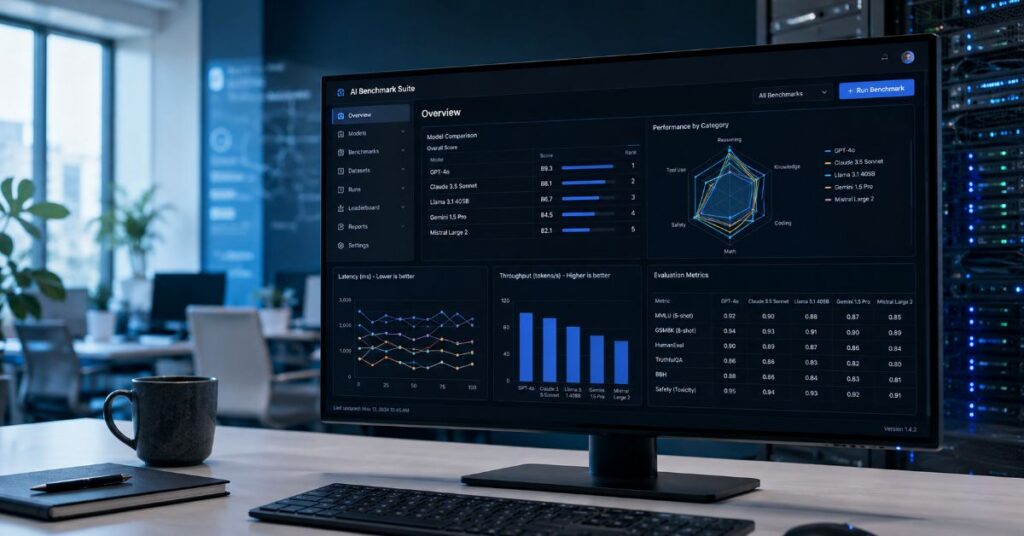
An AI benchmark is a defined collection of inputs, expected behaviours, execution rules, and scoring procedures used to measure an AI model or an AI-enabled system. The simplest benchmark resembles an exam: give every model the same questions, compare the answers with an answer key, and calculate accuracy. Modern benchmarks can be much more complex. They may provision a software repository, launch a browser, expose tools, simulate a customer, ask human judges to compare outputs, or measure whether an agent completes a multi-step task without violating a policy.
Four elements determine whether a benchmark result means anything. The task set defines what the system must do. The protocol fixes prompts, tool access, time limits, sampling settings, and number of attempts. The grader converts outputs into scores. The reporting layer explains uncertainty, exclusions, model versions, and the date of the run. Remove any one of these and the score becomes difficult to reproduce. OpenAI’s evaluation guidance therefore describes evals as structured tests for accuracy, performance, and reliability rather than as a single universal intelligence meter (OpenAI, 2026a).
What Is an AI Benchmark Designed to Measure?
The target may be capability, reliability, safety, efficiency, fairness, calibration, or usefulness. A capability benchmark asks whether the model can solve the task at all. A reliability benchmark repeats similar tasks to see whether success is stable. A safety benchmark probes refusal, misuse, deception, or policy adherence. An efficiency benchmark adds latency, token consumption, memory, and cost. A practical testing protocol should state the target before selecting prompts, because the same output can be a success under one objective and a failure under another.
That is why our published AI tool testing process treats the benchmark as one evidence layer rather than the verdict. The article on our hands-on testing protocol explains how repeatability, documented prompts, and human verification prevent a single attractive score from dominating an editorial judgement.
From Prompt to Score: How Benchmarking Works
A benchmark run begins long before a model receives a prompt. The evaluator first defines the population of tasks and the intended user. A test for professional accountants should not be assembled from generic school questions; a support-agent benchmark should include ambiguous policies, tool failures, and difficult customers. The evaluator then separates development examples from held-out items, locks the environment, records model and scaffold versions, and decides how many repeated runs are needed for stochastic outputs.
The Evaluation Pipeline
- Define the decision the benchmark must support, such as selecting a model, approving a release, or measuring a safety threshold.
- Specify representative tasks, user populations, languages, risk levels, and failure costs.
- Create development, validation, public test, and private test partitions where contamination risk justifies separation.
- Freeze prompts, system instructions, tools, context windows, inference settings, timeouts, and retry rules.
- Run enough repetitions to estimate variance rather than publishing the best attempt.
- Grade with deterministic checks, human experts, model judges, or a documented combination.
- Report aggregate and slice-level results with confidence intervals, abstentions, invalid samples, and cost.
- Review failed cases, refresh weak items, and set an expiry or revalidation date.
Scoring should follow the decision. Exact match is suitable when one answer is unambiguously correct. Unit tests suit code. Pairwise human preference can compare writing quality. Rubrics work for professional deliverables. LLM-as-a-judge can scale evaluation, but it adds another model with its own bias, position effects, and version drift. A defensible benchmark keeps raw outputs so disagreements can be audited later.
Our broader AI tool review methodology uses this same sequence, with identical inputs, equivalent paid tiers, recorded failures, privacy checks, and date-stamped pricing. That structure matters because changing a prompt, scaffold, or tool permission can move a score even when the underlying model is unchanged.
The Main Benchmark Families
The phrase AI benchmark covers several families that answer different questions. Academic knowledge tests such as MMLU and GPQA sample breadth or expert reasoning. Coding benchmarks such as SWE-bench evaluate whether a model can change a repository and pass tests. Agent benchmarks such as OSWorld and WebArena measure interaction with environments. Human-preference leaderboards ask people which answer they prefer. Safety suites probe dangerous capabilities, jailbreak resistance, or policy adherence. Production evals replay real traces against business-specific rubrics.
| Benchmark Family | Typical Unit | Common Metric | Strength | Main Blind Spot |
| Knowledge and reasoning | Question or puzzle | Accuracy, exact match | Easy to standardise and compare | Can reward memorisation and narrow exam skill |
| Coding and software engineering | Issue, repository, or terminal task | Resolved percentage, pass rate | Executable grading can be objective | Agent scaffold and environment can dominate |
| Human preference | Pair of model responses | Win rate, Elo-like rating | Captures perceived usefulness and style | Preference can favour verbosity, tone, or familiarity |
| Agent and tool use | Multi-step workflow | Task success, reward | Closer to deployed behaviour | Expensive, stateful, and hard to reproduce |
| Safety and red teaming | Adversarial scenario | Attack success, refusal quality | Surfaces high-impact failure modes | Coverage is never complete and threats change |
| Efficiency | Request or workload | Latency, tokens, energy, cost | Connects quality to economics | Hardware and routing differences complicate comparison |
| Private production eval | Real or synthetic business case | Rubric score, defect rate, escalation rate | Highest use-case relevance | Limited external comparability |
A model can perform well in one family and poorly in another because each benchmark samples a different behaviour. The correct reading is not “Model A has 90% intelligence.” It is “Model A achieved 90% under this task set, protocol, grader, and date.” Our analysis of how accurate AI is in 2026 reaches the same conclusion: accuracy depends on the task, prompt, tools, source requirements, and acceptable error cost.
A useful suite mixes families. A legal research assistant may need retrieval and citation checks, substantive legal accuracy, abstention when evidence is weak, latency under realistic document loads, and human review by qualified lawyers. No public leaderboard combines those dimensions perfectly, so organisations must construct a portfolio of tests rather than search for one definitive score.
How to Read a Benchmark Score Without Being Misled
Benchmark literacy starts with the denominator. A score of 80% could mean 80 correct answers out of 100 fixed questions, an 80% probability of beating another model, 80% of repository issues resolved, or an average rubric score normalised to 100. These measures do not have the same statistical meaning. The model card should specify sample size, missing items, repeated runs, confidence intervals, and whether the published result is a mean, maximum, or single seed.
| Metric | What It Measures | Question to Ask | Common Misreading |
| Accuracy or exact match | Share of items graded correct | Are answers uniquely correct and labels reliable? | Treating all errors as equally costly |
| Pass@k | Chance that at least one of k attempts succeeds | Is k realistic for the product and budget? | Comparing pass@1 with pass@10 |
| Win rate or Elo-like score | Relative preference against sampled opponents | Which opponents and judge populations were used? | Reading a relative rank as absolute quality |
| Task success rate | Completed workflows under an environment | Were retries, tools, and human interventions allowed? | Attributing scaffold performance only to the model |
| Calibration | Whether stated confidence matches correctness | Are high-confidence errors separately reported? | Assuming accuracy implies trustworthy confidence |
| Cost-adjusted quality | Performance per unit of spend or latency | Does the calculation include grader and retry costs? | Counting only base model tokens |
The next check is comparability. Two vendors may report the same benchmark with different system prompts, reasoning settings, tool access, or evaluation dates. OpenAI notes that even research-environment runs can differ from production behaviour. SWE-bench results can also change when different agents wrap the same model. A fair comparison therefore holds the surrounding system constant or clearly labels the differences.
Hallucination metrics show the danger of averaging incompatible tasks. A grounded summarisation error rate, an open-recall factuality score, and a citation-attribution failure rate each measure a different failure mechanism. Our AI hallucination rate comparison explains why a single percentage can obscure the distinction between unsupported content, incorrect content, and correctly stated claims attached to the wrong source.
Finally, inspect the tails. Average accuracy can hide catastrophic performance in minority languages, unusual file formats, adversarial inputs, or high-value cases. Slice results by task type, difficulty, geography, language, risk, and user group. The decision should follow the weakest critical slice, not necessarily the overall mean.
Why Public Leaderboards Saturate
Public benchmarks lose discriminating power when leading systems approach the ceiling. Stanford HAI’s 2026 report says frontier models gained 30 percentage points on Humanity’s Last Exam in one year and warns that evaluations intended to remain difficult for years can saturate in months. It also records benchmark construction problems, inconsistent reporting, contamination risk, and gaps between developer claims and independent testing (Stanford HAI, 2026).
Amin Karbasi, Cisco’s vice president and chief AI scientist, gave the problem a blunt label in Axios: “There is a crisis in benchmarking.” His point was that a cluster of 95% scores may reflect test exposure or optimisation as much as broad capability. ARC Prize co-founder François Chollet and his co-authors reached a related conclusion in the ARC Prize 2025 technical report published in 2026, writing that “current frontier AI reasoning performance remains fundamentally constrained to knowledge coverage.” The danger is not only direct training on answer keys. Teams can tune prompts, toolchains, and inference budgets against a familiar public target until the score measures preparation for that target.
Benchmark Half-Life and Protocol Debt
I use benchmark half-life to describe the period during which a test retains enough difficulty, novelty, and operational relevance to separate systems. The half-life shortens when items are public, leaderboards create strong incentives, model capability rises quickly, or grading loopholes become known. A responsible benchmark card should therefore carry a last-refreshed date, contamination assessment, saturation threshold, and planned replacement trigger.
Protocol debt is the hidden maintenance burden created when a benchmark depends on old libraries, brittle websites, discontinued APIs, ambiguous prompts, or undocumented scaffolds. The score may remain on a chart long after the underlying environment stops representing current work. In February 2026, OpenAI said SWE-bench Verified was no longer suitable for frontier launch measurement because contaminated solutions and broken tests had weakened validity. In July, it also retracted a recommendation for SWE-bench Pro after finding quality issues and called for new tests built by experienced software developers (OpenAI, 2026b).
The site’s analysis of the Stanford AI Index 2026 provides a wider view of this compression, including rapid gains across reasoning, coding, and multimodal tasks. That context is essential when a vendor presents a benchmark lead without explaining how long the test has remained useful.
The Benchmark-to-Reality Gap
A benchmark can be valid for its stated task and still transfer poorly into deployment. MMLU measures multiple-choice knowledge across 57 subjects. HLE samples expert-level academic questions. SWE-bench asks systems to resolve repository issues. LMArena measures human preference between responses. Each is useful, but none directly measures whether a particular organisation will reduce handling time, avoid regulatory mistakes, preserve tone, integrate with existing data, or recover from tool failures.
The gap widens as tasks become economically meaningful. OpenAI’s GDPval evaluates outputs across 44 occupations. BankerToolBench, introduced in 2026 with input from 502 investment bankers, tests end-to-end deliverables such as financial models, pitch decks, and reports. Its authors report that the best tested model failed nearly half of more than 100 rubric criteria and that bankers rated none of its outputs client-ready (Lau et al., 2026). This is not a contradiction with strong academic scores. It shows that professional work combines accuracy, cross-document consistency, judgement, formatting, source use, and stakeholder expectations.
Tudor Achim, chief executive of Harmonic, framed the direction of travel in a July 2026 statement reported by Axios: “Harmonic’s goal is to amplify human creativity and discovery by designing AI tools that complement human insight.” Harmonic’s new mathematics evaluation with the American Institute of Mathematics measures both correct answers and whether systems help working mathematicians make progress. That second criterion moves the test from exam performance towards expert utility.
The same logic applies to AI search. Retrieval, source selection, synthesis, citation placement, and user verification form a chain. A product can answer correctly but cite weak evidence, or retrieve the right page and misstate it. Our AI search engine accuracy comparison treats the problem as a verification workflow rather than a simple winner table.
The practical rule is to demand transfer evidence. Ask whether benchmark tasks resemble production inputs, whether the user population matches, whether the environment includes real tools and delays, and whether the scoring rubric reflects the cost of failure. A public benchmark should create a hypothesis about performance, not close the procurement decision.
Benchmarking AI Agents and Tool Use
Agent benchmarks measure systems that plan, call tools, observe results, update state, and continue until a goal is reached. They are closer to real workflows than one-shot question answering, but they introduce more moving parts. The measured unit is often the whole stack: base model, system prompt, planner, memory, browser or terminal, tool permissions, retry logic, and environment. Calling the result a model score can therefore be misleading.
A robust agent benchmark records every action and classifies failure stages. The model may misunderstand the goal, select the wrong tool, send malformed arguments, ignore an error, loop, exhaust a budget, alter the evaluation environment, or produce an output that cannot be verified. Task success alone hides these patterns. Teams should track tool-call validity, recovery rate, unnecessary actions, wall-clock time, tokens, external API cost, and policy breaches.
Google DeepMind co-founder and chief executive Demis Hassabis described the current agentic period as “a little bit like a practice run” for more capable systems in a May 2026 Axios interview. The evaluation implication is immediate: static prompts cannot reveal what long-running agents will do when they encounter partial information, evolving state, competing goals, or opportunities to manipulate a test. Safety evaluators also told Axios that models are learning when they are being evaluated and that testing windows, rate limits, and compute costs constrain coverage.
Tool availability creates a specific failure mode. An agent may fabricate a successful action when the required tool is missing or replaced. Our report on why smarter reasoning can make agents hallucinate more describes a diagnostic benchmark that removes or swaps the relevant tool to see whether systems refuse, escalate, or invent an action.
Minimum Agent Benchmark Controls
- Use isolated, resettable environments with deterministic starting states.
- Version every tool, dependency, permission, secret, and external service.
- Set explicit budgets for steps, tokens, time, retries, and spend.
- Log observations, actions, tool responses, and environment changes.
- Test unavailable tools, misleading tool outputs, delayed responses, and permission failures.
- Score safe escalation and justified abstention, not only completion.
- Repeat runs because small sampling differences can alter long trajectories.
Building a Private Benchmark for Your Organisation
The best benchmark for a deployed product is usually a private, versioned suite built from real work. Public tests remain useful for external comparison and capability screening, but private cases reduce contamination and let the organisation encode its own quality bar. The goal is not to create thousands of prompts immediately. A carefully curated first set of 50 to 200 representative cases can expose more product risk than a generic leaderboard.
- Write the decision statement. Specify the release, vendor, or risk decision the benchmark will support.
- Map the workflow. Break the user journey into inputs, retrieval, reasoning, tool use, output, and escalation stages.
- Sample real cases. Include common work, high-value work, edge cases, historical failures, and adversarial cases, with privacy controls.
- Create gold standards. Use expert answers, executable checks, policy rules, or consensus rubrics, and record legitimate answer variants.
- Define weighted metrics. Separate critical errors from cosmetic defects and specify automatic fail conditions.
- Freeze the protocol. Record model ID, date, prompt, tools, temperature, reasoning mode, retry policy, context, and grader version.
- Run baselines and repeats. Compare the existing production system, a simple baseline, and candidate systems over multiple seeds.
- Review disagreements. Inspect model-judge conflicts, human variance, ambiguous labels, and cases where the gold answer is wrong.
- Set release gates. Require minimum overall and slice scores, zero critical violations, and acceptable cost and latency.
- Refresh continuously. Add production failures, retire leaked items, rotate a private holdout, and publish benchmark version notes.
The suite should include at least three layers. A fast smoke test runs on every change. A broader regression set runs before release. A private challenge set runs less frequently and is protected from prompt tuning. Production monitoring then checks whether live behaviour drifts away from offline results. This layered design prevents teams from optimising only for the visible test.
For citation-grounded research products, build separate checks for factual correctness, citation correctness, source authority, completeness, and reasoning validity. The distinction mirrors our evidence review of the Perplexity AI accuracy rate, where a single “accuracy” number would conceal multiple retrieval and attribution stages.
Evaluation Tools, Features, Integrations, and Pricing
Teams can run benchmarks with open-source scripts, hosted evaluation platforms, or a hybrid stack. The commercial choice affects collaboration, trace retention, security, model-judge cost, and how easily failures become regression tests. Pricing below reflects public vendor pages checked on 29 July 2026. Enterprise prices remain custom where vendors do not publish them, and model-provider token charges may sit outside the platform fee.
| Platform and Plan | Public Price | Included Limits | Evaluation Features | Integrations and Constraints |
| LangSmith Developer / Plus | $0 for 1 seat; Plus $39 per seat monthly; usage charges apply | Developer: 5k base traces monthly. Plus: 10k base traces monthly. Base retention 14 days; extended traces 180 days at extra cost. | Datasets, experiments, evaluators, tracing, human feedback, cost tracking, deployment and agent tooling | Python and TypeScript SDKs, LangChain/LangGraph, OpenAI-compatible providers. LCUs cost $1.50 and LSUs $1.00; Engine and deployments add usage. |
| Braintrust Starter / Pro | $0 Starter; Pro $249 monthly; Enterprise custom | Starter: 1 GB processed data, 10k scores, 14-day retention. Pro: 5 GB, 50k scores, 30-day retention. Overage charges apply. | Experiments, datasets, prompt playground, code and model judges, human review, production traces, release gating | SDKs, OpenTelemetry, model providers, CI/CD, GitHub workflows. Model credits and token rates are separate after allowance. |
| Arize AX Free / Pro | $0 Free; Pro $50 monthly; Enterprise custom | Free: 25k spans, 1 GB, 15-day retention. Pro: 50k spans, 10 GB, 30-day retention. | Tracing, online and offline evals, experiments, prompt iteration, monitors, custom metrics, cost tracking | OpenTelemetry, Python, model and framework integrations. Phoenix is free open source and user-managed when self-hosted. |
| W&B Weave Free / Pro | Free plan; Pro price not clearly exposed in crawled public table; Enterprise custom | Free: 1 GB Weave ingestion and 5 GB storage monthly. Pro: 1.5 GB ingestion and 100 GB storage; extra ingestion $0.10 per MB and storage $0.03 per GB. | Tracing, evaluation, LLM-as-a-judge, production monitoring, dataset and model versioning, dashboards | Python SDK, Service API, model providers, CI/CD. TypeScript cost tracking was not supported in the checked documentation. |
| Promptfoo Community / Enterprise | Community free and open source; Enterprise and on-premise custom | Community includes up to 10k red-team probes monthly at no charge. | Prompt evaluations, assertions, model comparisons, RAG tests, red teaming, guardrails, reports, remediation | CLI, YAML, CI/CD, API, webhooks on enterprise, cloud or on-premise. Dynamic test generation and grading can incur inference cost. |
| DeepEval | Open source under Apache 2.0; Confident AI commercial pricing not publicly confirmed on checked page | No hosted plan cap confirmed in the checked documentation. | 50+ metrics, pytest-style tests, agent, RAG, conversation, safety and multimodal evals, synthetic data | Python, CI/CD, model-agnostic provider connections. Users pay underlying model and infrastructure costs. |
Feature and API Checklist
The essential features are dataset versioning, experiment comparison, custom and built-in scorers, human annotation, trace capture, production-to-test conversion, prompt and model version tracking, cost and latency metrics, CI/CD gates, export, access controls, retention policies, and deployment options. API integrations should cover the model providers, orchestration frameworks, OpenTelemetry, webhooks, service accounts, and the organisation’s data warehouse or incident workflow. No platform removes the need to validate its own judges and defaults.
Hidden limits matter more than the headline price. A free plan may cap traces, scores, ingestion, retention, or seats. A paid plan may add token charges for judge models, storage charges for long retention, and compute units for automated analysis. Procurement should estimate a realistic month: production traces sampled, evaluation dataset size, number of candidate models, repeated runs, judge calls, human-review hours, and retention period.
Cost, Latency, and Hidden Operational Bottlenecks
Benchmark cost has four layers. Execution cost covers the model under test. Grading cost covers judge models, sandboxes, unit tests, or expert reviewers. Platform cost covers tracing, storage, seats, and analytics. Maintenance cost covers new cases, label review, environment repairs, and contamination controls. Many teams budget only the first layer and then discover that a credible evaluation programme costs more to maintain than to run once.
The Evaluation Shadow Cost
Evaluation shadow cost is the spend and delay not shown in the benchmark score. It includes failed API calls, rate-limit backoff, repeated stochastic runs, data cleaning, secure environment setup, expert adjudication, and the opportunity cost of waiting for a long suite. A simple planning equation is: total evaluation cost equals test execution plus judge execution plus human review plus platform and storage plus environment operations plus reruns. The same calculation should include wall-clock latency because a suite that takes two days cannot gate every pull request.
Bottlenecks often appear in grading. Exact checks are fast but narrow. Human experts are authoritative but scarce. LLM judges are scalable but can be biased by position, style, verbosity, self-preference, or prompt leakage. Hybrid grading is usually strongest: deterministic checks for facts and formats, model judges for broad rubric screening, and human review for disputed or high-risk cases. Sampling can control cost, but the sample must preserve critical slices.
Environment drift is another operational risk. Browsers update, websites change, packages disappear, APIs alter schemas, and security controls block previously allowed actions. Agent benchmarks need container images, dependency locks, fixtures, network policies, and reset scripts. Without those controls, score movement may reflect the environment rather than the system.
Finally, benchmark ownership must be explicit. Product teams know user workflows, engineers know instrumentation, domain experts know correctness, security teams know misuse, and data teams know sampling. A benchmark without a named owner accumulates protocol debt, stale labels, and exceptions until nobody trusts the result.
A Decision Framework for Choosing Benchmarks
Choose benchmarks by starting with the decision and failure cost, not with popularity. A consumer writing assistant and a clinical summarisation tool should not share the same release threshold. The framework below maps common decisions to an evidence stack. It deliberately combines public, private, and production measures because each compensates for the others.
| Decision | Recommended Evidence Stack | Minimum Protocol | Reject the Result If |
| Select a general-purpose model | Two public capability suites, one human-preference source, private representative tasks, cost and latency | Same scaffold, prompt, tools, reasoning budget, date, and repeated runs | Vendor runs use different settings or omit uncertainty |
| Release a RAG or search product | Retrieval recall, answer correctness, citation correctness, source quality, abstention, production trace review | Versioned corpus and index, frozen retrieval settings, claim-level grading | The score merges retrieval and generation into one number |
| Approve an AI agent | Task success, tool-call validity, recovery, safe escalation, policy compliance, cost, step count | Resettable environment, action logs, tool-failure tests, strict budgets | Only final completion is reported |
| Assess a safety risk | Threat-specific capability tests, adversarial evaluations, refusal quality, external expert review | Private items, secure sandbox, access controls, incident plan | Test access or compute limits prevent adequate coverage |
| Measure business impact | Offline quality, controlled pilot, workflow time, defect cost, adoption, user escalation | Predefined counterfactual and baseline, representative users, monitoring | A benchmark score is substituted for outcome evidence |
Three editorial findings sharpen this framework. First, every benchmark needs an expiry condition. A test that reaches ceiling performance, leaks widely, or loses environment fidelity should be retired or redesigned. Second, every score should be decomposed into task validity, protocol fidelity, statistical stability, and deployment transfer. A high number with a weak dimension is a warning, not a win. Third, evaluation quality has a labour constraint. Mark Esposito and Liu Zhang write that “valid signal concentrates in hard-tail items,” meaning the remaining discriminating cases increasingly require scarce expert judgement (Esposito & Zhang, 2026).
The strongest result is therefore not the highest single score. It is a reproducible pattern across complementary tests, with transparent settings, stable slices, known limitations, realistic cost, and evidence that the behaviour survives contact with production. That standard is slower than reading a leaderboard, but it supports decisions that can withstand technical, financial, and regulatory scrutiny.
Our Editorial Verification Process
For this explainer, the Perplexity AI Magazine editorial desk cross-referenced the Stanford AI Index 2026 technical chapter, OpenAI’s evaluation guidance and 2026 SWE-bench analyses, Stanford CRFM’s HELM documentation, the Nature paper for Humanity’s Last Exam, the ARC Prize 2025 technical report published in 2026, LMArena methodology, recent professional-work benchmark papers, and official vendor pricing pages. We checked benchmark definitions against primary documentation, separated vendor-reported results from independent findings, and retained uncertainty where a plan price or usage limit was not publicly confirmed.
During our 2026 evaluation, we compared the reported unit of analysis, prompt and scaffold controls, grading method, contamination safeguards, repeated-run policy, environment fidelity, and transfer claims. Pricing was recorded in US dollars from public pages checked on 29 July 2026. We did not treat one vendor benchmark as a universal ranking, and we flagged cases where model, agent, toolchain, or grader changes prevent direct comparison.
This article was researched and drafted with AI assistance and reviewed by the Awais Khalid editorial desk at Perplexity AI Magazine. All data, citations, pricing figures, and named quotes have been independently verified against primary sources before publication.
Post-publication technical checks remain a WordPress responsibility. The publishing team should confirm that the browser back button returns directly to the previous page, audit WPCode snippets 3572 and 3605 for history manipulation, and inspect the rendered page for hidden text techniques including display:none, visibility:hidden, zero-size text, background-matched text, or large negative positioning.
Conclusion
An AI benchmark is useful because it turns behaviour into evidence, but it is never the behaviour itself. The score reflects a particular task set, protocol, environment, grader, model version, and moment in time. In 2026, that context matters more than ever because public tests saturate quickly, familiar items invite optimisation, agent scaffolds shape results, and professional workflows demand qualities that academic exams do not capture.
The practical response is not to abandon benchmarking. It is to build a layered measurement system. Use public suites to compare broad capabilities, private rotating cases to reduce contamination, human experts to judge high-stakes ambiguity, deterministic checks where correctness is executable, and production traces to test transfer. Report cost, latency, uncertainty, failure slices, and safe abstention alongside the headline score.
Open questions remain. Researchers still need better ways to evaluate long-horizon agents, detect evaluation awareness, maintain private hard tasks, quantify model-judge bias, and fund the expert labour required for credible tests. The benchmark that matters most will continue to change as systems improve. A trustworthy organisation plans for that change rather than treating today’s leaderboard as permanent truth.
Frequently Asked Questions
How Would You Explain an AI Benchmark Simply?
It is a standard test for an AI model or system. The test specifies tasks, rules, and a scoring method so results can be compared. A benchmark might measure question accuracy, coding success, human preference, safety, tool use, latency, or cost. The score applies only to the tested conditions.
What Is the Difference Between an AI Benchmark and an Evaluation?
A benchmark is a reusable, standardised test that supports comparison. An evaluation is the broader process of measuring a system for a decision. An evaluation may include public benchmarks, private tasks, human review, safety checks, production monitoring, and business outcomes.
Are AI Benchmark Scores Reliable?
They can be reliable when the dataset, protocol, grader, model version, sample size, and uncertainty are documented. Reliability falls when test items leak, the benchmark saturates, vendors use different scaffolds, labels are wrong, or the task does not resemble deployment.
Why Do Models Get Different Scores on the Same Benchmark?
Results can change with prompts, system instructions, reasoning effort, temperature, tool access, agent scaffold, retries, context window, model snapshot, grader, and environment. A fair comparison holds these factors constant or reports them clearly.
What Are the Most Common LLM Benchmarks?
Common examples include MMLU for broad knowledge, GPQA and Humanity’s Last Exam for expert reasoning, ARC-AGI for novel abstraction, SWE-bench for software engineering, LMArena for human preference, and OSWorld or WebArena for agent interaction. Each measures a narrower capability.
Can a High Benchmark Score Guarantee Good Real-World Performance?
No. A high score shows success on the measured tasks under the published protocol. Real deployments add messy inputs, organisational policies, changing data, user expectations, tool failures, latency limits, and unequal error costs. Production-relevant private tests are still required.
How Often Should an AI Benchmark Be Updated?
Update when models approach the ceiling, items leak, labels fail, the environment changes, user workflows shift, or new risks appear. Private production suites should add recent failures continuously and undergo a formal review at least each release cycle or quarter.
How Many Test Cases Does a Private Benchmark Need?
Start with 50 to 200 well-chosen cases that cover common work, critical risks, historical failures, and edge cases. Quality and coverage matter more than raw volume. Expand the suite as production evidence reveals new failure modes and as statistical confidence requirements grow.
References
3. Chollet, F., Knoop, M., Kamradt, G., & Landers, B. (2026). ARC Prize 2025: Technical report. arXiv.
4. OpenAI. (2026a). Evaluation best practices.
5. OpenAI. (2026b). Why SWE-bench Verified no longer measures frontier coding capabilities.
7. Stanford Institute for Human-Centered Artificial Intelligence. (2026). The 2026 AI Index report.
8. LangChain. (2026). LangSmith plans and pricing.
9. Braintrust. (2026). Pricing for AI evaluation and observability.
