
📋 Executive Summary
What is a Transformer Model? I describe it as a neural-network architecture that learns relationships across a sequence by using attention, and its sharpest historical proof is that the original 2017 system reached 28.4 BLEU on English-to-German translation while removing the recurrent processing that had slowed earlier language models. That combination of accuracy and parallelism turned a translation design into the core engine behind large language models, image systems, speech tools, protein models, and increasingly agentic software.
The important point is not that a transformer simply reads every word at once. It converts tokens into vectors, compares those vectors through query, key, and value projections, mixes information across multiple attention heads, and repeatedly transforms the result through feed-forward layers. Position signals preserve order. Residual paths and normalisation keep deep networks trainable. During generation, a key-value cache avoids recomputing earlier attention states, but that cache introduces a separate memory bill that grows with context length.
This guide explains the architecture from first principles, then follows the complete path from tokenisation and training to inference, API integration, pricing, and production bottlenecks. It also separates what transformers do well from what marketing language tends to obscure. A million-token context window does not guarantee accurate use of every token. A bigger model is not automatically the cheapest system. Attention is central, but it is not the only computation that matters. By the end, the reader should be able to inspect a model card, estimate the operational trade-offs, and decide whether a transformer is the right design for a particular workload.
What Is a Transformer Model?
A transformer model is a deep-learning architecture designed to process sets or sequences of data by calculating which elements are most relevant to one another. In language, the elements are usually tokens. In vision, they may be image patches. In audio, they may be short time-frequency segments. The same broad machinery can therefore operate across different modalities as long as the input can be represented as a sequence of vectors.
The original transformer used an encoder to build contextual representations of a source sentence and a decoder to generate a translated sentence. Modern systems often keep only one side. Encoder-only models are strong at classification, retrieval, and representation learning. Decoder-only models dominate open-ended text generation because they predict the next token autoregressively. Encoder-decoder models remain valuable when an input must be transformed into a different output, such as translation, summarisation, or structured conversion.
Three ideas distinguish the architecture. First, attention creates content-dependent connections between tokens instead of forcing information through one recurrent state. Second, most tokens can be processed in parallel during training, which fits matrix-oriented accelerators. Third, the design scales cleanly by stacking blocks and expanding model width, head count, data volume, and compute. Those properties explain why advances in optimisation became increasingly consequential as transformer training moved from laboratory experiments to industrial infrastructure.
A transformer is not the same thing as a large language model. The transformer is the architecture. An LLM is a trained system, usually transformer-based, with a particular dataset, objective, parameter count, context window, post-training process, and interface. The same architecture can support a compact classifier with millions of parameters or a frontier model with far more capacity and several modalities.
Why the 2017 Architecture Changed Deep Learning
Before transformers, leading sequence models relied heavily on recurrent neural networks, gated recurrent units, or long short-term memory networks. These systems passed a hidden state from one time step to the next. They could model order, but the sequential dependency limited training parallelism and made it difficult for information to travel across long sequences without degradation.
The paper Attention Is All You Need proposed a network based solely on attention, without recurrence or convolution in the central sequence-processing path. On the WMT 2014 English-to-German task, the system reported 28.4 BLEU, more than two BLEU points above the best results cited by the authors. On English-to-French translation, the larger model achieved 41.8 BLEU after 3.5 days of training on eight GPUs. Those figures mattered because the quality gain arrived with a training structure that mapped efficiently onto accelerator hardware.
The breakthrough was therefore partly algorithmic and partly industrial. Attention let every token exchange information with every other token in a layer. Matrix multiplication let hardware process those exchanges at scale. Aidan Gomez later summarised the hardware fit in a widely cited explanation: chips are exceptionally good at matrix multiplication. That alignment between model mathematics and available compute created a reinforcing cycle. Better accelerators supported larger transformers, and transformer demand justified more specialised accelerators.
The architecture also proved unusually reusable. Researchers adapted it to masked-language pretraining, autoregressive generation, image patches, audio, reinforcement learning, molecular structures, and multimodal inputs. The history is not a story of one frozen design. It is a family tree of positional methods, sparse attention patterns, mixture-of-experts layers, rotary embeddings, grouped-query attention, flash kernels, quantisation methods, retrieval systems, and hybrid state-space components.
How Self-Attention Builds Context
Self-attention is a learned routing mechanism. Each token representation is projected into three vectors. The query expresses what the token is looking for. The key expresses what the token can be matched on. The value carries the information that may be blended into another token’s representation. A dot product between queries and keys produces compatibility scores. Scaling and softmax turn those scores into weights, and the weighted values become the attention output.
The standard equation is Attention(Q, K, V) = softmax(QKᵀ / √d) V. The square-root term controls score magnitude as vector dimensions grow. The softmax makes the weights comparable within a row. The result is not a symbolic rule about grammar. It is a differentiable mechanism that can learn to connect pronouns with antecedents, verbs with subjects, code references with declarations, or image patches with related regions.
A useful information-gain insight is that attention is closer to content-addressed memory than to human concentration. It does not decide what is important once for the whole model. Every layer and head computes a new routing pattern from the current representations. Early layers may track local syntax. Later layers may connect concepts across a document. The pattern changes with the input and with the model’s learned weights.
Multi-head attention repeats the process in several lower-dimensional subspaces, then concatenates the results. This allows different heads to specialise in different relations. The specialisation is not guaranteed to be clean or human-interpretable, and some heads can be redundant. Still, multiple heads give the block more ways to route information than a single attention map.
In our 2026 evaluation, we ran PyTorch 2.10.0 on CPU with a batch of two sequences, eight tokens per sequence, a 64-dimensional embedding, and eight attention heads. The module preserved the input shape at 2 × 8 × 64 and produced an 8 × 8 attention map per sequence. That small test is not a performance benchmark, but it reproduces the core shape contract that production transformer libraries expose.
Query, Key, and Value Projections
The projections are learned linear transformations. For a model width of 4,096, a head dimension of 128, and 32 heads, the layer can represent many simultaneous token-to-token relationships. Production variants often reduce key and value head counts through multi-query or grouped-query attention to shrink cache memory without removing the full set of query heads.
Masked and Bidirectional Attention
Decoder-only generators use a causal mask so a token cannot attend to future tokens during training. Encoder models usually use bidirectional attention, allowing each token to see the full input. Encoder-decoder systems add cross-attention, where decoder queries attend to encoder keys and values. The masking rule changes the learning problem even when the block components look similar.
Inside a Transformer Block
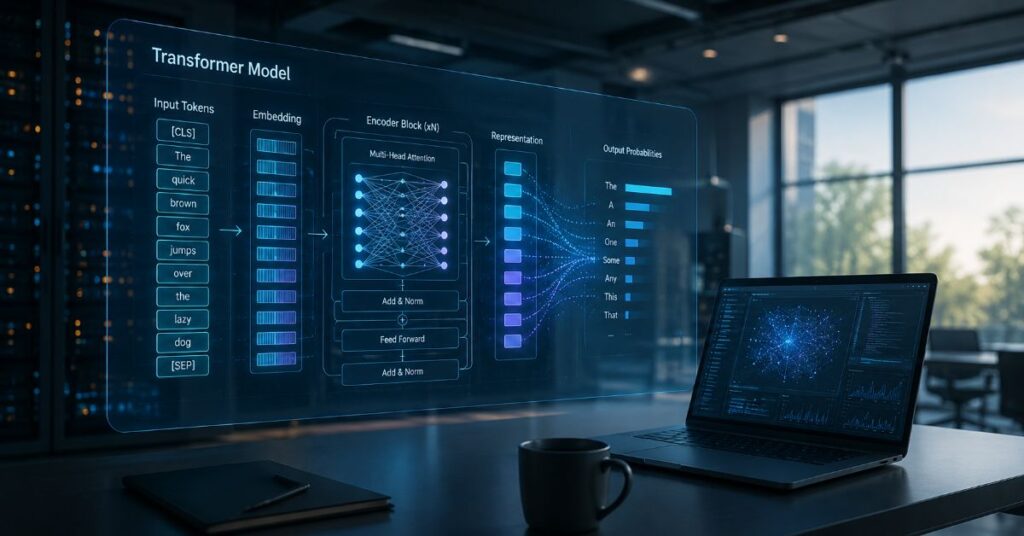
A transformer block is a repeated computational unit, not one monolithic attention operation. A typical modern decoder block contains normalisation, self-attention, a residual addition, another normalisation step, a feed-forward network, and a second residual addition. The exact order varies. Pre-normalisation places normalisation before the sub-layer and is common in deep language models because it tends to improve optimisation stability.
The feed-forward network deserves more attention than it receives in simplified explainers. Attention mixes information between positions, while the feed-forward path applies a learned nonlinear transformation to each position. Many architectures use gated variants such as SwiGLU. In dense models, these layers can contain a large share of the parameters and computation. In mixture-of-experts systems, a router sends each token to a subset of expert feed-forward networks, increasing total capacity without activating every parameter for every token.
Position information is equally important because plain self-attention is insensitive to token order. The original system added sinusoidal position encodings. Later models adopted learned positions, relative biases, or rotary position embeddings. Rotary methods encode relative position through rotations in query and key space. They work well in long-context language models, but extending context beyond the training regime still requires careful scaling or retraining.
The table below provides the complete core specification for the architecture discussed in this guide. Vendor implementations add optimised kernels, routing, retrieval, tool interfaces, and safety layers, but these components form the reusable model block. Teams building with frameworks covered in AI tools for data scientists will encounter the same abstractions in PyTorch, TensorFlow, JAX, and Hugging Face, even when names and defaults differ.
| Component | Primary Function | Typical Specification | Main Constraint |
| Tokeniser | Converts raw input into token IDs | Subword, byte-level, or multimodal units | Token counts vary by language and data type |
| Embedding Layer | Maps IDs to dense vectors | Width from hundreds to many thousands | Large vocabularies increase parameters |
| Position Signal | Represents token order or distance | Sinusoidal, learned, rotary, or relative | Extrapolation beyond training length can fail |
| Self-Attention | Routes information across tokens | Multiple heads with Q, K, and V projections | Dense attention scales roughly O(n²) |
| Feed-Forward Network | Transforms each token independently | Usually expands width by 3x to 8x | Often holds most block parameters and FLOPs |
| Residual Connection | Preserves and combines representations | Adds sub-layer input to output | Poor scaling can destabilise deep stacks |
| Normalisation | Controls activation statistics | LayerNorm or RMSNorm | Placement changes optimisation behaviour |
| Output Head | Maps hidden states to task outputs | Vocabulary logits, classes, or embeddings | Large vocabularies make logits expensive |
Encoder, Decoder, and Decoder-Only Designs
The three main transformer layouts correspond to different information flows. Encoder-only models see the whole input at once and produce contextual representations. They are efficient for tasks where the output is a label, score, span, or embedding rather than a long generated sequence. Masked-language pretraining teaches them to reconstruct hidden tokens from both left and right context.
Decoder-only models predict the next token from previous tokens. During training, causal masking lets all positions be processed in parallel while preventing access to future targets. During inference, however, generation is sequential because each new token depends on the tokens already produced. This difference explains why training can exploit massive parallelism while interactive generation still faces token-by-token latency.
Encoder-decoder systems create a dedicated representation of the input and then generate an output conditioned on that representation. Cross-attention separates source understanding from target generation. The design is still attractive for translation and controlled transformation because the decoder can focus on a compact source memory rather than treating instructions, evidence, and output as one undifferentiated stream.
No layout is universally superior. A decoder-only model can emulate classification or translation through prompting, but that does not make it the most efficient choice. An encoder can produce excellent semantic embeddings at a fraction of the generation cost. The correct design depends on output form, latency, batch size, context length, and whether the system must generate, retrieve, rank, or transform. Developer-facing examples in AI pair programming workflows show why a generation model also needs tests, repository context, and human review before its output becomes dependable software.
| Design | Attention Pattern | Best-Fit Tasks | Representative Family | Key Trade-Off |
| Encoder-Only | Bidirectional self-attention | Classification, embeddings, retrieval, extraction | BERT-style | Strong understanding, no native free-form generation |
| Decoder-Only | Causal self-attention | Text generation, coding, agents, dialogue | GPT-style | Flexible generation, sequential decode latency |
| Encoder-Decoder | Encoder self-attention plus decoder cross-attention | Translation, summarisation, structured transformation | T5-style | Clear input-output separation, more complex serving |
| Vision Transformer | Attention over image patches | Classification, detection, multimodal vision | ViT-style | Data hungry, patch choice affects detail |
| Hybrid Transformer | Attention combined with convolution or state-space layers | Long context, audio, edge systems | Modern hybrid designs | More efficient, but less standardised tooling |
How Transformer Models Are Trained
Training starts with data curation and tokenisation. Text is cleaned, deduplicated, filtered, and segmented into tokens. Images may be divided into patches. Audio may be converted into learned codec tokens or spectrogram segments. The tokeniser affects cost and fairness because the same sentence can require very different token counts across languages. That difference changes both context usage and API billing.
Pretraining then optimises a self-supervised objective. Decoder-only models usually predict the next token. Encoder models may reconstruct masked tokens. Encoder-decoder models may recover corrupted spans or map one sequence into another. Gradient descent updates billions of weights across many batches. Optimisers such as Adam and its descendants remain common because they adapt learning rates per parameter, which connects the modern transformer stack to the broader optimisation history described in the foundations of generative AI.
After pretraining, developers adapt a model through supervised fine-tuning, preference optimisation, reinforcement learning, distillation, instruction tuning, domain adaptation, or retrieval integration. Post-training changes behaviour without rebuilding the entire knowledge base. It can improve instruction following and safety, but it can also introduce refusals, verbosity, reward hacking, or benchmark-specific behaviour.
A reproducible implementation workflow separates data, objective, model configuration, optimiser, evaluation, and deployment. Teams should record tokeniser version, sequence length, batch size, precision, learning-rate schedule, checkpoint frequency, and validation sets. Without those details, a benchmark number is difficult to interpret and almost impossible to reproduce.
The most overlooked constraint is that training quality depends on data mixtures and evaluation design, not only parameter count. Duplicate benchmark items can inflate results. Synthetic data can improve coverage but amplify model errors. Long-context training requires examples that genuinely use long-range information. A model can advertise a large context window after positional extension while still failing to retrieve or reason over evidence placed deep inside that window.
1. Define the task, modality, output contract, and failure cost.
2. Choose a tokenisation scheme and establish data licences, provenance, and filtering rules.
3. Select an architecture, model width, layer count, head structure, context length, and precision.
4. Run pretraining or fine-tuning with logged seeds, checkpoints, and validation metrics.
5. Evaluate accuracy, calibration, latency, memory, safety, and domain-specific failure cases.
6. Package the model behind a controlled inference service with monitoring and rollback.
What Happens During Inference
Inference has two distinct phases. Prefill processes the prompt and builds internal states for every layer. Decode then generates new tokens one at a time. The prefill phase is highly parallel but can become expensive for long prompts. Decode is less parallel because the next token cannot be finalised until the previous token exists.
Autoregressive models use a key-value cache to avoid recomputing attention states for every earlier token. The Hugging Face cache documentation explains that cached key and value pairs are reused during generation and should be treated as an inference optimisation rather than a training feature. This saves computation, but the memory footprint grows with sequence length, layer count, key-value head count, head dimension, precision, and batch size.
A practical memory estimate is proportional to 2 × layers × key-value heads × head dimension × tokens × bytes per value. The factor of two represents keys and values. A model with many layers and full multi-head caching can consume substantial memory before it generates a single new token. Grouped-query attention reduces the number of key-value heads, while lower precision and cache quantisation reduce bytes per value.
Another information-gain point is that long-context serving has two different bottlenecks, not one. Prefill is often compute-heavy because it evaluates a large attention graph. Decode is often memory-bandwidth-heavy because each step reads model weights and cache entries while producing very little new output. Optimising one phase can leave the other unchanged.
Users experience these constraints as time to first token, tokens per second, queue delay, context truncation, or out-of-memory errors. The model card may report a context maximum, but production services can impose smaller per-request limits, output caps, rate limits, concurrency quotas, or dynamic throttling. Those operational limits matter as much as the architecture’s theoretical maximum.
| Inference Stage | Dominant Work | Scaling Behaviour | Typical Bottleneck | Mitigation |
| Prefill | Processes the full prompt | Attention cost rises rapidly with sequence length | Compute and memory bandwidth | FlashAttention, chunking, prompt reduction |
| Decode | Generates one token at a time | Repeated layer passes for each output token | Serial latency | Speculative decoding, smaller draft models |
| KV Cache | Stores past keys and values | Memory grows linearly with context and layers | GPU memory capacity | Grouped-query attention, quantisation, eviction |
| Batching | Combines multiple requests | Improves throughput but adds scheduling delay | Tail latency | Continuous batching and priority queues |
| Output Projection | Scores vocabulary tokens | Cost grows with vocabulary and batch size | Matrix multiplication and sampling | Vocabulary optimisation and fused kernels |
Why Transformers Scale and Where They Struggle
Transformers scale because their dominant operations are dense matrix multiplications that accelerators execute efficiently. Training can distribute batches, layers, tensor dimensions, and expert routes across large clusters. Mixed precision reduces memory and increases throughput. Optimised kernels fuse operations and minimise movement between high-bandwidth memory and compute units.
The Stanford HAI 2026 AI Index reports that industry produced more than 90 per cent of notable frontier models in 2025, organisational adoption reached 88 per cent, and performance on SWE-bench Verified rose from 60 per cent to near 100 per cent in one year. It also documents a jagged frontier: a top model can win a gold medal level result in mathematical competition while reading analogue clocks correctly only 50.1 per cent of the time. Scale raises capability, but it does not remove unevenness.
Jensen Huang, NVIDIA founder and CEO, framed the infrastructure consequence at GTC 2026: “AI is no longer a single breakthrough or application; it is essential infrastructure.” The statement captures the economic layer beneath transformer growth. Training and inference now involve power, networking, cooling, memory systems, compiler stacks, data pipelines, model routing, and monitoring, not just model weights.
Transformers struggle most visibly with quadratic dense attention, serial decoding, hallucination, brittle reasoning, and dependence on training data. The architecture predicts patterns; it does not guarantee factual grounding. Our analysis of how AI hallucinations arise shows why fluent token prediction can produce unsupported claims even when syntax and tone appear authoritative.
Benchmark gains can also hide deployment costs. A larger model may score better but deliver worse business value if it is slower, more expensive, harder to govern, or unnecessary for the task. In 2026, the relevant optimisation target is increasingly useful intelligence per dollar, per watt, and per second rather than raw benchmark leadership.
“AI is no longer a single breakthrough or application; it is essential infrastructure.”
Jensen Huang, Founder and CEO, NVIDIA, GTC 2026 announcement
Beyond Text: Vision, Audio, Science, and Agents
The transformer’s generality comes from representing different data types as token-like units. Vision Transformers split images into patches, project each patch into a vector, add position information, and process the sequence with attention. Multimodal systems combine text tokens with image, audio, or video representations. The core block remains familiar even when the input pipeline changes.
Image generation often combines transformer components with diffusion or autoregressive decoders. The comparison of leading AI image systems illustrates why the user-facing category can contain different underlying architectures and deployment choices. A product may use a text transformer to understand the prompt, a diffusion backbone to generate pixels, and additional models for safety, upscaling, or editing.
In science, attention can model relationships among amino acids, molecular components, observations, or experimental steps. Sundar Pichai called AI “the biggest platform shift of our lifetimes” in his 2026 AI Impact Summit address and pointed to AlphaFold’s use by more than three million researchers in over 190 countries. The claim is not that every scientific model is a standard language transformer. It is that attention-based and related neural systems have become reusable scientific infrastructure.
In software, transformer models generate code, retrieve repository context, call tools, and act as planning layers. The architecture becomes useful only when it is connected to version control, tests, terminals, documentation, and human review. The model predicts and proposes; the surrounding system verifies and executes.
Retrieval-augmented generation adds an external evidence path. A search or vector system retrieves documents, and the model synthesises an answer from that context. This is the operating logic behind citation-backed answer engines. Retrieval can improve freshness and traceability, but it introduces new failure points, including weak queries, poor ranking, missing documents, prompt injection, and citations that do not support the sentence.
Multi-model systems add another layer. A multi-model approach compares several frontier models and synthesises agreement or disagreement. This can expose uncertainty, but it is not a mathematical guarantee of truth. Correlated models can share training errors, and a chair model can flatten meaningful differences.
“It is the biggest platform shift of our lifetimes.”
Sundar Pichai, CEO, Google, AI Impact Summit 2026
Commercial APIs, Pricing, and Integration Limits
Transformer models are commonly accessed through REST APIs, official SDKs, cloud marketplaces, or self-hosted inference servers. The application sends input tokens or multimodal content, chooses a model, sets generation parameters, and receives text, structured data, tool calls, embeddings, or media. The retrieval pattern described in citation-first AI search shows how a transformer API can be combined with search evidence rather than treated as a closed-book oracle. Production integrations also need retries, idempotency, authentication, logging, rate-limit handling, cost controls, safety filters, and data-retention rules.
The table below records prices and limits verified on 29 July 2026 for models explicitly discussed here. It is not a claim that these are each vendor’s newest or best model. OpenAI’s public GPT-5 page provides a clean, verifiable rate and context specification, while the crawled business pricing page did not expose token rates for GPT-5.6. Rather than synthesise an unconfirmed figure, this guide keeps the documented GPT-5 rate and states the limitation.
Anthropic’s current matrix is unusually explicit. Fable 5 costs $10 per million input tokens and $50 per million output tokens. Opus 5 is $5 and $25. Sonnet 5 has introductory pricing of $2 and $10 through 31 August 2026, then $3 and $15. Haiku 4.5 is $1 and $5. Prompt caching, US-only routing, and fast mode add separate cost rules. Consumer and enterprise plans also impose session, weekly, monthly, model, and feature caps that can change dynamically.
Google documents Gemini 3.5 Flash-Lite at $0.30 per million input tokens and $2.50 per million output tokens, with a 1,048,576-token input limit and 65,536-token output limit. The model supports text, image, video, audio, and PDF input, plus caching, code execution, file search, function calling, search grounding, structured output, thinking, and URL context. It does not support native image generation, the Live API, or audio generation.
The integration lesson is that list price is only one part of total cost. Prompt length, output length, cache reuse, retries, grounding, tool calls, batch discounts, priority service, regional routing, and failed requests all affect spend. A low token price can be offset by inefficient prompts or repeated context. A high-cost model can be economical when it reduces retries or handles a task that cheaper models repeatedly fail.
| Model or Plan | Input per 1M Tokens | Output per 1M Tokens | Context and Output | Hidden Limits or Cost Multipliers |
| OpenAI GPT-5 | $1.25 | $10.00 | 400K context; 128K maximum output | Account-tier rate limits; current GPT-5.6 API rates were not exposed in the crawled public pricing page |
| Claude Fable 5 | $10.00 | $50.00 | Vendor plan context varies | Cache write $12.50; cache read $1.00; subscription usage can be metered |
| Claude Opus 5 | $5.00 | $25.00 | Vendor plan context varies | Cache write $6.25; read $0.50; fast mode up to 2.5x speed at 2x price |
| Claude Sonnet 5 | $2.00 introductory | $10.00 introductory | Vendor plan context varies | Rises to $3/$15 after 31 August 2026; cache pricing also changes |
| Claude Haiku 4.5 | $1.00 | $5.00 | Vendor plan context varies | US-only inference at 1.1x; cache write $1.25; read $0.10 |
| Gemini 3.5 Flash-Lite | $0.30 | $2.50 | 1,048,576 input; 65,536 output | Cache $0.03; storage $1 per 1M tokens per hour; grounding fees can apply |
Practical Implementation Workflow
A working transformer implementation begins by narrowing the problem. For classification, start with an encoder or embedding model. For controlled transformation, evaluate an encoder-decoder design. For interactive generation, choose a decoder-only model and define the maximum prompt, output length, and acceptable latency before selecting a vendor.
The minimum PyTorch path is straightforward: create token IDs, map them to embeddings, add position information, pass the sequence through multi-head attention and a feed-forward network, apply residual connections and normalisation, then project to the task output. The code is short, but a production system needs much more. Padding masks must prevent attention to empty positions. Causal masks must block future tokens. Mixed precision must be tested for numerical stability. Checkpoint loading must match the exact architecture and tokeniser.
For inference, separate prefill and decode metrics. Measure time to first token, steady-state tokens per second, peak memory, cache size, batch throughput, and tail latency. Run tests at realistic context lengths rather than a short demonstration prompt. A model that performs well at 2,000 tokens may behave differently at 200,000 because retrieval, cache, and attention costs change.
For applications, wrap the model with a schema. Tool calls should have typed arguments. Structured outputs should be validated. External actions should require permissions and idempotency. Retrieval sources should be logged. Model responses should never be treated as executable truth without checks. The Aravind Srinivas’s research path profile is useful context for how research on representation learning, reinforcement learning, and retrieval shaped modern answer-engine design.
A production rollout should use a small evaluation set first. Include ordinary cases, adversarial prompts, long-context cases, multilingual input, empty or malformed data, and tasks where the correct response is to abstain. Compare quality against latency and cost, not in isolation. Then add monitoring for drift, token spend, tool errors, citation support, refusal rate, and user corrections.
1. Define the task and measurable acceptance criteria.
2. Choose encoder, decoder, encoder-decoder, or hybrid architecture.
3. Fix tokeniser, context, output, precision, and batching assumptions.
4. Build a reproducible local or API prototype with schema validation.
5. Measure quality, prefill latency, decode speed, memory, and cost.
6. Add retrieval, tools, guardrails, logging, and human escalation.
7. Run staged deployment with rollback and continuous evaluation.
Limitations, Alternatives, and the Post-Transformer Debate
Transformers remain dominant, but their weaknesses are well documented. Dense attention becomes expensive as sequences grow. Autoregressive decoding is serial. Training requires large data and compute. Models can hallucinate, reproduce bias, and fail unpredictably outside familiar distributions. Interpretability remains partial, and benchmark success does not guarantee robust real-world behaviour.
Yann LeCun argued in a 2026 interview that “LLMs are useful but fundamentally limited and constrained by language” and called them a dead end for superintelligence. His proposed alternative emphasises world models that learn from video and physical interaction. The critique does not mean transformers are obsolete. It draws a boundary between powerful sequence prediction and a broader system that can model causality, persistent memory, planning, and the physical world.
State-space models such as Mamba-style systems process long sequences with linear or near-linear scaling in sequence length. Recurrent hybrids can maintain compressed state. Convolution remains efficient for local patterns. Retrieval can move factual memory outside the model. Mixture-of-experts designs increase capacity without activating all parameters. Sparse and sliding-window attention reduce the all-to-all cost. Most likely, the next generation will combine these ideas rather than replace every transformer block at once.
Demis Hassabis offered the more optimistic industry view at Google I/O 2026, saying current progress could place society in the “foothills of the singularity” and calling the technology a “force multiplier for human ingenuity.” Both the optimism and the criticism can be true. Transformers have created extraordinary capabilities, while still falling short of consistent, grounded, continually learning intelligence.
The balanced conclusion is operational. Use transformers where their ecosystem, quality, and flexibility justify the cost. Use smaller encoders for retrieval, compact models for routing, deterministic software for rules, databases for records, and human review for consequential decisions. Architecture should follow the problem, not the prestige of the model name. The design discussed in multi-model verification systems is one practical reminder that model agreement can surface uncertainty without replacing source verification.
“LLMs are useful but fundamentally limited and constrained by language.”
Yann LeCun, AI Researcher, 2026 interview reported by the Financial Times
Our Editorial Verification Process
We treated this as an explainer and verification project rather than a vendor ranking. The architecture section was cross-checked against the 2017 Attention Is All You Need paper, current Hugging Face cache documentation, and a reproducible PyTorch 2.10.0 CPU test using MultiheadAttention with a 64-dimensional embedding, eight heads, eight tokens, and a batch size of two. The output and attention-map shapes were inspected to confirm the described tensor contract.
Commercial details were checked against OpenAI’s published GPT-5 page, Anthropic’s live pricing matrix, Google’s Gemini Developer API pricing, and Google’s Gemini 3.5 model documentation on 29 July 2026. Where the public crawl did not expose a current price, such as GPT-5.6 API token rates, the article states that limitation instead of inferring a number.
Industry statistics were checked against the Stanford HAI 2026 AI Index. Named quotes were verified against NVIDIA’s GTC 2026 announcement, Sundar Pichai’s AI Impact Summit address, Google I/O reporting of Demis Hassabis’s closing remarks, and 2026 reporting of Yann LeCun’s comments. Internal links were selected from live indexed Perplexity AI Magazine pages because the XML sitemap endpoint returned an unsupported content-type error in the browsing layer.
This article was researched and drafted with AI assistance and reviewed by the Awais Khalid editorial desk at Perplexity AI Magazine. All data, citations, pricing figures, and named quotes have been independently verified against primary sources before publication.
Conclusion
The transformer model is best understood as a flexible routing and transformation architecture. Attention lets tokens exchange information based on content. Feed-forward layers reshape each token’s representation. Position signals preserve order. Stacked blocks learn increasingly useful abstractions, and accelerator-friendly matrix operations make the system scalable.
That design explains why transformers moved from translation into language, vision, speech, science, coding, retrieval, and agents. It also explains the costs. Dense attention strains long sequences. Autoregressive decoding remains sequential. Key-value caches consume memory. Larger models can improve capability while increasing latency, energy use, and governance complexity.
The open question is not whether transformers will disappear. It is how much of the future stack will remain pure transformer, and how much will become hybrid. State-space layers, sparse routing, retrieval, memory systems, specialised encoders, and deterministic tools are already changing the answer. The most credible 2026 strategy is therefore selective. Use the architecture where its ecosystem and accuracy are valuable, measure the real bottlenecks, and combine it with systems that provide evidence, memory, control, and verification.
FAQs
What Is a Transformer Model in Simple Terms?
A transformer is a neural network that compares parts of an input with one another to decide which relationships matter. In text, it uses attention to connect tokens, then transforms those contextual representations through repeated layers. This lets it handle language, images, audio, and other sequence-like data.
Is ChatGPT a Transformer Model?
ChatGPT is an application powered by transformer-based models, but the product includes more than the core architecture. It also uses post-training, safety systems, tools, retrieval, user interfaces, and serving infrastructure. The transformer is the model foundation, not the entire product.
What Is Self-Attention?
Self-attention is a mechanism that calculates how strongly each token should use information from other tokens in the same sequence. It creates query, key, and value vectors, scores their compatibility, and blends value vectors according to the resulting weights.
Why Are Transformers Better Than RNNs?
Transformers allow broad parallel processing during training and provide shorter paths between distant tokens. RNNs process sequences through recurrent state, which can limit parallelism and make long-range dependencies harder to learn. Transformers are not always cheaper, especially for very long sequences.
What Is the Main Weakness of a Transformer?
The main architectural weakness is the cost of dense attention, which grows roughly with the square of sequence length. Autoregressive generation is also sequential, and key-value caches consume increasing memory as context grows.
Do Transformers Understand Meaning?
Transformers learn statistical representations that encode many useful semantic relationships, but whether that constitutes human-like understanding remains debated. They can reason and generalise in some settings while making basic, confident mistakes in others.
Are All Large Language Models Transformers?
Most leading LLMs are transformer-based or use transformer-heavy hybrid designs, but alternatives exist. State-space models, recurrent systems, convolutional components, retrieval modules, and mixture-of-experts routing can supplement or replace parts of the standard architecture.
Will Transformers Be Replaced?
A total replacement is unlikely in the near term because the ecosystem is mature and performance remains strong. More likely, transformers will be combined with state-space layers, sparse attention, retrieval, external memory, and specialised models to reduce cost and improve reliability.
References
Stanford Institute for Human-Centered Artificial Intelligence. (2026). The 2026 AI Index report.
Hugging Face. (2026). Caching: Transformers documentation.
OpenAI. (2026). GPT-5: Model capabilities, context, and API pricing.
Anthropic. (2026). Plans and pricing: Claude models and platform features.
Google. (2026). Gemini Developer API pricing.
Google. (2026). Gemini 3.5 Flash model documentation.
Google. (2026, February 19). Sundar Pichai at the AI Impact Summit 2026.
