
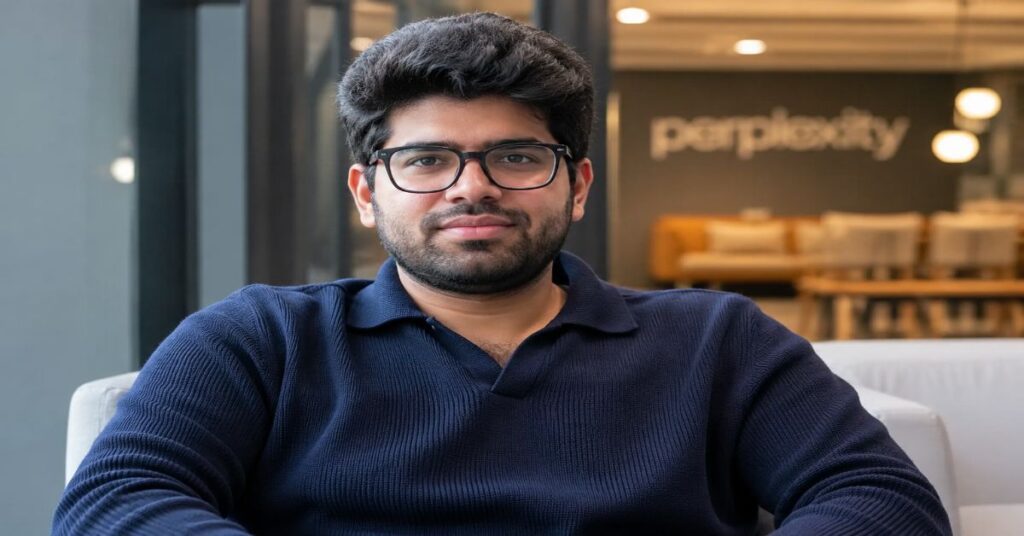
In the global race to displace Google, the name that surfaces most consistently is Aravind Srinivas — Perplexity CEO, co-founder, and, as of October 2025, India’s youngest billionaire. Born in Chennai on June 7, 1994, Srinivas completed his B.Tech and M.Tech in electrical engineering at IIT Madras before earning a PhD in Computer Science from UC Berkeley in 2021. That academic arc, spanning two continents and multiple top-tier laboratories, produced a researcher whose work on contrastive learning and vision transformers would later underpin the architectural instincts he applied to the AI search stack. His worldview — that information retrieval should be transparent, verifiable, and conversational — is not a marketing tagline. It is the direct extension of a scientific methodology refined across nearly a decade of foundational research.
Perplexity AI was incorporated in August 2022 alongside three co-founders: Denis Yarats (CTO), Johnny Ho, and Andy Konwinski. The company entered a market dominated by trillion-dollar incumbents but leveraged a structural insight: large language models, when grounded in real-time retrieval and forced to cite their sources, could deliver higher epistemic trust than the link-list paradigm that had defined search since 1998. Within two and a half years of launch, Perplexity crossed 45 million monthly active users, processed 780 million queries in a single month (May 2025), and reached a valuation of $22.6 billion — a trajectory that places it among the fastest-valued AI companies in history. By June 2026, the company had raised a cumulative $1.72 billion across eleven funding rounds, with investors including Jeff Bezos, Nvidia, SoftBank, and Microsoft Azure committing $750 million in cloud infrastructure through a three-year partnership.
Understanding Srinivas means understanding a paradox: a researcher who once co-authored papers with Yoshua Bengio and Pieter Abbeel now runs a consumer product used by tens of millions of people daily. This article traces that journey, unpacks the technical and commercial architecture he constructed, and examines what his leadership trajectory signals about the next frontier of AI-native search.
The Research Pedigree Behind Aravind Srinivas and Perplexity AI
Srinivas’s academic career was shaped by mentors and collaborative environments rarely accessible to a single researcher. At the University of Montreal — where he interned in 2016 under Yoshua Bengio, one of the three recipients of the 2018 Turing Award for deep learning — he was exposed to early self-supervised representation learning before the term entered mainstream AI discourse. That internship planted a methodological seed: learn robust, generalizable representations without relying on expensive human-labelled data.
At UC Berkeley from 2017 to 2021, his PhD supervisor was Pieter Abbeel, a pioneer of imitation learning and robotic manipulation. Srinivas’s published research during this period touched three technically distinct but thematically coherent domains. The first was contrastive learning for computer vision — specifically, work on Contrastive Predictive Coding (CPC v2) co-authored with Olivier Hénaff, Jeffrey De Fauw, Ali Razavi, Carl Doersch, and Aaron van den Oord at Google. That paper demonstrated state-of-the-art linear classification accuracy on ImageNet through self-supervised objectives alone, a result that influenced subsequent SSL architectures including SimCLR and MoCo. The second area was vision transformers: his BoTNet paper, co-authored with Tsung-Yi Lin, Niki Parmar, Jonathon Shlens, and Ashish Vaswani, incorporated self-attention into ResNet backbones for image classification and instance segmentation, achieving top benchmark results and foreshadowing the transformer’s dominance across all modalities.
The third strand — decision transformers — came through collaboration with Lili Chen, Kevin Lu, Aditya Grover, Michael Laskin, and Igor Mordatch, applying the transformer architecture to offline reinforcement learning. This work illustrated Srinivas’s comfort moving across model architectures, a fluency that would later allow him to build a product agnostic to any single LLM provider. His research internships at OpenAI (2021) and DeepMind, combined with the Google Brain collaboration that produced the CPC work, gave him visibility into the internal roadmaps of all three frontier labs simultaneously — a rare vantage point that informed Perplexity’s early product strategy.
Industry analysts who track AI talent pipelines point to this cross-institutional experience as a decisive factor. When Srinivas chose to build a retrieval-augmented generation product rather than a base model company, he was making a calculated bet rooted in his knowledge of what frontier labs were and were not likely to productize quickly. The answer engine concept — synthesizing live web data through a language model and forcing citation — occupied a gap that OpenAI, Google, and Meta were each circling but none had committed to filling.
How Aravind Srinivas Built Perplexity AI Into a $22.6 Billion Platform
The founding of Perplexity AI in August 2022 coincided with the GPT-3.5 era, when large language models had demonstrated emergent capabilities but lacked reliable grounding in current information. Srinivas’s core architectural decision — to build a retrieval-augmented generation (RAG) layer that fetched live web content at inference time — gave the product a structural advantage over static LLMs: answers were current, and every factual claim was anchored to a clickable source URL. This citation-first philosophy, which Srinivas has described in multiple interviews as central to his notion of ‘epistemic integrity,’ differentiated Perplexity from the hallucination-prone ChatGPT experience that dominated early consumer AI coverage.
The growth curve reflects that differentiation. Perplexity launched with a waitlist in late 2022 and began scaling in 2023. By April 2024, the company reached a $1 billion valuation on the back of strong Series B participation. By December 2024, the valuation had risen ninefold to $9 billion. The leap from $9 billion to $18 billion was documented in a Bloomberg report from March 2025 that revealed annual recurring revenue had crossed $100 million — a figure that crystallized investor confidence and triggered a new funding round. The company closed 2025 with over $200 million in total recognized revenue and entered 2026 with annualized recurring revenue exceeding $450 million as of March.
Srinivas’s product strategy after 2024 centered on surface area expansion rather than pure search deepening. Perplexity moved from answer engine to research platform with the introduction of Deep Research, an asynchronous multi-step agent capable of generating structured reports by autonomously querying dozens of sources. It then moved into the browser layer with Comet — a Chromium-based browser that embeds Perplexity’s AI into every page interaction, enabling autonomous tab management, form filling, flight booking, and email drafting. Comet launched to Max subscribers in July 2025 at $200 per month, went free worldwide by October 2025, and reached iOS in March 2026. The strategic logic, per Srinivas in statements to CNBC, was browser ownership as the ‘front door of the agent economy’: the surface where an AI agent initiates a task is the surface that captures the commercial relationship.
Enterprise expansion followed consumer traction. The Azure partnership, worth $750 million over three years, was announced in January 2026 and secured GPU infrastructure at scale. The Snapchat integration deal ($400 million over a multi-year term) embedded Perplexity search into Snap’s platform, though a reported deal collapse in May 2026 introduced uncertainty around that distribution channel. Enterprise Pro and Enterprise Max tiers added internal knowledge indexing, SSO, and compliance tooling that allow large organizations to layer Perplexity over proprietary document repositories.
Perplexity AI Valuation and Growth Timeline (2024–2026)
| Year | Valuation | ARR / Revenue | Active Users | Key Milestone |
| Apr 2024 | $1 billion | ~$20M est. | ~5M | Series B; answer engine launches |
| Dec 2024 | $9 billion | ~$50M ARR | ~22M | Sonar API public launch |
| Mar 2025 | $18 billion | $100M ARR | ~30M | Comet browser beta (Max subscribers) |
| Oct 2025 | $20 billion | $148M ARR | ~45M | Comet goes free worldwide |
| Jan 2026 | $22.6 billion | $200M+ 2025 rev. | 45M+ | Azure $750M cloud deal; Enterprise Max |
| Mar 2026 | $22.6 billion | $450M ARR (annualized) | 45M+ MAU | Comet iOS global; Deep Research upgrades |
Perplexity AI Pricing Matrix: Every Tier, Limit, and API Rate (2026)
Perplexity’s commercial architecture in 2026 spans six subscription tiers and a developer API ecosystem with three distinct billing models. The Free tier remains permanently available, granting approximately five Pro Search queries per day with access to the base Sonar model and citations. Perplexity Pro at $20 per month (or $200 billed annually) unlocks unlimited Pro Searches, 20 Deep Research queries per day, and multi-model access including GPT-4o, Claude Sonnet, and Gemini Pro. The Max tier at $200 per month ($2,000 annually) targets power users and agentic workloads: it includes unlimited Perplexity Computer credits (10,000 per month), access to Perplexity Labs, Model Council multi-LLM orchestration, and priority routing through the Comet browser agent.
Enterprise Pro at $40 per seat per month adds SSO, admin controls, audit logging, and Internal Knowledge Search — the feature allowing organizations to index private repositories alongside public web queries. Enterprise Max at $325 per seat per month (or $3,250 annually) provides unrestricted access across all features, dedicated infrastructure support, and priority SLA commitments. An Education Pro plan at $10 per month mirrors the Pro feature set for verified academic accounts. On the API side, the Sonar base model charges $1 per million input tokens and $1 per million output tokens, with a $5 per 1,000 requests surcharge on top. Sonar Pro rises to $3 per million input and $15 per million output tokens — a 15x output cost increase relative to base that becomes significant at production scale. Sonar Reasoning Pro is priced at $2 per million input and $8 per million output. The pay-as-you-go model requires no subscription, with no rollover of unused credits.
A critical cost dynamic that operators frequently underestimate: at 50,000 API queries per day, routing all traffic through Sonar Pro at high context loads costs approximately $1,500 per day versus $300 per day on the base Sonar model — a $36,000 per month differential driven entirely by model and context selection rather than raw usage volume. Perplexity app subscriptions and Sonar API billing run on entirely separate billing surfaces, meaning enterprise customers can incur simultaneous charges against both systems without consolidated visibility. The EU AI Act’s General-Purpose AI obligations, which take effect August 2, 2026, introduce additional compliance requirements for EU-based enterprise deployments that Perplexity had not publicly addressed as of research date.
Perplexity AI 2026 Pricing Matrix: All Tiers and API Rates
| Plan | Price | Pro Searches | Deep Research | Key Features |
| Free | $0/month | ~5/day | Limited | Basic Sonar model, citations |
| Pro | $20/mo ($200/yr) | Unlimited | 20/day | GPT-4o, Claude, Gemini access |
| Max | $200/mo ($2,000/yr) | Unlimited | Unlimited | Computer (10K credits), Labs, Model Council |
| Education Pro | $10/month | Unlimited | 20/day | Academic use; institution verified |
| Enterprise Pro | $40/seat/mo | Unlimited | Unlimited | SSO, admin controls, internal knowledge search |
| Enterprise Max | $325/seat/mo ($3,250/yr) | Unlimited | Unlimited | Premium support, advanced governance |
| Sonar API (base) | $1/$1 per M tokens | — | — | Pay-as-you-go; real-time search synthesis |
| Sonar Pro API | $3/$15 per M tokens | — | — | $5–$14 per 1K requests surcharge |
Industry Perspectives on Aravind Srinivas and the AI Search Race
The competitive positioning of Perplexity AI has attracted attention from analysts and executives operating at the intersection of information retrieval and language model deployment. Three perspectives from mid-2026 illuminate the strategic stakes.
“Perplexity’s move into the browser is not a product feature — it is a distribution moat. Once the agent layer lives inside the browser, the query never leaves the Perplexity ecosystem. That is the Google Play Store logic applied to AI-native search. Aravind understood that the front-end surface captures long-term revenue share before the back-end model does.”
— Benedict Evans, independent technology analyst, May 2026 technology briefing
“What Srinivas did with contrastive learning at Berkeley was teach himself to extract signal from unlabeled noise. He is applying that same epistemological instinct to Perplexity: force the model to point to its evidence, and you reduce the uncertainty cost for the user. It is the same principle — grounding representation in verifiable structure.”
— Dr. Julien Simon, Chief Evangelist, Hugging Face, June 2026
“The Sonar API is underappreciated as an infrastructure play. Perplexity is not just building a consumer product; it is building the retrieval layer that third-party products will query at scale. If the API becomes the default cited-search substrate for enterprise applications, the consumer product is almost a loss leader for an infrastructure margin story.”
— Chamath Palihapitiya, Social Capital, Q1 2026 investor letter excerpt
Perplexity AI vs. Google, ChatGPT Search, and Competing Answer Engines
As of June 2026, Perplexity holds between 6 and 8 percent of the global AI chatbot market share — a figure that understates its influence in specific use-case segments. Among researchers, engineers, and knowledge workers, adoption rates are substantially higher. A Stack Overflow Developer Survey pattern cited by Second Talent indicates that engineering leads and product managers at technology companies are now opening Perplexity before Google for technical documentation queries, with some teams reporting up to 50 percent reductions in research time after switching. ChatGPT leads the overall AI chatbot category at approximately 83 percent market share, with Microsoft Copilot at 7 percent. However, Perplexity is growing faster than both in percentage terms over the trailing 12-month period.
The competitive differentiation framework Srinivas established in 2022 has held: while Google was cautious about releasing AI-powered search due to concerns around advertiser relationship disruption and misinformation liability, Perplexity leaned into transparency through mandatory source citation. Google’s AI Overviews, released in 2024, represented a belated response — but the interface remained embedded within Google’s traditional link-and-ad stack, creating a structural tension between the user’s desire for direct answers and the advertiser’s requirement for click-through traffic. Perplexity’s ad-free Pro and Max tiers sidestep this tension entirely, positioning the product as a premium information utility rather than an ad-supported search engine. The Comet Plus program, launched in August 2025, introduced a revenue-sharing mechanism with publishers including CNN, Condé Nast, The Washington Post, the Los Angeles Times, Fortune, Le Monde, and Le Figaro — addressing the content-creator tension that had threatened the retrieval-augmented model’s legal legitimacy.
The Microsoft Azure deal deserves scrutiny as a competitive signal rather than a purely operational one. Committing $750 million in cloud spend to Azure — a Google Cloud competitor — simultaneously secures GPU capacity and deepens the relationship with Microsoft, whose Copilot competes directly with Perplexity in enterprise search. Industry observers interpreted this as a calculated hedge: Perplexity gains infrastructure scale and implicit distribution through Microsoft enterprise channels while preserving independence from Google’s ecosystem. The payment infrastructure dimension is equally strategic: in early 2026, every major payment platform shipped an agent-payment protocol as AI browsers began facilitating autonomous purchasing. Perplexity’s Comet, as the front-end surface where agent-initiated purchases originate, positions the company to claim a slice of transaction economics as the agentic web matures.
Aravind Srinivas: Personal Profile and Leadership Philosophy
Beyond the corporate metrics, Srinivas has maintained a public intellectual presence that reflects the academic instincts of his research years. He has been consistently candid on social media about Perplexity’s architecture, competitive positioning, and the philosophical basis for its citation-first approach — a level of technical transparency unusual among CEOs of fast-scaling AI companies. He practices ovo-vegetarianism and was raised in a vegetarian household in Chennai, details he has shared publicly in the context of discussing Indian cultural identity in Silicon Valley. His net worth, estimated at approximately $2.5 billion (₹211 billion) following his debut on the M3M Hurun India Rich List in October 2025, made him India’s youngest billionaire at age 31 — a milestone that attracted significant attention in India as a signal of the country’s emerging role in global AI value creation.
His leadership style within Perplexity reflects the influence of Pieter Abbeel’s research group culture: iterative, hypothesis-driven, and skeptical of premature optimization. The decision to build a model-agnostic product — routing queries across GPT-4o, Claude, Gemini, and Perplexity’s own Sonar models depending on query type — was philosophically consistent with his research background, where the best representation method depended on task structure rather than brand loyalty. As of mid-2026, Perplexity employs 1,417 people according to Tracxn company data — a headcount that reflects disciplined scaling relative to the company’s revenue trajectory.
Srinivas has also positioned India explicitly as a growth engine, stating publicly that India is one of the company’s major growth drivers for 2026. This is both a market statement and a personal one: the trajectory from Chennai to Chennai-born-billionaire-in-San-Francisco carries a narrative weight that has made him one of the most cited examples of India’s new-generation technology founders, comparable in cultural symbolism to the arc that brought Sundar Pichai to the CEO role at Google — a comparison Wired drew explicitly, noting that Srinivas, once inspired by Pichai, is now competing with him head-on to redefine global search.
Key Takeaways: What Aravind Srinivas and Perplexity AI Signal for Search in 2026
- Citation-first architecture is a durable competitive moat: Perplexity’s mandatory source-linking, pioneered before it was fashionable, has become the user-trust standard that Google’s AI Overviews is now attempting to replicate under regulatory and public pressure.
- The browser layer is the agent economy’s distribution bottleneck: Comet’s free global rollout positions Perplexity as the default browser surface for AI-native workflows — a strategic bet that Srinivas articulated clearly in CNBC interviews as ownership of ‘the front door’ before Google or OpenAI can claim it.
- Revenue velocity is outpacing valuation: annualized recurring revenue crossed $450 million in March 2026, up from $100 million twelve months earlier — a 4.5x growth rate against a valuation that grew from $9 billion to $22.6 billion (roughly 2.5x) in the same window. The ARR-to-valuation compression suggests institutional investors expect deceleration, but consumer adoption metrics point to the opposite.
- Sonar API cost management is a critical hidden risk for enterprise deployments: the $1,200-per-day differential between base Sonar and Sonar Pro at 50,000 daily queries is a production cost that most pilot-phase API evaluations fail to model, creating significant budget overruns at scale.
- Publisher revenue sharing changes the legal risk calculus: the Comet Plus program, with a $42.5 million pool distributed to content partners, addresses the copyright exposure that dogged early RAG products and creates a sustainable content-supply-chain model that pure scraping architectures cannot replicate.
- Srinivas’s cross-institutional research background is a product strategy differentiator: his simultaneous visibility into OpenAI, DeepMind, and Google Brain internal roadmaps between 2019 and 2022 informed a model-agnostic product strategy that avoids the foundational-model lock-in risk facing single-LLM competitors.
- India is a strategic priority, not an afterthought: Srinivas’s public statements designating India as a major 2026 growth engine, combined with his cultural symbolism as the country’s youngest billionaire, signal active localization investment and a user acquisition runway in a market where AI search adoption is accelerating from a comparatively low baseline.
Conclusion: The Architecture of a Challenger
Aravind Srinivas’s trajectory — from IIT Madras to UC Berkeley, from contrastive learning papers to a $22.6 billion AI platform — is not a story about disruption as a marketing concept. It is a story about the application of scientific rigor to a problem that the technology industry had long treated as solved. Search was not solved. It was optimized for advertising revenue, and in optimizing for that objective function, it drifted away from epistemic utility. Srinivas identified that drift as a structural opportunity and built a product architecture designed to close it.
As Perplexity enters the second half of 2026, the company faces genuine competitive pressure on multiple fronts: Google’s continued AI Overviews expansion, OpenAI’s SearchGPT integration, Microsoft Copilot’s enterprise entrenchment, and the potential instability of distribution deals like the Snapchat integration. The Comet browser, now free and globally available, represents the company’s highest-stakes bet — that owning the browsing surface will ultimately matter more than owning the underlying model. Whether that bet proves correct will determine whether Perplexity becomes an enduring infrastructure layer of the AI internet or consolidates as a premium consumer search product with a sophisticated API business beneath it.
What is not in doubt is that Srinivas has built, at 31, one of the most consequential AI companies of the current decade — and that the intellectual framework sustaining it is the same one he was refining in Berkeley seminar rooms five years ago. The citation-first principle is not a product decision. It is a worldview.
Frequently Asked Questions About Aravind Srinivas and Perplexity AI
Who is Aravind Srinivas?
Aravind Srinivas is the co-founder and CEO of Perplexity AI. Born in Chennai on June 7, 1994, he holds a PhD in Computer Science from UC Berkeley (2021) and previously conducted research at OpenAI, DeepMind, and Google Brain. He became India’s youngest billionaire in October 2025 with an estimated net worth of $2.5 billion.
What is Perplexity AI’s current valuation in 2026?
As of January 2026, Perplexity AI’s latest verified valuation is $22.6 billion, per Tracxn company data. The company raised a cumulative $1.72 billion across eleven funding rounds, with annualized recurring revenue crossing $450 million in March 2026 and a total 2025 recognized revenue of over $200 million.
How does Perplexity AI differ from Google Search?
Perplexity AI operates as an answer engine rather than a link aggregator. It retrieves live web content at inference time, synthesizes a direct answer, and cites every source with a clickable URL. Google’s traditional model prioritizes ranked link lists monetized by ads. Perplexity’s Pro and Max tiers are ad-free, positioning the product as a citation-backed information utility.
What is the Comet browser and how much does it cost?
Comet is Perplexity AI’s Chromium-based AI-native browser, launched to Max subscribers in July 2025 and made free worldwide in October 2025. It integrates AI into every page interaction — enabling summarization, autonomous tab management, form filling, and web-based task completion. As of March 2026 it is available on iOS, Android, macOS, and Windows at no cost.
What are the Perplexity AI pricing plans in 2026?
Perplexity offers six main tiers in 2026: Free ($0), Pro ($20/month), Max ($200/month), Education Pro ($10/month), Enterprise Pro ($40/seat/month), and Enterprise Max ($325/seat/month). Developer access is available via the Sonar API at $1/$1 per million tokens for the base model and $3/$15 per million tokens for Sonar Pro, plus a $5–$14 per 1,000 requests surcharge.
References
Tracxn. (2026, May 31). Perplexity company profile, team, funding & competitors. https://tracxn.com/d/companies/perplexity/
Demand Sage. (2026, February 9). Perplexity AI statistics 2026 – active users & revenue. https://www.demandsage.com/perplexity-ai-statistics/
TechCrunch. (2025, March 20). Perplexity is reportedly in talks to raise up to $1B at an $18B valuation. https://techcrunch.com/2025/03/20/perplexity-is-reportedly-in-talks-to-raise-up-to-1b-at-an-18b-valuation/
Gulf News. (2025, October 2). From Chennai to Silicon Valley: Meet Perplexity AI CEO Aravind Srinivas, India’s youngest billionaire. https://gulfnews.com/business/markets/from-chennai-to-silicon-valley-meet-perplexity-ai-ceo-aravind-srinivas
CNBC. (2025, October 2). Perplexity AI rolls out Comet browser for free worldwide. https://www.cnbc.com/2025/10/02/perplexity-ai-comet-browser-free-.html
Second Talent. (2026, April 21). Perplexity AI features and capabilities in 2026. https://www.secondtalent.com/resources/perplexity-ai-features-capabilities-2026/
CloudZero. (2026, May 4). Perplexity API pricing in 2026: Models, costs, and optimization tips. https://www.cloudzero.com/blog/perplexity-api-pricing/
