
📋 Executive Summary
What is Model Distillation? It is the controlled transfer of useful behaviour from a strong teacher model into a smaller student, but the sharpest 2026 lesson is that a cheaper model is not automatically a cheaper system. I treat distillation as an engineering contract: the student must meet explicit quality, latency, cost, safety, and deployment thresholds on the real task, not merely imitate a handful of impressive answers. That distinction matters because the technique now sits in two very different stories. Cloud platforms and model laboratories use it legitimately to create faster, specialised models. Anthropic, meanwhile, reported in February 2026 that three laboratories had generated more than 16 million Claude exchanges through roughly 24,000 allegedly fraudulent accounts in what it called industrial-scale distillation campaigns. The method is neutral; authorisation, data provenance, and intended use determine whether the workflow is normal model development or capability extraction.
This guide explains the mathematics without turning the topic into a formula sheet. It separates response-based, logit-based, feature-based, attention-transfer, sequence-level, self-distillation, and reasoning-trace methods. It also compares distillation with fine-tuning, quantisation, pruning, retrieval-augmented generation, prompt routing, and mixture-of-experts systems. During this documentation-led 2026 evaluation, I traced current OpenAI, AWS, NVIDIA, Google, and Anthropic workflows, checked model and API constraints, and modelled the cost layers that headline “up to” claims often omit. The result is a practical answer for technical leaders: distillation is most valuable when a costly general model repeatedly solves a stable, measurable subtask, and least valuable when requirements change quickly or failure costs exceed the savings.
What Model Distillation Actually Transfers
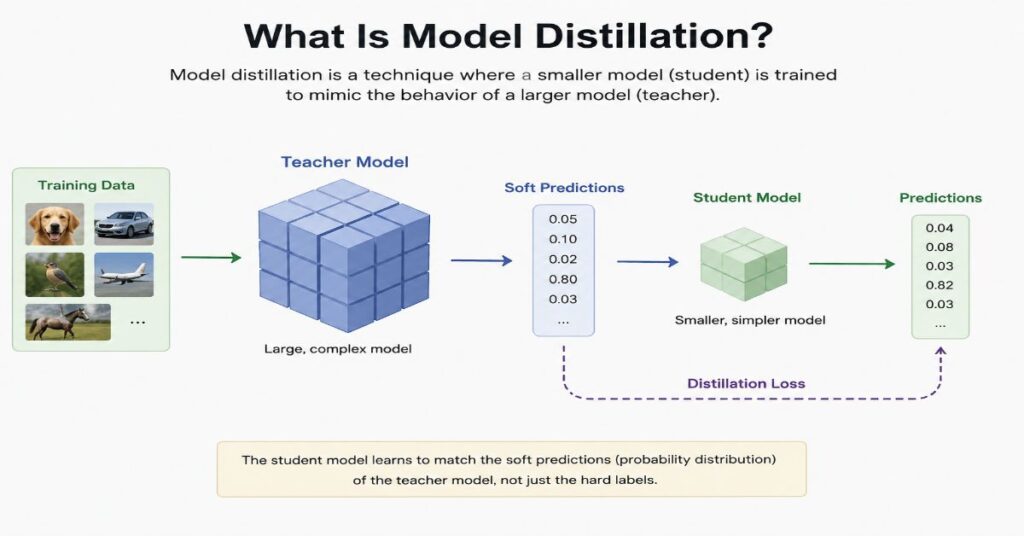
A trained neural network does not store knowledge as a database of sentences. It encodes statistical relationships in weights, activations, attention patterns, and output distributions. Distillation gives the student an additional learning signal derived from the teacher. In the classic Hinton, Vinyals, and Dean formulation, the teacher produces softened class probabilities. Those probabilities reveal not only which answer wins, but how the teacher ranks plausible alternatives. A hard label says “cat”. A soft distribution can say “cat 0.72, fox 0.17, dog 0.08”, exposing relationships that a one-hot label discards.
For language models, the transferred object can be broader. The student may learn token probabilities, complete teacher responses, structured tool calls, chain-of-thought-like reasoning traces where policy permits, hidden representations, or attention relations. The adjacent data science tool stack is relevant because production distillation rarely uses one isolated library. It sits beside data pipelines, experiment tracking, evaluation suites, model registries, serving engines, and observability.
The word “knowledge” therefore needs discipline. Distillation does not copy weights, recover the exact training corpus, or guarantee that the student has acquired the teacher’s internal concepts. It optimises behaviour under a chosen loss on a chosen sample. The closer the sample is to production traffic, the more useful the transfer. The narrower the sample, the more likely the student is to become an excellent specialist with brittle boundaries.
| Element | What It Means | Operational Consequence |
| Teacher | A stronger model, ensemble, or specialist system that generates supervision. | Teacher quality sets an upper bound, but expensive or inconsistent teachers can produce costly noise. |
| Student | The model being trained, usually smaller or cheaper to serve. | Architecture, tokenizer, context length, and deployment target constrain what can be transferred. |
| Soft Targets | Probabilities or logits adjusted with a temperature value. | They preserve relative preferences between alternatives instead of only the winning label. |
| Generated Traces | Teacher-written answers, JSON, tool calls, or step sequences. | Easy to collect through an API, but vulnerable to style imitation, hidden errors, and policy restrictions. |
| Evaluation Set | Held-out real tasks and adversarial cases. | Without this, a student can look cheaper while silently losing the business-critical tail. |
How the Teacher-Student Training Loop Works
A robust workflow starts before training. The team defines a target task, a failure budget, and a production distribution. It then establishes the teacher baseline and freezes an evaluation set that will not be used to generate training examples. Only after those controls exist should the teacher produce labels or responses for the student.
The Core Loss Function
In a common classification formulation, the student minimises a weighted combination of ordinary cross-entropy against ground-truth labels and Kullback-Leibler divergence against the teacher’s softened distribution: L = (1 – alpha) × CE(y, student) + alpha × T² × KL(teacher_T || student_T). The temperature T makes the probability distribution softer. A higher temperature reveals more information about lower-ranked alternatives, while the T² factor keeps gradient magnitudes comparable. Alpha controls how much the student trusts the teacher relative to human or observed labels.
For autoregressive language models, training usually operates token by token or sequence by sequence. Logit distillation compares probability distributions over the vocabulary. Sequence-level distillation asks the teacher to generate a complete answer, then uses that answer as supervised fine-tuning data. Feature and attention methods add intermediate losses between aligned layers. In every case, the objective is selective imitation, not metaphysical knowledge transfer.
Google’s compact-model strategy illustrates this layered approach. The publication’s Google Gemma 4 analysis covers the commercial and deployment context, while Google’s own Gemma 3 documentation says its post-training combined distillation, reinforcement learning from human feedback, machine feedback, execution feedback, and model merging. That combination matters because production models are rarely products of one optimisation technique.
The teacher and student do not always need identical architectures, but compatibility reduces friction. NVIDIA’s current NeMo Customizer documentation is more restrictive: its logit-pair workflow requires the same tokenizer, supports GPT-based NeMo 2.0 checkpoints, and cannot use LoRA adapters as teacher models. Those constraints are not incidental. If token spaces differ, token-level probabilities do not align cleanly; if layer shapes differ, hidden-state losses require projection modules or different objectives.
Distillation Methods Compared
The most important design decision is not teacher size. It is the type of signal the student receives. Different signals expose different parts of the teacher’s behaviour and create different infrastructure requirements.
| Method | Transferred Signal | Strengths | Main Constraint |
| Response or Sequence Distillation | Complete teacher outputs used as supervised examples. | Works with black-box APIs; supports prose, JSON, classification, and tool calls. | Learns only from sampled outputs; teacher uncertainty is hidden. |
| Logit Distillation | Full or top-k token probability distributions. | Carries richer relative preference information and calibration signals. | Usually requires weight-level or special API access; vocabularies must align. |
| Feature Distillation | Hidden states or projected intermediate representations. | Can transfer internal abstractions beyond final outputs. | Layer mapping and memory overhead become difficult across architectures. |
| Attention Transfer | Attention maps or query-key-value relations. | Useful for Transformer compression; MiniLM showed strong task-agnostic results. | Attention similarity does not guarantee identical reasoning or robustness. |
| Self-Distillation | A model teaches a smaller copy, later checkpoint, or alternate head. | Avoids an external teacher and can regularise training. | Teacher errors and biases remain inside the same model family. |
| Multi-Teacher Distillation | Signals from an ensemble or specialist teachers. | Can combine complementary expertise and reduce single-teacher quirks. | Conflicting outputs require weighting, routing, or consensus rules. |
| Reasoning-Trace Distillation | Teacher-generated intermediate steps and final answers. | Can improve structured problem solving on narrow domains. | Traces may be unreliable, proprietary, verbose, or policy-restricted. |
Black-box response distillation is currently the easiest route for application teams because it needs only a model API. It is also the least information-rich. Two teacher answers can look equally correct while carrying very different uncertainty. Logits reveal that uncertainty, but most commercial APIs do not expose full probability vectors for frontier reasoning models. Feature and attention methods provide deeper supervision but require both models inside the training environment, which can double memory pressure.
Diffusion systems use the same family of ideas in a different setting. Guidance distillation can reduce the number of denoising steps or teach a student to reproduce classifier-free guidance more efficiently. The Flux open-model review notes that FLUX.1 [dev] was released as a guidance-distilled model, a reminder that “distillation” can optimise image generation trajectories as well as language-model outputs.
How Distillation Differs From Other Optimisation Methods
Distillation is frequently confused with every technique that makes inference cheaper. The distinction is practical: distillation changes a model by training it on a teacher-derived signal. Quantisation changes numerical precision. Pruning removes weights, channels, heads, or layers. Low-rank adaptation changes a small set of parameters for a task. Retrieval-augmented generation keeps knowledge outside the model. Prompt routing sends easy requests to cheaper models. Mixture-of-experts architectures activate only part of a large network for each token.
These methods can be combined. A team can distil a 7B student from a 70B teacher, quantise the student to INT4, serve it through a TensorRT engine, and route low-confidence cases back to the teacher. This stack often beats the fantasy of finding one universally efficient model. It also creates more interfaces to monitor: quantisation can affect calibration, routing can mask student weaknesses, and retrieval can introduce a separate source-selection failure.
Google’s TurboQuant memory compression is a useful contrast because it targets memory and arithmetic representation without requiring teacher-student retraining. A drop-in compression method may be preferable when a team already trusts the model’s behaviour and only needs a lower memory footprint. Distillation is preferable when the goal is to teach a smaller architecture task-specific behaviour that it does not yet possess.
The right order of operations usually starts with simpler levers. Improve prompts, cache stable context, batch requests, constrain outputs, and route workloads before funding a training project. Use retrieval when the problem is missing or changing knowledge. Use fine-tuning when the model needs a consistent style, schema, or domain behaviour. Use distillation when a strong teacher repeatedly demonstrates the desired task and the student must approach that performance at lower steady-state cost.
Benchmark Gains Versus Production Reality
The classic evidence for distillation is real, but every figure carries a scope. DistilBERT reported that its student was 40% smaller, 60% faster, and retained 97% of BERT’s language understanding capability. MiniLM reported more than 99% of teacher accuracy on SQuAD 2.0 and several GLUE tasks while using 50% of the Transformer parameters and computation. AWS currently markets Bedrock-distilled models as up to 5x faster and up to 75% less expensive, with less than 2% accuracy loss for selected workloads such as retrieval-augmented generation.
| Evidence | Reported Result | What the Number Does Not Prove |
| DistilBERT, 2019 | 40% smaller; 60% faster; 97% retained language understanding. | It does not guarantee the same ratio for generative reasoning, tool use, multilingual long context, or a different serving stack. |
| MiniLM, 2020 | Over 99% accuracy on selected SQuAD 2.0 and GLUE tasks with 50% parameters and compute. | Task averages can hide category-specific drops, calibration changes, and long-tail failures. |
| AWS Bedrock, current product claim | Up to 5x faster and 75% cheaper with under 2% accuracy loss on selected use cases. | “Up to” results are workload-dependent and do not include every data, training, evaluation, or hosting cost. |
| Google Gemma 3n, 2025 | MobileNet-V5 vision encoder reported 13x speedup with quantisation, 46% fewer parameters, and 4x smaller memory footprint. | The result combines architecture, distillation, and quantisation, so distillation alone cannot claim the full gain. |
The production test must therefore use task-weighted metrics. A broader AI accuracy evaluation makes the point that an aggregate accuracy number can be operationally weak. For distillation, teams should track exact-match or task success, calibration error, refusal quality, tool-call validity, p50 and p95 latency, tokens per answer, throughput, GPU memory, energy per request where relevant, and the rate at which traffic escalates to a teacher.
A student can beat the teacher on a narrow metric because the training set regularises the task and removes irrelevant behaviour. That is not paradoxical. The teacher may be broadly capable but inconsistently formatted, while the student is optimised for one schema. Conversely, the student can match average accuracy while failing catastrophically on rare inputs. Production acceptance should use slices for language, document type, prompt length, safety class, customer tier, and tool path, not only one headline score.
Current Tooling, Features, and API Integrations
The 2026 tooling market divides into managed cloud workflows and weight-level training frameworks. Managed services reduce infrastructure work but limit teacher-student combinations. Frameworks expose richer losses but require GPU capacity, compatible checkpoints, and training expertise.
Amazon Bedrock Model Distillation
- Teacher responses can be generated from prompt-only datasets or taken from production invocation logs.
- Bedrock applies synthetic-data augmentation, splits training and validation data, and fine-tunes the selected student.
- Core integrations include Amazon S3 for datasets and artefacts, IAM roles and trust policies, CloudWatch invocation logging, KMS controls where configured, and Bedrock InvokeModel or Converse APIs for serving.
- Current documentation supports text-to-text distillation and lists provider-specific teacher-student pairs. Anthropic models are not currently available for Bedrock distillation, with no confirmed restoration date.
- AWS states that only the customer can access the final distilled model and that customer data is not used to train public teacher or student models.
OpenAI Response-to-SFT Workflow
- Tune a prompt on a larger model, capture accepted Responses API outputs, filter them against evaluation criteria, and convert them into JSONL examples for a smaller model.
- OpenAI says Responses API outputs are stored for 30 days by default, which affects retention reviews and data-export timing.
- The supervised fine-tuning dataset minimum is 10 examples; OpenAI reports improvement often begins around 50 to 100 and recommends starting with 50 well-crafted demonstrations.
- Integrations include the Responses API, Files API, Fine-tuning API, Evals, JSONL chat-format records, structured outputs, and function-call examples.
- As of July 2026, OpenAI’s current documentation says the fine-tuning platform is being wound down for new users. Existing users retain temporary job creation access, so availability is now a material constraint.
NVIDIA NeMo and ModelOpt
- NeMo Framework 2.0 supports knowledge distillation through NVIDIA TensorRT Model Optimizer, including logit-based training and distributed GPU workflows.
- NeMo Customizer currently documents logit-pair distillation only, requires teacher and student models with the same tokenizer, and supports GPT-based NeMo 2.0 checkpoints.
- LoRA adapters cannot act as teacher models in the documented microservice workflow.
- The training environment must accommodate teacher and student memory, or use parallel and offloading strategies supported by the stack.
- Deployment can connect to NVIDIA NIM, TensorRT-LLM, Kubernetes, model registries, and observability systems, depending on the chosen NeMo platform configuration.
Google Tunix and Gemma
- Tunix is a JAX-native post-training library distributed through the google-tunix PyPI package.
- Its DistillationTrainer supports logit-based distillation and attention transfer, alongside other post-training methods in the same library.
- Gemma 3 documentation identifies distillation as one component of post-training, combined with several reinforcement-learning stages and model merging.
- Gemma models can be deployed through local runtimes, Hugging Face-compatible tooling, Google AI Studio, Vertex AI, Cloud Run, LiteRT, Keras, JAX, and other ecosystem integrations, with exact support varying by model.
The Nota AI robotics partnership shows why these integrations matter outside data centres. Myungsu Chae, Nota AI’s chief executive, said in July 2026 that models must be “optimised for the compute and memory constraints” of industrial robots. That constraint determines the student architecture before the first training batch runs.
Pricing and the Hidden Cost Stack
Distillation economics have two phases. The build phase consumes teacher tokens, data engineering, training compute, repeated evaluations, storage, and engineering time. The run phase consumes student inference, monitoring, model registry, autoscaling capacity, and occasional teacher fallbacks. A project creates value only when run-phase savings repay build-phase costs before the task, teacher, or product requirements change.
| Platform or Model | Public Price or Commercial Status, July 2026 | Limits and Cost Traps |
| OpenAI GPT-4.1 teacher | US$2.00 per 1M input tokens; US$8.00 per 1M output tokens. | Teacher-output generation is only one cost. Fine-tuning access is being wound down for new users. Responses are stored 30 days by default unless configured otherwise. |
| OpenAI GPT-4.1 mini student | US$0.40 input; US$1.60 output per 1M tokens. | A lower inference rate does not include training, evaluations, storage, or failed data-generation calls. |
| OpenAI GPT-4.1 nano student | US$0.10 input; US$0.40 output per 1M tokens. | Rate limits depend on usage tier. The published long-context limits range from 500 RPM and 200,000 TPM at Tier 1 to 30,000 RPM and 150M TPM at Tier 5. |
| Amazon Bedrock Model Distillation | No single flat public fee. Charges depend on teacher inference, selected customisation job, region, model, and deployment. Custom Nova inference is priced like the corresponding base Nova model. | AWS exposes model and region selectors. Provisioned-throughput prices may require an account team. Unsupported teacher-student pairs, S3, logging, evaluation, and idle capacity can dominate cost. |
| NVIDIA NeMo / ModelOpt | Framework documentation is public; software and infrastructure cost depends on NVIDIA AI Enterprise terms, cloud GPU rates, or owned hardware. | Teacher plus student memory, distributed training, checkpoint storage, and serving licences can exceed token-API savings at low volume. |
| Google Tunix | Open-source Python package; no per-job software fee stated. | Users still pay for JAX training compute, storage, data generation, evaluation, and deployment. Gemma hosting costs depend on the selected runtime or cloud service. |
A simple break-even model is: build cost ÷ per-request savings = requests required to recover the project. Suppose a teacher workflow costs US$0.010 per request and the student costs US$0.002, leaving US$0.008 savings. A US$40,000 build and validation programme needs five million successful student requests to break even, before maintenance. If 20% of traffic still escalates to the teacher, the effective savings shrink. If the task changes after two million requests, the project never pays back.
“This is the incredible power of extreme codesign.” Jensen Huang, founder and chief executive of NVIDIA, speaking at GTC 2026 about lowering token cost through full-stack optimisation.
The quote captures the broader truth: model size is only one variable. Kernel efficiency, batching, quantisation, cache reuse, network overhead, queueing, and hardware utilisation can determine whether a smaller student is actually faster or cheaper. A poorly served 3B model may lose to a well-batched 8B model.
A Step-by-Step Technical Implementation Workflow
The safest implementation treats distillation as a gated software release rather than an open-ended training experiment. The following workflow is vendor-neutral and can be mapped to Bedrock, OpenAI-style response capture, NeMo, Tunix, or an internal PyTorch stack.
- Define one bounded production task. Specify inputs, outputs, languages, context lengths, tool schemas, refusal rules, and latency or cost targets. Avoid “general assistant” as a first distillation project.
- Build a frozen evaluation set before generating training data. Include normal traffic, rare classes, adversarial prompts, malformed inputs, long contexts, tool errors, and examples where the correct action is escalation or refusal.
- Select a teacher on measured task performance, not reputation. Record model version, system prompt, decoding settings, tool definitions, and policy configuration. A teacher change invalidates comparability.
- Select the student around deployment constraints. Check tokenizer, context window, output length, licence, supported precision, GPU or device memory, function calling, structured outputs, and serving runtime.
- Collect teacher supervision from representative prompts. For black-box APIs, store prompt, response, metadata, model version, latency, token use, safety outcome, and reviewer decision. For white-box training, store logits or selected intermediate signals.
- Filter and balance the dataset. Remove incorrect, non-compliant, duplicated, leaking, or stylistically unstable teacher outputs. Rebalance rare but costly cases instead of matching raw traffic frequency blindly.
- Train a baseline student with ordinary supervised fine-tuning, then add distillation losses. This isolates whether the teacher signal improves performance beyond the same data with hard labels.
- Tune temperature, alpha, top-k logit coverage, sequence length, learning rate, and layer mappings through controlled experiments. Change one major variable at a time and log every checkpoint.
- Evaluate against the frozen set and a fresh shadow-traffic set. Compare teacher, base student, fine-tuned student, and distilled student on quality, safety, calibration, latency, throughput, memory, and cost.
- Deploy in shadow mode or a small canary. Route low-confidence, out-of-distribution, or high-risk requests to the teacher. Monitor drift and teacher-fallback frequency as first-class metrics.
- Promote only when the student meets a written acceptance threshold. Preserve rollback, model versioning, dataset lineage, and an expiry date for revalidation.
For device deployment, the edge AI deployment shift provides useful context on industrial vision and embedded inference. Masum Mir, Cisco’s senior vice president for provider mobility, said in March 2026 that physical AI is shifting intelligence towards “distributed decision making at the network edge”. Distillation can support that shift, but only when device-level thermal, memory, and power tests are part of acceptance.
Known Constraints, Bottlenecks, and Failure Modes
The most common failure is distribution mismatch. A student trained on clean internal prompts may fail on shorthand, multilingual requests, corrupted documents, or adversarial phrasing. Synthetic examples help only when they expand meaningful coverage. Generating thousands of near-duplicates can make training metrics rise while production robustness stalls.
Capacity and Architecture Gaps
A very small student may not have enough capacity to represent the teacher’s behaviour. The gap can appear as shallow reasoning, loss of instruction hierarchy, weaker long-context retrieval, unstable tool arguments, or poor multilingual transfer. Teacher-assistant distillation, where an intermediate model bridges a large capacity gap, can help. So can separating one broad student into several specialists behind a router.
Teacher Error and Style Contamination
The student learns the teacher’s systematic errors, verbosity, refusal quirks, and formatting habits unless the dataset is filtered. It can also overfit to surface style and appear teacher-like without preserving causal competence. Human labels, executable checks, unit tests, retrieval verification, and model-based graders should complement one another rather than appointing the teacher as the only judge.
Training and Serving Bottlenecks
- Logit and feature distillation may require both models in GPU memory, increasing parallelism and communication overhead.
- Long vocabulary distributions are expensive to store; top-k logits reduce storage but discard tail information.
- Different tokenizers break direct token alignment and make sequence-level methods more practical than logit matching.
- Quantised students may pass pre-quantisation tests and fail after conversion, so the deployable artefact must be evaluated.
- Latency gains disappear under low GPU utilisation, excessive network hops, cold starts, or poor batching.
- Safety behaviour can regress because harmful or refusal examples are underrepresented in the teacher-generated corpus.
“We use one backbone to solve all the different tasks.” Ming-Yu Liu, vice president of Cosmos Lab at NVIDIA, describing the diversity expected from a foundation model at SIGGRAPH 2026.
That breadth is exactly what a compressed specialist may surrender. The trade can be sensible, but the product must recognise when a request falls outside the student’s remit. Confidence thresholds alone are weak because language models can be confidently wrong. Better escalation combines task classifiers, input-policy rules, retrieval checks, output validators, and sampled human review.
Legitimate Distillation Versus Extraction Attacks
Distillation is legitimate when the organisation owns the teacher, has contractual permission to use its outputs for training, or works with an open model under compatible licence terms. It becomes contentious when one party systematically queries another model to reproduce protected capabilities in breach of access controls, terms, regional restrictions, or intellectual-property rights.
Anthropic’s February 2026 disclosure, covered in the magazine’s Claude extraction controversy, alleged that DeepSeek, Moonshot, and MiniMax generated more than 16 million Claude exchanges through about 24,000 fraudulent accounts. Anthropic explicitly described ordinary distillation as a widely used legitimate method while arguing that unauthorised industrial-scale extraction changes the security and competitive context.
The technical detection problem resembles abuse and fraud detection. Providers look for coordinated account creation, unusual prompt templates, high-volume sampling across capability boundaries, synchronised traffic, shared infrastructure, repeated paraphrases, and requests designed to maximise training value rather than solve user tasks. Defences can include rate limits, identity verification, behavioural classifiers, output watermarking or canaries, account graph analysis, and contractual enforcement. None is perfect, and aggressive blocking can harm legitimate evaluation or research.
Anthropic’s newer Claude Fable safety controls reportedly route suspected distillation queries away from the most capable configuration. The design illustrates a growing policy layer: providers may treat training-data extraction as a distinct safety domain, separate from cyber, biological, or chemical misuse.
“There’s a big gap between an AI model that works in a demo and one that works in a regulated industry.” Dario Amodei, co-founder and chief executive of Anthropic, in the company’s February 2026 Infosys announcement.
Authorised enterprise distillation helps close that gap only if governance travels with performance. Contracts should state whether outputs may be retained, used for training, shared with contractors, or transferred across regions. Dataset lineage should record every source, reviewer, licence, and deletion request. Safety evaluation should test whether the student preserves refusal and escalation behaviour rather than merely matching helpful answers.
Where Distillation Fits in a 2026 AI Strategy
The strongest business case is a stable, high-volume task where a frontier model is clearly overqualified. Examples include intent classification, document field extraction, query routing, moderation subcategories, standardised customer-service answers, tool selection, code transformation under tests, speech or vision components on constrained devices, and repetitive domain summarisation with strict schemas.
The weakest case is a volatile product that depends on the teacher’s newest knowledge or broad reasoning. Distillation freezes a capability snapshot into a student and creates a maintenance obligation. If the teacher changes monthly, the organisation may enter a permanent cycle of re-generation, re-training, and re-certification. Retrieval, routing, prompt optimisation, or a cheaper general model may deliver more flexibility.
“Physical AI is accelerating the shift from centralized intelligence to distributed decision making at the network edge.” Masum Mir, senior vice president and general manager at Cisco, in a March 2026 NVIDIA announcement.
That edge shift makes efficiency strategic, not cosmetic. Local inference can reduce network dependency, improve privacy, and make real-time control possible. It also exposes hard limits in memory, thermal design, and energy. A student intended for a robot, vehicle, browser, or phone should be judged on the target device, with real sensor or user inputs and the final quantised runtime.
A useful portfolio pattern is teacher, student, and router. The student handles the predictable majority. The teacher receives rare, ambiguous, or high-stakes cases. The router is evaluated as carefully as either model because its mistakes determine both cost and quality. This pattern also creates fresh distillation data: teacher fallbacks reveal where the student is weak, while reviewed production outcomes provide higher-value examples for the next training cycle.
The decision rule is straightforward. Distil when the task is narrow enough to measure, large enough to repay build cost, stable enough to survive the payback period, and safe enough to automate with monitored escalation. Do not distil because a vendor slide promises a percentage. Distil because a documented workload, dataset, model pair, and deployment target show a credible path to better intelligence per pound, watt, or millisecond.
Our Editorial Verification Process
We cross-referenced the original Hinton, Vinyals, and Dean distillation paper with the DistilBERT and MiniLM research records to separate foundational findings from later marketing language. For current workflows, we checked Amazon Bedrock Model Distillation product and user documentation, the live Bedrock pricing page, OpenAI’s supervised fine-tuning and model pages, NVIDIA NeMo Framework and NeMo Customizer documentation, Google’s Gemma and Tunix announcements, and Anthropic’s February 2026 distillation-attack disclosure.
Pricing was recorded only where an official page exposed a current public amount. Where AWS pricing depends on model, region, service tier, provisioned capacity, or account negotiation, the article states that variability instead of synthesising a flat fee. OpenAI’s current documentation also says fine-tuning access is being wound down for new users, so we treated availability as a live constraint rather than assuming historic access still applies.
Benchmark claims are labelled by source and scope. We did not run proprietary Bedrock, OpenAI, NeMo, or Gemma distillation jobs for this article, so vendor “up to” figures remain vendor-reported. Our information-gain analysis comes from comparing the full build-and-run cost stack, mapping compatibility constraints, and treating escalation rate as a core economic metric rather than assuming every request moves permanently to the student.
This article was researched and drafted with AI assistance and reviewed by the Awais Khalid editorial desk at Perplexity AI Magazine. All data, citations, pricing figures, and named quotes have been independently verified against primary sources before publication.
Conclusion
Model distillation is one of the clearest ways to turn expensive general intelligence into a cheaper specialist, but its success depends on everything surrounding the training loss. The teacher must be strong on the actual task. The dataset must represent production, including failures and refusals. The student must fit the target runtime. The evaluation must measure long-tail quality, safety, latency, throughput, memory, and escalation. The financial model must include teacher generation, filtering, training, hosting, and maintenance, not only the final token rate.
The technique will become more important as AI moves towards devices, industrial systems, and high-volume agent workflows. It will also remain contested because the same output-based learning process can be used with permission or used to extract capabilities against a provider’s terms. Technical controls, contracts, provenance, and auditing will therefore evolve alongside better loss functions.
The open question is how much generality small students can retain as teachers become more capable and multimodal. Better synthetic data, teacher assistants, multi-teacher systems, reasoning supervision, and hardware-aware training will narrow the gap. They will not remove the need for judgement. Distillation is not a universal replacement for frontier models. It is a disciplined way to decide which parts of frontier performance are worth carrying into a smaller, faster, and more governable system.
FAQs
What Is Model Distillation in Simple Terms?
Model distillation trains a smaller student model to imitate useful behaviour from a stronger teacher. The teacher supplies soft probabilities, complete answers, hidden features, attention patterns, or reasoning traces. The student is then evaluated to see whether it preserves enough task performance while using less compute, memory, time, or money.
Is Model Distillation the Same as Fine-Tuning?
No. Fine-tuning adapts a model using labelled examples or preferences. Distillation specifically uses a teacher-derived signal. Sequence distillation often ends in supervised fine-tuning, so the workflows overlap, but the source of supervision is different.
Does Distillation Make an AI Model Smaller?
Usually, but not always. The student is commonly smaller, faster, or cheaper. Distillation can also train a same-sized model, transfer behaviour between architectures, combine teachers, improve calibration, or create a specialist without reducing parameter count.
How Much Accuracy Does a Distilled Model Lose?
There is no universal percentage. DistilBERT reported 97% retained language understanding, while AWS reports less than 2% loss for selected Bedrock use cases. Real outcomes depend on task breadth, teacher quality, student capacity, data coverage, loss design, and evaluation method.
Can Large Language Models Be Distilled Through an API?
Yes. A team can collect approved outputs from a larger API model, filter them, and fine-tune a smaller model on the resulting examples. This black-box method is practical but lacks full teacher logits and must comply with the provider’s terms, retention rules, and training permissions.
What Is the Difference Between Distillation and Quantisation?
Distillation retrains a student using signals from a teacher. Quantisation represents weights or activations with fewer bits, such as INT8 or INT4. They can be combined, but quantisation alone does not teach a new model to imitate another.
When Should a Business Use Model Distillation?
Use it for a stable, high-volume, measurable task where teacher inference is expensive and a smaller model can meet clear acceptance thresholds. Avoid it when requirements change quickly, the workload is low-volume, failures are hard to detect, or current knowledge matters more than fixed specialised behaviour.
Is Distilling a Competitor’s Model Legal?
The answer depends on contracts, terms of service, licences, jurisdiction, access methods, and intellectual-property law. Authorised distillation is normal. Large-scale automated extraction through fraudulent accounts or prohibited retention can create contractual, security, and legal exposure. Specialist legal advice is necessary for a specific deployment.
References
Amazon Web Services. (2025). Amazon Bedrock Model Distillation is now generally available.
Amazon Web Services. (2026). Amazon Bedrock Model Distillation.
Anthropic. (2026, February 23). Detecting and preventing distillation attacks.
Google. (2025, March 12). Introducing Gemma 3: The developer guide.
Hinton, G., Vinyals, O., & Dean, J. (2015). Distilling the knowledge in a neural network.
NVIDIA. (2026). Distillation: NeMo Framework user guide.
OpenAI. (2026). Supervised fine-tuning: Distilling from a larger model.
Sanh, V., Debut, L., Chaumond, J., & Wolf, T. (2019). DistilBERT, a distilled version of BERT: Smaller, faster, cheaper and lighter.
Wang, W., Wei, F., Dong, L., Bao, H., Yang, N., & Zhou, M. (2020). MiniLM: Deep self-attention distillation for task-agnostic compression of pre-trained Transformers.
