
📋 Executive Summary
I describe what is a token in AI this way that it is the model’s working unit for reading and generating information, and a 2026 study found that agentic coding tasks can consume 1,000 times more tokens than ordinary code chat. That contrast explains why a term that sounds like a minor technical detail now matters to writers, developers, finance teams, product leaders, and anyone using a large language model.
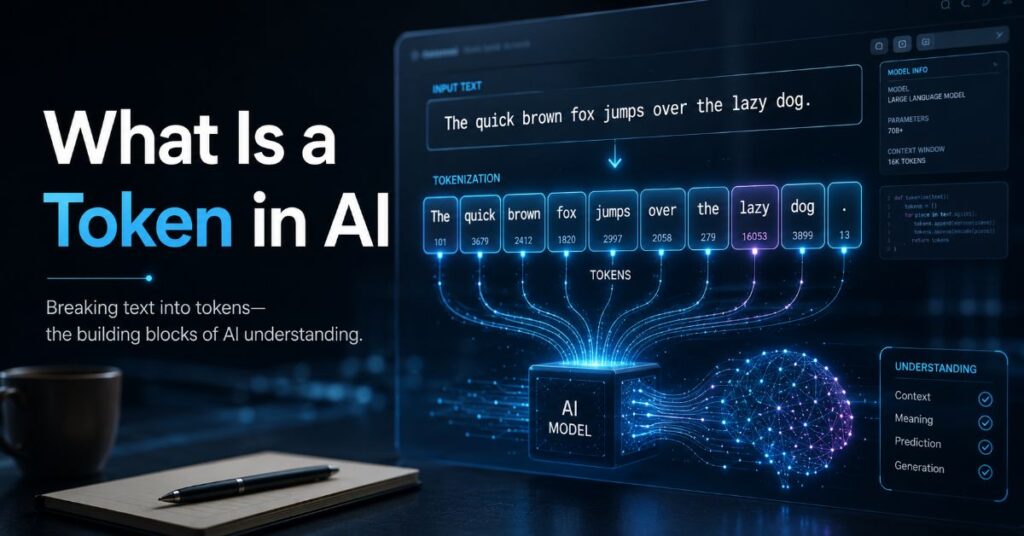
A token is not always a word. It may be one character, a punctuation mark, part of a word, a whole word, or a unit derived from an image, audio clip, or video frame. The model converts these units into numerical identifiers, processes the resulting sequence, and predicts the next token repeatedly until it completes a response. The visible paragraph is therefore the final reconstruction of a much less human-looking chain of token IDs.
Understanding what is a token in AI also clarifies three questions that users regularly confuse. First, why can two prompts with the same word count produce different costs? Second, why does a model with a million-token context window still lose important details in a long document? Third, why can an apparently short AI agent task generate a surprisingly large bill? The answers sit in tokenisation, context assembly, repeated tool loops, hidden reasoning, and output generation.
This guide explains the complete path from text to token IDs, distinguishes input, output, cached, reasoning, multimodal, and tool tokens, compares current API pricing structures, and provides an implementation workflow for controlling usage. It also addresses a crucial limitation: a larger token budget does not automatically produce a better answer. In practice, relevance, placement, retrieval quality, model choice, and stopping rules often matter more than raw context size.
What Is a Token in AI?
A token is a discrete unit that an AI model accepts as input or produces as output. In a text model, the tokenizer divides a string into pieces drawn from a fixed vocabulary. Each piece receives an integer ID. The model operates on those IDs, not directly on the words a person sees. After generation, the system maps predicted token IDs back into readable text.
The simplest answer to what is a token in AI is therefore not “a word”. It is “a vocabulary unit used by the model”. A common word may occupy one token, while a rare surname, technical compound, URL fragment, emoji sequence, or word in a less efficiently represented language may require several. Capitalisation and leading spaces can also change the token ID. OpenAI’s documentation, for example, notes that the same visible colour word can map differently when it begins with a capital letter or includes a preceding space.
This model-specific behaviour matters. Two providers can process the same sentence with different token counts because they use different vocabularies, training corpora, normalisation rules, and tokenisation algorithms. Even a provider can change tokenisation between model generations. Anthropic’s July 2026 pricing documentation states that Claude 4.7 and later use a newer tokenizer that may produce approximately 30 per cent more tokens for the same text, depending on content and workload shape. A nominally unchanged price per million tokens can therefore conceal a changed effective cost per document.
Tokens also connect language to model capacity. A context window expressed as 128,000 or one million tokens is a sequence-length budget, not a word limit. It must accommodate system instructions, user messages, document extracts, retrieved pages, tool definitions, tool results, conversation history, hidden control text, and usually the generated answer. Our related analysis of the Perplexity Sonar model architecture shows why search context and model context are related but separate budgets.
Quanyan Zhu, the author of the 2026 AI Tokenomics paper, describes tokens as the “practical accounting unit” of foundation-model services. That phrase is useful because tokens connect four layers at once: representation, computation, memory, and money.
What Is a Token in AI Compared With a Word?
The relationship is approximate rather than fixed. OpenAI gives a rough English rule of one token per four characters, or roughly three-quarters of a word. Google gives a similar character estimate and says 100 Gemini tokens are about 60 to 80 English words. These estimates are useful for planning, but production systems should count with the target model or use the provider’s usage metadata.
How Tokenisers Convert Language Into Numbers
A tokenizer solves a difficult compromise. A vocabulary containing every possible word, spelling, code symbol, name, and inflection would be unmanageably large. A character-only vocabulary would be compact but would create long sequences, increasing computation and making it harder for the model to learn useful patterns. Modern systems commonly use subword units that sit between characters and full words.
Byte Pair Encoding, or BPE, became influential after Rico Sennrich, Barry Haddow, and Alexandra Birch adapted it for open-vocabulary neural machine translation. The method begins with small units and repeatedly merges frequent adjacent pairs. Common sequences become single tokens, while rare words remain combinations of smaller pieces. SentencePiece takes a language-independent approach that can train directly from raw text rather than assuming that spaces have already separated words.
A simplified tokenisation pipeline looks like this:
- Normalise the input according to model-specific rules.
- Convert the text into a base representation, often bytes or characters.
- Match or merge sequences against the tokenizer vocabulary.
- Replace each matched piece with its token ID.
- Add special control tokens required by the chat or API format.
- Pass the complete ID sequence into the model.
The control-token step is easy to overlook. A chat request can include structural markers for roles, message boundaries, tools, images, or function schemas. These tokens may not appear in the user’s visible prompt, but they still occupy context and may be billable. Anthropic, for example, documents additional system-prompt tokens when tools are enabled and separate token overhead for Bash, text-editor, and computer-use definitions.
Prompt design changes this sequence indirectly. Clearer instructions can reduce retries, unnecessary retrieval, and long outputs, even when the initial prompt is slightly longer. The step-by-step prompt engineering guide explains how constraints, formats, and staged workflows affect context and output quality. The target is the smallest reliable context that produces the required result without repeated correction.
Tokenisation also creates language inequity. English planning heuristics may fail for languages with complex morphology, different scripts, or weaker representation in the tokenizer’s training corpus. Code, mathematical notation, JSON, tables, and compressed identifiers can also tokenise differently from prose. Budgeting should therefore use real production samples rather than one universal word-to-token ratio.
The Token Categories That Appear in Real Systems
The phrase what is a token in AI becomes more useful when separated into operational categories. Providers use different names, but most production workloads include several of the following types.
| Token Category | What It Represents | Typical Cost or Constraint |
| Input Tokens | User prompts, system instructions, files, retrieved passages, history, and tool definitions | Count against context and usually carry the lower base rate |
| Output Tokens | Text, code, structured data, or other content generated by the model | Usually priced above input because autoregressive decoding is slower |
| Cached Input Tokens | Reused prompt prefixes or stable context retrieved from a provider cache | Often discounted, but cache writes and storage may cost extra |
| Reasoning or Thinking Tokens | Internal intermediate computation used by reasoning models | May be billed, included in output pricing, or exposed only through usage metadata |
| Tool Tokens | Function schemas, computer-use instructions, command outputs, screenshots, or tool results | Add context overhead and may combine with per-tool charges |
| Multimodal Tokens | Encoded image patches, audio segments, video frames, or mixed-media representations | Conversion and pricing vary substantially by modality and model |
| Special Tokens | Role markers, message boundaries, stop markers, or internal format controls | Usually invisible to users but can affect exact counts |
Input tokens are not limited to the sentence typed into a chat box. In retrieval-augmented generation, they may include a system policy, query rewrite, retrieved chunks, citations, database records, tool schemas, and a growing conversation transcript. This is why a 20-word user request can create a request containing thousands of model-visible tokens.
Output tokens tend to be more expensive because generation is sequential. During the input or prefill phase, many input tokens can be processed in parallel. During decoding, the system repeatedly predicts one new token based on everything generated so far. A July 2026 energy study of vision-language models found that each output token took 11 to 39 times more wall-clock time than each input token on the tested edge hardware. That does not establish one universal cloud ratio, but it demonstrates why output length often dominates latency and energy.
Cached tokens can improve economics when an application repeatedly sends the same long system prompt, policy manual, codebase prefix, or product catalogue. However, caching is not free in every pricing model. There may be write multipliers, storage charges, expiry rules, minimum cacheable lengths, and provider-specific eligibility. Our AI tool pricing transparency report covers why headline rates should be separated from cache, search, storage, and tool fees.
Reasoning tokens require special care. They may not be identical to a visible chain of thought, and providers do not expose internal reasoning in the same way. A usage record can still report thought-token totals or fold them into output charges. Users should treat the API’s final usage metadata, not a pre-request estimate, as the authoritative billing record.
Text, Code, Images, Audio, and Video Do Not Tokenise Alike
Text examples dominate explanations of what is a token in AI, but modern models are multimodal. The term token now covers representations that are not naturally expressed as words. An image may be divided or transformed into visual units. Audio may be represented in time-based segments or learned codec units. Video combines temporal and visual processing. The provider then converts these inputs into model-readable units that count against context, billing, or both.
Google’s token-counting documentation states that all Gemini input and output is tokenised, including text, image files, and other non-text modalities. Its usage metadata can separately report input, output, thought, cached, tool-use, and total tokens. Its pricing page also shows why a single universal token price is impossible: text, image, audio, and video can have different rates, while some image outputs are translated into per-image equivalents.
Code introduces a different problem. Repeated punctuation, indentation, long variable names, minified files, generated lockfiles, stack traces, and embedded data can expand the token count without adding equal reasoning value. An agent that automatically reads an entire repository may spend most of its budget on low-relevance files. Logs and command output can then be appended on every loop. This is one reason context engineering has become distinct from prompt writing.
Structured formats can be efficient or wasteful depending on the schema. JSON is reliable for machine parsing, but verbose property names repeated across hundreds of objects add tokens. CSV may be smaller but loses nested structure. A compact internal representation can reduce input cost, but aggressive compression can make the task ambiguous and increase retries. The right measure is successful completion cost, not raw prompt length.
Reducing image resolution may lower visual tokens but remove details needed for the task. The 2026 edge VLM study found output length, rather than visual input alone, dominated measured energy in its tested systems. A concise classification can save more than heavy image compression followed by a long explanation.
For developers, the robust approach is model-native counting. Use the provider’s count endpoint before submission when available, then store the final usage metadata after execution. Do not assume that a character estimate for English prose applies to Python, Urdu, legal PDFs, screenshots, or audio transcripts.
Context Windows Are Working Memory, Not Guaranteed Recall
A context window is the maximum token sequence a model can reference for one generation. It includes the answer being generated, so a request near the maximum cannot always reserve the full window for input. Applications should subtract a deliberate output allowance and additional overhead for tools, control messages, and provider-specific formatting.
The most important distinction is between capacity and effective use. A one-million-token model can technically accept an enormous input, yet it may not retrieve every detail with equal reliability. Anthropic’s context-window documentation describes the context window as working memory and warns that accuracy and recall can degrade as token count grows, a problem often called context rot. Relevant evidence may be diluted, contradicted, placed too early, or surrounded by near-duplicate material.
Dario Amodei, Anthropic’s chief executive, described the practical effect of a large context in a February 2026 interview: a model can read a codebase into context and absorb knowledge that might take a new employee months to learn. The opportunity is real, but so is the engineering burden. Context has to be selected, ordered, refreshed, and compacted.
| Context Component | Why It Consumes Tokens | Control Method |
| System Instructions | Policies, role, format, safety, and task rules | Keep stable prefixes concise and cache eligible content |
| Conversation History | Earlier user and assistant messages | Summarise, compact, or retain only decision-relevant turns |
| Retrieved Evidence | Search results, database passages, and document chunks | Rerank, deduplicate, set top-k limits, and cite source IDs |
| Tool Definitions | Function names, descriptions, schemas, and examples | Load only tools available for the current step |
| Tool Results | Logs, webpages, code output, screenshots, and errors | Truncate safely, extract fields, and store full artefacts outside context |
| Reserved Output | Space needed for the answer, code, or structured response | Set a realistic maximum and stop criteria |
Model comparisons often treat the largest advertised context window as an automatic advantage. Our ChatGPT versus Claude analysis shows why selection should also include context pricing, tokenizer behaviour, retrieval quality, tool overhead, and long-context accuracy.
A useful operating rule is to treat the context window as scarce working memory. Store long-term state in databases, files, vector indexes, or structured summaries. Pull only what the current step needs. When a conversation grows, compact it into decisions, unresolved questions, constraints, and citations instead of replaying every turn. This approach usually improves both reliability and cost.
What Tokens Cost in Leading AI APIs
Token pricing changes frequently, so the matrix below is a dated snapshot verified on 29 July 2026 from official provider documentation. It is not a complete catalogue of every model or modality. It compares representative text models that illustrate the main pricing structures. All figures are in US dollars per one million tokens unless noted.
| Provider and Model | Input | Cached Input | Output | Context or Pricing Note |
| OpenAI GPT-5.6 Luna, Short Context | $0.50 | $0.05 | $3.00 | Long-context rates rise to $1.00 input, $0.10 cached, and $4.50 output |
| OpenAI GPT-5.6 Terra, Short Context | $1.25 | $0.125 | $7.50 | Long-context rates rise to $2.50 input, $0.25 cached, and $11.25 output |
| OpenAI GPT-5.6 Sol, Short Context | $2.50 | $0.25 | $15.00 | Long-context rates rise to $5.00 input, $0.50 cached, and $22.50 output |
| Anthropic Claude Haiku 4.5 | $1.00 | $0.10 cache hit | $5.00 | Five-minute cache writes cost $1.25; one-hour writes cost $2.00 |
| Anthropic Claude Sonnet 5, Introductory | $2.00 | $0.20 cache hit | $10.00 | Introductory rate applies through 31 August 2026, then $3.00 and $15.00 |
| Anthropic Claude Opus 5 | $5.00 | $0.50 cache hit | $25.00 | Fast mode costs $10.00 input and $50.00 output |
| Google Gemini 2.5 Flash | $0.30 text | $0.03 text | $2.50, including thinking | One-million-token context; audio input and cache rates differ |
| Google Gemini 2.5 Flash-Lite | $0.05 text | $0.01 text | $0.20 | Search grounding and storage can add separate charges |
These rates answer only part of what is a token in AI from a commercial perspective. OpenAI distinguishes short and long context for the listed GPT-5.6 models. Anthropic distinguishes base input, cache writes, cache hits, fast mode, batch processing, data residency, and server-side tool charges. Google distinguishes standard, batch, flex, priority, modality, caching, storage, and grounding.
The public rate does not reveal how many tokens a task will consume. A cheaper model can become expensive through retries, long answers, excessive retrieval, or premium fallback. A costlier model can be cheaper overall when it succeeds in one pass.
Jensen Huang, NVIDIA’s chief executive, made the opposite productivity argument in GTC 2026 reporting, saying he would be “deeply alarmed” if a highly paid engineer did not consume substantial AI tokens. The remark captures the central business tension. Token minimisation can reduce waste, but indiscriminate minimisation can also suppress useful work. The relevant metric is value produced per dollar, not the smallest bill.
The recent shift from volume to efficiency is examined in our report on enterprise AI token cost declines. Buyers should verify the date, model ID, context tier, batch status, cache policy, and tool charges immediately before deployment.
The Hidden Charges Behind a Token Bill
A simple cost equation is input tokens multiplied by the input rate, plus output tokens multiplied by the output rate. Production systems rarely remain that simple. Hidden or secondary costs can include cache writes, cache storage, reasoning tokens, search calls, tool invocations, file storage, computer-use sessions, image processing, retries, model fallback, regional routing, data residency, and orchestration overhead.
| Hidden Cost Source | How It Appears | Why Estimates Miss It |
| Conversation Replay | Earlier turns are resent as input | The visible new prompt is short, but the request body grows each turn |
| Retrieval Expansion | Multiple chunks, citations, or search pages enter context | Search depth and top-k settings may change dynamically |
| Tool Schemas | Function definitions and control prompts are inserted | They are not visible in the user’s message |
| Tool Results | Logs, HTML, screenshots, and database results are appended | Agents may repeat or preserve large outputs across loops |
| Reasoning Activity | Internal thought tokens or deliberation are counted | Pre-request token counters cannot predict all generated reasoning |
| Retries and Fallbacks | Failed calls are repeated or routed to another model | Billing dashboards may aggregate attempts into one user action |
| Long-Context Premiums | Rates increase beyond a threshold | Word-count estimates ignore tier boundaries |
| Search and Computer Use | Per-search or per-session fees apply in addition to tokens | Headline model pricing excludes tool infrastructure |
Anthropic’s documentation provides concrete examples. Web search costs $10 per 1,000 searches in addition to standard token costs for retrieved content. Tool definitions add model-specific system-prompt overhead. Bash and computer-use features add further tokens, while command outputs, errors, screenshots, and files all increase context. OpenAI and Google likewise separate model rates from some search, storage, or modality charges.
A particularly costly pattern is the growing agent transcript. Each cycle may include the plan, previous tool calls, returned content, error traces, revised instructions, and the next action. The agent may pay again to read material it generated or retrieved earlier. This helps explain the 2026 SWE-bench finding that agentic coding tasks used 1,000 times more tokens than code reasoning and code chat, and that repeat runs on the same task differed by up to 30 times.
Rate limits create another non-price constraint. A low per-token price is irrelevant if the application hits requests-per-minute, tokens-per-minute, concurrent-session, search, or daily quotas. Our Perplexity API rate-limit analysis shows how usage tiers and request categories can differ from the model’s token price.
Satya Nadella has promoted tokens per dollar per watt as an AI efficiency metric. It is a useful infrastructure lens, but application teams need one more denominator: successful outcomes. Cheap tokens can still produce weak or unusable work.
A Step-by-Step Token Implementation Workflow
A reliable token strategy begins before the first API call. The objective is to make usage measurable, bounded, and connected to task success. The workflow below applies to chat, retrieval-augmented generation, document analysis, and agentic systems.
1. Pin the Model and Tokeniser
Use an explicit model ID rather than a floating alias where reproducibility matters. Record the tokenizer or provider counting method. A model upgrade can alter both quality and token counts, even when the prompt remains unchanged.
2. Count the Complete Request Before Submission
Count the system prompt, user content, retrieved passages, tool definitions, examples, structured-output schema, and planned conversation history. Google’s `count_tokens` method and OpenAI’s `tiktoken` tooling are examples. Treat estimates as admission control, not final billing.
3. Reserve Output and Reasoning Capacity
Subtract a realistic output budget from the maximum context. A system that fills the entire window with input may truncate the response or fail. For reasoning models, allow for provider-reported thought tokens where relevant.
4. Apply Context Selection
Deduplicate retrieved chunks, remove boilerplate, prioritise primary evidence, and keep citations or record identifiers. Do not send an entire knowledge base because the context window permits it. Use query-specific retrieval and reranking.
5. Configure Stops, Schemas, and Tool Limits
Set maximum output tokens, stop conditions, JSON schemas, tool-call ceilings, search-depth limits, and retry budgets. Every unrestricted loop is a potential token multiplier. The security implications of excessive tool context and leaked credentials are covered in our AI agent security risks guide.
6. Capture Final Usage Metadata
Store input, output, cached, reasoning, and tool-use counts where the provider exposes them. Also record latency, model, region, cache status, number of searches, tool calls, retries, and success or failure.
7. Calculate Cost per Successful Task
Use a task-level formula:
Total task cost = all model calls + tool charges + storage + retries + fallback calls
Then divide by accepted outcomes, not attempts. A lower-cost model with a poor acceptance rate may be more expensive in production.
8. Review Outliers and Context Growth
Flag requests above expected token, latency, or cost thresholds. Inspect why they grew. Common causes include duplicated retrieval, verbose tool output, unbounded history, malformed structured output, and repeated agent planning.
9. Test Cache and Batch Options
Cache stable prefixes only when reuse is high enough to offset write and storage costs. Use batch pricing for non-urgent workloads when provider rules and latency tolerance permit it.
10. Revalidate After Every Model or Prompt Change
A new model, tokenizer, tool definition, safety policy, or output schema can alter usage. Run the same representative test set and compare cost, success rate, latency, and error types.
Constraints and Performance Bottlenecks
Tokens provide a convenient abstraction, but they are not equivalent units of computational work. An input token during prefill, an output token during decoding, an audio token, an image token, and a reasoning token can impose different hardware, memory, and latency costs. Provider pricing simplifies these differences into commercial categories rather than exposing every infrastructure detail.
The first bottleneck is sequence length. Transformer attention has historically become more expensive as context grows, although providers use architectural optimisations, sparse attention, caching, and specialised kernels. Long context also increases memory pressure through key-value caches. Even when an API accepts a million tokens, latency and quality may vary by request shape.
The second bottleneck is decoding. Output generation is sequential, so long answers directly extend completion time. The 2026 edge VLM study found decode accounted for 86 to 97 per cent of energy in its tested setup. This supports a practical rule: control unnecessary output before aggressively compressing useful input.
The third bottleneck is retrieval quality. Adding more chunks can lower signal density. Near-duplicates, outdated pages, irrelevant tables, and contradictory passages compete for attention. A system can remain under its context limit and still perform worse because the strongest evidence is buried.
The fourth bottleneck is stochastic agent behaviour. Bai and colleagues found that identical agent tasks could vary by up to 30 times in total tokens, while higher token usage did not necessarily improve accuracy. This creates forecasting risk, so static budgets need runtime ceilings, loop counters, and escalation rules.
The fifth bottleneck is tokenizer drift. Anthropic’s documented tokenizer change for Claude 4.7 and later can produce approximately 30 per cent more tokens for the same text. This is a critical procurement insight because a per-million-token price comparison can be misleading when providers segment the same workload differently.
The sixth bottleneck is observability. Some dashboards aggregate usage after the fact, while teams need per-feature and per-customer attribution. Without request IDs linked to user actions, model calls, tools, and accepted outputs, finance cannot distinguish valuable consumption from failures.
The final bottleneck is governance. Long contexts can contain personal information, source code, credentials, copyrighted material, or confidential documents. Token optimisation cannot be separated from data minimisation, access control, retention, and auditability. A smaller context is often safer, faster, and easier to verify.
Why More Tokens Do Not Guarantee Better Answers
The common assumption is that more context gives the model more knowledge and therefore improves the result. Sometimes it does. A complete contract, codebase, or research corpus may contain necessary evidence that cannot be represented in a short prompt. But more tokens also create more opportunities for distraction, contradiction, stale information, and misplaced attention.
The quality relationship is not linear. The 2026 agent study found that accuracy often peaked at an intermediate cost and then saturated. Models also failed to predict their own token use accurately, with reported correlations no higher than 0.39 in that study. This means an agent cannot be trusted to set its own budget without external controls.
Long context can hide the “needle” rather than preserve it. Important facts placed in the middle of a large prompt may receive less effective attention than material near the beginning or end. Repetition can help in limited cases, but it also consumes budget and can bias the model towards overrepresented claims. Retrieval should therefore optimise evidence quality and placement, not merely quantity.
More reasoning tokens are also not a universal remedy. Harder tasks may benefit from additional deliberation, but simple extraction or classification can become slower and more expensive without measurable improvement. Route tasks by complexity. Use a fast, lower-cost model for deterministic transformations and reserve deeper reasoning for ambiguous, multi-step decisions.
Verification remains essential. A fluent answer can still be unsupported. Our AI hallucination rate comparison explains why hallucination benchmarks use different truth standards and should not be reduced to one universal percentage. Token counts measure workload, not factuality.
Bharat Patel of Dell Technologies summarised an infrastructure response in 2026 infrastructure reporting: “Start local, govern early, scale smart.” Local execution can be appropriate for private or repetitive workloads, but it introduces hardware, maintenance, model-quality, and capacity trade-offs. Cloud APIs remain useful for frontier capability, elasticity, and managed operations. A balanced architecture may route sensitive or routine tasks locally and use premium cloud models selectively.
The practical lesson is to optimise for evidence-weighted utility. A good system delivers the required answer, cites or preserves the supporting record, stays within an agreed latency, and does so at a predictable cost. Token volume is an input to that objective, not the objective itself.
Practical Ways to Reduce Token Use Without Damaging Quality
Effective optimisation removes low-value repetition while preserving task-critical information. It is not a contest to write the shortest possible prompt. The following methods are generally reproducible across providers.
First, separate stable and dynamic context. Put durable policies, definitions, and examples in a cacheable prefix. Keep user-specific data and retrieved evidence in the dynamic section. Measure cache-hit rates before assuming savings.
Second, compress conversation history into structured state. Preserve decisions, constraints, unresolved issues, and source references. Drop social filler and already-resolved branches. For agents, store full logs externally and return only the fields needed for the next step.
Third, retrieve fewer, better passages. Use metadata filters, date constraints, source-quality rules, and reranking. Deduplicate passages before they enter the prompt. Ask the model to cite record IDs so the system can verify whether the answer relies on the supplied evidence.
Fourth, limit tool exposure. Do not attach every possible function to every call. Load the minimum tool set required for the current step, and shorten verbose descriptions while preserving unambiguous schemas. Sanitize command output and return structured summaries rather than full terminal histories.
Fifth, control output. Specify length, format, and stopping conditions. A request for “a comprehensive explanation” can generate far more output than the application needs. A bounded table or JSON object may be cheaper and easier to validate, provided the schema is not excessively verbose.
Sixth, route by task. Use smaller models for extraction, classification, formatting, and simple retrieval. Escalate to more capable models only when confidence, ambiguity, or task type requires it. Test routing against accepted outcomes because cheap failures create expensive retries.
Seventh, use batch processing for non-urgent work. Official provider pages show substantial batch discounts for some models. The trade-off is delayed completion and different operational limits.
Eighth, monitor token productivity. Track accepted words, resolved tickets, verified citations, passed tests, or completed business actions per dollar. This turns token management into product measurement rather than a finance-only exercise.
Finally, maintain a regression set. Run representative prompts whenever the model, tokenizer, retrieval pipeline, or system prompt changes. Compare token counts, cost, latency, accuracy, and failure modes. A deployment that appears cheaper per million tokens may become more expensive per successful task because its tokenizer or behaviour changed.
Three Findings That Change How Teams Should Think About Tokens
The first finding is tokenizer-adjusted pricing. Buyers often compare model rates as though one million tokens represent the same amount of source material across providers. They do not. Anthropic’s documented 30 per cent token increase for the same text on newer tokenizers shows that effective document cost can change even when the nominal rate appears stable. A fair comparison should price the same corpus through each target model’s counting method.
The second finding is that output governance can outperform input trimming. The 2026 edge VLM study found each output token took 11 to 39 times more wall-clock time than each input token on its tested hardware, while controlling output length saved up to 97 per cent of total energy in some configurations. The exact percentages should not be generalised to every cloud model, but the direction is operationally important. Concise completion rules can reduce latency and energy without deleting useful evidence.
The third finding is token variance as a reliability problem. Bai and colleagues found 30-fold variation between runs on the same agentic task and only weak-to-moderate correlation between predicted and actual usage. Token budgeting is therefore not only a cost exercise. It is a control-system problem requiring ceilings, timeouts, stop conditions, and escalation policies.
These findings also explain why what is a token in AI is no longer a beginner-only question. A token is the interface between language and infrastructure. It determines what the model can see, how much work it performs, how fast it responds, and how the provider charges. Yet tokens remain model-specific and operationally unequal.
Mature teams will stop treating context size as a prestige metric. They will measure corpus-specific tokenisation, context relevance, output efficiency, tool overhead, verification success, and cost per accepted outcome.
Our Editorial Verification Process
We verified the definition and English planning heuristics for what is a token in AI against OpenAI’s token-counting guidance and Google’s Gemini token documentation. We cross-checked current pricing on 29 July 2026 using the official OpenAI API pricing page, Anthropic Claude Platform pricing documentation, and Google Gemini Developer API pricing. The pricing table deliberately uses representative text models rather than claiming to list every provider model, modality, regional multiplier, or enterprise contract.
We validated context-window claims against Anthropic’s context-window documentation and Google long-context guidance. We checked tokenisation history against the original subword-unit research by Sennrich, Haddow, and Birch and the SentencePiece paper by Kudo and Richardson. We used the 2026 studies by Quanyan Zhu and Bai and colleagues for token-economics and agent-usage findings, and the 2026 edge VLM study by Zhan and colleagues for measured input-output energy asymmetry.
Named quotations were checked against the cited 2026 interview, conference reporting, or publication. Where vendor pages expose rapidly changing model names, rates, or promotional periods, the article states the verification date and the relevant expiry. Enterprise discounts, negotiated contracts, taxes, cloud marketplace mark-ups, and unpublished caps cannot be independently confirmed and are not presented as universal prices.
This article was researched and drafted with AI assistance and reviewed by the Awais Khalid editorial desk at Perplexity AI Magazine. All data, citations, pricing figures, and named quotes have been independently verified against primary sources before publication.
Conclusion
A precise answer to what is a token in AI begins with representation: a token is a model-readable unit mapped to an ID. The useful answer goes further. Tokens define the working sequence a model can process, the units it generates, the capacity of its context window, and much of the commercial logic behind API pricing.
That does not make every token equal. Tokenisers divide the same material differently. Input and output impose different performance costs. Tool definitions, retrieved pages, reasoning, search, screenshots, retries, and conversation replay can expand usage beyond what the user sees. A large context window can hold more information while still suffering from diluted relevance or reduced recall.
The evidence in 2026 points towards disciplined context engineering rather than indiscriminate token expansion. Count model-native tokens, reserve output space, cache stable prefixes, retrieve selectively, cap agent loops, and measure the cost of accepted outcomes. These controls reduce waste without assuming that the cheapest or shortest request is always best.
Open questions remain. Providers disclose token categories differently, tokenizer changes complicate price comparisons, and agents still struggle to forecast their own usage. As models become more multimodal and autonomous, the token will remain a useful accounting unit, but organisations will need richer measures of value, reliability, energy, and risk around it.
Frequently Asked Questions
What Is a Token in AI in Simple Words?
A token is a small unit of information that an AI model reads or generates. In text, it can be a character, punctuation mark, part of a word, or whole word. The model converts tokens into numerical IDs, processes them, and predicts new tokens to build its answer.
How Many Words Are in 1,000 Tokens?
For English prose, 1,000 tokens is often roughly 700 to 800 words. OpenAI’s rule of thumb is about 0.75 words per token, while Google says 100 tokens is about 60 to 80 English words. Exact counts vary by model, language, formatting, code, and punctuation.
Is One Token Equal to One Word?
No. A common short word may be one token, while a rare or long word may be split into several. Spaces, capitalisation, punctuation, emojis, code, and language also influence tokenisation. Always use the tokenizer or counting endpoint for the target model when precision matters.
What Is the Difference Between Input and Output Tokens?
Input tokens are the instructions, user content, history, files, retrieved passages, and tool information sent to the model. Output tokens are generated by the model. Output tokens are often priced higher because decoding happens sequentially and usually requires more time per token.
Do Tokens Affect AI Accuracy?
Tokens affect how much information fits into context, but more tokens do not guarantee higher accuracy. Excess context can dilute important evidence, introduce contradictions, and reduce recall. Accuracy depends on model quality, retrieval, prompt structure, evidence placement, verification, and task fit.
What Happens When the Token Limit Is Exceeded?
The API may reject the request, truncate content, or require the application to reduce input. Developers normally reserve room for output, summarise old conversation turns, split documents, retrieve only relevant passages, or use a model with a larger context window.
How Can I Check Token Usage?
Use the provider’s tokenizer, count endpoint, or SDK before the request, then read the final usage metadata after completion. The final record is more reliable because it can include output, cached, reasoning, tool-use, and other provider-reported categories that were not predictable beforehand.
Why Are Output Tokens More Expensive?
Output generation is autoregressive: the model produces one token, then uses it to predict the next. This sequential decoding is generally slower than processing the input prompt in parallel. Providers therefore commonly charge a higher rate for generated output than for input.
References
OpenAI. (2026). What are tokens and how to count them?
Anthropic. (2026). Pricing: Claude Platform documentation.
Anthropic. (2026). Context windows: Claude Platform documentation.
Google. (2026). Understand and count tokens: Gemini API.
Google. (2026). Gemini Developer API pricing.
