
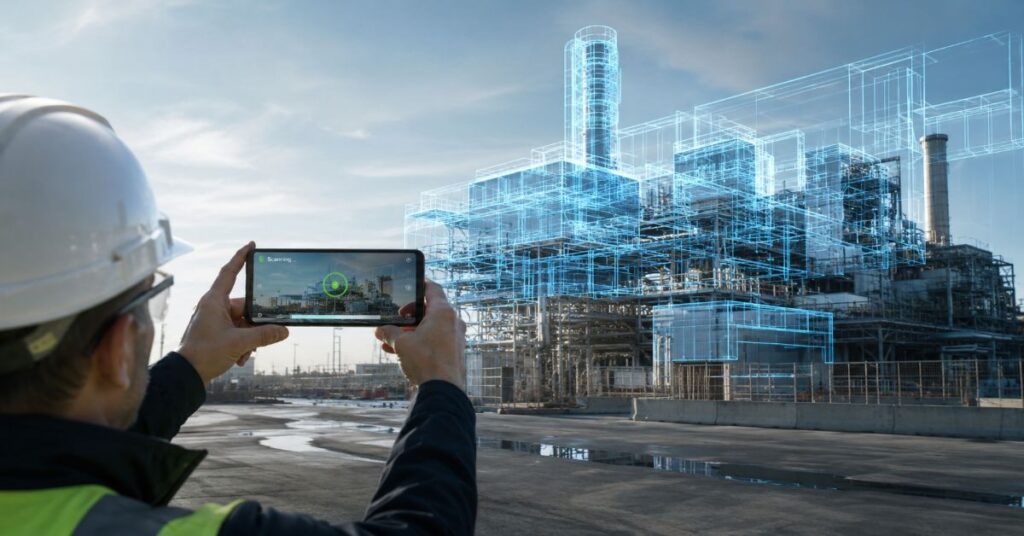
Point a smartphone at a bridge, a construction site, or a utility substation. Walk around it for a few minutes. Hand the footage to NEC’s newest AI. Wait 60 seconds. The result: a navigable, high-resolution 3D digital twin of the structure — without LiDAR scanners, dedicated servers, or a survey crew. That is what NEC Corporation announced on July 14, 2026, in what the company describes as the world’s first AI system capable of producing a deployment-ready digital twin from general-purpose camera footage in approximately one minute.
The implications reach across every sector that owns physical assets at scale — infrastructure operators, energy companies, highway authorities, municipalities, and construction firms — all of which currently face the same dilemma: digital twin technology is valuable, but the cost and complexity of producing a usable model has limited adoption to well-resourced organisations with specialist equipment.
🔱 Key Developments
- NEC unveiled AI that converts smartphone video into high-resolution 3D digital twin models in as little as 60 seconds, targeting infrastructure inspection for construction, utilities, and highways.
- The system uses Gaussian Splatting + NEC’s proprietary AI to automatically detect and remove transient objects — vehicles, pedestrians, machinery — reconstructing the hidden geometry behind them.
- Output data compressed by ~90%: in one demo, 4.4 GB of source data became a 316 MB model with bolt-level surface detail preserved.
- Commercialisation targeted for fiscal year 2027; designed for municipalities, energy companies, and highway operators seeking remote inspection without specialist hardware.
What NEC Announced
NEC’s system converts video captured by ordinary smartphones or general-purpose cameras into three-dimensional digital twin models in approximately one minute. Two capabilities define the advance over existing approaches. First, automatic transient object removal: the AI identifies moving or temporarily present objects in each frame — a truck passing through, a pedestrian crossing, a piece of construction equipment moved the following day — and reconstructs the underlying scene geometry as if those objects were not present. Second, aggressive data compression: NEC has demonstrated reducing 4.4 gigabytes of raw 3D point cloud data to approximately 316 megabytes of usable model data, a reduction of roughly 90 percent, while preserving surface detail fine enough to identify individual bolts on a structural component.
The Technology: Gaussian Splatting Meets Proprietary AI
How Gaussian Splatting Works
Conventional 3D reconstruction from photographs produces a triangle mesh: the surface of an object represented as a network of triangular faces positioned in three-dimensional space. Mesh-based models are accurate for geometric measurement but computationally expensive to generate and struggle with complex materials like vegetation, glass, and fine structural elements. Gaussian Splatting takes a different approach: the scene is represented as millions of small, semi-transparent ellipsoids — ‘splats’ — each storing position, orientation, colour, and opacity data derived from the input imagery. These splats render in real-time at high frame rates using a differentiable rasterizer, producing photorealistic results at speeds that mesh-based models cannot match. The technique won the Best Paper award at SIGGRAPH 2023 and has since moved from research into commercial applications in film, virtual production, and now industrial inspection.
NEC’s Specific Contribution
The open-source Gaussian Splatting framework has been available since 2023. NEC’s contribution is threefold: training the AI to infer and reconstruct geometry occluded by transient objects rather than simply ignoring obscured regions; developing the compression pipeline that reduces output size by 90 percent while preserving the fine detail infrastructure inspection requires; and integrating the whole system into a workflow that accepts footage from consumer-grade smartphone cameras rather than requiring calibrated survey equipment.
Why This Matters for Infrastructure
Physical infrastructure inspection is among the most expensive and operationally disruptive activities in asset-heavy industries. Sending an inspection team to a remote transmission tower, a bridge in active traffic, or an offshore platform involves travel costs, safety planning, access coordination, and operational disruption. The ability to produce a usable 3D model from a short smartphone walk-around compresses that process dramatically. NEC’s framing — targeting municipalities, energy companies, and highway operators — reflects precisely the organisations for which repeat physical inspection of distributed assets is most burdensome. The growing demand for digital twin infrastructure is also directly relevant to the broader AI data center energy and infrastructure build-out, as operators managing large physical plant increasingly look for remote monitoring solutions that reduce the labour and logistics costs of in-person inspection cycles.
Accuracy Trade-offs
Gaussian Splatting-based reconstruction is not without limitations on geometric accuracy. Independent benchmarking has found mean geometric errors of 7–8 centimetres for Gaussian Splatting models, versus 1–3 centimetres for professional photogrammetry and sub-millimetre for professional LiDAR scanners. For remote visual inspection, stakeholder communication, and preliminary site assessment, that accuracy level is adequate. For regulatory-grade structural measurement, it is not. NEC’s commercialisation materials focus specifically on inspection and decision-support use cases, which is an accurate positioning of where the technology sits today. The compressed 316-megabyte output also represents a design trade-off: compression that aggressive inevitably involves some information loss, and the specific accuracy profile of the compressed output across different surface types and lighting conditions has not yet been published through peer-reviewed channels.
Reactions
NEC framed the July 14 announcement in terms of social value rather than immediate commercial return — language consistent with the company’s broader positioning as a technology company that solves societal challenges. The company explicitly named disaster prevention, urban development digitalization, and labour shortage mitigation as primary drivers, reflecting the acute workforce reduction pressures facing Japan’s infrastructure sector. Japan’s construction industry, energy sector, and public works operations all face severe skilled worker shortages that are expected to intensify over the next decade as the population ages. A technology that enables a single non-specialist operator with a smartphone to produce inspection-grade site documentation in one minute addresses that shortage more directly than any staffing or training programme.
Coverage from technology outlets focused on the Gaussian Splatting angle and the comparison to existing consumer tools. The substantive editorial note in most coverage was appropriate scepticism about the 60-second claim at scale: smartphone video in controlled conditions with good lighting and a cooperative subject is a different proposition from a maintenance worker filming a corroded bridge support in rain. NEC has not published accuracy results across adverse environmental conditions, and that data will be the critical benchmark when pilot deployments begin in 2027.
Backstory: NEC’s Digital Twin Trajectory
NEC’s announcement builds on a trajectory of proprietary world-model development the company has been pursuing since at least 2025, when it deployed AI for worksite task recognition at manufacturing and logistics facilities. A parallel development — announced in May 2026 — demonstrated NEC’s ability to convert existing large-capacity 3D point cloud data into lightweight high-definition 3D models using Gaussian Splatting, reducing data by 90 percent without the smartphone video capture component. The July 14 announcement extends that compression capability to work directly from video footage rather than requiring pre-existing point cloud data as input, which is the step that eliminates the specialist capture equipment requirement entirely.
NEC’s April 2026 strategic collaboration with Anthropic, which is deploying Claude across NEC’s enterprise product portfolio for the Japanese market, has accelerated its AI product development capacity. The company’s proprietary NEC cotomi large language model, enhanced for business use in late 2024, provides an additional AI development foundation that NEC has indicated will be applied to products in its digital twin and infrastructure monitoring pipeline as it approaches the FY2027 commercialisation target.
Competitive Context
NEC is not the only organisation pursuing fast 3D reconstruction. Consumer-facing Gaussian Splatting apps including Niantic’s Scaniverse already process smartphone captures in 60–90 seconds on-device, and the open-source ecosystem has produced multiple rapid-reconstruction tools. NEC’s differentiators are the transient object removal and the infrastructure-grade compression pipeline — capabilities consumer apps do not offer and that are specifically required for the industrial use cases NEC is targeting. The broader competitive pressure from agentic AI on smartphones is also relevant: as mobile edge AI improves, the processing pipeline NEC currently handles server-side may increasingly run on the capture device itself, further reducing latency from footage capture to usable model.
What Happens Next
NEC has targeted commercialisation for fiscal year 2027, which in Japan runs April 2027 to March 2028. The next meaningful signals to watch are third-party accuracy benchmarks from independent research institutions, pilot deployments with named infrastructure operators, and whether the system’s performance holds across adverse conditions — rain, low light, partial occlusion by scaffolding — that characterise real sites rather than controlled demonstrations.
Why It Matters
NEC’s 3D AI matters because it removes the specialist equipment barrier from digital twin creation. LiDAR scanners and photogrammetry rigs have kept industrial-grade 3D reconstruction out of reach for most infrastructure operators outside large, well-capitalised organisations. If NEC’s approach delivers on its accuracy and compression claims at commercial scale, the next decade of infrastructure inspection looks different: faster, cheaper, more distributed, and more continuous — with inspections that previously required multi-day site mobilisations reduced to a smartphone walk-around and a 60-second AI processing run.
Sources
NEC Corporation press release, July 14, 2026 (nec.com). Telecompaper, July 14, 2026. 3D Gaussian Splatting benchmark data: Plain Concepts / SIGGRAPH 2023 original paper (Kerbl et al.).
