
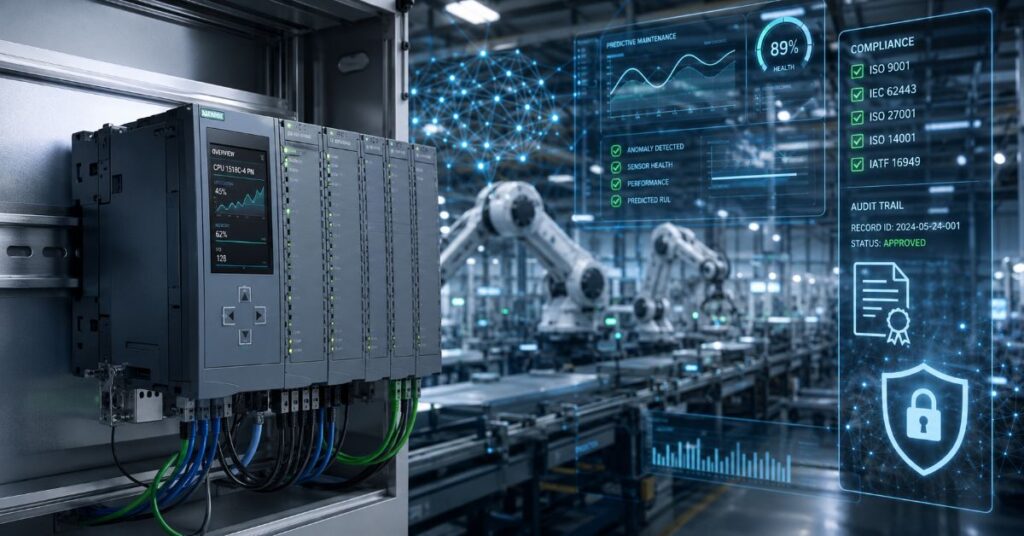
A CNC controller is the brain of a machine tool: it takes a programme, a set of cutting parameters, and a defined geometry, and translates all of that into the precise, repeatable physical movements of a spindle, cutting tool, or grinding wheel at speeds and tolerances measured in microns. Getting that right has always been a deterministic computing problem. Getting it right while simultaneously running AI workloads that analyse sensor data, detect quality deviations, and predict component wear in real time is a different order of computational challenge, one that has outpaced the hardware generations that most of the global machine tool industry is currently running on.
Siemens announced a new hardware generation for its Sinumerik One CNC control system on July 9, 2026, built specifically to address that gap. The updated platform combines significantly higher processor performance with a dedicated PLC chip and a 64-bit architecture that provides the headroom for industrial AI applications to run at the machine edge without competing with the deterministic control cycles that precision machining cannot compromise. It is also the first Sinumerik generation designed from the ground up to meet the EU Cyber Resilience Act’s hardware-level security requirements.
KEY DEVELOPMENTS
- Siemens announced a new hardware generation for its Sinumerik One CNC control system, built on NCU 1740.2 and NCU 1760.2 processors with a 64-bit architecture designed to run industrial AI workloads at the machine edge without performance compromise to core machining operations.
- A new dedicated PLC ASIC separates programmable logic controller functions from the numerical control unit, enabling high-frequency Profinet communications without interference to the deterministic interpolation cycles that precision machining requires.
- The entire new Sinumerik platform is designed to comply with the EU Cyber Resilience Act, which takes effect by end of 2027 for manufacturers selling connected products in the EU, with long-term updateability and hardware-level security mechanisms built into the architecture.
- The new hardware lays the infrastructure foundation for data-driven quality control, predictive maintenance, and real-time machining process optimisation using AI models running directly on the CNC controller rather than requiring a separate server or cloud round-trip.
What Siemens Announced
The official Siemens press release describes two new NCU processor models at the core of the update: the NCU 1740.2 and NCU 1760.2, both delivering significantly higher computing power than the previous NCU 1740 and 1760 generation. The increase is not incremental. Siemens describes the new units as providing “performance headroom for demanding applications and future expansion,” a phrase that in the context of industrial CNC systems means the ability to run concurrent workloads — AI inference, data logging, cloud connectivity, digital twin synchronisation — without borrowing cycles from the real-time motion control that defines the controller’s primary function. The 64-bit architecture is the architectural enabler: modern AI frameworks, large data processing pipelines, and the memory addressing required for meaningful edge AI inference all require 64-bit processing environments that the previous generation of Sinumerik hardware was not designed to support.
The dedicated PLC ASIC is the second significant hardware change. Previously, PLC functions — the logical programming layer that handles machine sequencing, safety interlocks, and Profinet communication with peripheral devices — shared compute resources with the NCU’s numerical control functions. The new architecture separates these entirely: the ASIC handles all PLC and Profinet workloads on dedicated silicon, while the NCU processors focus on motion control and AI applications. In highly connected production environments with dozens of peripherals communicating over Profinet, this separation produces both more stable data processing and more predictable latency for time-critical safety and control functions. A high-performance graphics processor supports modern HMI visualisation, enabling the kind of contextual operator interfaces that industrial AI applications require to be actionable rather than just informational.
The AI Integration: What Changes for Manufacturers
Edge AI Without Cloud Dependency
The practical value of the new platform for manufacturing operations is about where AI inference runs. Current AI-assisted machining typically involves one of two architectures: either AI models run on a separate edge server installed alongside the machine, or sensor data is transmitted to a cloud service for analysis with results returned to the operator or controller. Both approaches introduce latency, infrastructure cost, and potential connectivity dependencies that make real-time closed-loop AI feedback difficult. The new Sinumerik One platform is designed to run AI models directly on the CNC controller itself, using the NCU’s 64-bit processor headroom to handle inference workloads that would previously have required a dedicated server. That means quality deviation detection, predictive maintenance alerts, and machining process optimisation can operate in the same execution environment as the controller’s core functions, with data latency measured in milliseconds rather than seconds.
Data-Driven Machining
Siemens describes three specific application areas that the new hardware enables: data-driven optimisation of machining processes, improved use of machine data for quality control and process improvement, and predictive maintenance based on real-time sensor analysis. Each of these is a known value driver in advanced manufacturing. Process optimisation using cutting force data, vibration signatures, and thermal profiles can extend tool life, reduce scrap rates, and tighten dimensional tolerances. Quality control that analyses part geometry and surface finish data in real time can detect deviations before a part leaves the machine rather than after it reaches inspection. Predictive maintenance that models bearing wear, spindle condition, and coolant system health from historical and real-time sensor patterns reduces unplanned downtime, which is the most expensive form of productivity loss in precision manufacturing. The hardware is also designed for seamless connectivity to cloud and edge infrastructure, enabling manufacturers who do want to use cloud analytics to do so without replacing the controller.
The Cyber Resilience Act: Why This Is Now a Hardware Question
What the CRA Requires
The EU Cyber Resilience Act, which took effect in December 2024 and has a compliance deadline of December 2027 for manufacturers selling connected products in the EU, establishes requirements that are fundamentally different from previous cybersecurity regulations in how they reach into hardware design. Previous frameworks — NIS2, DORA, even the AI Act — primarily regulate processes, policies, and software. The CRA requires that security is built into product hardware architectures at the design stage, with specific requirements around long-term updateability, vulnerability disclosure, and the ability to maintain security properties over the product’s entire operating lifecycle. For a CNC controller that may operate on a machine tool for fifteen to twenty years, that is a genuinely demanding architectural requirement.
How Sinumerik Meets It
Siemens has designed the new Sinumerik One hardware generation to meet the CRA’s requirements through three mechanisms: increased computing power that enables security mechanisms to run without degrading machine performance, an architecture specifically engineered for long-term maintainability and update delivery, and hardware-level design choices that allow security patches and firmware updates to be applied reliably over the product’s operating lifetime. The entire Sinumerik portfolio, not just the new NCU generation, is described by Siemens as CRA-ready, which means the regulatory compliance claim extends to the broader range of products that machine tool builders configure using Sinumerik components. For machine builders who sell into the EU market, this matters commercially: a CNC controller that is not demonstrably CRA-compliant by 2027 is a controller that cannot be sold in the EU market. Siemens is positioning the new hardware generation as a forward-looking investment in regulatory readiness, not just a performance upgrade. The intersection of AI hardware requirements and cybersecurity regulation in a single product generation reflects the same convergence that is shaping the enterprise AI security picture, as documented in the Orca Security 2026 State of AI Security findings on how AI infrastructure security gaps compound as connectivity grows.
The Competitive Context
Siemens’ Sinumerik dominates the high-end CNC market in Europe and has significant share in Asia, competing primarily with FANUC, Heidenhain, and Bosch Rexroth for precision machining applications. The Sinumerik One platform was introduced in 2019 as Siemens’ “Digital Native” CNC, designed from the start with digital twin integration and cloud connectivity capabilities that older controller architectures lacked. The 2026 hardware generation is the most significant processor update to the platform since its launch, and the explicit AI-readiness positioning represents a competitive differentiation move: if Siemens can establish that Sinumerik One is the only leading CNC controller with proven edge AI inference capability and regulatory CRA compliance, it creates a product advantage that machine builders will pay a premium to access in EU and export markets where CRA compliance is a procurement requirement.
What Happens Next
Siemens has not specified pricing or availability timelines for the NCU 1740.2 and 1760.2 processors beyond describing them as available now. Machine tool builders integrating the new hardware into machine designs will have their own qualification and testing timelines, and the first production machines with the new Sinumerik generation are likely to appear at industry trade shows before the end of 2026. The AI application layer — the specific models and analytical tools that run on the new hardware’s 64-bit edge computing capability — is not specified in the launch announcement, suggesting that Siemens expects machine builders and end users to develop their own AI workloads on the platform rather than deploying Siemens-provided models. The infrastructure layer is the product; the AI value is what manufacturers build on top of it. For the broader manufacturing AI market, the Sinumerik update is one data point in a larger trend toward edge AI deployment at machine level, consistent with the growing recognition that AI’s energy and infrastructure footprint at scale makes cloud-only AI architectures increasingly uneconomical for high-frequency industrial applications, pushing compute closer to the physical processes being monitored and controlled.
Why It Matters
The Siemens Sinumerik One update is significant because it represents a leading industrial technology company making a definitive architectural commitment: the CNC controller of the next decade must handle AI inference natively, and it must handle it securely under regulatory frameworks that reach into hardware design. That combination — edge AI performance plus regulatory hardware compliance — is a harder engineering target than either alone, and Siemens reaching it with a production-ready platform establishes a design reference that competitors, machine builders, and industrial AI developers will now have to respond to. The CRA compliance angle in particular has broader implications for every category of industrial connected product sold in the EU: Sinumerik One is one of the first major industrial control system platforms to launch with explicit CRA-readiness as a product feature, and its commercial reception will be an early signal of how much premium the EU market assigns to regulatory hardware compliance as a procurement criterion.
Sources
Siemens official press release: press.siemens.com, July 9, 2026. Automation Fair, July 11, 2026. Metalworking International, July 11, 2026. EuropaWire technical specifications summary.
