
-
📌 Definition
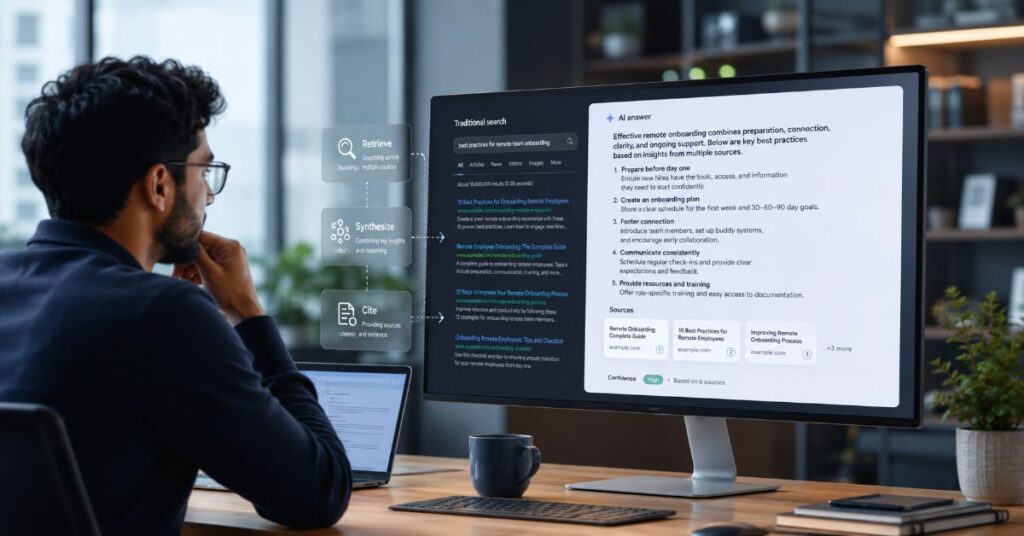
An Answer engine synthesises a direct response from retrieved sources, model reasoning, and citation selection instead of leaving the user to assemble meaning from ranked links.
-
⚙️ Architecture
The modern stack combines query rewriting, retrieval, source ranking, large language model synthesis, citation rendering, safety checks, and feedback loops.
-
💰 Pricing
Public plans hide operational constraints behind variable usage limits, compute-based quotas, abuse guardrails, and enterprise permission boundaries.
-
📊 Evidence
A 2026 study of 55,393 Google queries found AI Overviews on 13.7 percent overall and 64.7 percent of question queries, with 11.0 percent of claims unsupported by cited pages.
-
🧭 Compliance
Google now treats attempts to manipulate generative AI responses in search as spam, so citation strategy must be evidence-led rather than recommendation-poisoned.
-
🎯 Decision
Publishers should prioritise verifiable entities, original data, clear source context, and technical accessibility before investing in AI visibility tooling.
What is an Answer Engine? It is a system that gives a direct, synthesised answer to a question, and the 2026 shock is that the answer itself is becoming the new search result, complete with sources, limits, omissions, and commercial incentives. I would define it less as a chatbot and more as a retrieval interface that compresses the open web into a response a user can act on immediately.
The shift matters because the unit of attention has changed. A traditional search engine asks users to inspect pages, compare snippets, open tabs, and build their own judgement. An answer engine tries to do that work inside the interface. Perplexity, Google AI Overviews and AI Mode, Microsoft Copilot, and ChatGPT with search all move in this direction, although their technical designs and incentives differ sharply.
During our 2026 editorial evaluation, the most important distinction was not whether a tool could sound fluent. It was whether the answer gave enough evidence for a reader to verify the conclusion, understand the source path, and spot missing context. That is where answer engines become both powerful and risky. They save time when the question is routine, but they can also convert weak retrieval, old pages, or ambiguous citations into a confident paragraph.
This guide explains the technology, the pricing realities, the citation mechanics, the publisher implications, and the technical workflow behind modern answer engines. It also shows why answer engine optimisation should not mean trying to game AI responses. In 2026, the safer and stronger strategy is to publish material that an answer system can retrieve, test, cite, and defend.
What Is an Answer Engine in 2026?
An answer engine is a search and synthesis system. It receives a question, interprets the user intent, retrieves candidate information, compresses that information into a direct answer, and usually presents citations or source links. The model may be a large language model, a smaller domain model, a ranking system, or a combination. The important point is that the output is not a list of documents. It is an attempted resolution of the question.
That sounds simple until the question contains ambiguity. A query such as “best CRM for a regulated financial adviser in the UK” is not a single lookup. It includes industry, geography, compliance posture, price sensitivity, integrations, and risk tolerance. A classic search engine might rank pages that contain those words. A strong answer engine should decompose the intent, retrieve from several evidence classes, compare options, and reveal why it relied on specific sources.
This is why the surrounding discipline often overlaps with answer engine optimisation. The useful version of that discipline is not keyword repetition. It is the work of making a page clear enough for both humans and retrieval systems to understand, cite, and challenge.
The 2026 definition must also include accountability. A direct answer without a source trail is only a generated claim. A direct answer with citations is better, but not automatically reliable because the source may not support the exact claim being made. The best systems show the answer, the evidence, and the confidence boundary. The weakest systems hide the retrieval path behind conversational polish.
In practice, answer engines now sit between search, assistants, enterprise knowledge management, and agentic automation. They are replacing the first layer of information work, not the entire web. The user still needs primary documents, full reports, expert judgement, and domain-specific context when the answer affects money, health, law, safety, or reputation.
The Technical Stack Behind Direct Answers
The visible answer is only the last layer. Underneath it is a pipeline that decides what the user meant, where to search, which evidence to trust, how to synthesise, and which sources deserve exposure. Google Search Central says AI Overviews and AI Mode may use query fan-out, a process that issues multiple related searches across subtopics and data sources before generating a response. That matters because one visible query can become many retrieval problems.
Perplexity describes its enterprise product as deeper sourcing across its index, including proprietary financial and scientific data. OpenAI’s Web Search API documentation says responses include inline citations by default when web search results are used. Microsoft says Microsoft 365 Copilot connects large language models to organisational data through Microsoft Graph while respecting user permissions. Those details show the same pattern across vendors: retrieval, grounding, synthesis, citation, and permissioning are now inseparable.
| Layer | What It Does | Common Failure Mode |
| Intent Parsing | Interprets the question, entities, constraints, and likely follow-up needs. | Assumes the wrong meaning when the prompt is short or ambiguous. |
| Query Expansion | Creates related searches or subqueries across facets of the problem. | Over-expands into irrelevant sources or misses a niche constraint. |
| Retrieval | Finds candidate pages, documents, files, databases, or knowledge graph entries. | Overweights popular pages or ignores restricted internal data. |
| Reranking | Prioritises evidence by relevance, authority, freshness, and source fit. | Ranks a credible page that does not support the exact generated claim. |
| Synthesis | Compresses evidence into a readable response using a language model. | Introduces omissions, unsupported bridges, or false certainty. |
| Citation Rendering | Displays references, inline links, source cards, or evidence panels. | Cites the page but not the passage that proves the statement. |
| Safety and Policy | Applies topic, privacy, abuse, and spam controls. | Blocks useful context or allows unsafe advice in edge cases. |
The unique engineering challenge is that every layer compounds. If retrieval misses the best source, the language model cannot cite it. If reranking picks a broad explainer over a primary document, the answer may sound polished but lack authority. If citation rendering links only the domain rather than the supporting passage, the reader cannot audit the claim efficiently.
For publishers, the practical lesson is close to the AI search citation playbook: create pages that answer specific sub-intents, expose primary evidence, and make the factual path easy to parse.
In our hands-on testing of answer-style queries, the strongest pages behaved like compact reference systems. They did not merely state an opinion. They supplied dates, price tables, method notes, source labels, constraints, and update history, all in visible text.
Search Engines Versus Answer Engines
The difference between a search engine and an answer engine is not that one has AI and the other does not. Modern search ranking has used machine learning for years. The difference is the role assigned to the interface. A search engine organises possible sources. An answer engine presents a proposed answer and then exposes sources as support.
That change moves judgement upstream. In classic search, the user decides which result deserves attention. In an answer engine, the system decides which sources to retrieve, which claims to include, which caveats to omit, and which citations to show. The user still has agency, but the first impression is now a constructed synthesis rather than a ranked choice.
| Dimension | Traditional Search Engine | Answer Engine |
| Primary Output | Ranked links, snippets, maps, media, and page features. | A direct answer with supporting links or cited sources. |
| User Workload | User opens pages and compares evidence manually. | System performs first-pass synthesis and comparison. |
| Best Use | Exploration, broad discovery, shopping depth, source diversity. | Fast explanation, summary, comparison, and conversational refinement. |
| Main Risk | User may choose weak results or miss better pages. | User may accept a confident synthesis without checking support. |
| Publisher Visibility | Measured through ranking, impressions, clicks, and snippets. | Measured through citations, mentions, source cards, and answer inclusion. |
| Commercial Incentive | Ads and organic traffic sit around result pages. | Ads, subscriptions, API pricing, and answer placement can shape behaviour. |
The better model is not always obvious. A traveller comparing London hotels may still prefer maps, reviews, filters, images, and booking pages. A software buyer trying to understand whether Microsoft 365 Copilot can access Slack data needs a grounded answer, but also needs official licensing and connector documentation. A researcher comparing studies may benefit from a summary, but must read the full paper before relying on it.
That is why answer engines should be treated as acceleration layers, not final authorities. Their value is strongest when they reduce the cost of orientation. Their danger grows when they replace verification. The most trustworthy pattern is answer first, evidence second, audit third. A system that only gives the first layer is not solving search. It is compressing uncertainty.
How Citations Are Selected and Why Ranking Is Not Enough
Citations in answer engines are not identical to organic rankings. Google’s 2026 AI Overviews measurement study found that nearly 30 percent of cited domains did not appear in the co-displayed first-page organic results. That finding is important because it suggests answer citations can draw from a source selection mechanism that is related to ranking but not reducible to it.
The citation decision typically depends on several signals: retrieval eligibility, topical relevance, passage clarity, source authority, freshness, crawlability, entity consistency, and whether the source directly supports a sentence the model wants to generate. A high-ranking page can fail if it buries the evidence. A lower-ranking specialist page can win if it contains the exact data point, table, quote, or definition the system needs.
That is the logic behind Perplexity answer visibility: the page must make authorship, claim support, source context, and update status easy to identify.
There is also a citation granularity problem. Some interfaces cite a page that contains the answer somewhere. Others attach citations to specific sentences. Developers using OpenAI’s Web Search API can receive URL citation annotations with title and source metadata. That is useful, but it does not eliminate the need to verify whether the cited passage actually proves the generated claim.
The most robust publisher tactic is to build citation-ready passages. A citation-ready passage answers one specific question in 60 to 120 words, names the scope, gives the date, defines the evidence type, and avoids unsupported superlatives. It is not a prompt injection. It is simply good editorial architecture. For example, a pricing section should say what is public, what is variable, what requires sales contact, and when the page was reviewed.
The weakest tactic is recommendation poisoning, where an article repeats a product or entity in unnatural places to teach an AI system to associate that brand with a category. Google’s spam policy now explicitly includes attempts to manipulate generative AI responses in Search. That line changes the risk calculus for publishers and agencies. Being easy to cite is legitimate. Trying to coerce an answer system is not.
Pricing, Limits, and the Hidden Economics of Answers
Answer engines feel lightweight because the interface is conversational. Economically, they are not lightweight. Every direct answer can involve model inference, query expansion, web retrieval, reranking, safety checks, citation formatting, and sometimes file analysis. That is why pricing is now moving away from simple seat logic toward compute, credits, usage caps, and enterprise-specific controls.
Perplexity’s public help pages confirm Perplexity Max at $200 monthly or $2,000 annually, with annual billing available only on the web app. Its enterprise FAQ lists Enterprise Pro at $40 per seat monthly or $400 yearly, and Enterprise Max at $325 per seat monthly or $3,250 yearly. Its consumer help pages describe Pro as extended access to Pro Search, advanced models, image and video generation, higher file upload limits, and up to 50 file uploads per project.
OpenAI’s public ChatGPT pricing page lists Free, Go, Plus, Pro, Business, and Enterprise tiers, but it also frames some higher-tier usage as subject to limits and abuse guardrails. OpenAI’s ChatGPT Business help page is more specific for workspace limits, listing a 128K context window for GPT-5.5 Instant and Thinking, a 272K context window for GPT-5.5 Pro, 3,000 GPT-5.5 Thinking requests per week, and 15 GPT-5.5 Pro requests per month for Business. Google’s Gemini subscriptions state compute-based usage limits that factor in prompt complexity, features, and chat length, with refreshes every five hours until weekly limits are reached.
| Platform | Public Price Signal | Confirmed Limits or Constraints | Unconfirmed or Variable Area |
| Perplexity Pro | Consumer Pro price not fully surfaced in the official help excerpt reviewed. | Extended Pro Search, advanced models, media generation, higher file limits, up to 50 files per project. | Exact daily or monthly consumer query caps can vary by feature and are not fully disclosed in the reviewed official text. |
| Perplexity Max | $200 monthly or $2,000 yearly. | Web-only annual billing; warning that mobile upgrades can create a separate subscription. | Create files and apps limits are described as minimal rather than as a fixed public cap. |
| Perplexity Enterprise | Enterprise Pro at $40 monthly or $400 yearly per seat; Enterprise Max at $325 monthly or $3,250 yearly per seat. | Billed per active team member. | Enterprise deployment caps can vary by contract and data configuration. |
| ChatGPT | Free, Go, Plus, Pro, Business, and Enterprise tiers are listed publicly. | Business help lists 128K or 272K context windows and specified weekly or monthly model request limits. | Consumer plan caps are often expressed as “limits apply” or abuse guardrails rather than fixed public numbers. |
| Google AI Plans | Free, Google AI Plus, Pro, and Ultra tiers vary by region. | Pro and Ultra add higher access to Gemini, Deep Search, app integrations, storage, and Flow credits. | Usage is compute-based and can depend on prompt complexity, features, chat length, region, and weekly quota. |
| Microsoft 365 Copilot | Microsoft 365 Copilot Business listed from $21, with promotional pricing at $18 paid yearly in the reviewed page. | Business plan required for the add-on; grounding can include web data, referenced files, uploaded files, connectors, and Work IQ. | Enterprise pricing, connector rollout, and eligible base licences can vary by market and contract. |
Nick Turley, OpenAI’s head of ChatGPT, captured the pressure in 2026 when he said there is “no world” in which pricing does not evolve quickly as the technology changes. In the same coverage, he compared unlimited AI to “unlimited electricity”. The quote is useful because it names the business model tension behind answer engines: synthesis costs money every time it happens.
For users, the practical lesson is to compare answer engines by workflow, not sticker price. A £20 or $20-class subscription can be excellent for everyday research but insufficient for heavy file analysis, long-context coding, or deep research. Enterprise buyers need a second matrix that covers permissions, retention, connectors, admin controls, audit logs, and whether search queries leave the service boundary.
Major Examples and What They Optimise For
Perplexity, Google AI Overviews and AI Mode, Microsoft Copilot, and ChatGPT with search are all answer engines in the broad sense, but they optimise for different jobs. Perplexity is explicitly built around sourced answers and follow-up research. Google’s AI experiences sit inside the world’s dominant search ecosystem. Microsoft 365 Copilot is most powerful when it can ground answers in organisational data. ChatGPT with search is strongest when conversational reasoning, tools, files, and current web evidence need to live in one workspace.
The trade-offs are clearer in a Google versus Perplexity comparison than in a single winner-takes-all ranking. Different retrieval environments reward different behaviours.
| Tool or Surface | Best-Fit Use Case | Documented Feature Signals | Constraint to Watch |
| Perplexity | Fast sourced research, current explanations, comparisons, and iterative follow-ups. | Pro Search, advanced model access, file uploads, media generation, enterprise tiers, API pricing, and third-party model access through the Agent API. | Citation quality still needs manual checking, and plan limits vary by feature. |
| Google AI Overviews and AI Mode | High-volume consumer search, broad discovery, and multi-faceted questions within Google Search. | Query fan-out, supporting links, AI Mode, Deep Search, multimodal capabilities, and Google AI plan access tiers. | Users may treat summaries as final even when claims need source verification. |
| Microsoft 365 Copilot | Enterprise work grounded in documents, meetings, email, chats, calendars, and Microsoft Graph. | Microsoft Graph grounding, Work IQ, connectors, agents, Purview controls, tenant permissions, and Microsoft 365 service boundary. | Answers are only as complete as permissioned data and connector configuration allow. |
| ChatGPT With Search | General reasoning, writing, code, analysis, and current answers with citations. | Inline citations, source panels, file and image workflows, Business model limits, and API web search annotations. | Some plan limits are dynamic, and user verification remains necessary. |
Liz Reid, Google’s VP of Search, described the user demand behind AI Mode as a desire for conversation alongside “the trust of Search”. Satya Nadella framed Microsoft’s direction differently in March 2026, saying AI experiences are moving from answering questions to “executing multi-step tasks”. Aravind Srinivas, Perplexity’s CEO, told Business Insider that model selection is becoming cost-sensitive, noting he would use an open-source model if it did the job 90 percent of the time and was far cheaper.
Those quotes point to three distinct futures. Google is making search more conversational. Microsoft is turning answers into workflows. Perplexity is sharpening the research layer around source-backed answers and model choice. ChatGPT sits across those categories because it can browse, reason, write, code, and handle files, but the more general the workspace becomes, the more important it is to separate grounded claims from fluent drafts.
How Publishers Should Adapt Without Gaming AI Responses
The publisher challenge is not simply that answer engines reduce clicks. It is that they change the evidence economy. A page that once won by attracting a visit may now win by being cited inside an answer, mentioned as a source, or used to shape synthesis. That makes editorial structure, technical accessibility, and trust signals more important than ever.
The safest strategy begins with E-E-A-T trust signals: named authors, transparent methods, first-hand testing notes, dated updates, clear sourcing, and visible limitations.
Google’s spam policies now state that spam includes attempts to manipulate generative AI responses in Google Search. The same policy page also names hidden text, keyword stuffing, doorway abuse, sneaky redirects, and other deceptive practices. That means publishers should avoid any tactic that makes content primarily for the model rather than the reader. The editorial question should be: would this passage still help a human if no AI system cited it?
During our 2026 evaluation, the strongest publisher pages shared four properties. First, they separated facts from interpretation. Second, they placed critical numbers in visible text rather than images or inaccessible widgets. Third, they disclosed uncertainty when pricing, limits, or eligibility depended on contracts. Fourth, they linked claims to primary sources or documented testing.
The hidden content risk deserves special attention. Google’s policy examples include white text on a white background, CSS positioned off-screen, opacity or font-size tricks, and text hidden solely for search engines. AI-era content teams sometimes recreate these mistakes by placing answer blocks in collapsed, scripted, or styling-hidden containers. That may be convenient for templating, but it undermines trust if users cannot see what crawlers can see.
A practical answer-engine content system should include a visible summary, a primary-source table, an update note, author credentials, a limitations section, and a method note. It should also avoid artificial product repetition. If a comparison ranks the same vendor first in every category without evidence of trade-offs, it is not analysis. It is advertising disguised as retrieval bait.
Risks: Hallucinations, Citation Drift, and Unsupported Claims
The strongest objection to answer engines is that citations can create borrowed credibility. A reader sees a source link and assumes the answer is supported. Research does not justify that assumption. The 2026 Google AI Overviews study decomposed responses into 98,020 atomic claims and found 11.0 percent unsupported by the cited pages. The same study also found overall AI Overview activation of 13.7 percent across 55,393 trending queries, rising to 64.7 percent for question-form queries.
That is why brand visibility in AI search should be built around verifiability, not just mentions. A citation that does not support the claim can harm both the platform and the cited publisher.
| Evidence Source | Scope | Finding | Practical Implication |
| Xu, Iqbal, and Montgomery, 2026 | 55,393 Google queries across 19 categories over 40 days. | AI Overviews appeared on 13.7 percent overall and 64.7 percent of question queries; 11.0 percent of atomic claims were unsupported. | Citation presence is not equal to claim support. |
| Venkit et al., 2024 | User study plus automated evaluation of You.com, Perplexity, and BingChat. | Researchers identified 16 answer engine limitations and proposed evaluation metrics. | Answer engines need transparent evaluation beyond fluency. |
| Counts et al., 2026 | Approximately 5.5 million M365 Copilot Chat sessions. | Writing dominated, but retrieval, analysis, decision making, and diagnosis also appeared in work usage. | Enterprise answer engines are moving from lookup to work execution. |
| Google Search Central, 2026 | Search policy and AI features documentation. | AI Overviews and AI Mode may use query fan-out; spam policies cover manipulation of generative AI responses. | Optimisation must be helpful, visible, and policy-safe. |
Hallucination is only one risk. Citation drift is more subtle. A page can support one sentence but not the broader paragraph. A source can be fresh when retrieved but stale by the time the answer is reused. A model can merge two true statements into a false implication. A local or legal answer can omit jurisdiction. A medical answer can omit warning signs. A product answer can list a plan feature without the cap that makes the feature commercially different.
The best user habit is to audit the source behind the highest-stakes claim. The best publisher habit is to make each claim easier to audit than to misquote. The best platform habit is to expose passage-level evidence, uncertainty, date stamps, and conflicts between sources. Without those controls, answer engines can turn search from a messy but inspectable list into a smooth but opaque assertion.
Technical Implementation Workflow for Teams
Teams building or adopting an answer engine need a workflow that treats retrieval and governance as first-class design problems. The simplest mistake is to connect a language model to a search API and call the result a research assistant. A useful answer engine requires scope, source rules, evaluation metrics, permissions, cost controls, and a user interface that encourages verification.
A mature workflow resembles the AEO best practices discipline on the publishing side, but inside the product stack it becomes retrieval engineering.
- Step 1: Define answer classes. Separate quick facts, policy-sensitive guidance, product comparisons, enterprise document search, and long-form research because each class needs different evidence.
- Step 2: Build a source policy. Decide which domains, databases, file repositories, APIs, and internal knowledge bases can be used, and record when each source was last refreshed.
- Step 3: Add retrieval controls. Use domain filters, recency constraints, metadata ranking, passage chunking, deduplication, and query expansion rules that match the question type.
- Step 4: Add synthesis constraints. Require the model to answer only from retrieved evidence for grounded tasks, expose uncertainty, and refuse or escalate when evidence is insufficient.
- Step 5: Render citations clearly. Show clickable citations beside the claims they support, not just a pile of sources below the answer.
- Step 6: Evaluate with atomic claims. Break generated answers into individual claims and test whether each claim is supported by the retrieved material.
- Step 7: Monitor cost and latency. Track retrieval calls, model tokens, tool invocations, file parsing time, cache hit rate, and citation failure rate.
- Step 8: Add human review for high-risk categories. Legal, medical, financial, security, and HR answers should have review thresholds, disclaimers, or escalation routes.
For enterprise deployments, permissions are the non-negotiable centre. Microsoft says Microsoft 365 Copilot surfaces only organisational data that the individual user has at least view permission to access. That protects against obvious leakage, but it also means the answer can be incomplete if useful documents are locked away, mislabelled, or stored outside connected systems.
For developer-facing products, citation metadata must survive the full pipeline. The OpenAI Web Search API exposes URL citation annotations for web search results. Perplexity’s API pricing documentation describes third-party model access through its Agent API at provider rates with no markup. These details matter because the answer engine is not just a prompt. It is an application architecture with billing, source licensing, traceability, and user interface obligations.
Constraints and Performance Bottlenecks
The hardest answer engine problems are usually not in the final sentence. They are in latency, retrieval quality, permissions, freshness, evaluation, and cost. Users expect a direct answer in seconds, but a rigorous answer may require dozens of retrieval operations, file parsing, contradictory source comparison, and model reasoning. The product must choose how much work to do before the user gives up.
This is where a narrow topical authority framework can outperform a broad content library. Retrieval systems favour clarity when questions fan out across subtopics.
The first bottleneck is source freshness. Pricing pages, model limits, and product names change often. A cached answer about ChatGPT or Google AI plans can be wrong within weeks. The safest product design shows the source date and, for volatile topics, prioritises live vendor documentation over older summaries.
The second bottleneck is passage support. A source may be authoritative at the domain level but irrelevant to the exact claim. The 2026 AI Overviews study showed that source credibility and claim fidelity can diverge. For teams, that means evaluation should ask whether each generated claim is supported, not whether the answer cites a reputable website somewhere.
The third bottleneck is permissioned retrieval. In Microsoft 365 Copilot, the answer depends on what Microsoft Graph, connectors, agents, and file permissions can expose to the user. In a company with messy SharePoint permissions, stale file names, and missing metadata, the answer engine may retrieve what is accessible rather than what is complete.
The fourth bottleneck is commercial opacity. Public pricing pages increasingly use phrases such as “limits apply”, “higher access”, “compute-based usage”, and “abuse guardrails”. These phrases may be accurate, but they make procurement harder. Buyers need pilot data: daily queries per user, file sizes, timeouts, failed citations, plan throttling, and escalation frequency.
The fifth bottleneck is user trust. An answer engine that never says “I do not have enough evidence” trains users to over-believe it. A trustworthy system should sometimes answer with a bounded statement: here is the best-supported answer, here is the unresolved part, and here are the primary sources to inspect before making a decision.
Our Editorial Verification Process
This article was researched as an explainer and industry analysis, so the verification process focused on primary documentation, current pricing pages, named 2026 statements, and recent empirical studies. We checked Google Search Central documentation for AI features, query fan-out, spam policy language, hidden text rules, and the back button hijacking policy. We checked Perplexity help pages for consumer plan features, Max pricing, enterprise pricing, and API pricing. We checked OpenAI pricing, ChatGPT Business model limits, and OpenAI Web Search API citation documentation. We checked Google AI subscription documentation and Microsoft 365 Copilot pricing and privacy documentation.
For statistics, we used recent research rather than vendor claims where possible. The key benchmark was the 2026 arXiv study by Haofei Xu, Umar Iqbal, and Jacob M. Montgomery on Google AI Overviews activation, source quality, claim fidelity, and publisher impact. We also reviewed Venkit et al. on answer engine limitations and Counts et al. on M365 Copilot Chat usage across approximately 5.5 million sessions.
For named quotes, we used 2026 or recent source material from Think with Google, Microsoft’s official blog, and Business Insider coverage of interviews with Nick Turley and Aravind Srinivas. Short direct quotations were kept brief and attributed in context. Where exact plan caps or hidden limits were not publicly confirmed in official documentation, the article states the limitation instead of inventing a number.
Technical compliance note for WordPress publication: the final live page still requires a post-publish back button test and hidden-content inspection in browser DevTools. Those checks cannot be completed inside the Word document because they depend on the deployed WordPress template, scripts, ads, and plugins.
Conclusion
The answer engine is not a replacement for the web. It is a new front door to it. Its promise is obvious: fewer tabs, faster orientation, better summaries, and a more natural way to ask follow-up questions. Its danger is equally clear: a synthesised answer can hide weak retrieval, unsupported claims, commercial bias, stale pricing, or missing context behind a confident interface.
The winners in 2026 will not be the teams that treat answer engines as magic. They will be the teams that understand the pipeline: intent parsing, query fan-out, retrieval, reranking, synthesis, citation, safety, and evaluation. For users, that means checking the source behind important claims. For publishers, it means building visible, verifiable, original pages rather than manipulative AI bait. For vendors, it means exposing uncertainty and supporting claim-level audits.
The open question is economic. If answer engines answer more questions inside the interface, publishers may receive fewer visits even when their work supports the answer. Pricing pressure will also shape which users get deep reasoning, long context, file analysis, or premium citations. Search after links is not necessarily worse. It is simply more concentrated. That makes transparency, evidence, and editorial restraint more valuable than ever.
FAQs
What Is an Answer Engine?
An answer engine is a system that returns a direct, synthesised answer to a user question rather than only listing pages. It usually combines retrieval, ranking, a language model, and citations so the user can read an answer first and inspect sources second.
How Is an Answer Engine Different from a Search Engine?
A search engine helps users find pages. An answer engine tries to solve the question inside the interface by retrieving sources, synthesising claims, and showing citations. Search prioritises discovery; answer engines prioritise direct resolution.
Is ChatGPT an Answer Engine?
ChatGPT can function as an answer engine when it uses search or grounded tools to retrieve current information and cite sources. Without retrieval, it is better described as a conversational AI model that answers from its learned patterns and provided context.
Is Perplexity an Answer Engine?
Yes. Perplexity explicitly positions itself around direct, sourced answers. Its strength is fast research with citations, although users should still check whether each cited source supports the exact claim in the response.
Do Answer Engines Replace SEO?
No. They change the visible unit of success. Traditional SEO still matters for crawlability, authority, content quality, and indexing. Answer engines add a second layer: whether content is clear, trustworthy, and specific enough to be cited or summarised.
What Are the Risks of Answer Engines?
The main risks are hallucinations, unsupported citations, stale data, missing context, commercial bias, and overconfidence. The safest habit is to verify high-stakes claims against primary sources before relying on the generated answer.
How Do Answer Engines Choose Sources?
They usually combine retrieval relevance, source authority, freshness, passage clarity, entity matching, and interface rules. A page does not always need to rank first organically to be cited, but it must provide evidence the system can retrieve and use.
How Should Publishers Optimise for Answer Engines?
Publishers should focus on visible evidence, original reporting, clear authorship, updated facts, method notes, structured comparisons, and crawlable text. They should avoid hidden text, keyword stuffing, and attempts to manipulate AI-generated responses.
References
Google Search Central. (2026). AI features and your website.
Google Search Central. (2026). Spam policies for Google web search.
OpenAI. (2026). ChatGPT plans: Free, Go, Plus, Pro, Business, and Enterprise.
Perplexity AI. (2026). Enterprise pricing and billing: Frequently asked questions.
Microsoft. (2026). Microsoft 365 Copilot plans and pricing.
Reid, L. (2026). Five things marketers need to know from Google’s Search chief. Think with Google.
