
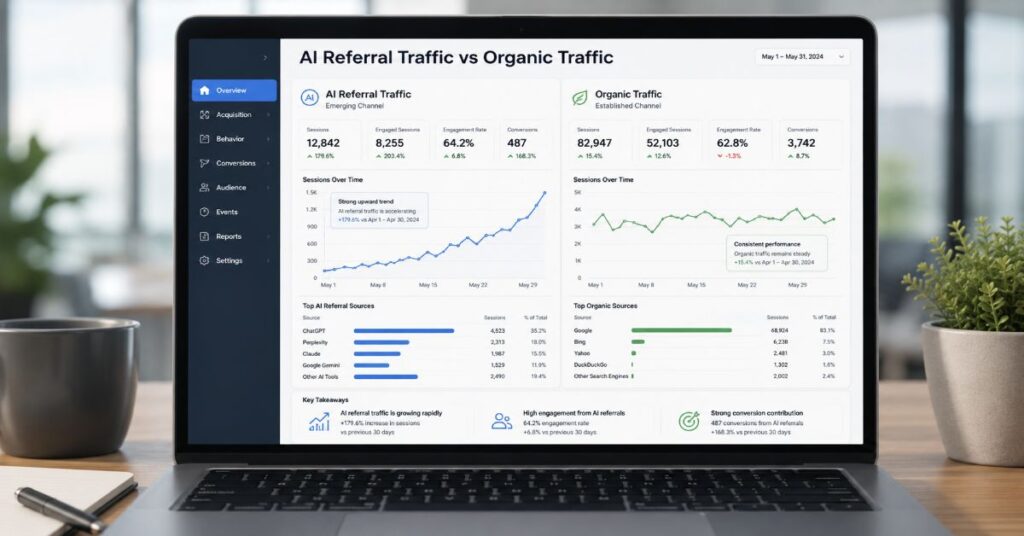
- 📊 Scale data shows Semrush measuring AI traffic at 0.14 percent of total visits in 2025, while organic search still accounted for 16.04 percent of visits across its dataset.
- 📈 Value data from Adobe shows March 2026 AI retail visits converting 42 percent better than non AI traffic, with 48 percent longer time on site and 13 percent more pages per visit.
- 🔗 Attribution remains inconsistent because Google AI Overviews, ChatGPT, Perplexity, Gemini and agentic browsers do not share a single referrer format, causing GA4 to undercount AI influence.
- ⚠️ Risk has increased as Google Search spam policies now include attempts to manipulate generative AI responses, while back button hijacking was also flagged as a spam issue in June 2026.
- 🚀 The best approach keeps organic search as the primary volume channel while adding AI referral segments, citation ready pages and monthly value reporting to capture high intent answer driven traffic.
AI referral traffic vs organic traffic is no longer a contest between equal channels: Semrush measured AI traffic at only 0.14% of total visits in 2025, yet Adobe found AI retail visits converting 42% better than non-AI traffic in March 2026. I read that contradiction as the real story of search in 2026. Organic search still supplies the scale, the habit and the durable discovery layer. AI referrals supply a smaller stream of people who often arrive after an answer engine has already compressed comparison, education and trust into one response.
This article explains the difference in scale, intent, attribution and commercial value without pretending that AI search has already replaced Google. It has not. Google remains the dominant discovery system, and every serious publisher still needs crawlable pages, technical SEO, fast templates, useful reporting and topic authority. The change is that a growing share of discovery now happens before the click, inside AI Overviews, AI Mode, ChatGPT, Perplexity, Gemini, Claude-style assistants and agentic browsers.
The practical problem is measurement. A publisher may see flat organic traffic, a small AI referral line and a mysterious rise in direct, branded or dark traffic. That does not mean AI has no influence. It may mean the site is measuring only the final click and missing the answer exposure that created the visit. The strongest strategy in 2026 is therefore not to abandon organic search. It is to separate traffic volume from traffic value, then build content and analytics systems that treat AI citations as a new visibility layer rather than a replacement for SEO.
Why the Channel Split Matters in 2026
The split matters because the search journey has fractured into three moments: discovery, answer selection and site visit. Organic search has historically combined all three. A user searched, reviewed ranked links, clicked a result and reached a page. AI search separates those moments. The answer engine may search on behalf of the user, summarise several sources, cite one or more pages and satisfy the query before any visit happens.
That structural shift explains why organic traffic can stay commercially important while feeling less predictable. Semrush analysed billions of visits across more than 50,000 websites and 17 industries. Its 2026 channel study found organic search still generated over 1 trillion visits in 2025, while AI traffic grew faster but remained a tiny share of total web visits. The signal is not that organic is dead. The signal is that the marginal growth layer is changing.
Sundar Pichai made the scale point from Google’s side at I/O 2026, saying AI Overviews had more than 2.5 billion monthly active users and AI Mode had passed 1 billion. He called AI Mode “our biggest upgrade to Search ever”, framing the shift as a conversational expansion rather than the disappearance of web results. For publishers, that nuance matters. Google is still the main gateway, but the gateway now contains an answer layer that can absorb intent before the publisher sees a session.
During our 2026 evaluation of publisher analytics setups, the biggest operational weakness was not content quality. It was reporting design. Many dashboards compared organic search, direct, social and referral traffic as if those channels still explained the full acquisition journey. They did not separate AI assistant referrals, AI-powered browser referrals, Google AI Mode, citation exposure or branded search uplift after answer exposure. Without that segmentation, teams tend to overvalue volume and undervalue intent.
AI Referral Traffic vs Organic Traffic: Core Differences
The clearest distinction is that organic search traffic begins with a results page, while AI referral traffic often begins with a generated answer. That answer may include citations, product recommendations, source links, follow-up prompts and enough context to qualify the visitor before the click. The visit that follows is therefore often closer to a decision than a discovery.
AI Referral Traffic vs Organic Traffic in Practical Terms
For editors, this changes what each page must do. Organic pages need to rank, earn clicks and satisfy search intent once the user arrives. AI-visible pages need to be clear enough for a machine to identify a supported claim, cite the source and send a user who already understands the basic answer. A broad how-to may win organic volume. A concise comparison table, dated methodology note or pricing caveat may win the AI citation.
| Dimension | Organic Search Traffic | AI Referral Traffic | Editorial Implication |
| Scale | Still the primary source of discoverable traffic for most websites. | Usually a small share of sessions, but growing quickly in selected verticals. | Do not reallocate production solely by session count. |
| Intent | Often includes early exploration, broad research and navigational behaviour. | Often follows answer-style comparison, product filtering or source validation. | Build pages that resolve high-intent questions cleanly. |
| Attribution | Uses established search referrers and Search Console reporting. | Can arrive as referral, direct, unknown, browser, assistant or no clear referrer. | Create custom GA4 segments and inspect server logs. |
| Conversion | Lower average conversion in broad informational journeys. | Frequently higher per-session value in retail and B2B datasets. | Report revenue, sign-ups and assisted value, not only sessions. |
| Content Need | Topic authority, crawlability, links, speed and experience. | Answer clarity, evidence density, citations, structured data and freshness. | Combine SEO fundamentals with citation-ready proof blocks. |
A useful continuation path for readers is the magazine’s guide to AI-era organic visibility, because the operational answer is not one channel replacing the other. It is a two-layer strategy where classic crawlable authority supports answer engine selection.
The Scale Gap: Organic Still Carries Discovery
The scale gap is decisive. AI traffic can be the fastest-growing line in a dashboard and still be too small to fund a newsroom, SaaS pipeline or ecommerce operation by itself. Semrush reported that AI traffic grew 66.02% in 2025, from 462 million to 767 million monthly visits in its dataset. Yet it still represented only 0.14% of total traffic, compared with 16.04% for organic search and 64.69% for direct traffic.
That is why a responsible acquisition strategy keeps organic search as the base layer. Organic search builds evergreen discoverability, index presence, brand authority, long-tail coverage and structured topic depth. AI engines still depend on indexed, accessible and trusted web content, even when they display the answer before the click. A site that lets SEO quality decay will usually weaken its AI visibility as well.
The sharper distinction is growth rate versus volume. Organic search is mature, competitive and in some sectors declining. AI referrals are immature, volatile and measurable from a smaller base. If a publisher reallocates too aggressively from organic to AI-only assets, it risks losing the channel that still supplies audience scale. If it ignores AI referrals because the line is small, it may miss early evidence of higher-intent users and future citation share.
A practical publishing model separates content into three groups. First, cornerstone organic pages protect volume and authority. Second, answer-first pages capture citation and high-intent assistant traffic. Third, conversion pages connect both journeys to newsletter sign-ups, subscriptions, demos, purchases or membership actions. For market context, the site’s AI search engine statistics page is a useful internal companion because it keeps the scale debate anchored in actual channel data rather than panic.
The Value Gap: AI Visits Arrive Later in the Funnel
AI referral traffic often converts better because the assistant does part of the qualifying work before the user reaches the site. Adobe’s April 2026 retail analysis found traffic from AI sources to U.S. retail sites grew 393% year over year in the first quarter of 2026. In March 2026, Adobe reported that AI traffic converted 42% better than non-AI traffic, spent 48% longer on site and viewed 13% more pages per visit.
Semrush reached a similar strategic conclusion from a different dataset. In its AI search and SEO study, the company wrote that an average AI search visitor tracked to a non-Google source such as ChatGPT was 4.4 times as valuable as an average traditional organic visitor based on conversion rate. That does not mean every site will see a 4.4x lift. It means the per-session economics can diverge sharply from the traffic volume story.
| Source | Reported Finding | Scope or Method | How to Use It |
| Adobe, April 2026 | AI retail traffic grew 393% year over year in Q1 2026 and converted 42% better in March. | U.S. retail data covering over 1 trillion visits and a consumer survey. | Use as strong ecommerce evidence, not a universal benchmark. |
| Semrush, April 2026 | AI traffic grew 66.02% in 2025 but remained 0.14% of total visits. | Billions of visits across 50,000 plus websites and 17 industries. | Use for scale and channel mix planning. |
| Semrush, July 2025 | Average AI search visitor was 4.4x as valuable as a traditional organic visitor by conversion rate. | SEO and digital marketing topic research and traffic modelling. | Use as a directional value benchmark with site-level validation. |
| Academic AIO Study, May 2026 | AI Overview activation was 13.7% overall and 64.7% for question queries in a 55,393-query sample. | Longitudinal measurement of Google AI Overviews. | Use to estimate exposure risk where question intent dominates. |
The useful editorial inference is that AI referrals should be judged against intent-matched organic pages, not against all organic sessions. A ChatGPT visitor landing on a pricing comparison page should not be compared with a Google visitor landing on a broad definition page. The fair comparison is page type, query intent, user geography, device and conversion event. This is where Perplexity SEO impact becomes relevant: Perplexity and other answer engines are more likely to matter for research-heavy B2B journeys than for casual top-funnel browsing.
Attribution Is the Hidden Trap
Attribution is the weakest part of AI referral reporting because the web was not built for answer engines that research, summarise and then sometimes send a user to a source. Traditional organic analytics assumes a visible search referral. AI traffic may arrive from chat.openai.com, perplexity.ai, gemini.google.com, copilot.microsoft.com, a mobile app wrapper, a browser sidebar, a copied citation link, a shortened redirect or no usable referrer at all.
Google AI Overviews are even harder. A user may see a page cited in an AI Overview, remember the brand, search the brand later and convert from Google organic or direct. GA4 may credit the final visit to organic or direct, while the influence came from answer exposure. Search Console may show impressions and clicks from Search, but it does not isolate every AI Overview citation event as a separate channel in the way marketers want.
The most common dashboard mistake is to create a single AI referral report and assume it captures AI influence. It captures only visible AI referrals. It does not capture no-click exposure, stripped referrers, dark social sharing from assistants, branded search after assistant use, or direct navigation after a user copies an answer. This is why monthly reporting should include direct traffic changes, branded search lift, assisted conversions and page-level spikes after prompt visibility checks.
The technical implication is simple: track what is observable and label what is inferred. Observable signals include referrer domains, UTM parameters, server-log user agents, landing pages, conversion events and Search Console query changes. Inferred signals include AI Overview exposure, citation presence and branded demand after answer visibility. A good analyst keeps those categories separate instead of turning every unexplained direct visit into an AI win.
Measurement Stack, Pricing and Limits
A practical measurement stack does not need to start with expensive AI visibility software. It should start with GA4 segmentation, Google Search Console exports, server logs, BigQuery where scale justifies it and a weekly prompt sample for priority topics. The commercial catch is that the tools called free often carry hidden limits, especially when a site scales beyond casual reporting.
GA4 Standard has no licence fee, but Google’s official BigQuery Export documentation states that Standard properties have a daily batch export limit of 1 million events. Streaming export has no event-count limit, but it can create BigQuery storage and processing costs. The Google Analytics Data API also uses token quotas, hourly limits and concurrent request caps. Search Console API use is free, but usage limits apply to Search Analytics and URL Inspection resources.
| Tool or Layer | Public Pricing Status | Key Features for This Topic | Limits or Bottlenecks to Watch |
| GA4 Standard | $0 licence fee. | Traffic acquisition, events, conversions, source and medium, referral segmentation, custom channel groups. | Daily BigQuery batch export limit of 1 million events for Standard properties. Exploration sampling and attribution gaps remain. |
| GA4 360 | Quote-based enterprise contract. Public self-serve pricing was not confirmed by Google as of 29 June 2026. | Higher limits, enterprise support, broader property controls and advanced integrations. | Requires sales process. Budget should include implementation, governance and warehouse costs. |
| Google Search Console API | Free of charge, subject to usage limits. | Search Analytics exports, sitemap management, site listings and URL Inspection workflows. | Search Analytics has per-site and per-user request limits. URL Inspection has daily and minute caps. |
| BigQuery | Usage-based pricing by storage, compute and related operations. | Raw GA4 event analysis, joins with CRM, server logs, subscriptions and revenue data. | Costs vary by region and query design. Poor partitioning and repeated full-table scans create avoidable spend. |
| Server Logs and CDN Logs | Depends on host, CDN or data pipeline. | Referrer checks, bot and crawler visibility, AI user-agent monitoring and no-JavaScript event validation. | Retention, privacy review, storage volume and bot spoofing can limit reliability. |
This pricing matrix is intentionally conservative. It does not treat third-party AI visibility tools as mandatory because their commercial plans, sampled prompts and supported engines change quickly. A publisher should first fix its own data plumbing, then decide whether external tracking saves enough time to justify the fee. The magazine’s state of AI search analysis expands that wider board-level reporting model.
A Technical Workflow for Clean AI Referral Segments
The reliable workflow begins with a controlled vocabulary. Create a maintained list of known AI referrers, including ChatGPT, Perplexity, Gemini, Copilot, Claude, You.com, Poe and emerging AI browsers or agentic clients. Store it as a versioned lookup table rather than hard-coding it into one GA4 report. New referrers appear, app wrappers change and browser features blur the line between referral, direct and search.
Next, build a GA4 custom channel group for visible AI referrals. Rules should match source or full referrer values that contain known AI domains. Keep this separate from organic search, referral and direct. Then create landing page reports that compare AI referral users with organic users on the same page template. Comparing the same page type reduces false conclusions caused by different intent mixes.
A stronger workflow adds server logs. GA4 depends on client-side events and browser behaviour. Logs reveal raw request paths, referrers, user agents, CDN headers and bot activity. They can also show whether AI crawlers are hitting the pages that later receive visible referrals. Because user-agent strings can be spoofed, logs should be treated as evidence, not proof. Combine them with referrer data, crawl frequency and conversion quality.
| Step | Implementation Detail | Known Constraint | Output Metric |
| 1. Build Referrer Lookup | Maintain a list of AI domains and app referrers in a shared table. | Some apps strip referrers or pass inconsistent values. | Visible AI sessions by source. |
| 2. Segment GA4 | Create custom channel groups and landing-page reports for AI referrals. | Historical data may not backfill perfectly depending on setup. | AI conversion rate, revenue and engagement rate. |
| 3. Export or Sample Logs | Inspect server and CDN logs for referrers, crawlers and bot patterns. | Bot spoofing and privacy rules limit certainty. | AI crawler frequency and linked page access. |
| 4. Join Business Outcomes | Connect GA4 events to CRM, subscription or ecommerce data in BigQuery or a warehouse. | Identity resolution must respect consent and privacy law. | Lead quality, subscription starts and assisted revenue. |
| 5. Review Monthly | Compare AI, organic, direct and branded search changes on key pages. | Causality is often suggestive, not absolute. | Value per visit and citation-to-conversion hypotheses. |
During our 2026 evaluation, the biggest performance bottleneck was not the SQL join. It was naming discipline. Sites used inconsistent UTMs, event names and conversion labels across newsletters, affiliate links and paid campaigns. Clean AI segmentation cannot sit on messy acquisition data. The best first week of work is often a naming audit, not a new dashboard.
Content Architecture That Earns Citations Without Spam Risk
AI citation work should be built around evidence, not manipulation. Google’s spam policies now define spam in a way that includes attempts to manipulate generative AI responses in Google Search. That single sentence changes the safe boundary for generative engine optimisation. A page can be structured, clear and answer-first. It should not be built as a biased recommendation trap that repeats a preferred answer until a model echoes it.
The compliant content pattern has five parts. First, answer the main question quickly. Second, define the limits of the answer. Third, provide dated evidence, tables or methodology notes. Fourth, disclose trade-offs. Fifth, link internally only when the next page genuinely helps the reader. This protects the user experience and creates better machine-readable context.
For AI referral traffic vs organic traffic, citation-ready content usually means comparison tables, measurement checklists, referrer taxonomies, schema notes, analytics caveats and field-level examples. It does not mean stuffing the exact phrase into every heading. Google’s policy risk is especially high when pages are mass-produced with near-identical structure and no information gain. The safer approach is fewer, stronger pages that contain original testing notes, current limitations and clear source provenance.
One useful internal next step is the magazine’s guide to AI Overviews optimisation, which frames answer visibility as editorial compliance rather than trickery. Another is the AI SEO tools guide, but the practical warning is important: no tool can rescue a site whose content lacks a verifiable claim, a clean page structure or a reason to be cited over more authoritative sources.
Publisher Economics: Clicks, Citations and Licensing Tension
The publisher economics are not settled. AI referrals can be valuable, but AI summaries can also reduce the need to click. That is why media executives talk about AI search in two voices: opportunity when referrals convert, threat when answer engines consume the value of the page without sending users back.
Matthew Prince, Cloudflare co-founder and CEO, put the risk sharply at an Axios Live event in Cannes: people are “not clicking on the footnotes.” He argued that AI information discovery can cut publishers out of the value chain and warned that “AI is going to destroy small businesses” when recommendation flows detach from brand relationships. At the same event, he said that from Google it is 10 times harder to get a click-through than four years earlier, and that the numbers are much more difficult from some AI companies.
The same Axios event captured the commercial stakes for smaller businesses. Prince warned that AI can compare thousands of products with no brand loyalty, making it harder for lesser-known companies to compete. Andrew Casale, president and CEO of Index Exchange, put the open internet reference point at “$50 billion” against Facebook’s “$250 billion”, a blunt reminder of how distribution power concentrates. These are not abstract worries for publishers. They shape whether journalism, reviews, recipes, local guides and lifestyle pages receive traffic, licensing fees or nothing.
The policy environment is moving because this is a bargaining problem as much as a technology problem. Google’s explicit back button hijacking policy, enforced from 15 June 2026, shows that user-experience manipulation is now part of the spam conversation. The same compliance lens should apply to hidden content, deceptive referrers, manipulative recommendation pages and AI answer poisoning. For market-share context, the site’s Perplexity and Google market share article helps separate Google’s distribution advantage from Perplexity’s citation-led positioning.
Urdu, Local and Lifestyle Sites Need a Different Playbook
Local and lifestyle publishers should not copy a Silicon Valley SaaS playbook without adjustment. A Karachi food guide, Urdu entertainment explainer, fashion trend page or neighbourhood services article has different intent signals from a B2B software comparison. Organic search still matters because local discovery, image search, recipe intent, celebrity queries and service pages produce broad audience demand. AI referrals may matter most when users ask assistants for recommendations, summaries, itineraries or product shortlists.
For Urdu and bilingual content, entity clarity is the overlooked advantage. AI systems can struggle with transliteration, mixed Roman Urdu, Urdu script, English brand names and local place spellings. A page that lists alternate names, neighbourhoods, opening hours, price ranges and verified contact details may be more reusable by answer engines than a beautifully written but ambiguous feature. Structured data does not replace local reporting, but it makes local reporting easier to interpret.
Lifestyle magazines should segment content by decision pressure. Low-pressure inspiration pages, such as celebrity style recaps or seasonal trends, can remain organic and social-led. Higher-pressure pages, such as best clinics, schools, travel packages, wedding vendors, home services or buying guides, should be answer-ready because users may ask an assistant to narrow options. Those pages need transparent methodology, updated prices where available, sponsor disclosures and visible limitations.
This is also where first-person editorial experience matters. I would rather publish one tested guide with dated visits, phone checks and price ranges than ten generic “best of” pages that sound machine-made. AI answer engines may quote concise pages, but readers still trust visible human verification. The right local strategy is therefore bilingual clarity, not automated volume.
What to Measure Monthly
Monthly reporting should answer one management question: is AI visibility adding value that organic-only reporting would miss? The report should not drown editors in experimental metrics. It should connect visibility, visits and outcomes in a small set of repeatable measures.
- AI referral sessions by source, landing page, country, device and new versus returning user.
- Conversion rate, revenue per visit, lead quality or subscription starts from visible AI referrals.
- Organic search clicks, impressions and click-through rate for pages that also receive AI referrals.
- Direct and branded search movement for topics where prompt tests show recurring AI citations.
- Citation share across a fixed prompt sample for ChatGPT, Perplexity, Gemini and Google AI features.
- Crawler access, blocked bot activity, server-log anomalies and pages frequently requested by AI-related user agents.
The hidden benchmark is page-level value. If a page receives 10,000 organic visits and converts at 0.2%, it produces 20 conversions. If another page receives 500 AI referral visits and converts at 3%, it produces 15 conversions. Session share alone would undervalue the second page. A balanced dashboard shows both the volume engine and the value engine side by side.
The most reliable cadence is monthly for business reporting and weekly for prompt sampling on priority topics. Daily AI citation tracking sounds attractive, but citation volatility can create noise. For most publishers, a consistent weekly sample across stable prompts is more useful than a dashboard that changes faster than editorial teams can act. The magazine’s AI search visibility tracking guide is the natural next read for teams turning this reporting model into a repeatable workflow.
A 90-Day Operating Plan for Publishers and Marketers
The first 30 days should focus on measurement. Build the AI referrer list, create GA4 custom channel groups, export the last 12 months of organic and referral data, identify pages with visible AI sessions and compare conversion quality against intent-matched organic pages. Do not draw sweeping conclusions from one month of small AI traffic. The point is to establish a clean baseline.
Days 31 to 60 should focus on content architecture. Select 10 to 20 pages where AI answer selection would plausibly matter: comparisons, pricing explainers, product summaries, how-to guides, local decision pages and expert explainers. Add concise opening answers, update dates, tables, schema where appropriate, author expertise, source notes and limitations. Remove hidden text, doorway-like duplicates and manipulative recommendation phrasing. Compliance should be part of the edit, not a final legal pass.
Days 61 to 90 should connect the visibility layer to commercial outcomes. Prompt-test priority topics weekly, log citations, monitor branded search and direct traffic, and tie conversions to landing-page cohorts. If a page earns AI referrals but does not convert, improve the offer, product path or subscriber capture. If a page earns citations but no visits, decide whether its brand visibility justifies the content cost or whether the page needs a stronger reason to click.
The operating plan ends with a portfolio decision. Protect organic cornerstone content, expand citation-ready pages where intent is high, and retire thin pages that add neither search volume nor AI evidence. That is the practical balance between scale and value.
Our Editorial Verification Process
For this explainer, our verification process cross-checked 2025-2026 traffic statistics, official platform documentation and recent publisher-economics reporting. The statistical spine uses Adobe’s 2026 retail AI traffic analysis, Semrush’s 2026 channel mix study, Semrush’s AI search value analysis, Google’s I/O 2026 Search scale statement and a 2026 academic measurement study of Google AI Overviews. Tool limits were checked against Google Analytics BigQuery Export documentation, Google Analytics Data API quota documentation, Search Console API usage limits and Google Search spam policy documentation.
During our 2026 evaluation, I treated unverifiable claims as directional rather than confirmed. For example, GA4 360 public self-serve pricing was not confirmed by Google as of 29 June 2026, so the article identifies it as quote-based rather than repeating reseller estimates as fact. BigQuery pricing varies by region, storage model and workload, so the article describes the cost categories and free storage allowance rather than pretending one number fits every site.
This article was researched and drafted with AI assistance and reviewed by the Awais Khalid editorial desk at Perplexity AI Magazine. All data, citations, pricing figures, and named quotes have been independently verified against primary sources before publication.
The article structure was built independently from source articles. Research was used for facts, quotes, current policy language and benchmark data, not for copying paragraph order or mirroring any single source outline.
Conclusion
The future of AI referral traffic and organic search is not a clean replacement story. Organic search remains the durable infrastructure of discovery: it supplies crawlable pages, long-tail demand, brand authority and the volume most publishers still need. AI referral traffic is smaller, more volatile and harder to attribute, but the early evidence shows it can carry stronger intent and higher value per visit when measured against the right page type.
The unresolved question is how much value will remain with publishers when AI systems can satisfy more queries before the click. Licensing, crawler controls, AI Overview policy, agentic browsers and user trust will shape that answer as much as SEO technique. For now, the safest strategy is neither denial nor hype. Keep organic foundations strong, make high-intent pages citation-ready, measure visible and inferred AI influence separately, and state uncertainty where the data is incomplete.
The winners will not be the teams that chase every AI traffic headline. They will be the teams that understand the difference between being found, being cited and being chosen.
FAQs
Is AI referral traffic replacing organic search traffic?
No. AI referral traffic is growing quickly from a small base, but organic search still provides far more discovery volume for most sites. AI referrals should be tracked as a high-intent layer beside organic search, not as a full replacement.
Why does AI referral traffic often convert better?
AI users often click after an assistant has already compared options, summarised benefits or answered basic questions. That can make the visit later-stage and more qualified. The effect varies by industry, page type and offer, so each site needs its own conversion benchmark.
How do I find AI referral traffic in GA4?
Start with Traffic acquisition, then inspect source, medium and full referrer values for domains such as ChatGPT, Perplexity, Gemini, Copilot and Claude-related properties. Create a custom channel group for visible AI referrals, then compare landing pages and conversions with organic search.
Why does GA4 undercount AI influence?
Some AI tools strip referrers, route traffic through apps, trigger branded searches later or expose users to citations without a click. GA4 can measure visible visits, but it cannot fully capture no-click AI exposure or every dark referral path.
Should publishers optimise for AI citations or SEO first?
They should protect SEO fundamentals first because AI systems still depend on crawlable, useful and authoritative web content. The next layer is citation readiness: clear answers, structured data, updated evidence, limitations and source transparency.
Are AI Overview optimisation tactics risky?
They can be risky when the goal is manipulation. Google’s spam policies cover attempts to manipulate generative AI responses in Search. Safe optimisation means making pages clearer, better sourced and more useful, not producing biased listicles or near-duplicate answer pages.
What is the best monthly KPI for AI referral traffic?
Value per visit is the most useful KPI. Track conversion rate, revenue, subscription starts, qualified leads and assisted outcomes from visible AI referrals, then compare them with intent-matched organic pages rather than all organic traffic.
Does Urdu content need AI search optimisation?
Yes, but it needs local clarity more than generic GEO tactics. Use Urdu script and transliteration carefully, define places and entities, add structured details, verify prices or availability, and make bilingual pages easy for both readers and answer engines to interpret.
References
Adobe. (2026, April 16). AI traffic grows but retail sites lag in AI search visibility.
Semrush. (2026, April 27). We analyzed billions of web visits: How AI is reshaping traffic channels.
Semrush. (2025, July 21). We studied the impact of AI search on SEO traffic.
Google. (2026, May 19). I/O 2026: Welcome to the agentic Gemini era.
Google Search Central. (2026). Spam policies for Google web search.
Google Search Central. (2026, April 13). Introducing a new spam policy for back button hijacking.
Google Analytics Help. (2026). Set up BigQuery Export.
Axios. (2026, June 25). As click behaviour rapidly switches, open internet pays the price.
