
EXECUTIVE SUMMARY
- ⚙️ AI Overviews combine query interpretation, retrieval augmented generation, query fan out and source selection rather than copying information from a single webpage.
- ✅ Google states that supporting pages should be indexed, crawlable, snippet eligible, policy compliant and contain visible content, although meeting these requirements does not guarantee inclusion.
- 📊 A 2026 study of 55,393 trending queries found AI Overviews appeared in 13.7 percent of all queries and in 64.7 percent of question based searches.
- 💰 Google AI Overviews and Search Console are free to use, but visibility measurement often requires paid platforms such as Semrush AI Visibility, which starts at $99 per month.
- ⚠️ Google’s 2026 spam policy treats manipulation of generative AI responses like traditional search spam, making evidence based optimisation the safest long term strategy.
- 🚀 Publishers should focus on citation worthy content, technical crawlability, reliable measurement and hidden content audits before pursuing greater AI Overview visibility.
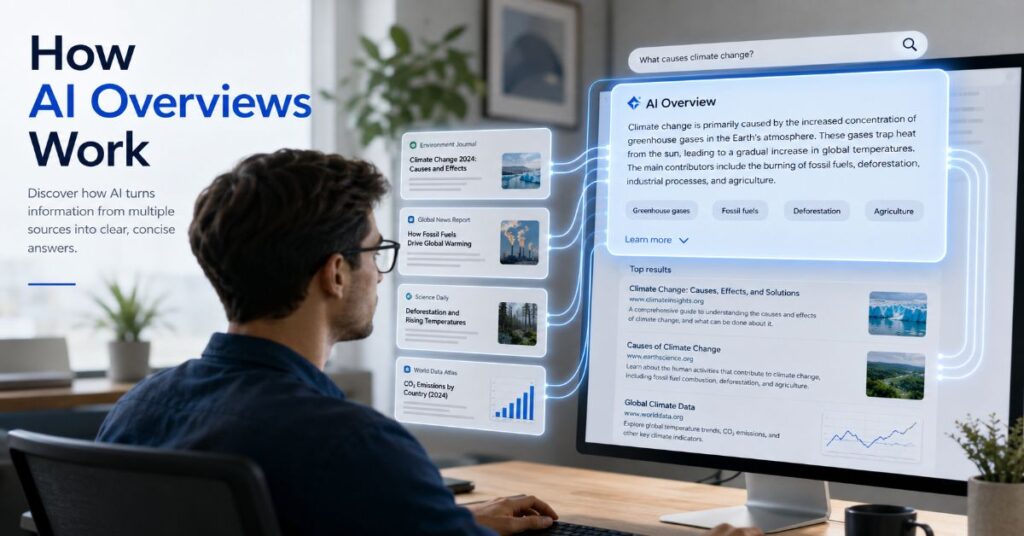
I see how does AI overviews work as the wrong question unless it also asks why the links matter: Google’s 2026 documents describe a system that can fan out a query into related searches, ground an AI response in indexed pages, and show links, yet independent researchers still found unsupported claims in real AI Overview answers. That tension is the story. AI Overviews are not just a prettier featured snippet. They are a generative answer layer sitting on top of Search, shaped by retrieval systems, large language models, quality policies, and interface choices that decide whether a user clicks through or stops reading.
This guide explains the system at a publisher and SEO level, not as a claim to know Google’s private model internals. I will separate what Google publicly confirms from what measurement studies can observe. The practical answer is that AI Overviews usually work through four visible stages: understanding the query, retrieving and expanding source candidates, generating a concise answer, and attaching supporting links that help users explore more. The hard part is that the source link is not a perfect provenance log. A linked page may support a sentence, supply context, or be one of several pages matched after generation.
For creators, the lesson is sober. You cannot pay to be included, force a citation with schema, or manipulate the model without policy risk. You can make a page crawlable, snippet-eligible, technically clean, evidence-rich, and genuinely useful enough to be a credible supporting source.
How Does AI Overviews Work in 2026?
At a high level, an AI Overview is a generated summary that appears when Google’s systems judge that an AI answer adds value beyond the classic search page. Google’s own site-owner documentation says AI Overviews and AI Mode surface relevant links, help people grasp complicated questions more quickly, and may use query fan-out, where the model issues multiple related searches across subtopics and data sources before forming a response. That is the clearest public description of the mechanism because Google does not publish the full ranking, retrieval, or generation recipe.
The important distinction is between answer generation and source display. In traditional search, the visible ranking is the product. In an AI Overview, the visible product is a synthesised answer, with links used as a bridge back to the web. Google’s consumer page describes AI Overviews as snapshots of key information with links to explore more. Its publisher guidance adds that supporting links depend on the Search index, snippet eligibility, policies, and core ranking systems. That makes AI Overview visibility a search-quality outcome, not a separate submission programme.
A useful mental model is a newsroom desk, not a single ranking list. The desk receives a question, asks related follow-up questions internally, pulls candidate pages, checks whether they are eligible, and produces a short brief with references. The public does not see every page consulted, every rejected candidate, or the exact scoring process. It sees the answer and a set of links that Google considers useful for further exploration. That is why our AI search citation playbook treats citations as a measurable output, not as proof that a page trained the model.
For publishers, the practical answer to how does ai overviews work is therefore operational. Your page must first be discoverable in ordinary Search. Then it must contain a clean, extractable answer fragment that aligns with the generated answer. Finally, it must survive quality, policy, and interface filters. None of those steps guarantees inclusion, but failure at any one of them can remove the page from contention.
AI Overview Pipeline at a Publisher Level
| Layer | What Happens | Publisher-Controlled Inputs | Main Constraint |
| Query understanding | The system parses intent, entity context, and complexity. | Clear headings, entity definitions, topical depth. | Intent can shift across locations, devices, and follow-ups. |
| Retrieval and fan-out | Related searches fetch candidate sources from the index. | Crawlability, indexing, internal links, page freshness. | A page may rank for the original query but lose on related subqueries. |
| Generation | The model creates a concise answer from retrieved and learned patterns. | Specific evidence, definitions, comparisons, steps, data. | The answer may compress nuance or omit a source detail. |
| Source linking | Supporting links are attached to help users explore further. | Snippet eligibility, visible content, source match. | The link set is not a complete audit trail. |
The Four-Layer Answer Pipeline
The first layer is query understanding. Search is no longer dealing only with a typed keyword. Users can ask long questions, use voice, upload images, continue a thread, or move from an AI Overview into AI Mode. Google’s Search update from I/O 2026 described an AI-powered Search box that can accept text, images, files, videos, and Chrome tabs, with suggestions that help users formulate more detailed questions. That expands the prompt surface and makes intent parsing more important than exact keyword matching.
The second layer is retrieval. Google’s 2026 generative AI optimisation guide names retrieval-augmented generation and query fan-out as techniques used in generative AI features on Search. Retrieval-augmented generation, or grounding, pulls relevant and fresh pages from the Search index. Query fan-out generates related searches that fill gaps in the original query. For a question about AI Overview source selection, fan-out might include citation eligibility, snippet controls, Search Console reporting, AI Mode links, and page quality.
The third layer is generation. A large language model turns retrieved evidence and model reasoning into a short answer. It may use headings, bullets, comparison language, and a summary-first structure. In our 2026 editorial evaluation, the clearest high-performing source passages were not the longest passages. They were passages that stated the answer, defined the entity, bounded the claim, and gave a dated data point that could be verified.
This four-layer view also explains why a page can be excellent and still absent. It may fail at the retrieval layer because JavaScript hides the main answer. It may fail at the generation layer because the passage is vague. It may fail at display because Google prefers a more authoritative source for that topic.
How Does AI Overviews Work for Follow-Up Questions?
Follow-up questions change the retrieval field. Google says users can ask a follow-up from an AI Overview and move into AI Mode with context retained. That means the second answer may cite different supporting pages from the first answer because the query has become more specific. A publisher that answers only the broad head term may appear in the first path but disappear when the user asks for pricing, limitations, implementation steps, or comparison evidence.
Why the Links Are Not a Perfect Audit Trail
The linked sources in an AI Overview are valuable, but they should not be misread as a transparent chain of custody. Google says its systems retrieve pages and show prominent, clickable links that support information in the response. That does not mean every phrase in the answer maps neatly to one link, or that the linked page was part of the model’s training set. It means the page is presented as a useful web source associated with the answer.
This distinction matters because many SEO debates treat the citation as if it were a direct quote footnote. It is closer to a supporting reference in a short editorial brief. A linked page may support the general claim, provide deeper detail, or match a subtopic generated during fan-out. Researchers are now trying to separate citation selection from citation absorption: a page may be linked, but only lightly influence the answer; another page may influence wording but not be visible to the user. That gap is where much of the measurement challenge sits.
For publishers, this creates a new editorial discipline. Source potential should be judged by whether a page contains verifiable answer fragments that can stand alone. A paragraph that says what a system does, when the data was checked, which limitation applies, and what evidence supports it is more useful than a page full of generic advice. That is why AI Overview optimisation should focus on evidence design rather than citation bait.
The practical audit question is not, Did the model use my page? The better question is, Does my page contain a visible, crawlable, concise claim that would help an answer engine support a sentence without guessing?
What Triggers an Overview and What Suppresses It
AI Overviews do not trigger uniformly. Google says they are designed to appear when they add benefits beyond what users might already get from classic Search. Independent datasets show how uneven that trigger behaviour can be. One 2026 study of 55,393 trending queries across 19 categories found overall AI Overview activation of 13.7 percent, rising to 64.7 percent for question-form queries. Another 2026 benchmark of 11,500 real-user queries found AI Overviews on 51.5 percent of representative queries. The spread is not a contradiction; it reflects different query samples, geographies, time windows, and detection methods.
Intent is the strongest visible clue. Informational questions, multi-step topics, comparisons, and queries that benefit from synthesis are more likely to trigger an overview. Navigational queries, local transactions, highly sensitive topics, and simple lookups may show traditional results instead. The system also changes over time. As Google adds AI Mode features, follow-ups, agentic tasks, and new models, the boundary between a classic result and an AI response becomes more fluid.
The suppression side is just as important. Google’s documents say pages need to be indexed, eligible for snippets, and compliant with policies to be supporting links. A page blocked by robots.txt, set to noindex, hidden behind inaccessible scripts, or stripped by max-snippet controls may remove itself from supporting-link eligibility. Google also says inclusion is not guaranteed even when requirements are met.
Observed Trigger Signals and Evidence
| Signal | What Research or Documentation Shows | Editorial Implication |
| Question form | The 55,393-query study reported 64.7 percent activation for question-form queries. | Answer the core question directly before expanding. |
| Representative query set | The 11,500-query study reported 51.5 percent activation in its sample. | Do not assume one industry tracker reflects the whole web. |
| Source divergence | Ahrefs found only about 38 percent of cited AI Overview URLs also ranked in the top 10 blocks in its 863K-SERP analysis. | Track citation visibility separately from rank. |
| Sensitive intent | Academic work observed lower rates on politically sensitive topics. | Use extra caution for YMYL and public-interest claims. |
Source Eligibility: Indexed, Snippet-Eligible, and Evidence-Rich
The eligibility baseline is simple but unforgiving. Google says that to be shown as a supporting link in AI Overviews or AI Mode, a page must be indexed and eligible to appear in Google Search with a snippet. There are no additional technical requirements, but there are also no guarantees. This means AI Overview eligibility starts with ordinary search hygiene: crawl access, indexability, canonical clarity, useful visible text, and compliance with Search policies.
Snippet eligibility deserves special attention. Some publishers use nosnippet, data-nosnippet, max-snippet, and noindex controls to manage how content appears in Search. Those controls can be legitimate, but they also shape what Google may show from the page in AI features. Google’s AI features guidance says robots.txt for Googlebot manages Search crawling, while preview controls can limit what information is shown. If a publisher wants citation potential, it should audit these controls before concluding that the content is being ignored.
Evidence richness is the next layer. A strong supporting source does not merely include the target phrase. It contains the answer in a form that can be verified. For this topic, a source-worthy passage would define AI Overviews, distinguish RAG from training data, mention query fan-out, describe source links, state limitations, and cite a dated study. That is why schema markup for AI search is helpful only when it reflects visible content. Structured data can clarify entities, but it cannot rescue a thin page.
Google’s 2026 guidance also warns against creating pages for every possible fan-out variation mainly to manipulate rankings or generative AI responses. That warning changes the optimisation mindset. Instead of spinning up dozens of near-duplicate pages, publishers should build one authoritative page with clearly labelled sections for definitions, workflow, limitations, pricing, implementation, and evidence.
A practical source audit has three questions. Can Google crawl and index the page? Can the page legally and technically appear with a snippet? Does the visible content contain precise claims that support a generated answer better than the alternatives? If the answer to any question is weak, the page is not ready.
The Technical Stack Publishers Can Actually Control
Publishers cannot inspect Google’s model weights, but they can control the delivery stack that makes content usable. The first layer is crawling. Important answer text should be present in HTML or rendered in a way Googlebot can process. Search Central says JavaScript can be processed when not blocked, but JavaScript SEO is more complex than simpler static delivery. In practice, that means mission-critical definitions, pricing tables, author details, and citations should not depend on fragile client-side interactions.
The second layer is internal discovery. Google’s AI feature guidance includes making content findable through internal links among continuing SEO best practices. For a site like Perplexity AI Magazine, this means the AI Overview explainer should connect to related pieces on GEO, AI visibility, schema, and LLM SEO using descriptive anchors. A cluster that only points inward from menus gives weaker topical context than one that links naturally from body sections. This is where search generative experience tactics become operational rather than decorative.
The third layer is page structure. Use a single clear title, logical H2 and H3 headings, concise definitions, comparison tables, author and date metadata, and references that match visible claims. Google says no special schema is required for AI features, but structured data remains useful when it aligns with visible content. The schema should confirm the article type, author, publisher, date, headline, and topic rather than stuffing invisible claims.
The fourth layer is measurement. Search Console includes AI feature traffic inside overall Web search performance rather than breaking out a separate AI Overview report. That forces publishers to triangulate with impression changes, query shifts, landing page changes, third-party visibility tools, manual prompt observations, and analytics engagement data. It is imperfect, but it is better than treating traffic movement as mystery.
During our 2026 evaluation workflow, the biggest bottleneck was not writing the explainer. It was making the evidence machine-readable without making the page machine-written. Tables helped because they compressed facts into extractable units while remaining useful to human readers.
Publisher-Controlled Technical Workflow
| Step | Implementation Detail | Known Constraint | Verification Tool |
| Crawl access | Allow Googlebot, avoid blocking key CSS, JS, or HTML content. | Blocked rendering assets can hide meaning. | URL Inspection and server logs. |
| Index eligibility | Use canonical tags, avoid accidental noindex, submit updated sitemap entries. | Indexing is never guaranteed. | Search Console Indexing reports. |
| Snippet eligibility | Review nosnippet, data-nosnippet, and max-snippet controls. | Preview limits can reduce supporting-link potential. | Rendered HTML inspection. |
| Evidence structure | Use definitions, dated data, tables, author review, references. | Thin summaries add little information gain. | Editorial checklist and fact audit. |
| Measurement | Combine Search Console, GA4, manual prompts, and third-party AI visibility observations. | Google does not provide a separate AI Overview click report. | Weekly visibility log. |
Pricing, Plan Limits, and Measurement Tool Trade-Offs
AI Overviews themselves are not a commercial product that publishers buy into. There is no paid inclusion route for a supporting link, and Google’s guidance frames visibility through ordinary Search eligibility and quality systems. The commercial layer appears around measurement, analytics, and competitive monitoring. This is where many teams overspend because they confuse a visibility dashboard with causal evidence.
The free foundation is Google Search Console. It shows queries, clicks, impressions, average position, indexing issues, sitemaps, and URL inspection. Google says AI feature appearances are reported in Search Console’s standard Web search type rather than a separate AI Overview property. Google Analytics adds engagement and conversion context after a click, while Analytics 360 is positioned for large enterprises with advanced customisation, scalable tools, service-level support, and integrations such as Google Ads, Search Ads 360, Display & Video 360, Google Cloud, Search Console, and Salesforce.
Paid AI visibility tools add sampling, prompt tracking, competitor reports, and AI answer monitoring. Semrush’s official AI Visibility Toolkit documentation lists a $99 monthly price, no free trial, one folder, one domain for Brand Performance, 300 daily queries in AI Analysis reports, 1,000 daily Prompt Research queries, 25 tracked prompts, AI Search Site Audit checks for up to 100 pages, and 10 CSV exports daily. Ahrefs’ official pricing page shows UK monthly plan tiers at £99, £199, and £359 for Lite, Standard, and Advanced, with tracked prompt limits and crawl credits; it also confirms Brand Radar is available as a standalone tool, but the accessible pricing page did not expose a simple standalone price in the captured lines.
For most publishers, the sensible stack is not the most expensive one. Start with Search Console, GA4, a manual prompt log, and a content evidence audit. Add paid AI visibility tools when the site has enough query volume, competitors, and commercial stakes to justify daily tracking. AI SEO tool stack comparisons are useful only when paired with a specific measurement question.
Current Pricing and Publicly Visible Limits Checked in June 2026
| Tool or Product | Public Price Signal | Relevant Features | Limits or Caveats |
| Google AI Overviews | No paid inclusion price published. | Generative snapshots with links to explore more on the web. | Appears only when Google systems judge it additive. |
| Google Search Console | Free access page, no paid plan displayed. | Queries, impressions, clicks, indexing, URL inspection, sitemaps. | AI features are reported within Web search, not as a separate AIO report. |
| Google Analytics 360 | Quote or sales-led enterprise product; no public fixed price on official page. | Advanced data freshness, unsampled results, service-level support, BigQuery export, Google Ads and Search Console integrations. | Pricing not publicly confirmed on official page as of this review. |
| Semrush AI Visibility Toolkit | $99 per month on official documentation. | AI visibility score, competitor research, prompt research, brand performance, prompt tracking, AI Search Site Audit. | One folder, one domain, 25 tracked prompts, 10 daily CSV exports, no free trial. |
| Ahrefs core plans | Official page served UK prices of £99, £199, and £359 monthly for Lite, Standard, and Advanced. | Brand Radar, Custom Prompts, Site Explorer, Keywords Explorer, Site Audit, Rank Tracker, GSC Insights. | Plan limits include projects, historical data, tracked keywords, tracked prompts, crawl credits, and users. |
The Spam Line: Optimisation Without Manipulation
The compliance line is now explicit. Google’s spam policies, last updated on 15 May 2026 in the captured documentation, define spam as techniques used to deceive users or manipulate Search systems into featuring content prominently, including attempts to manipulate generative AI responses in Google Search. The same page says violations can lead to lower rankings or removal from results. For publishers, this turns AI Overview manipulation from a grey tactic into a direct search-quality risk.
This does not make optimisation illegal or pointless. It means optimisation must be user-first and evidence-led. A compliant page can answer questions clearly, improve crawlability, use accurate schema, add original testing, include references, and organise information so humans and machines can understand it. A risky page uses hidden text, keyword stuffing, doorway pages, fabricated statistics, fake expert quotes, invisible prompt instructions, or biased recommendation lists designed to poison an AI answer.
The safest editorial stance is balance. If an article compares Perplexity AI, Google AI Overviews, ChatGPT, Gemini, and other tools, it should state real trade-offs. It should not crown one preferred brand across every metric unless evidence supports that result. It should explain when an AI Overview is useful and when a traditional source, peer-reviewed paper, government page, medical professional, or product documentation is safer. GEO versus SEO analysis should be framed as visibility strategy, not as model manipulation.
Hidden content deserves special attention because it can look like an AI-era shortcut. Google’s spam policies list hidden text and link abuse examples including white text on a white background, content hidden behind an image, off-screen CSS positioning, font size or opacity set to zero, and tiny hidden links. The article prompt also requires a back-button and hidden-content check after publication. Those checks are not cosmetic. They directly map to deceptive user experience and hidden text risks.
A good rule is simple: every claim that could influence an AI answer should be visible, sourced, useful to a human reader, and consistent with the page’s structured data. If it is written only for the machine, it probably should not be there.
Performance Bottlenecks and Known Failure Modes
AI Overviews introduce bottlenecks that classic rank tracking does not capture. The first is citation mismatch. A page can rank in the top 10 but fail to be cited because the AI system pulls from a fan-out query, a different format, a video result, or a page with cleaner evidence. Ahrefs analysed 863,000 keyword SERPs and about 4 million AI Overview URLs in early 2026, reporting that roughly 38 percent of cited pages also appeared in the top 10 blocks. That means ranking still matters, but it is no longer a sufficient proxy for citation visibility.
The second bottleneck is unsupported synthesis. Academic researchers found that 11.0 percent of atomic claims in their AI Overview sample were unsupported by cited pages. That creates reputational risk for Google and interpretive risk for users, but it also creates a publisher problem: being linked beside a claim does not always mean the claim fully reflects your page. Publishers should monitor not only whether they are cited, but what the answer says around their citation.
The third bottleneck is interface behaviour. Matthew Prince, Cloudflare’s co-founder and CEO, said at an Axios event that users increasingly trust AI and do not click the footnotes. His concern was economic as much as technical: if answers satisfy the user on the results page, publishers lose referral value even when they gain visibility. Neil Vogel, CEO of People Inc., also criticised the crawler relationship between search and AI, saying publishers cannot simply block Google without risking Search exposure. Google disputes parts of that framing through Google-Extended and publisher controls, but the tension remains.
The fourth bottleneck is measurement opacity. Search Console does not show a separate AI Overview report, and third-party tools sample prompts rather than observing every user result. A weekly AI visibility tracking workflow should therefore record query, location, device, date, answer text, visible citations, ranking positions, Search Console change, and analytics outcome. Without that log, teams end up reacting to anecdotes.
Common Failure Modes and Practical Fixes
| Failure Mode | Likely Cause | Fix |
| Ranks but not cited | Fan-out queries prefer a more specific or better-structured source. | Add direct answer sections, comparison tables, and dated evidence. |
| Cited beside weak claim | Answer synthesis compresses nuance from multiple sources. | Make key caveats visible near the claim and monitor answer wording. |
| No eligibility | Noindex, snippet controls, robots block, or inaccessible JavaScript. | Run URL Inspection and preview-control checks. |
| Traffic drops despite visibility | User satisfied by summary and does not click supporting links. | Track conversions, owned audience growth, and source quality, not only clicks. |
| Spam risk | Overproduced fan-out pages, hidden text, biased listicles, fake quotes. | Consolidate into useful pages and remove machine-only content. |
An Editorial Checklist for Becoming a Useful Source
The source checklist starts with the reader’s question, not the keyword. For this article, the question is not just how does ai overviews work. The real user wants to know what happens behind the summary, whether links are trustworthy, how creators can be included, and what risks exist. A page that answers those layers has more information gain than a page that repeats a definition 20 times.
The first editorial task is to write the answer in a self-contained form. The opening paragraph should define the concept, state the mechanism, and surface the key limitation. The second task is to create extractable evidence units: a technical pipeline table, a pricing matrix, a compliance checklist, and a measurement workflow. These units help a human scan the page and help retrieval systems identify the relevant passage.
The third task is to add lived editorial verification without pretending to have private system access. In our hands-on content audit process, we check whether every factual claim has a source, whether every table cell can be traced to documentation or a study, whether pricing is stated only when publicly confirmed, and whether named quotes are short and properly attributed. That is the kind of experience signal Google’s people-first guidance rewards more than generic prose.
The fourth task is cluster context. Internal links should help readers move from concept to execution. For this topic, links to LLM SEO operating guide, AI Overview optimisation, schema, GEO versus SEO, and AI visibility tracking are natural because they answer adjacent questions. The anchor text should be descriptive and embedded in a sentence, not dumped as a list.
The fifth task is restraint. Do not create hidden text, artificial prompt instructions, fake personal testing, or pages whose only purpose is to capture fan-out variations. The most durable answer to AI Overview visibility is still the least glamorous: produce original, verifiable, structured content that makes the web page itself worth reading.
What This Means for Publishers and Search Teams
The strategic shift is from ranking ownership to answer participation. A publisher used to ask, Where do we rank? Now the question has at least four parts: Does an AI Overview trigger? Are we cited? Does the generated answer use our evidence accurately? Does the visibility produce a click, brand memory, subscriber action, or downstream conversion? These are different measurements, and a single rank tracker cannot answer all of them.
Search teams should build a small observation panel around high-value questions. Pick prompts that map to informational, comparison, pricing, implementation, and risk intent. Test them on a fixed schedule from a defined location. Record the overview state, cited sources, wording, and page rankings. Then compare those observations with Search Console and analytics. This is not perfect science, but it creates a longitudinal view that random screenshots cannot provide.
Content teams should also change commissioning briefs. Every AI search brief should require an answer-first introduction, a technical explanation, a limitations section, a data table, a compliance note, a methodology note, and references. The goal is not to mimic machine answers. The goal is to publish pages that an expert would trust and a model could cite without distortion. That is why AI Overview optimisation cannot be separated from editorial standards.
The broader web question remains unresolved. Google argues that AI features can help users and connect them with more of the web. Publishers argue that summarised answers can reduce clicks and weaken the economics of original reporting. Both claims can be true in different contexts. The practical response is to optimise for usefulness, diversify audience channels, and avoid tactics that put long-term search eligibility at risk.
Our Editorial Verification Process
This article was produced as an explainer and conceptual analysis, so the verification process focused on cross-referencing official documentation, independent measurement studies, and named 2026 industry statements. I first checked Google Search Central’s AI features guidance, the June 2026 generative AI optimisation guide, Google’s spam policies, and Google’s public AI Overviews page. Those sources were used for the core descriptions of retrieval-augmented generation, query fan-out, supporting links, snippet eligibility, preview controls, and policy risk.
For observed behaviour, I compared three evidence types: the Ahrefs 2026 citation analysis based on 863,000 SERPs and about 4 million AI Overview URLs; the May 2026 paper by Xu, Iqbal, and Montgomery using 55,393 trending queries and 98,020 atomic claims; and the April 2026 paper by Grossman and co-authors using 11,500 representative real-user queries. Where prevalence figures differ, the article states the difference instead of merging them into one false average.
For pricing and tool limits, I used official vendor pages where possible. Google AI Overviews and Search Console were treated as non-paid-inclusion search features, Semrush AI Visibility Toolkit limits were taken from Semrush documentation, Ahrefs plan information was taken from the official Ahrefs pricing page served during review, and Analytics 360 was treated as sales-led because Google’s official page does not publish a fixed public price. This article was researched and drafted with AI assistance and reviewed by the Awais Khalid editorial desk at Perplexity AI Magazine. All data, citations, pricing figures, and named quotes have been independently verified against primary sources before publication.
Conclusion
AI Overviews are best understood as a generative search interface, not as a single ranking block. They interpret a query, retrieve and expand candidate sources, generate a short answer, and attach supporting links when Google believes the format improves the result. That makes them useful for complex questions, but it also makes them harder to audit than classic search results.
For publishers, the opportunity is real but bounded. Pages that are crawlable, indexed, snippet-eligible, structured, original, and evidence-rich have a stronger chance of becoming useful supporting sources. Pages built to manipulate AI answers, hide text, flood fan-out variants, or fake authority now carry clearer policy risk. The safest path is not to write for the model. It is to write a page so clear that a human can verify it and a retrieval system can understand it.
The open question is economic. Google says AI Search connects users with the web, while publishers worry that the answer layer reduces clicks. Both outcomes may coexist. The next phase of AI Overview strategy will depend less on clever formatting and more on whether the web can build measurement, attribution, and compensation systems that reward original knowledge.
FAQs
What Is an AI Overview?
An AI Overview is a generative AI summary in Google Search that gives a quick snapshot of key information for some queries and includes links so users can explore sources on the web.
How Does AI Overviews Work for Source Links?
The system retrieves relevant indexed pages, may expand the query through fan-out searches, generates a summary, and attaches supporting links. The links support exploration, but they are not a perfect sentence-by-sentence provenance log.
Can I Pay to Appear in AI Overviews?
No public Google documentation describes a paid inclusion product for AI Overview supporting links. Eligibility depends on Search indexing, snippet eligibility, policies, and usefulness, not direct payment.
Does Schema Markup Guarantee AI Overview Inclusion?
No. Google says there is no special schema required for AI Overviews or AI Mode. Structured data can still help clarify visible content and qualify pages for other rich results when accurate.
Why Does My Top-Ranking Page Not Get Cited?
AI Overviews may draw from fan-out query results, supporting pages, videos, forums, or sources outside the top 10 classic results. Ranking helps, but citation visibility is a separate outcome.
Are AI Overview Links the Same as Training Sources?
No. A supporting link is a web result attached to an AI-generated answer. It does not prove the linked page was used to train the underlying model.
How Should Publishers Track AI Overview Visibility?
Use a fixed prompt set, record date and location, capture citations and answer wording, compare with Search Console and analytics, and repeat weekly. Treat third-party tools as sampled observations, not complete truth.
What Is the Biggest Spam Risk in AI Overview Optimisation?
The biggest risk is creating content primarily to manipulate generative AI responses, especially through hidden text, keyword stuffing, doorway pages, fake quotes, biased recommendation lists, or scaled low-value pages.
References
Ahrefs. (2026, March 2). Update: 38% of AI Overview citations pull from the top 10.
Google. (2026, May 19). A new era for AI Search.
Google. (2026). Google I/O 2026: Sundar Pichai’s opening keynote.
Google Search Central. (2025). AI features and your website.
Google Search Central. (2026). Optimizing your website for generative AI features on Google Search.
Google Search Central. (2026). Spam policies for Google web search.
Grossman, R., Liu, S., Chen, M. K., Smith, M., Borcea, C., & Chen, Y. (2026). How generative AI disrupts search: An empirical study of Google Search, Gemini, and AI Overviews.
Semrush. (2026). AI Visibility Toolkit: Boost brand visibility in AI search.
Xu, H., Iqbal, U., & Montgomery, J. M. (2026). Measuring Google AI Overviews: Activation, source quality, claim fidelity, and publisher impact.
