
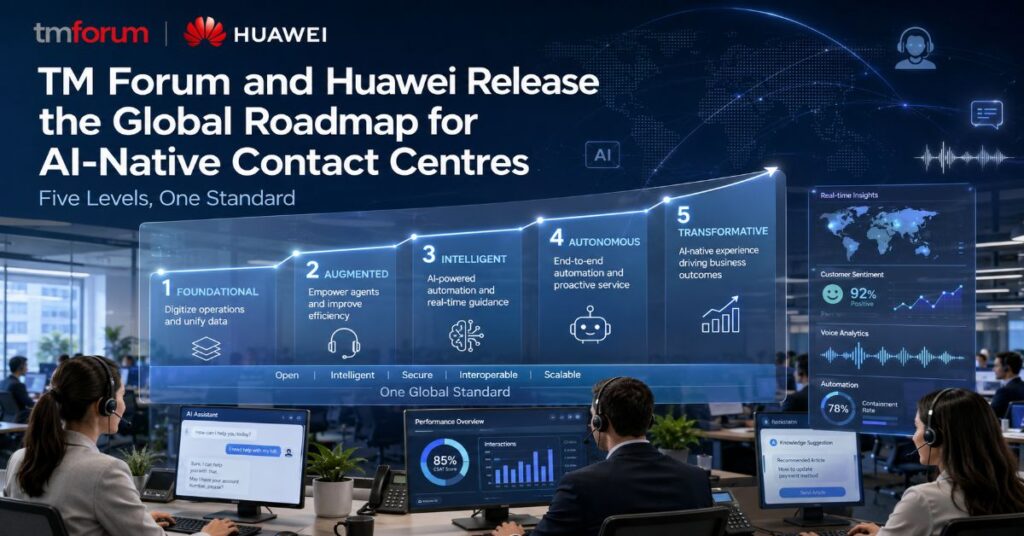
Every telecoms operator in the world runs a contact centre. Most of them are running it the same way they were five years ago — legacy IVR menus, bolt-on chatbots that handle only the simplest queries, and human agents absorbing the overflow. TM Forum and Huawei released a document on June 29 that maps the path from that reality to something fundamentally different: a contact centre where intelligence is the core architecture rather than a feature layer grafted onto existing systems.
At DTW 2026 in Copenhagen, TM Forum together with Huawei, China Mobile, China Telecom, and other industry partners officially released IG1465 AI4Contact-Center: AI Transformation Whitepaper v2.0.0, during the AI and Data Masterclass session. The publication introduces the Contact Center Intelligence Maturity Model, or CCIMM, a five-level framework that sets a structured global standard for how contact centres evolve from rule-based query handling to fully autonomous AI-native operations — and provides the evaluation metrics, business KPI mappings, and ROI analysis frameworks enterprises need to calibrate where they are on that path and what the next investment step should be.
The whitepaper is notable for what it is not. It is not a product announcement, a proof of concept, or a vendor pitch. It is a TM Forum industry standard — an international guidance document produced by a multi-stakeholder workstream covering a cross-section of operators, technology vendors, and systems integrators — designed to create a shared vocabulary and reference architecture for an industry transformation that is currently happening at inconsistent speeds with incompatible approaches across different organisations.
Key Developments
- TM Forum, Huawei, China Mobile, and China Telecom released IG1465 AI4Contact-Center: AI Transformation Whitepaper v2.0.0 at DTW 2026, Copenhagen, on June 29, 2026.
- The whitepaper introduces the Contact Center Intelligence Maturity Model (CCIMM) — a 5-level framework (L1–L5) built on three pillars: technical foundation, business productivity, and user experience, each with clear evaluation metrics and business KPI mappings.
- The central argument: future contact centres must be designed with intelligence as the core architecture engine, using LLM-native AI-native design rather than bolt-on AI plugins layered onto rule-based legacy systems.
- The whitepaper provides ROI analysis, business practice examples, and a structured roadmap to guide the industry’s transition from passive service handling toward fully autonomous operations — repositioning contact centres as experience-and-revenue centres rather than cost centres.
What Happened
According to Huawei’s official announcement of the release, the whitepaper was released during the AI and Data Masterclass at DTW 2026, with Judith Zhang, Huawei’s contact centre product expert, presenting the CCIMM framework alongside TM Forum representatives and operator partners. The whitepaper’s architectural argument is that the contact centre industry has spent the past several years applying AI as a bolt-on capability — a chatbot here, a voice assistant there, an analytics layer on top of existing infrastructure — rather than rebuilding the underlying system architecture around AI as the primary engine. That distinction matters because bolt-on AI can automate specific interactions within a legacy architecture but cannot enable the kind of real-time, context-aware, multi-channel orchestration that defines what the whitepaper calls a true Artificial Intelligence Contact Centre, or AICC.
The IG1465 TM Forum project page confirms that the CCIMM framework is built on a three-layer technical architecture that aligns with TM Forum’s Open Digital Architecture: an infrastructure layer (compute, network, data), a platform layer (AI model management, capability APIs, orchestration), and an application layer (specific contact centre functions, customer experience tools, business intelligence). The five CCIMM levels map an organisation’s journey from assisted automation at L1, through self-service optimisation at L2 and proactive intelligence at L3, to cross-channel collaboration at L4 and fully autonomous operations at L5 — each level defined by measurable capability criteria across the three pillars of technical foundation, business productivity, and user experience.
The Mechanism: What AI-Native Architecture Actually Changes
The distinction between bolt-on AI and AI-native architecture is not primarily a technical one — it is an organisational and economic one. A contact centre that adds a chatbot to its existing IVR system reduces the volume of simple queries reaching human agents, but the underlying operational model — call routing, agent queuing, case tracking, quality assurance, workforce management — remains substantially unchanged. The AI layer is an efficiency improvement layered on top of a process that was designed for a different operating model. An AI-native contact centre redesigns those processes from the ground up: routing decisions are made by a real-time LLM that has access to the full customer context and service history; quality assurance runs on all interactions simultaneously rather than a sampled subset; and workforce management is driven by predicted demand patterns rather than historical averages.
The business consequence of the difference is the central commercial argument the whitepaper is making. Cost-per-contact is the traditional metric contact centres are measured against; the whitepaper argues that AI-native architecture shifts the relevant metric to value-per-interaction, because an AI-native contact centre can actively resolve problems, identify cross-sell and upsell opportunities, and generate revenue rather than simply processing service requests. That repositioning — from cost centre to experience-and-revenue centre — is both the commercial case for the investment required to rebuild contact centre architecture and the reason TM Forum is treating the transformation as a strategic priority for the entire telecoms sector rather than an individual operator technology decision.
The Backstory: DTW 2026 as the AI-in-Telecoms Convergence Point
The AI4Contact-Center whitepaper is one of several AI-in-telecoms governance documents released at DTW Ignite 2026 this week. ZTE and China Mobile unveiled their Network Graph Model for Level-4 autonomous network operations at the same event on June 25, targeting autonomous AI management of live commercial networks. TM Forum also released an AI Talent and Skill Matrix White Paper (IG1492C) on June 23, addressing how telecoms organisations build the workforce capabilities needed to operate AI-native infrastructure. The pattern across all three documents is the same: the industry’s AI transformation is mature enough that it now requires structured international standards — shared maturity models, skill frameworks, and governance architectures — rather than individual vendor implementations, and DTW Ignite 2026 is the event where those standards are being formalised and published.
Huawei’s central role as a co-author of the AI4Contact-Center whitepaper connects to its broader AI monetisation strategy for the carrier sector. As the company argued at MWC Shanghai 2026, telecoms carriers must shift from billing for bytes to billing for tokens and AI service value, and the contact centre is one of the clearest commercial contexts in which that shift is already visible: a carrier that can provide an AI-native contact centre as a managed service, rather than a legacy call platform, can charge for the value of resolved interactions rather than the cost of call minutes. The CCIMM maturity model creates a standardised vocabulary for that commercial conversation, giving carriers and enterprise customers a shared framework for evaluating AI contact centre investment and measuring its returns.
Reactions
TM Forum’s framing of the whitepaper emphasises the practical problem it is solving rather than the technical architecture. The problem is fragmented transformation paths — organisations attempting AI contact centre upgrades without a common reference architecture end up with inconsistent implementations that cannot be benchmarked against each other, cannot be evaluated for ROI against a shared standard, and cannot interoperate when different parts of an enterprise’s service infrastructure are managed by different vendors. The CCIMM’s five-level model, with its pillar-based evaluation criteria and business KPI mappings, is designed to give any organisation — regardless of starting point, technology vendor, or sector — a consistent way to describe where it is and what the next step looks like.
Huawei’s Judith Zhang framed the whitepaper’s significance in terms of the business outcome at the top of the maturity model: “Ultimately, it empowers contact centers to strategically transform into true experience-and-revenue centers.” That framing positions the five-level journey not as a technology upgrade path but as a business model transformation — from a defensive cost function to an offensive revenue function — which is the commercial argument that justifies the investment required to rebuild contact centre architecture from the ground up rather than continuing to layer AI capabilities onto legacy systems.
The Dispute: Standards vs. Speed
The tension in any industry standards publication of this kind is between comprehensiveness and speed. The CCIMM framework is thorough, with its three pillars, five levels, evaluation metrics, and business KPI mappings providing a detailed reference architecture for organisations at any stage of transformation. But the AI contact centre market is not waiting for a common standard to mature before moving: vendors including Huawei, AWS Connect, Salesforce Einstein, Genesys, and NICE are already deploying AI contact centre products at enterprise scale, and the implementations that are furthest ahead of the standard will be the ones that define the practical meaning of “L4” and “L5” capability in real enterprise environments, regardless of what the TM Forum framework describes.
The whitepaper’s emphasis on AI-native architecture is also more prescriptive than many enterprises are ready to implement. Rebuilding contact centre infrastructure from the ground up requires a capital investment and organisational change programme that is substantially larger than adding AI capabilities to existing systems. For most of the 38 pages of telcos represented at DTW Ignite, the practical question is not whether to rebuild native-first but how to extract more value from bolt-on AI while planning a longer-term native transition — a more incremental path than the whitepaper’s architecture arguments fully accommodate. The same tension is visible across enterprise AI adoption, where research consistently finds that the gap between AI adoption and AI ROI is wider than early projections suggested, because deployment complexity and change management costs are higher than technical capability alone would imply.
What Happens Next
The AI4Contact-Center whitepaper v2.0.0 is a living standard that the AI4Contact-Center Workstream will continue updating as the technology and business practice landscape evolves. The near-term development areas flagged in the whitepaper include ultra-low-latency voice AI, real-time sentiment and intent modelling across all channels simultaneously, and the regulatory and compliance implications of AI-native contact centre architectures in regulated industries — areas where European AI governance frameworks like the Irish AI Office are beginning to define what “compliant and auditable” AI deployment looks like in practice. Watch for operator-led case studies that use the CCIMM framework to document their own maturity journeys, which will be the practical test of whether the standard becomes the reference point the industry actually uses when evaluating AI contact centre investments.
Why It Matters
The AI4Contact-Center whitepaper matters because it formalises, at an international standards level, the argument that the AI contact centre transformation is not an incremental upgrade but a fundamental architectural shift. That formalisation matters for enterprise buyers evaluating AI contact centre investment — a shared maturity model and ROI framework reduces the evaluation risk of adopting an AI-native approach before it is the industry’s settled default — and it matters for the broader AI-in-enterprise story. Contact centres are one of the highest-volume AI deployment contexts in the enterprise world: the average large telco handles tens of millions of customer interactions per year, and the economic impact of moving those interactions from legacy IVR to L4 or L5 autonomous AI is substantial enough to show up materially in operator financials. Huawei’s GigaUplink work addresses the network capacity AI wearables require; the CCIMM addresses the service layer that runs on top of that network. Together, the two publications from this week’s DTW event map both the infrastructure and the operations dimensions of what an AI-native carrier will look like by the end of the decade.
Sources
Huawei newsroom (DTW 2026 release); TM Forum IG1465 project page; Total Telecom; Telecompaper; Pipeline Publishing; TelcoTitans.
