
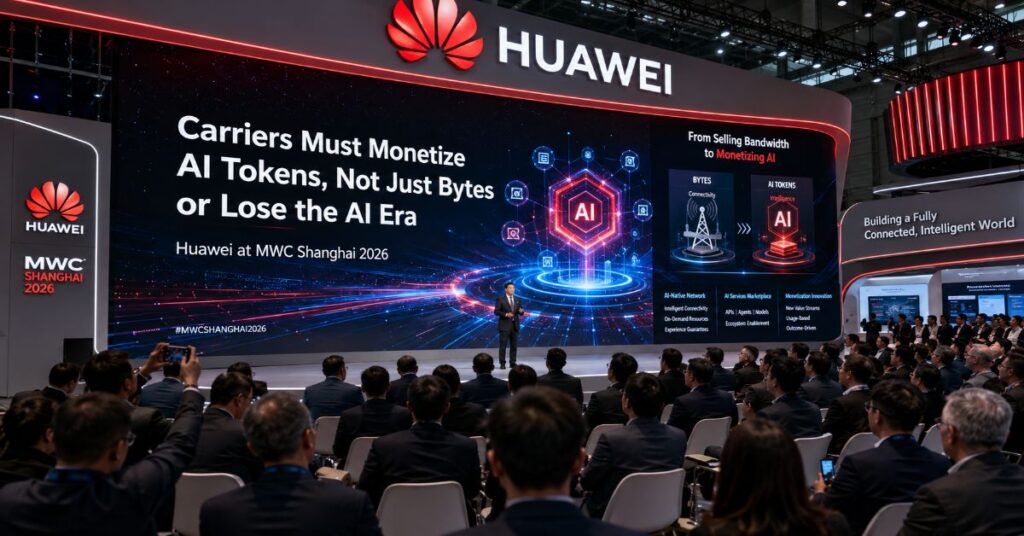
Telecom carriers have spent thirty years billing customers for bytes: how much data you moved, how fast, across how much spectrum. Huawei’s central argument at this year’s MWC Shanghai is that the AI era requires a fundamentally different billing model — and that carriers who don’t adapt will end up running the pipes for an AI economy they capture almost none of the value from.
At MWC Shanghai 2026, held June 24–26, Huawei showcased a suite of innovations under the theme “Advancing All Intelligence,” centred on integrating services, networks, and compute to enable growth in what the company calls both “bytes and tokens.” The token framing is deliberate: as AI agents and large language models become the dominant consumers of network capacity, Huawei argues that the natural unit of network billing shifts from data transferred to AI tokens generated, processed, and delivered — a higher-value metric that could allow carriers to capture a share of the economic output their networks enable rather than simply charging for the bandwidth consumed to produce it.
Huawei’s Deputy Chairman and Rotating Chairman David Wang delivered the keynote on how AI is transforming mobile networks, framing the transition from 4G’s consumer internet era to 5G-A’s AI agent era as the most consequential generational shift the mobile industry has faced.
Key Developments
- Huawei presented its “Advancing All Intelligence” strategy at MWC Shanghai 2026 (June 24-26), arguing carriers must shift from byte-based to token-based monetization to capture value from the AI agent era.
- Huawei and China Mobile Hubei announced the first successful carrier industry validation of Huawei’s AI Inference Acceleration Solution, delivering a 372% improvement in token throughput for long-sequence AI inference workloads.
- AI glasses and similar AI wearables require 20 Mbps uplink for real-time multimodal interaction — a new high-uplink requirement that 5G-A’s Upper-6 GHz band (U6 GHz) is positioned to serve.
- Global 5G-A users have exceeded 100 million; Huawei is working with carriers across China, the Middle East, and Hong Kong to monetize 5G-A through high-uplink services and experience-based pricing.
What Happened
According to Huawei’s official MWC Shanghai announcement, the company is showcasing innovations across three interconnected layers: services (5G-A experience monetization and AI-powered business upgrades), infrastructure (an AI-centric target network architecture designed for both byte and token delivery), and compute (a validated AI inference acceleration solution built on Huawei’s OceanStor A800 storage, Ascend A3 SuperPoD, and Unified Cache Manager). The compute layer is the most concretely validated: Huawei and China Mobile Hubei announced the successful carrier-industry-first validation of the AI Inference Acceleration Solution, delivering a 372 percent improvement in token throughput for long-sequence AI inference — code generation and multi-turn dialogue being the primary use cases — addressing a bottleneck that has limited how efficiently carrier-hosted AI services can serve the extended interactions that agentic applications require.
On the radio side, Huawei is highlighting the Upper-6 GHz spectrum band (U6 GHz) as the next-generation frequency band for AI agent traffic. The company points to a specific uplink requirement that makes AI wearables like Meta’s new $299 AI Glasses running the Muse Spark model commercially meaningful from a network standpoint: real-time multimodal AI interaction through glasses requires 20 Mbps of sustained uplink bandwidth, a requirement that 5G’s uplink capacity was not optimized for and that U6 GHz’s wider channels can serve more reliably. More than 20 countries have explicitly designated U6 GHz for IMT, and 2026 is the year Huawei is calling the commercial debut of U6 GHz, with the first commercial 5G-A networks running on U6 GHz expected in the Middle East within the year.
The Mechanism: What Token Monetization Actually Means for Carriers
The shift from bytes to tokens is not merely a rebranding exercise; it reflects a substantive change in how AI applications generate and consume network resources. A byte-based billing model measures how much data moves between a device and a server — it does not distinguish between data moved to stream a video, to deliver an AI chatbot response, or to process a real-time AI agent decision. A token-based model would, in principle, allow carriers to bill for the AI compute output their network infrastructure delivers to end users rather than just the data transport layer underneath it.
That is commercially meaningful because AI agent interactions are not symmetric with data consumption. An AI-assisted customer service interaction that resolves a billing dispute may consume relatively few bytes of network data but produce significant economic value for the business using it; a video stream may consume vastly more bytes but produce comparatively less per-bit value. If carriers can position their networks as compute delivery infrastructure rather than pure transport, they can potentially charge for the value of what the network delivers — AI inference, agent responses, real-time multimodal processing — rather than competing indefinitely on per-gigabyte pricing. Huawei’s AI-centric target network architecture is designed specifically to give carriers the visibility into compute workloads that would make such a monetization model technically feasible.
The Backstory
MWC Shanghai 2026 is taking place against the backdrop of a 5G-A commercial rollout that has moved faster in China than anywhere else in the world: the number of 5G-A users globally has exceeded 100 million, with China’s three major carriers all commercially deploying 5G-A networks and beginning to build the monetization programmes around high-uplink, AI-optimised services that Huawei is showcasing. That Chinese deployment base gives Huawei a real-world validation environment for its AI-centric network architecture that Western competitors and analysts cannot easily replicate or dismiss.
Huawei’s position at MWC Shanghai is nonetheless complicated by the geopolitical context surrounding its technology. The same week Huawei is presenting on AI-native networks in Shanghai, the US government is finalising the CAISI AI security review framework under which OpenAI, Anthropic, and four other labs have agreed to pre-release model evaluations, and the Five Eyes issued their joint warning about AI-enabled cyber threats. Huawei operates in a world where its infrastructure is explicitly excluded from new deployments in the US, UK, Australia, Canada, and Sweden — the same Five Eyes countries whose security agencies published that warning. The tension between Huawei’s genuine technical capabilities and its geopolitical position structures every public announcement the company makes at a Western-oriented conference, even one held in Shanghai. Its strongest validation stories — China Mobile Hubei’s 372% token throughput improvement, Middle East U6 GHz deployments — are all in markets outside the Five Eyes perimeter that defines where Huawei’s infrastructure is most constrained.
Reactions
David Wang’s keynote positioned the token-and-bytes framing as a decade-long inflection point comparable in significance to the shift from 3G’s voice optimization to 4G’s data optimization. “AI is transforming mobile networks, paving the way for the next decade of industry growth,” he said, arguing that carriers who redesign their network architecture around AI workload delivery rather than pure data transport will be positioned to capture the commercial opportunity the AI era represents, while those who treat AI traffic as undifferentiated bytes will see its economic value captured by AI platform companies instead.
The Dispute: Who Actually Captures the Token Economy’s Value
Huawei’s token monetization argument is compelling as a theoretical frame but faces a practical challenge: the AI platform companies generating tokens — OpenAI, Anthropic, Google, Meta — are not currently paying carriers for token delivery; they are paying for bandwidth like any other data service. Convincing them to accept a new billing model in which carriers charge for AI output rather than data transport would require either regulatory frameworks that do not yet exist, or a technical and commercial relationship in which carriers are providing something AI platforms cannot replicate through pure cloud infrastructure. Carriers have made similar arguments before — about video streaming, about VoIP — and have consistently lost the revenue argument while retaining the infrastructure role.
There is also a question about whether the token-monetization frame is more useful for Huawei’s carrier customers in markets where Huawei is not geopolitically constrained — China, the Middle East, Southeast Asia, Africa — than in the markets where it would be most commercially impactful. The largest AI agent deployments by volume are in the US and Europe, and Huawei’s architecture cannot reach those deployments through carrier infrastructure in countries where its equipment is banned. What Huawei is essentially offering at MWC Shanghai is a vision of how AI-era telecom infrastructure should be designed, alongside a deployed example of that vision in markets it can serve. Whether that vision influences the network architectures being built in markets Huawei cannot enter — through standards bodies, through third-party adoption, or through competitive pressure on Western vendors to match it — is the strategic question the MWC Shanghai showcase raises but cannot answer. The pattern of AI capability flowing through infrastructure investment is now global enough that no single vendor’s absence from specific markets prevents their architectural ideas from influencing the broader trajectory.
What Happens Next
Huawei has signalled that 2026 is the year U6 GHz moves from regulatory designation to commercial deployment, starting with the Middle East and Hong Kong. The 372% token throughput validation with China Mobile Hubei will likely be followed by additional carrier validations over the coming months as Huawei attempts to build a data-driven case for the AI inference acceleration architecture it is proposing as the compute layer of the AI-centric target network. Watch for whether the token-monetization commercial agreements Huawei is pointing to as the industry’s future actually produce disclosed revenue figures for carriers — the difference between “we can charge for tokens in principle” and “we are generating incremental ARPU from AI agent traffic in practice” will determine whether this MWC Shanghai framing becomes a sustainable business model or remains a compelling theory.
Why It Matters
Huawei’s MWC Shanghai 2026 announcements matter for two reasons that cut in opposite directions. Technically, the 372% token throughput improvement from its carrier-validated AI inference acceleration solution is a concrete, measurable advance in carrier-hosted AI compute efficiency — the kind of result that influences how carriers in Huawei-accessible markets design their AI infrastructure decisions over the next several years. Commercially, the token-monetization framing is the most fully developed public articulation of how mobile carriers might reposition from bit-pipes to AI infrastructure providers, a commercial question that is as consequential for the industry as the technical questions about what 6G needs to do. Whether the answer to that commercial question ends up shaped by Huawei’s architecture or by Nokia’s MantaRay AutoPilot approach or by something neither has proposed yet will likely be determined less by what happens at MWC Shanghai 2026 than by which carrier AI deployments actually demonstrate measurable revenue impact at scale over the next two years.
Sources
Huawei / PRNewswire; Huawei News (huawei.com); The Fast Mode; MWC Shanghai 2026 programme.
