
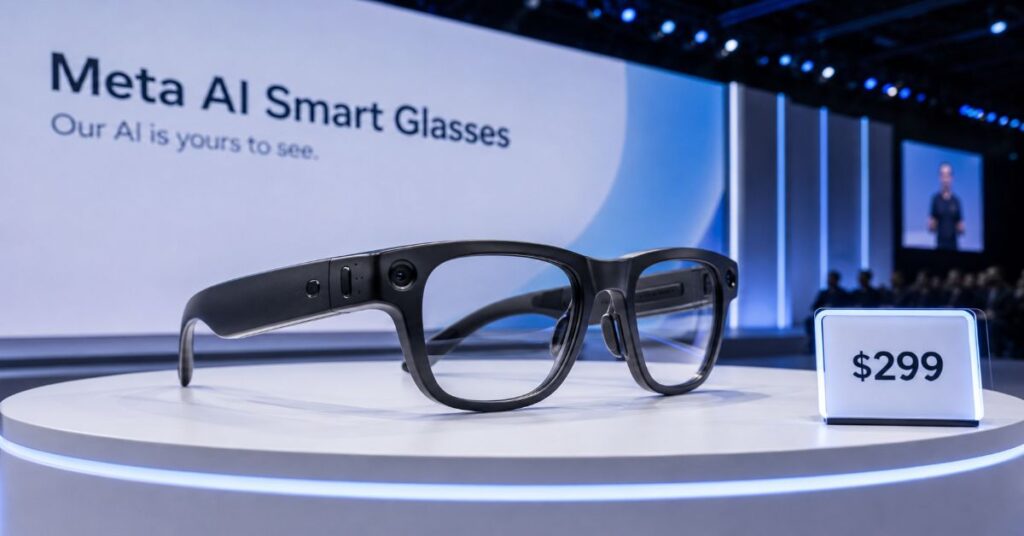
Meta Platforms and EssilorLuxottica launched Meta Glasses on June 23, 2026 — the company’s first AI smart glasses sold under its own name rather than a partner’s brand. Starting at $299 across three frame styles, and powered from day one by Muse Spark, the first AI model out of Meta’s new Superintelligence Labs division, the launch formally establishes Meta as a hardware brand in its own right rather than a technology company that sells through somebody else’s label.
EssilorLuxottica still builds the glasses. The frames still come from the same manufacturing partnership that produced the Ray-Ban Meta line. But the Ray-Ban wordmark is gone from the box, and with it goes the implicit message that consumers were buying a fashion brand that happened to contain Meta technology. The new message is the reverse: this is Meta hardware that happens to look like glasses.
Key Developments
- Meta launched Meta Glasses on June 23, 2026 starting at $299 — the company’s first AI glasses sold under its own brand, dropping the Ray-Ban label for the first time.
- The glasses run Muse Spark, the first model from Meta Superintelligence Labs, delivering multimodal AI that understands both voice commands and what the camera sees.
- Three frame styles at launch: Meta Adventurer ($299), Meta Fury ($299), and Meta Glasses by Kylie ($399), a collaboration with Kylie Jenner. All are audio-only — no in-lens display.
- EssilorLuxottica sold 7 million AI-enabled glasses in 2025. Meta and EssilorLuxottica together hold approximately 82% of the global smart glasses market per Counterpoint Research.
What Happened
According to Meta’s own launch announcement, Meta Glasses launch in three frame families: the Meta Adventurer (a rectangular frame in standard and large sizes), the Meta Fury (a bolder, chunkier silhouette), and Meta Glasses by Kylie — co-designed with Kylie Jenner, featuring a slim oval frame inspired by her personal style and a charging case with a mirror inside, priced at $399. All three run the same core hardware: a 12-megapixel ultrawide camera, 3K video recording, a five-microphone array, and open-ear speakers, with battery life rated at over eight hours of mixed use and a charging case extending total runtime to roughly 40 hours. Prescription lens support is available from day one.
The glasses are audio-first and display-free at the $299 price point. The $799 Ray-Ban Meta Display, which includes a full-colour in-lens display and a neural-band wristband for micro-gesture control, remains a separate, premium tier. Meta Glasses go on sale immediately via Meta.com, Best Buy, Amazon, LensCrafters, and Sunglass Hut in the US, UK, Canada, Australia, and select European markets. The Next Web’s hands-on report noted the camera appears smaller than in previous Ray-Ban glasses, and that Muse Spark’s AI interactions feel less scripted and more conversational than earlier Meta AI responses.
The Mechanism: What Muse Spark Actually Changes
Muse Spark is the first model Meta has released from its Superintelligence Labs division — a team it has been building since last year, separate from the broader Llama-series open-source research that defines most of Meta’s AI public profile. Unlike Llama, Muse Spark is designed specifically for Meta’s own products rather than as a general-purpose model for developers, and its launch inside the glasses rather than as a standalone API reflects a deliberate product-first positioning. The model is multimodal: it processes what the user says alongside what the glasses’ camera sees, enabling contextual answers about the real-world environment that audio-only AI assistants cannot provide.
Concrete Muse Spark features arriving at launch or imminently include live translation now covering 14 additional languages including Japanese, Mandarin, Hindi, and Korean; pedestrian turn-by-turn navigation for the displayless frames; and dynamic photo, a burst-capture feature that automatically recommends the best frame from a series of shots taken by the glasses. The same Muse Spark software upgrade is also rolling out to existing Ray-Ban Meta and Oakley Meta glasses in the US and Canada via a software update, meaning the AI capability improvement extends well beyond the new hardware launch itself.
The Backstory
The drop of the Ray-Ban name follows a years-long arc that the financial logic of the partnership made almost inevitable. EssilorLuxottica tripled Meta AI glasses sales in 2025 alone, selling 7 million units — up from roughly 2 million combined across 2023 and 2024. By January 2026, the two companies were reportedly discussing doubling production capacity to at least 20 million units annually. As those numbers grew, the case for continuing to split brand equity with a partner weakened: Meta was driving the consumer demand and the technology development, while Ray-Ban provided the initial fashion credibility that got the category started. The Oakley Meta launch in 2025 was the first signal Meta was thinking beyond a single licensed brand. The Meta Glasses launch is the second, larger step.
The launch also lands as Meta’s Reality Labs division continues to bleed — $4 billion in losses in Q1 2026 alone. The glasses line is one of the few Reality Labs products with demonstrated consumer demand at meaningful scale, which makes its commercial trajectory unusually important to the division’s longer-term narrative. At the same time, Meta is making the launch in the same week it faces a direct standoff with the Trump administration over national security reviews of its frontier AI models — creating an unusual contrast between the company’s consumer-facing AI hardware ambitions and its regulatory posture on the model side.
Reactions
EssilorLuxottica chairman and chief executive Francesco Milleri framed the Meta-branded line explicitly as an access play rather than a threat to the Ray-Ban relationship: “while our iconic brands continue to be a leading driver of adoption in the market, we see an opportunity to drive access to broader audiences through this company-branded collection. More price-sensitive consumers will have an opportunity to experience the power that wearables bring into their everyday lives.” The two-tier framing — Ray-Ban for premium, Meta for accessible — is the public answer to the obvious question of whether the $299 glasses cannibalize the $379-and-up Ray-Ban Meta range.
The Kylie Jenner collaboration on the Starfire model reflects Meta’s effort to position smart glasses as a fashion accessory rather than a tech gadget — a strategy the company has pursued since pairing Ray-Ban’s fashion credibility with its camera hardware in 2021. Jenner’s involvement mirrors the influencer-driven marketing approach that helped Ray-Ban Meta reach mainstream buyers who might not have considered a Facebook-branded wearable, extended now to Meta’s own label.
The Dispute: Privacy Where It Counts Most
Smart glasses with always-available cameras raise the same privacy concerns that have followed this category since its earliest days, and they are not made easier by the fact that Meta — a company with a long public record of regulatory friction over data use — is the company building them. Meta’s glasses lack any visible recording indicator light that bystanders in public could use to know whether they’re being filmed. The Miasma worm attack earlier this month demonstrated specifically that AI-integrated hardware tools can become attack surfaces in ways their designers don’t anticipate — a concern that applies to wearables with live camera feeds and continuous microphone access as much as it applies to coding tools.
The two-tier market structure Meta and EssilorLuxottica are building also raises a competitive-dynamics question the launch does not resolve. With approximately 82 percent of the global smart glasses market between them, the partnership has the kind of market dominance that historically attracts antitrust attention. Dropping the Ray-Ban brand from the lower-cost tier while keeping it on the premium tier — with both tiers manufactured by the same company and distributed through many of the same retailers — creates a product architecture that looks, from a regulatory standpoint, a lot like a vertically integrated distribution strategy rather than a genuine multi-brand market.
What Happens Next
Meta has signaled a steady software update cadence for Meta Glasses post-launch, with the dynamic photo feature, pedestrian navigation, and expanded live translation all listed as “coming soon” rather than day-one capabilities. The clearest near-term indicator of whether the $299 price point achieves what Meta is claiming — expanding the smart glasses category to price-sensitive buyers who were locked out at $379-plus — will be early sales velocity data, likely surfacing in EssilorLuxottica’s next quarterly results. Watch also for whether the Meta-branded line gets distribution approvals in France, Italy, and other EU markets where Meta currently lacks the privacy regulatory clearance it needs to roll out AI camera hardware freely.
Why It Matters
The launch answers a question that has been building since Ray-Ban Meta found mainstream traction: when the technology succeeds, does it stay inside the partner brand, or does it eventually migrate to the company’s own label? Meta’s answer is both — but the long-term center of gravity is now clearly the Meta brand, not Ray-Ban’s. For the broader AI hardware landscape, the $299 price point is the more strategically significant detail: it represents Meta’s first attempt to establish smart glasses as a mass-market AI interface rather than a premium niche product, competing not with other AI glasses so much as with the idea that you need a phone in your hand to access AI at all. Whether AI on your face is actually more useful than AI in your pocket — and whether consumers will pay $299 to find out — is the commercial question the launch is designed to answer. Early signs from adjacent AI commerce partnerships like L’Oréal’s ChatGPT integration suggest consumer AI spending is growing, but demand for specific form factors remains genuinely unsettled.
Sources
Meta official announcement; The Next Web; PYMNTS; SiliconAngle; The Gadgeteer; Seeking Alpha; Slashdot.
