
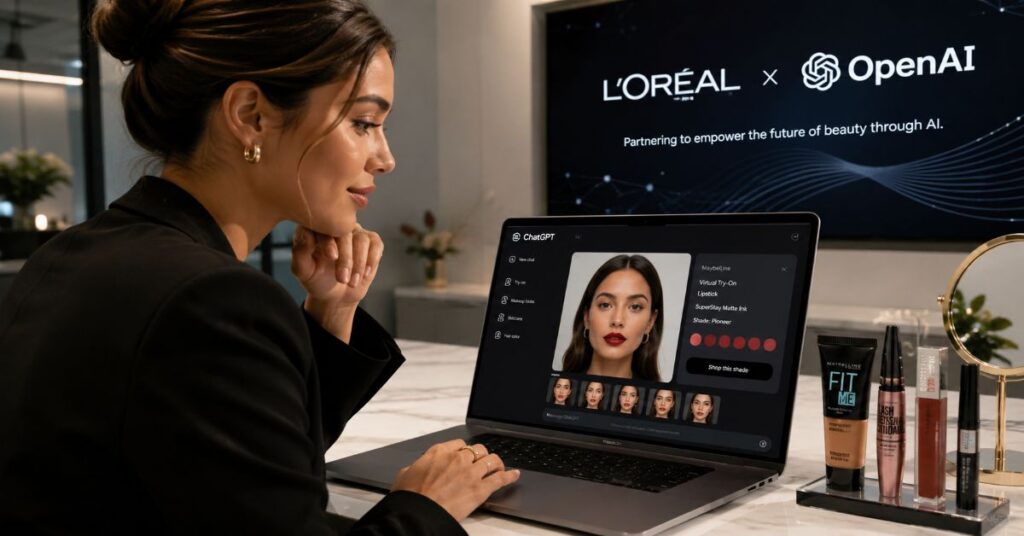
L’Oréal has spent two years teaching generative AI to write its ad copy and render its product photography. Its newest deal with OpenAI does something more ambitious: it hands ChatGPT itself a say in how 4 billion people search for mascara.
L’Oréal and OpenAI announced a wide-ranging partnership at VivaTech 2026 in Paris on June 17, structured around two priorities the companies are calling AI-powered consumer journeys and AI-powered métiers — the French word for trades or professions, here covering research, science, and marketing. The most visible piece lands first: Maybelline New York will bring its Makeup Virtual Try-On tool, built on L’Oréal’s ModiFace technology, directly inside ChatGPT later this summer, letting users test makeup looks without leaving the conversation.
But the try-on feature is the consumer-facing tip of a deal that runs considerably deeper into how L’Oréal expects to be found, advertised, and researched in an AI-mediated internet — and it arrives as the beauty industry’s biggest player makes an explicit bet that conversational AI is rewriting, not shortening, the path from search to sale.
Key Developments
- L’Oréal and OpenAI announced a multi-part partnership June 17, 2026 at VivaTech in Paris, spanning consumer commerce, advertising, and scientific research.
- Maybelline New York will integrate its ModiFace-powered virtual makeup try-on tool directly inside ChatGPT, launching this summer.
- L’Oréal will feed verified product data into ChatGPT to strengthen discovery for Lancôme and Kérastase in the US, while SkinCeuticals, CeraVe, and Garnier join OpenAI’s global ChatGPT advertising pilot.
- OpenAI’s GPT-Rosalind life-sciences model will help L’Oréal map the skin microbiome for La Roche-Posay product research.
What Happened
According to L’Oréal’s own investor announcement, the collaboration positions OpenAI as a “foundational partner” in L’Oréal’s broader Transformative AI roadmap, which the company has built around three priorities: personalizing the consumer experience, augmenting internal business functions, and accelerating research. Four concrete initiatives anchor the announcement: Maybelline’s virtual try-on inside ChatGPT; enhanced product discovery within ChatGPT in the US for Lancôme and Kérastase, built on enriched product signals L’Oréal will feed into OpenAI’s models; a global ChatGPT advertising pilot covering SkinCeuticals, CeraVe, and Garnier, designed to reach consumers at moments of shopping intent; and a research application using GPT-Rosalind, OpenAI’s life-sciences reasoning model, to map the skin microbiome for La Roche-Posay.
OpenAI’s latest model will also power CreAItech, L’Oréal’s in-house generative content engine used to produce marketing imagery and video while preserving brand-specific visual identity. No financial terms were disclosed by either company.
The Mechanism: Feeding the Model Instead of Just Buying Ads
The product-discovery piece of the deal is the one with the most lasting structural significance, because it inverts the usual relationship between a brand and a search engine. Rather than simply buying placement or hoping ChatGPT’s training data happens to describe their products accurately, L’Oréal will feed OpenAI verified, structured product data — the kind of clean catalog feed retailers already supply to Google Shopping — specifically so that when a user asks ChatGPT about a Lancôme serum or a Kérastase treatment, the answer reflects L’Oréal’s own information rather than whatever scraped, outdated, or third-party retailer copy the model might otherwise surface.
That mechanism matters because of a behavioral shift L’Oréal’s own executives are citing as the deal’s underlying rationale. Chief digital and marketing officer Asmita Dubey described what she called the “11-minute paradox” on stage at VivaTech: research she cited from Google Analytics and eMarketer suggesting that conversational AI search is lengthening the consumer journey rather than shortening it, as shoppers spend more time in extended back-and-forth with a chatbot before converting to a purchase. If that pattern holds, brands whose product data is structurally embedded in ChatGPT’s responses stand to capture a disproportionate share of a longer, more AI-mediated decision process — which is precisely the bet L’Oréal is making with this deal.
The Backstory
This is not L’Oréal’s first major AI infrastructure bet, and the OpenAI deal slots into a pattern the company has been building for two years. CreAItech itself launched in 2024 and expanded in earnest in 2025, already drawing on models and tools from Google (Gemini, Veo3, Imagen), Adobe, Stable Diffusion, and Chinese video model Seedance — OpenAI becomes the latest, not the first, model provider feeding the platform. The company signed a separate deal with Nvidia in 2025 specifically to improve GPU efficiency as CreAItech scaled, and more recently expanded that Nvidia relationship into its research-and-innovation division through Alchemi, a chemistry- and materials-science-focused AI model Dubey has described as particularly useful for product formulation.
The scale CreAItech has already reached gives the OpenAI deal real institutional weight rather than treating it as a pilot. On L’Oréal’s most recent full-year earnings call, chief executive Nicolas Hieronimus told analysts the platform had cut production costs by 40 percent, with the company’s roughly 10,000-strong global marketing staff having used CreAItech’s tools to produce 50,000 marketing assets. The company says 73,000 employees company-wide have now been trained in generative AI, supported by internal tools including L’OréalGPT and individual AI assistants — context that frames the OpenAI partnership as one more layer added to an AI stack L’Oréal has been building deliberately, not a reactive scramble to catch up.
L’Oréal was also among the first alpha testers of Google’s AI Max advertising product in 2025, running 800 campaigns across 23 countries and 30 brands — a program Google credited with driving a 23 percent sales increase for direct-to-consumer brands including NYX Professional Makeup. The OpenAI advertising pilot extends that same experimental posture to a second major AI platform rather than betting the company’s AI-commerce strategy on a single partner.
Reactions
Dubey framed the deal as raising L’Oréal’s expectations of AI rather than simply adopting it, saying the company believes it “can be more demanding of AI to augment our beauty consumers, our metiers such as Marketing and Research and our employees,” and that the OpenAI collaboration “structurally supports this ambition to bring new solutions within the beauty vertical.” OpenAI’s EMEA managing director Emmanuel Marill reciprocated in similarly strategic terms, saying the company was “excited to be working with their teams to support that next chapter, from accelerating research and innovation to helping employees work in new ways and creating more useful, intuitive experiences for consumers.”
The announcement lands as part of L’Oréal’s tenth consecutive year exhibiting at VivaTech, where the company is positioning itself, alongside LVMH’s parallel push into Google Cloud, as one of the luxury and beauty sector’s most aggressive AI adopters — a competitive framing trade coverage has echoed directly, noting that while Estée Lauder, Shiseido, and Coty have each invested in AI-driven try-on and recommendation tools, L’Oréal’s OpenAI partnership stands out specifically for its breadth across commerce, advertising, and scientific research simultaneously.
The Dispute: Whose Data, Whose Advantage
The deal raises a structural question that neither company’s public statements address directly: feeding verified product data into a dominant AI model’s discovery layer is a meaningful advantage for L’Oréal specifically, and a disadvantage for every smaller beauty brand that lacks the scale or the relationship to do the same. If ChatGPT increasingly mediates how consumers research and decide on beauty purchases — the exact behavioral shift Dubey’s “11-minute paradox” framing assumes — then which brands get to shape what the model says about their products, rather than relying on however the model happens to interpret scraped or third-party data, becomes a meaningful new axis of competitive advantage that smaller, independent beauty brands have no comparable path to access.
There is also an unresolved advertising-disclosure question embedded in the announcement. SkinCeuticals, CeraVe, and Garnier joining a “global ChatGPT advertising pilot” designed to reach shoppers “at moments of shopping intent” means paid brand content will increasingly sit alongside, or be blended into, ChatGPT’s conversational product answers — part of a broader monetization push that comes as OpenAI heads toward a targeted Q4 2026 public listing, and neither company’s materials specify how, or whether, that paid placement will be visually or structurally distinguished from organic product discovery for the consumer asking the question.
What Happens Next
The Maybelline virtual try-on feature is the most concrete near-term marker: L’Oréal has said it expects to launch inside ChatGPT this summer, which will be the first point at which the partnership’s consumer-facing impact becomes directly observable rather than promised. That launch also lines up with OpenAI’s own internal consolidation: the company is merging ChatGPT with its Codex and Atlas products into a single “superapp” built to host exactly this kind of embedded third-party brand experience, alongside partners like Canva and Booking.com. The enhanced product-discovery rollout for Lancôme and Kérastase is similarly scoped to the US market for now, leaving open whether and how quickly the structured-data approach expands to other countries or other L’Oréal brands beyond the four named in this announcement.
Why It Matters
This deal is a concrete test case for a question every consumer brand is currently wrestling with: as AI chat interfaces absorb a growing share of product research and discovery, is the right strategic move to optimize for being found accurately inside someone else’s model, or to build proprietary AI experiences instead? L’Oréal’s answer is explicitly both — it is simultaneously feeding its own data into OpenAI’s discovery layer while continuing to build out CreAItech as proprietary internal infrastructure, a dual-track approach that echoes the broader enterprise shift toward agentic AI platforms for customer experience that other consumer brands watching this deal will likely study closely as they weigh their own AI-commerce strategies over the next year.
Sources
L’Oréal Finance (investor relations); Digiday; WWD; Drug Store News; Happi; CosmeticsBusiness; FashionNetwork.
