
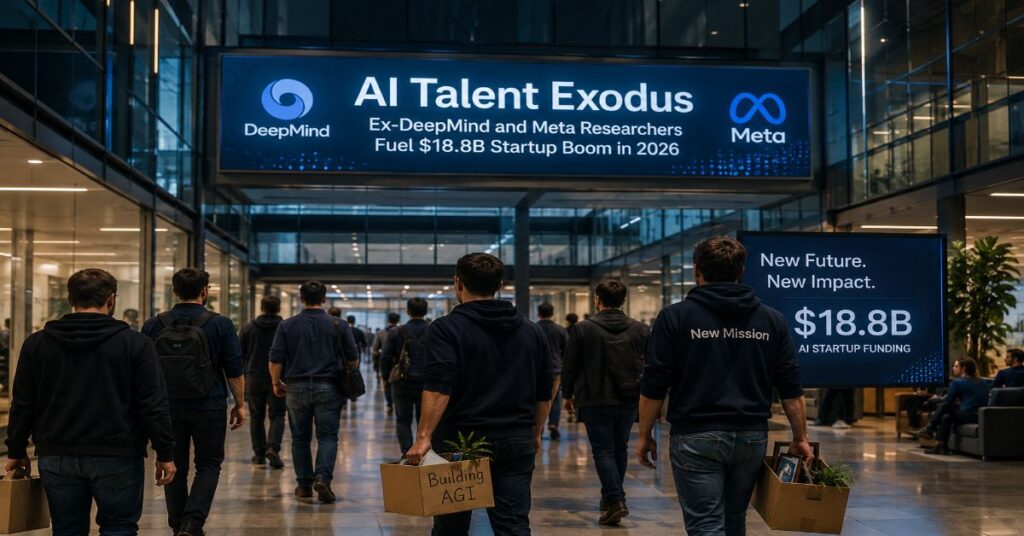
A wave of senior researchers is leaving Google DeepMind, Meta, and other frontier AI labs to launch independent startups — and venture capital is following them at a record pace. According to data from Dealroom cited by CNBC, investors have funneled $18.8 billion into AI startups founded since the start of 2025, a figure on track to surpass the $27.9 billion raised last year by companies founded since 2024.
The Headline Deals
The most striking recent example is Ineffable Intelligence, founded in late 2025 by former Google DeepMind reinforcement learning lead David Silver, one of the architects behind AlphaGo, AlphaZero, and AlphaFold. The London-based startup closed a $1.1 billion seed round in late April 2026 at a $5.1 billion valuation — reportedly the largest seed round in European history — led by Sequoia Capital and Lightspeed Venture Partners, with participation from Nvidia, Google, and the UK’s Sovereign AI Fund. Notably, Ineffable has no released product, revenue, or public roadmap; its stated goal is to build a reinforcement-learning “superlearner” that acquires knowledge without human-curated data.
Tim Rocktäschel, another former Google DeepMind researcher, has been reported by the Financial Times to be raising up to $1 billion for his new venture, Recursive Superintelligence, also UK-incorporated. Separately, Yann LeCun’s AMI Labs — founded after LeCun stepped down as Meta’s chief AI scientist — closed a $1.03 billion round in March 2026 at a $3.5 billion pre-money valuation.
Other alumni-founded ventures gaining traction include Periodic Labs (founded by former OpenAI and DeepMind staff, focused on autonomous research labs) and Ricursive Intelligence, founded by former Anthropic and Google DeepMind researchers Anna Goldie and Azalia Mirhoseini, which focuses on AI tools for chip design and raised $335 million across two rounds in December 2025 and January 2026.
Why Researchers Are Leaving
Investors and founders point to a common dynamic: as the largest AI labs sharpen their focus on commercial products and defend valuations that have reached into the hundreds of billions of dollars, researchers working on longer-horizon or less commercially obvious projects — alternative architectures, agent simulations, chip-design tooling — say that work is being deprioritized internally.
Elise Stern, managing director at French VC firm Eurazeo (an AMI Labs backer), told CNBC that founders coming from frontier labs bring “unique” insight: they know what works at scale and “exactly what is being left on the table internally.” Alexander Joël-Carbonell, a partner at HV Capital, another AMI Labs investor, said the sharpening focus on commercial goals at major labs is limiting the freedom of top researchers to pursue open-ended research.
Context: A Volatile Pattern
The exodus is not one-directional, and not every high-profile spinout has gone smoothly. Thinking Machines Lab, founded in early 2025 by former OpenAI CTO Mira Murati with a star-studded team and a $2 billion seed round, has seen multiple co-founders depart in 2026 — several returning to Meta and OpenAI — illustrating how quickly fortunes can shift even for the most heavily funded alumni ventures. Meta has been an active beneficiary of this churn, hiring several former Thinking Machines staff, including a reported $1.5 billion compensation package for one co-founder, as part of a broader AI hiring push under its Superintelligence Labs division.
Taken together, the pattern points to an unusually fluid AI labor market: massive seed checks for pre-product, pre-revenue ventures founded by researchers with frontier-lab pedigrees, alongside equally large counter-offers from the same labs they left.
Why It Matters
For an industry where talent concentration has been a key competitive advantage for a small number of companies, this level of capital flowing to alumni-founded startups suggests the center of gravity for frontier AI research may be diffusing — at least at the seed stage. Whether any of these heavily funded, pre-product ventures translate funding into results comparable to their valuations remains an open question; Ineffable Intelligence, for instance, has said first model benchmarks are not expected until late 2026.
Sources
CNBC; TechCrunch; GeekWire; TechFundingNews; AI2Work; The Next Web; MLQ.ai.
