
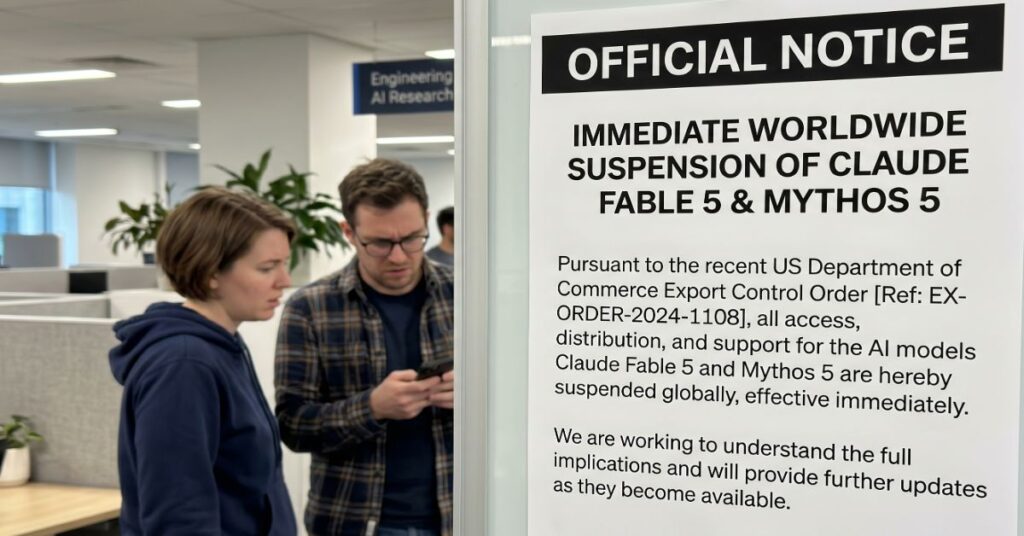
Anthropic disabled both Mythos-class models for all customers globally just three days after launch, after the US Commerce Department cited national security concerns over a possible jailbreak.
Anthropic’s newest and most capable AI models, Claude Fable 5 and Claude Mythos 5, have been suspended worldwide for all customers, just three days after their public launch. The shutdown follows a directive from the US Commerce Department that orders the suspension of access to both models for any foreign national, whether located inside or outside the United States.
Anthropic confirmed it received the directive on Friday, June 12, 2026, at approximately 5:21 PM Eastern Time. Because the company could not reliably distinguish foreign nationals from other users across its infrastructure in real time, it disabled both Claude Fable 5 and Claude Mythos 5 entirely, for every customer, rather than attempt a partial rollout of the restriction.
All other Claude models, including Claude Opus 4.8, remain fully available and unaffected by the order.
What Happened
The directive came directly from US Commerce Secretary Howard Lutnick, in a letter sent to Anthropic CEO Dario Amodei on June 1, 2026, and acted upon by Anthropic on June 12. The order requires that any export, re-export, or domestic transfer of Claude Fable 5 and Claude Mythos 5 to non-US persons receive government approval first.
In a statement, Anthropic wrote that the US government, citing national security authorities, issued an export control directive to suspend all access to Fable 5 and Mythos 5 by any foreign national, whether inside or outside the United States, including foreign national Anthropic employees. The company said the letter did not provide specific details of the government’s national security concern.
Within hours, requests to both claude-fable-5 and claude-mythos-5 began returning errors across the Claude API, Claude apps, Amazon Bedrock, Vertex AI, Microsoft Foundry, and GitHub Copilot. Anthropic said there is no workaround on the API side, as the models are disabled at the infrastructure level.
Why the US Government Acted
According to Anthropic, the directive appears to be linked to a method for bypassing, or “jailbreaking,” Claude Fable 5’s safety classifiers. Officials reportedly believe the technique could be used to assist with cybersecurity-related tasks such as vulnerability discovery.
Anthropic has pushed back firmly on the characterisation of the risk. The company said it reviewed the reported jailbreak and concluded it was narrow, non-universal, and capable of surfacing only a limited set of previously known vulnerabilities. Anthropic also noted that comparable results could reportedly be obtained using other publicly available AI models, including GPT-5.5, without bypassing any safeguards at all.
The models at the centre of the order trace back to Claude Mythos Preview, first introduced in April 2026 through Project Glasswing, a restricted access programme involving partners such as AWS and Microsoft. According to Anthropic, Mythos Preview had already helped organisations such as Mozilla identify and fix hundreds of vulnerabilities under that controlled programme.
What Were Claude Fable 5 and Mythos 5
Claude Fable 5 and Claude Mythos 5 launched on June 9, 2026, as the first publicly available models in Anthropic’s new “Mythos-class” tier, positioned above the existing Opus line. Anthropic described Fable 5 as state-of-the-art on nearly all tested benchmarks of AI capability, with particular strength in software engineering, knowledge work, vision, and long-horizon autonomous tasks lasting up to several days with minimal human intervention.
Both models shipped with a 1 million token context window and a maximum output of 128,000 tokens, priced at 10 dollars per million input tokens and 50 dollars per million output tokens, roughly twice the cost of Claude Opus 4.8.
Claude Fable 5 was generally available to all customers, while Claude Mythos 5 carried the same underlying capability but with certain safety classifiers lifted, restricted to approved Project Glasswing partners such as cybersecurity defenders. Fable 5 included safety classifiers designed to detect requests in high-risk areas such as cybersecurity, biology, chemistry, and distillation, automatically rerouting such requests to Claude Opus 4.8 instead of refusing outright.
Impact on Developers and Enterprise Users
The suspension has immediate, practical consequences for anyone who built workflows on top of Fable 5 or Mythos 5 in the days since launch.
API and Platform Customers
Any application calling claude-fable-5 or claude-mythos-5 is currently returning errors across the Claude API, Amazon Bedrock, Vertex AI, Microsoft Foundry, and GitHub Copilot integrations. There is no model-side workaround while the suspension remains in effect.
Enterprise and Agentic Workflows
Organisations that adopted Fable 5 for long-horizon agentic coding, research automation, or knowledge work must temporarily fall back to other Claude models. For software engineering tasks specifically, Claude Opus 4.8 is being widely recommended as the closest available substitute, as the capability gap between Opus 4.8 and Fable 5 narrows for tasks fitting within a few hundred thousand tokens.
Subscription Users
Fable 5 had been included at no extra cost on Pro, Max, Team, and seat-based Enterprise plans from launch through June 22, 2026, after which usage credits would have been required. With the model suspended, that billing transition is currently moot. Anthropic says users are being redirected to Claude Opus 4.8 or their selected default model.
Which Claude Models Remain Available
Anthropic has confirmed the suspension is limited to two models:
- Claude Fable 5
- Claude Mythos 5
Every other model in Anthropic’s lineup, including Claude Opus 4.8, Claude Opus 4.7, Claude Sonnet 4.6, and Claude Haiku 4.5, remains fully operational and is not affected by the export control directive in any way.
Anthropic’s Response
Anthropic said it is complying fully with the directive while disputing its underlying rationale. The company has characterised the situation as a misunderstanding and criticised the lack of technical detail provided alongside the order, arguing that future restrictions on frontier AI systems should be grounded in transparent, technical review rather than emergency directives.
In its public statement, Anthropic apologised for the disruption to customers and said it is working with US authorities to clarify the security concerns and restore access to Fable 5 and Mythos 5 as quickly as possible. As of publication, no timeline for restoration has been provided.
A New Direction for AI Export Controls
The suspension marks a notable shift in how export controls are being applied to artificial intelligence. Previous US export restrictions in the AI space have focused primarily on hardware, including advanced GPUs and semiconductor manufacturing equipment destined for certain countries. This directive instead targets access to a deployed software model itself, based on its capabilities rather than the hardware it runs on.
The timing is also notable. The suspension lands just days after Anthropic publicly urged major AI labs to coordinate on safety brakes for frontier AI development, and as the company reportedly works toward a future public listing alongside other major AI players.
Whether this becomes an isolated incident or the first of a broader pattern of capability-based export restrictions on AI models is likely to become a significant point of discussion across the AI industry and among policymakers in the months ahead.
What Happens Next
For now, the practical guidance for affected users is straightforward: route software engineering and agentic workloads previously built on Fable 5 to Claude Opus 4.8, and monitor Anthropic’s official channels for updates on restoration. Anthropic has said it will communicate any changes ahead of time so customers know where things stand.
Perplexity AI Magazine will continue to track developments on this story as Anthropic and US authorities work toward a resolution.
