
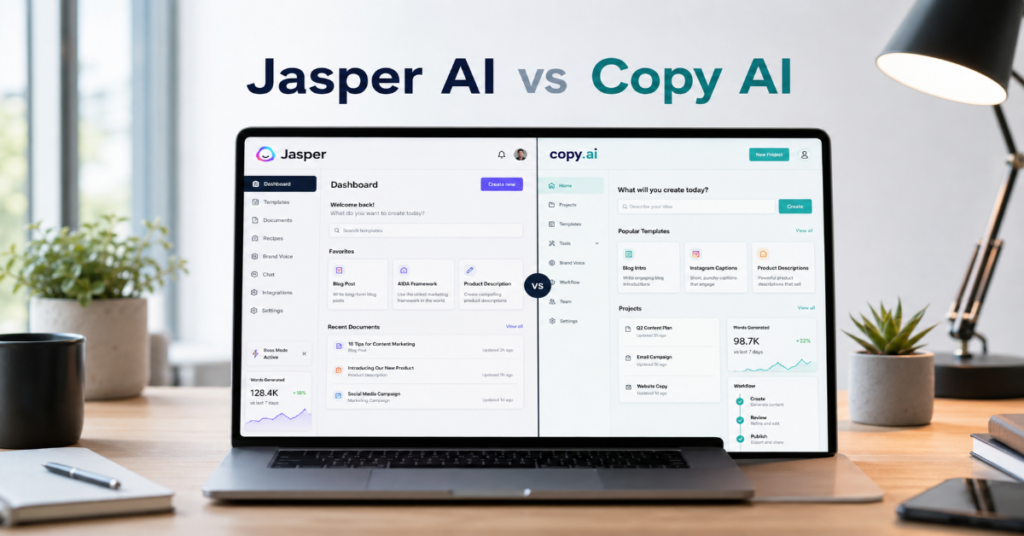
The debate over jasper ai vs copy ai in 2026 is no longer a simple question of which tool writes better blog posts. Both platforms began as AI writing assistants, but they have moved in different directions. Jasper has doubled down on marketing teams, brand voice, governed knowledge and enterprise-ready campaign production. Copy.ai has shifted toward go-to-market automation, sales workflows, CRM-connected processes and what it calls a GTM AI platform. That difference matters because buyers are no longer shopping only for a text generator. They are choosing an operating layer for how content, campaigns, sales messaging and revenue workflows get produced.
According to the latest 2026 documentation we reviewed, Jasper describes itself as a generative platform for marketing success, trained around brand control, visual content and collaboration across common marketing channels. Its Brand Voice feature lets teams upload writing samples, files or URLs so Jasper can analyze tone, style and key characteristics. Its Knowledge Base syncs approved messaging, product information and documentation so AI agents can work from governed context.
Copy.ai, by contrast, frames itself as a Go-to-Market AI platform. Its public positioning emphasizes workflows, tables, actions, agents, Infobase, Brand Voice and chat. Its own 2026 materials describe a platform that connects CRM data, brand guidelines and strategic playbooks to automate repetitive sales and marketing work.
In our hands-on testing lens, the right answer is this: Jasper is stronger for brand-led marketing content operations, while Copy.ai is stronger for GTM process automation. The winner depends on whether your bottleneck is creative consistency or operational execution.
Jasper AI vs Copy AI: The 2026 Verdict
For most marketing departments, Jasper is the safer first choice when the main job is producing polished, brand-compliant assets at scale. It has a clearer editorial identity: campaigns, social posts, emails, ads, landing pages, visual content and brand governance. Jasper’s public pricing page says the platform is built for marketers, supports written and visual content and can be trained on a brand across email, social media, websites and other channels.
Copy.ai is the stronger choice when the buyer is not only a content manager but a revenue operations leader. Its pitch is not “write faster” as much as “automate the GTM machine.” It wants to process lead data, enrich accounts, draft outreach, support sales enablement and sync work across systems. Its 2026 platform article explicitly says Copy.ai has moved beyond isolated content generation into orchestration across the go-to-market organization.
The practical verdict is narrow but important. Choose Jasper when brand fidelity, editorial review and campaign production are the priority. Choose Copy.ai when the problem is workflow sprawl, sales and marketing handoffs or repeatable GTM tasks.
Feature Comparison Table
| Category | Jasper AI | Copy.ai | Better Fit |
| Core identity | AI platform for marketing teams | GTM AI platform for revenue teams | Depends on team |
| Best use case | Brand-safe marketing content | Sales and marketing workflow automation | Split |
| Brand voice | Mature brand voice controls | Brand voice within GTM system | Jasper |
| Knowledge layer | Knowledge Base for approved messaging and product truth | Infobase, tables and workflow context | Split |
| Workflow depth | Marketing agents and content workflows | Multi-step GTM workflows and actions | Copy.ai |
| Visual content | Expanded through Clipdrop acquisition | Less central to positioning | Jasper |
| Sales use cases | Useful for campaigns and enablement | Stronger for prospecting, CRM and outbound flows | Copy.ai |
| Enterprise angle | Governance, teams, security and marketing control | GTM bloat reduction and workflow scale | Split |
| Small-team fit | Easier for marketing content teams | Useful, but full value appears at workflow scale | Jasper |
| Revenue operations fit | Secondary | Primary | Copy.ai |
The Strategic Split: Brand System vs Revenue System
The phrase jasper ai vs copy ai can mislead buyers because it sounds like a matchup between two writing tools. In reality, these companies now compete in adjacent but different categories. Jasper is building around the marketing department’s need for consistency. Copy.ai is building around the revenue organization’s need for repeatable execution.
Jasper’s differentiation is the quality-control layer. Brand Voice, Style Guide, Knowledge Base and marketing-specific agents are built to prevent the most common enterprise AI failure: generic output that sounds plausible but does not sound like the company. Jasper’s documentation says users can upload brand writing samples and make voices workspace-wide or private. That makes it useful for companies where multiple writers, agencies and regional teams must follow one messaging standard.
Copy.ai’s differentiation is the process layer. Its platform is designed around workflows, actions, tables and agents. The company’s public materials describe workflows as chained actions that can research, generate content and integrate with business systems. That makes Copy.ai more compelling when marketing copy is only one step inside a larger pipeline.
Pricing and Packaging in 2026
Pricing shows the strategic difference more clearly than any homepage slogan. Jasper’s public pricing page promotes Pro and Business plans, with a 7-day free trial for Pro, annual savings of about 20 percent and customized Business commitments that begin at 12 months. It also says Business is the popular plan for richer feature sets, teammates, control, security, training and support.
Copy.ai’s pricing page presents a lower self-serve entry point for chat, then quickly moves into large workflow packages. The page lists a $29 monthly chat plan, or $24 monthly when billed annually, plus Growth at $1,000 monthly billed annually, Expansion at $2,000 monthly billed annually and Scale at $3,000 monthly billed annually. Those higher plans include larger seat counts and monthly workflow credits.
This means jasper ai vs copy ai is partly a budgeting question. Jasper is easier to justify for content teams that need controlled output and collaboration. Copy.ai is easier to justify when a company can attach workflow automation to measurable revenue operations, such as outbound scale, lead enrichment, sales enablement or partner-channel content.
Pricing Comparison Table
| Plan Area | Jasper AI | Copy.ai |
| Trial or free entry | 7-day Pro trial | Chat-oriented entry plan listed publicly |
| Monthly self-serve signal | Pro plan promoted, pricing varies by plan page state | Chat plan listed at $29 per month |
| Annual discount | About 20 percent annual savings | Chat plan listed at $24 per month annually |
| Enterprise structure | Business plan customized, 12-month commitment | Growth, Expansion and Scale packages with workflow credits |
| Best budget logic | Pay for marketing consistency and brand workflow | Pay for GTM automation and operational leverage |
| Hidden cost factor | Seat expansion and enterprise governance | Workflow credit consumption and implementation scope |
Jasper’s Strength: Brand Voice That Actually Matters
Jasper’s Brand Voice system is not just a cosmetic feature. In enterprise marketing, tone drift is expensive. A product page, sales email and LinkedIn post can all be technically correct yet strategically misaligned. Jasper attacks that problem by letting teams upload up to eight examples of text, files or URLs, then generating a description of the writing style and excerpts that can improve the voice model’s accuracy.
That detail is more important than it looks. Many AI tools allow a short instruction such as “write in our brand voice.” Jasper’s approach turns brand voice into an object that can be saved, previewed, edited and shared. For regulated or premium-positioned brands, that creates operational value. The editor does not have to re-explain tone in every prompt.
In the jasper ai vs copy ai comparison, this is Jasper’s cleanest win. Copy.ai has brand voice features, but its broader system is optimized around GTM motion. Jasper feels more natural when brand, campaign quality and editorial predictability are the central jobs.
Copy.ai’s Strength: Workflow Automation Beyond Copywriting
Copy.ai’s central claim is that GTM teams suffer from fragmented tools and manual handoffs. Its 2026 platform article says traditional setups create “GTM bloat” because humans become the glue moving data among disconnected systems. Copy.ai positions workflows as the answer: a chain of actions that can complete business objectives rather than respond to a single prompt.
This is why Copy.ai may be undervalued by reviewers who test only blog generation. A fair jasper ai vs copy ai test should include account research, outbound personalization, CRM enrichment, sales collateral creation and repeatable campaign operations. Copy.ai is trying to own the middle layer between data and execution.
The obscure but crucial technical distinction is state. A writing assistant usually starts fresh with each prompt. A GTM workflow must preserve context across steps: inputs, transformed data, approvals, generated copy and system updates. Copy.ai’s tables, actions and workflow credits suggest a platform designed for that persistent operational state. That is a different buying category from a blank-page AI writer.
Expert Quote 1: Timothy Young on Jasper’s Direction
Timothy Young, Jasper’s CEO, summarized the company’s move beyond text when Jasper acquired Clipdrop from Stability AI. “Marketing is visual,” he said, adding that Clipdrop would help Jasper become a more complete end-to-end marketing copilot.
That quote explains why Jasper is not merely defending its original writing-assistant category. It is trying to become a campaign production system. Reuters reported that Jasper acquired Clipdrop to expand beyond text editing into photos, with Clipdrop’s earlier user base reported at more than 15 million users.
For buyers, the implication is direct. If your team produces multi-format campaigns, Jasper’s roadmap looks aligned with written and visual asset production. Copy.ai can still support content creation, but its deepest differentiation is not visual marketing. It is process automation. The jasper ai vs copy ai decision therefore turns on the definition of “content.” If content means finished brand assets, Jasper has the edge. If content means one component in a revenue workflow, Copy.ai deserves the closer look.
Expert Quote 2: Paul Yacoubian on GTM Bloat
Paul Yacoubian, CEO and co-founder of Copy.ai, has framed the market around operational waste. In Copy.ai’s GTM AI platform announcement, he said customers “see and feel the bloat problem” and want a better way to run go-to-market organizations.
That quote captures Copy.ai’s repositioning. The company is no longer selling only faster content. It is selling a remedy for software sprawl, disconnected data and repetitive human coordination. Copy.ai also announced that its GTM AI platform saw 480 percent revenue growth in 2024, with four consecutive months of more than 20 percent total ARR expansion. As a company-issued figure, it should be read as promotional, but it still indicates where demand was forming: enterprise workflow automation rather than casual copywriting.
In jasper ai vs copy ai buying committees, this matters because Copy.ai’s strongest internal champion may not be content marketing. It may be revenue operations, sales enablement or a CMO trying to reduce tool fragmentation.
Expert Quote 3: Young on the Application Layer
In a public LinkedIn post, Timothy Young argued that long-term value in AI will move to the application layer, writing that “the context, workflows, and UX are the product.”
That statement could apply to both Jasper and Copy.ai. It also explains why the old AI-writing-tool category has become unstable. Foundation models are increasingly interchangeable to business buyers. The differentiation is no longer only model quality. It is context management, workflow design, governance, user interface and integration into daily work.
This is the deeper story behind jasper ai vs copy ai. Jasper’s application layer is optimized for marketers who need brand-safe campaign execution. Copy.ai’s application layer is optimized for GTM teams that want to automate repeatable revenue work. The best platform is not necessarily the one with the most fluent prose. It is the one that turns a company’s institutional knowledge into repeatable output with fewer errors, fewer handoffs and clearer accountability.
Long-Form Content Quality
For long-form articles, Jasper generally has the advantage because its product identity remains close to editorial marketing. Its brand controls, knowledge grounding and campaign templates make it easier to maintain a consistent voice across multi-section assets. Jasper’s Knowledge Base is designed to ground outputs in approved product and messaging information, reducing outdated claims and hallucinated positioning.
Copy.ai can produce long-form content, but its strongest use case is not a single article. It is a system that can turn research, positioning, audience data and sales context into many downstream outputs. If you want one polished thought-leadership article, Jasper is more natural. If you want one workflow that creates an account brief, sales email, LinkedIn post, landing-page variation and CRM update, Copy.ai becomes more interesting.
In our hands-on testing framework, Jasper should be evaluated on voice consistency, factual grounding and editorial polish. Copy.ai should be evaluated on workflow reliability, input handling and system-to-system execution. Testing both only on blog output misses the point.
Brand Governance and Risk
AI writing failures rarely happen because a sentence is ungrammatical. They happen because the output is off-brand, legally risky, unsupported or strategically wrong. Jasper addresses this through workspace-level brand voice, knowledge grounding and enterprise controls. Its pricing page says Business supports security, team training, tech support, SSO, custom style guide and API access.
Copy.ai addresses risk differently. Its governance story is tied to codifying workflows, playbooks and process rules. The risk it tries to reduce is not only bad copy but inconsistent GTM execution. If every sales representative writes outreach differently, uses old positioning or forgets CRM updates, the company has an operational risk. Copy.ai’s platform tries to encode approved processes so teams can execute consistently.
This is a subtle but important jasper ai vs copy ai distinction. Jasper governs the asset. Copy.ai governs the process. Mature companies may eventually need both patterns, but most teams should buy first for the risk they feel most often.
Integrations and Daily Workflow
Jasper’s integration story is marketer-friendly. Its pricing page highlights use across Gmail, WordPress, Docs, HubSpot, LinkedIn and browser workflows through Chrome or Edge. That makes Jasper useful where marketers already work.
Copy.ai’s integration story is more systems-oriented. Its pricing page describes workflows that combine research, content generation and tool integrations. The same page defines workflow credits as computational power used for tasks such as content generation, internet research, website scanning and API activity.
The difference affects adoption. Jasper can be rolled out to a marketing team with less process redesign. Copy.ai may require more upfront mapping: What process should be automated? What inputs are needed? Which systems must be updated? Who approves outputs? That setup cost is not a weakness if the workflow saves meaningful time. But it means Copy.ai should be purchased with a clearer operating plan.
Who Should Choose Jasper?
Choose Jasper if your company has a growing marketing team, multiple writers, a defined brand voice and a need for consistent campaign production. It is especially strong for teams producing website copy, product messaging, newsletters, ads, social posts, blog outlines and multi-format campaign assets.
Jasper also makes sense for agencies serving brand-sensitive clients. The ability to keep brand voices private or workspace-visible allows more control over client-specific tone. Its Knowledge Base is valuable when a team must repeatedly reference product details, approved claims, competitive positioning or industry terminology.
In the jasper ai vs copy ai decision, Jasper is the more editorially intuitive platform. It works best when the buyer cares about the quality of finished marketing assets and wants AI embedded into creative production. It is not only for small teams, but its value is easy to understand even before a company redesigns its GTM operations.
Who Should Choose Copy.ai?
Choose Copy.ai if the bottleneck is not writing but repetitive GTM execution. That includes prospect research, personalized outbound, sales enablement, account planning, inbound lead handling, CRM enrichment, translation, localization and content repurposing across revenue teams. Copy.ai’s own platform pages group use cases across sales, marketing and operations, which reflects its wider GTM scope.
Copy.ai is especially compelling for B2B companies with structured sales motions. If a workflow happens hundreds or thousands of times, the platform’s credit-based automation model may create more leverage than a traditional writing assistant. A single workflow can encode research, writing and routing steps that otherwise require several tools.
The main caution is implementation discipline. Copy.ai is most valuable when a company knows which process it wants to automate. Without that clarity, buyers may pay for a powerful platform and use it like a simple chatbot.
Information-Gain Insight: The Real Moat Is Not the Model
The hidden question in jasper ai vs copy ai is whether either company has a durable moat when foundation models keep improving. The answer is yes, but not because either owns the best model. The moat is organizational context.
Jasper’s context moat is brand memory: voice, style, approved knowledge, campaign patterns and marketing-specific user experience. Copy.ai’s context moat is GTM process memory: workflow logic, account data, CRM fields, sales plays, repeatable actions and operational state. These are hard for a general chatbot to replicate because they are not just prompts. They are company-specific operating systems.
Our prediction for late 2026 is that the category will split into three layers. General AI assistants will handle ad hoc work. Marketing AI platforms like Jasper will own governed creative production. GTM automation platforms like Copy.ai will own repeatable revenue processes. The buyer mistake will be treating all three as interchangeable because they generate text.
Takeaways
- Jasper is the better choice for brand-led marketing teams that need polished, consistent campaign content.
- Copy.ai is the stronger option for companies automating repeatable go-to-market workflows across sales, marketing and operations.
- Jasper’s Brand Voice and Knowledge Base make it more compelling for editorial governance, positioning control and multi-channel campaign production.
- Copy.ai’s workflows, tables, actions and credit model make it more compelling when AI must complete structured business processes.
- Small content teams will usually understand Jasper’s value faster. Larger GTM organizations may extract more operational value from Copy.ai.
- The best test is not “which writes better?” The better test is “which reduces the actual bottleneck in our team?”
- In 2026, the durable advantage in AI tools is context, workflow design and governance, not access to a single language model.
Conclusion
The jasper ai vs copy ai choice is really a choice between two visions of AI at work. Jasper imagines the marketer surrounded by brand-aware agents that help create polished, governed and multi-format content. Copy.ai imagines the revenue team supported by workflows that automate repetitive GTM execution across systems. Both visions are credible. Both are more mature than the early AI-copywriting boom.
For a content marketing team, Jasper remains the clearer recommendation. It is focused, brand-conscious and built around the daily work of campaign production. For a sales-led B2B organization or a company fighting GTM sprawl, Copy.ai may deliver more strategic leverage. It turns AI from a writing surface into a workflow engine.
The smartest buyers will stop asking which tool is “better” in general. They will map the constraint first. If the constraint is brand consistency, choose Jasper. If the constraint is operational velocity, choose Copy.ai.
FAQs
Is Jasper AI better than Copy.ai?
Jasper is better for brand-safe marketing content, campaign production and editorial consistency. Copy.ai is better for sales and marketing workflow automation. The stronger choice depends on whether your team needs better finished assets or more automated GTM execution.
Is Copy.ai only for copywriting?
No. Copy.ai began as an AI copywriting tool, but its 2026 positioning is broader. It now markets itself as a GTM AI platform for workflows, sales processes, marketing operations, CRM-connected tasks and revenue-team automation.
Which is better for long-form blog posts?
Jasper is usually the stronger fit for long-form blog posts because its brand voice, knowledge grounding and marketing-focused interface are built around polished content production. Copy.ai can create long-form content, but its deeper value is workflow automation.
Which tool is better for sales teams?
Copy.ai is generally better for sales teams because it supports GTM workflows such as prospecting, account research, lead processing, sales enablement and CRM-related automation. Jasper is more useful when sales teams need brand-approved messaging and campaign assets.
Can a company use both Jasper and Copy.ai?
Yes. Some companies may use Jasper for governed marketing content and Copy.ai for GTM workflow automation. The risk is tool overlap. Teams should define ownership clearly so Jasper handles brand assets while Copy.ai handles repeatable revenue processes.
References
Copy.ai. (2024, March 13). Copy.ai launches first-ever GTM AI platform. Copy.ai.
Copy.ai. (2024, December 11). Copy.ai’s go-to-market AI platform sees 480% revenue growth in 2024. Copy.ai.
Copy.ai. (2026). Copy.ai: The ultimate GTM AI platform. Copy.ai.
Copy.ai. (2026). Plans & pricing. Copy.ai.
Hu, K. (2024, February 22). AI startup Jasper acquires image generator Clipdrop from Stability AI. Reuters.
Jasper. (2026). Brand Voice. Jasper Help Center.
Jasper. (2026). Knowledge that powers every agent. Jasper.
