
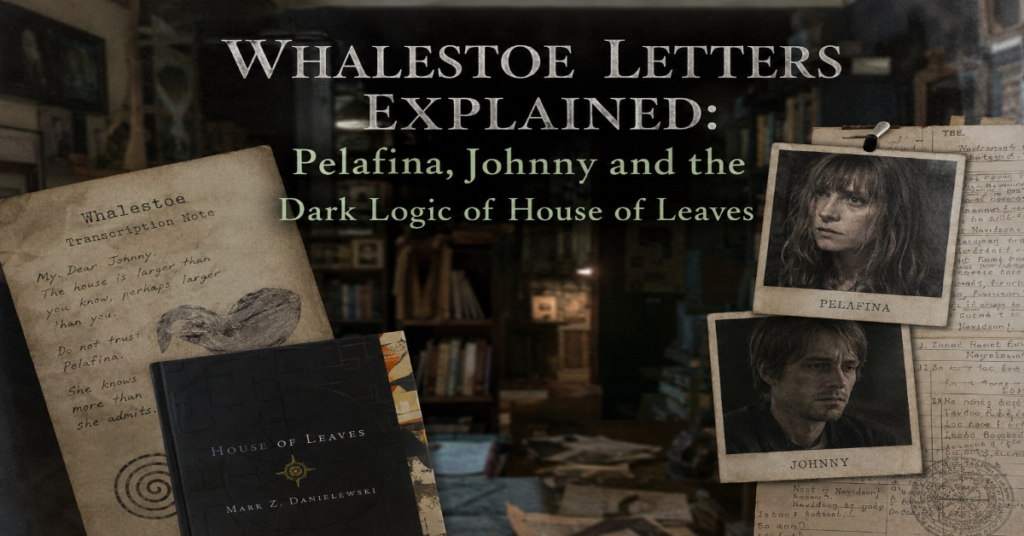
The whalestoe letters are a short but central companion text to Mark Z. Danielewski’s House of Leaves. They collect letters written by Pelafina H. Lièvre to her son Johnny Truant while she is confined at the fictional Three Attic Whalestoe Institute in Ohio. Penguin Random House describes the correspondence as letters sent between 1982 and 1989 from a psychiatric facility, centered on the relationship between a “brilliant though mentally ill mother” and her son.
For readers of House of Leaves, these letters do more than fill a biographical gap. They change the emotional temperature of the whole novel. Johnny’s fear, erotic dissociation, fragmented memory and unreliable narration begin to look less like isolated instability and more like symptoms of inherited damage. Pelafina is not simply “the mad mother” in the background. She is a writer inside the novel’s writing system, a voice that uses affection, riddles, repetition, literary reference and coded distress to reach a son she cannot physically protect.
The standalone edition, published by Knopf Doubleday/Pantheon in 2000, expands the material beyond the version included in House of Leaves. Google Books lists The Whalestoe Letters: From House of Leaves as a 104-page work by Mark Z. Danielewski with ISBN 9780375714412. The article brief also requires the piece to treat the text as an epistolary work embedded in, then separated from, House of Leaves.
What Are the Whalestoe Letters?
The Whalestoe Letters are fictional epistolary documents attributed to Pelafina H. Lièvre, Johnny Truant’s mother. In House of Leaves, they appear in Appendix II as part of the novel’s documentary architecture. In the separate edition, the letters are presented with additional material that allows Pelafina’s voice to stand more independently.
| Element | Function in the text |
| Pelafina H. Lièvre | Mother, patient, letter writer and unstable witness |
| Johnny Truant | Son, future narrator and emotional recipient |
| Three Attic Whalestoe Institute | Fictional psychiatric institution in Ohio |
| Date range | 1982 to 1989 |
| Form | Letters, coded messages, emotional fragments |
| Literary role | Expands Johnny’s trauma and complicates reader trust |
The letters are not a simple supplement. They are part of Danielewski’s larger system of nested documents. House of Leaves is already built from manuscripts, editorial notes, footnotes, appendices, invented scholarship and fragmented testimony. Penguin Random House’s reading guide describes the novel as an experience built from footnotes, appendices, poems, music, letters, journal entries and shifting visual formats.
That matters because Pelafina’s letters do not sit outside the maze. They are one of its corridors.
Why Pelafina’s Voice Matters
Pelafina is written as intelligent, unstable, tender, manipulative, frightened and rhetorically dazzling. Her letters often move from maternal affection into disordered association. A sentence may begin with ordinary concern for Johnny, then slip into verbal excess, coded pattern or private symbolic logic.
This is the first major insight: the letters do not merely represent mental illness as confusion. They represent mental illness as a language problem. Pelafina cannot rely on ordinary institutional channels, family structure or stable memory. So she overinvests in language. Words become a substitute for touch, custody, testimony and rescue.
Her writing creates three simultaneous effects:
| Effect | How it appears | Reader impact |
| Maternal intimacy | Pet names, advice, longing, apologies | Builds sympathy for Pelafina |
| Psychological instability | Fragmentation, leaps in logic, verbal intensity | Makes interpretation uncertain |
| Hidden testimony | Codes, acrostics, abnormal capitalization | Suggests buried violence |
This is why the letters are so disturbing. They are beautiful and unsafe at the same time.
Mental Illness as Form, Not Decoration
Many fictional works describe mental illness from the outside. The whalestoe letters attempt something more formally risky: they make instability visible through syntax, structure and reader labor.
Pelafina’s mind is not summarized by another narrator. It is staged through the pressure she puts on the page. Her letters often feel overfull, as though every sentence must carry love, fear, memory, self-defense and accusation at once. This density mirrors the wider design of House of Leaves, where typography and textual arrangement force the reader to work physically and cognitively through the book.
Academic discussion of House of Leaves often emphasizes its unusual relationship between text, space and trauma. One thesis on trauma representation argues that Danielewski combines textualization and typography to represent trauma through the structure of the novel itself. Another study describes House of Leaves as using textual space and metafictional strategies to make the reader more active in interpretation.
Pelafina’s letters operate by the same principle. Mental illness is not just content. It is form.
The Hidden Codes and Their Ethical Problem
The most famous feature of the letters is their hidden messaging. Readers have long discussed acrostics, capital-letter patterns and other methods that reveal darker meanings beneath Pelafina’s surface text. Fan chronologies and reading guides often track coded letters and place them inside the larger timeline of House of Leaves.
The temptation is to treat these codes as puzzles to solve. That is partly fair. Danielewski’s fiction invites decoding. But treating the letters only as puzzles risks flattening Pelafina into a game mechanic.
The better reading is more uncomfortable. The codes show how trauma often survives by hiding inside acceptable speech. Pelafina cannot simply state everything plainly. Whether because of institutional surveillance, psychological fragmentation or narrative design, her most dangerous meanings arrive indirectly.
This creates an ethical problem for the reader. Decoding may reveal hidden violence, but it can also feel invasive. The reader becomes investigator, witness and trespasser.
Pelafina and Johnny: Love Under Constraint
The emotional core of the letters is the mother-son relationship. Pelafina loves Johnny intensely, but her love is compromised by separation, illness and the conditions of confinement. Johnny receives a mother through paper rather than presence.
That absence helps explain his later instability in House of Leaves. Johnny’s narration is full of bravado, sexual detachment, paranoia and collapsing boundaries between reality and imagination. The letters suggest that his adult voice is haunted not only by Zampanò’s manuscript, but by earlier emotional abandonment.
This does not mean Pelafina is reducible to blame. The text is more complex than that. She is both damaging and damaged. She is a mother who cannot mother safely, a patient whose testimony may be unreliable and a writer whose language sometimes sees more clearly than anyone around her.
Comparison: Appendix Version vs Standalone Edition
| Feature | House of Leaves Appendix | Standalone Whalestoe Letters |
| Reading context | Embedded inside the larger novel | |
| Main effect | Reframes Johnny’s narration | |
| Extra material | More limited | |
| Reader experience | Fragmentary and delayed | |
| Standalone value | Lower without House of Leaves context | |
| Best use | Essential for full novel interpretation |
The standalone edition has a different effect. It gives Pelafina more room. In House of Leaves, her letters are one chamber inside a larger architectural nightmare. In the separate book, they become the central performance.
That shift changes the reader’s attention. The house, Navidson, Zampanò and the editorial apparatus recede. Pelafina’s voice becomes the main labyrinth.
Strategic and Practical Implications for Readers
For students, critics and first-time readers, the practical question is reading order. Should the letters be read during House of Leaves, after it or separately?
The best answer depends on purpose.
| Reader goal | Recommended approach |
| First reading of House of Leaves | Read the letters when the novel directs you to the appendix |
| Literary analysis | Read the appendix version, then compare the standalone edition |
| Character study of Johnny | Treat Pelafina’s letters as essential primary material |
| Mental illness theme | Track changes in syntax, tone, address and coded speech |
| Puzzle decoding | Decode only after reading for emotional meaning first |
The Whalestoe Letters work best when read twice. The first reading should follow emotion. The second can follow pattern.
Risks and Trade-Offs in Interpretation
There are three major risks when writing about this text.
First, do not diagnose Pelafina as if she were a real patient. She is a fictional character constructed through literary technique. Clinical language may help describe patterns, but it should not replace interpretation.
Second, do not treat hidden messages as the only “real” content. The surface letters matter. Their tenderness, repetition and theatricality are part of the meaning.
Third, do not romanticize mental illness. Danielewski’s prose can be beautiful, but the beauty is tied to suffering, confinement and relational harm. A responsible reading holds both facts together.
Cultural Impact: Why the Letters Still Matter
The continuing interest in the whalestoe letters comes from the way they combine literary difficulty with emotional directness. House of Leaves has remained a cult text partly because it rewards rereading, annotation and community interpretation. Goodreads lists thousands of ratings for The Whalestoe Letters, showing that the companion text continues to circulate as its own object of reader attention.
The letters also anticipate a modern reading culture built around screenshots, decoding threads, fan annotations and nonlinear engagement. Readers do not simply consume them. They investigate them. That makes Pelafina’s correspondence feel unusually contemporary, even though the book was published in 2000.
The Future of Whalestoe Letters in 2027
By 2027, the strongest future for The Whalestoe Letters is likely academic and community-based rather than commercial. The work is not a mass-market franchise object in the usual sense. Its value lies in annotation, pedagogy, digital reading groups and trauma-focused literary analysis.
Three trends support that future.
First, House of Leaves remains a durable object of print-era experimentation. Its design resists clean digital flattening, which makes physical editions and annotated reading communities more important.
Second, readers are increasingly comfortable with nonlinear texts. Hypertext, ARGs, fan wikis and puzzle-based media have trained audiences to read across fragments, clues and hidden structures.
Third, mental health representation is now read with more ethical attention than it was in 2000. Future discussion of Pelafina will likely be less interested in calling her “mad” and more interested in how institutions, family separation and narrative authority shape her voice.
The uncertainty is adaptation. Danielewski has explored screen possibilities for House of Leaves in the past, and public discussion around a TV version has circulated for years. But the letters would be difficult to adapt without losing their textual force. Their power is in writing, spacing, coding and rereading.
Takeaways
• Pelafina’s letters are not background material. They are central to understanding Johnny Truant’s emotional structure.
• The text uses epistolary form to turn absence into presence. Johnny has a mother through language, not through touch.
• The hidden codes should be read as trauma signals, not merely as puzzles.
• Pelafina’s instability is written into form, syntax and structure rather than explained from a safe distance.
• The standalone edition gives her voice more autonomy, but House of Leaves gives it fuller architectural context.
• The text remains culturally relevant because it rewards rereading, annotation and collective interpretation.
Conclusion
The Whalestoe Letters endure because they make the reader feel the burden of interpretation. Pelafina’s letters are loving, unstable, coded and sometimes terrifying. They do not solve House of Leaves. They deepen its wounds.
Their importance lies in how they connect private trauma to textual form. Johnny’s later fragmentation becomes harder to dismiss once Pelafina’s voice is heard directly. At the same time, the letters resist easy sympathy. Pelafina is vulnerable, brilliant and unreliable. She is a mother reaching for her son through a system that may be watching her, limiting her or failing her.
For that reason, the letters should be read slowly. Decode them, but do not only decode them. Their surface tenderness matters as much as their buried darkness. In Danielewski’s fiction, the most frightening spaces are not always houses. Sometimes they are the gaps between a mother’s words and what those words are trying to survive.
FAQ
What are the whalestoe letters?
They are fictional letters written by Pelafina H. Lièvre to Johnny Truant from the Three Attic Whalestoe Institute between 1982 and 1989. They appear in House of Leaves and were later published as a separate companion text.
Are The Whalestoe Letters necessary to understand House of Leaves?
They are not required for the basic plot, but they are essential for understanding Johnny’s emotional history, family trauma and unreliable narration.
Who wrote The Whalestoe Letters?
They were written by Mark Z. Danielewski as part of the fictional world of House of Leaves. Inside the story, the letters are attributed to Pelafina H. Lièvre.
What do the hidden messages in the letters mean?
Some letters contain coded messages that suggest darker material beneath Pelafina’s surface language. They are often read as signs of trauma, institutional violence or concealed testimony.
Should I read The Whalestoe Letters before House of Leaves?
Most readers should read House of Leaves first or read the letters when the novel directs them to the appendix. The standalone edition works best after the main novel.
Is Pelafina a reliable narrator?
Not fully. Her letters are emotionally powerful but unstable. The point is not to decide whether she is simply reliable or unreliable, but to study how love, illness and confinement distort testimony.
Methodology
This article was prepared from the supplied editorial brief, publisher descriptions, bibliographic listings and literary-critical context for House of Leaves. The article uses Penguin Random House for the book description and relationship context, Google Books and retail bibliographic pages for publication data and academic sources for broader claims about typography, metafiction, trauma and reader participation.
References
Danielewski, M. Z. (2000). The Whalestoe Letters: From House of Leaves. Pantheon Books / Knopf Doubleday Publishing Group.
Penguin Random House. (n.d.). The Whalestoe Letters by Mark Z. Danielewski. Penguin Random House.
Penguin Random House. (n.d.). House of Leaves reading guide. Penguin Random House.
Google Books. (n.d.). The Whalestoe Letters: From House of Leaves. Google Books.
Wall, E. A. (2022). Trauma representation in Mark Z. Danielewski’s House of Leaves. Buffalo State Digital Commons.
Barton, S. (2006). Textual space and metafiction in Mark Z. Danielewski’s House of Leaves. University of Central Lancashire.
