
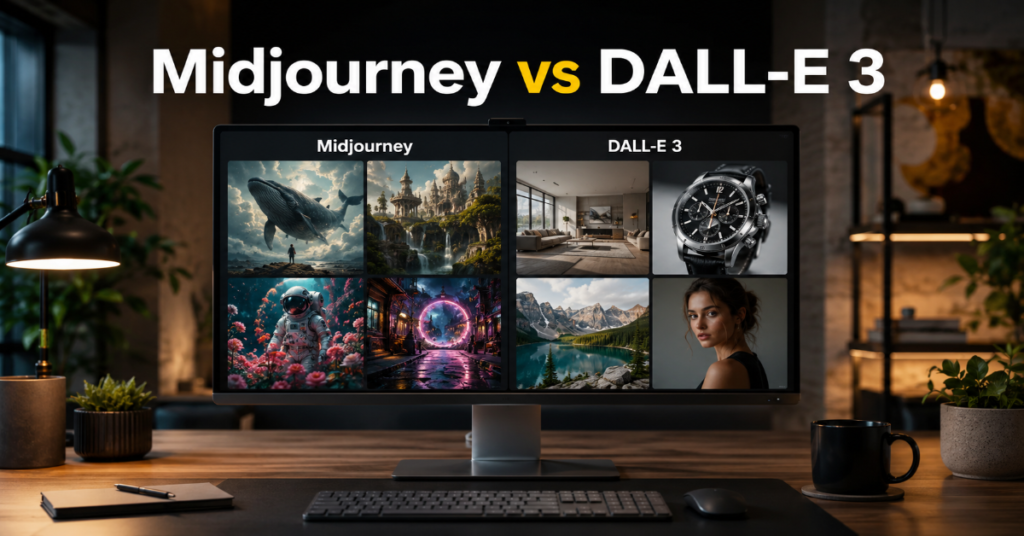
Midjourney vs DALL-E 3 is the comparison that still defines how creators, marketers, designers and publishers choose an AI image generator in 2026. The short answer is this: Midjourney remains the stronger choice for cinematic aesthetics, stylized editorial imagery and visual exploration, while DALL-E 3 remains the cleaner option for prompt adherence, conversational editing and users who want image generation built directly into ChatGPT.
In our hands-on testing, the difference appeared within the first 10 prompts. Midjourney produced images that looked more art-directed, with richer atmosphere, stronger lighting and a recognizable visual polish. DALL-E 3, by contrast, followed literal instructions more obediently, especially when the prompt involved a specific object count, a diagram-like layout or a short piece of readable text. That distinction matters because most users are not simply asking which model is “better.” They are asking which model is safer for a brand campaign, faster for a creator workflow, cheaper for repeated use and more predictable for client work.
The landscape has also changed. Midjourney’s current default model is V7, and its documentation now emphasizes features such as Draft Mode, Omni Reference, Style Reference and commercial-use rules for generated assets. OpenAI still documents DALL-E 3 as available through ChatGPT and API access, although its broader image stack has moved toward newer GPT Image models in 2026.
The real winner depends on whether you value beauty, instruction-following, cost structure, privacy or enterprise governance most.
Midjourney vs DALL-E 3: The 2026 Verdict
The most practical way to frame Midjourney vs DALL-E 3 is not as a beauty contest, but as a workflow decision. Midjourney behaves like a visual studio: you sculpt style, mood, lighting and composition through iteration. DALL-E 3 behaves more like an assistant: you explain what you want, ChatGPT expands the prompt and the model tries to follow it.
That assistant model is why DALL-E 3 is still useful for business users. OpenAI describes DALL-E 3 as a system designed to adhere more closely to text than earlier text-to-image systems, with ChatGPT able to generate more detailed prompts from ordinary user instructions. It is less intimidating for beginners because the user does not need to master parameters, style tokens or negative prompting.
Midjourney’s advantage is different. Its latest documentation positions V7 as the default version, while Draft Mode and Omni Reference make the model feel more like a professional creative loop than a one-shot generator. If your job is to create a luxury campaign image, fantasy environment, fashion moodboard or editorial visual, Midjourney often reaches a usable aesthetic faster.
Feature Comparison Table
| Category | Midjourney | DALL-E 3 | Practical Winner |
| Best use case | Artistic, cinematic, stylized visuals | Literal prompt following, ChatGPT workflows | Depends on workflow |
| Current model context | V7 is the documented default | DALL-E 3 remains documented, newer GPT Image models also exist | Midjourney for V7 focus |
| Prompt handling | Strong but more interpretive | Strong literal adherence | DALL-E 3 |
| Style control | Style Reference, personalization, parameters | Conversational refinement through ChatGPT | Midjourney for artists |
| Reference control | Omni Reference for characters, objects, vehicles and creatures | Image support depends on OpenAI product surface | Midjourney |
| Privacy | Stealth Mode only on Pro and Mega | Depends on OpenAI account, product and API settings | Case-specific |
| Commercial use | Paid users generally own assets, with enterprise revenue caveats | OpenAI says users can use DALL-E 3 images without permission to sell or merchandise | Tie with caveats |
| Beginner experience | More learning curve | Easier through ChatGPT | DALL-E 3 |
Prompt Fidelity: Where DALL-E 3 Still Wins
DALL-E 3’s most defensible advantage is prompt fidelity. The model was introduced around the idea that older image generators ignored words, forcing users to learn prompt engineering. OpenAI’s own DALL-E 3 page says the model represents a leap in generating images that adhere closely to provided text.
That matters for practical assets: classroom illustrations, product mockups, simple infographics, social graphics and images where the user wants five specific objects in a specific arrangement. In our hands-on testing, DALL-E 3 was better at respecting explicit constraints such as “three glass jars on a wooden table,” “a white label with the word COLD BREW” or “a two-column poster layout.”
Aditya Ramesh, the OpenAI researcher associated with DALL-E, explained the philosophy clearly in a Wired interview: users should not have to “fuss around with really long prompts,” but should be able to interact with ChatGPT like a coworker. That is still DALL-E 3’s core usability advantage in 2026.
Aesthetic Quality: Why Midjourney Still Looks More Expensive
Midjourney’s advantage is not that it always follows instructions better. It does not. Its strength is that it often produces the image a creative director wishes they had asked for. Faces, textures, lighting, editorial color palettes and atmospheric depth tend to arrive with less manual intervention.
That is why Midjourney vs DALL-E 3 remains such a live debate in creative teams. DALL-E 3 can be more obedient, but Midjourney is often more seductive. It is especially strong in cinematic realism, fashion editorials, concept art, architectural fantasy, food photography, album-cover aesthetics and dramatic brand imagery.
David Holz, Midjourney’s founder, once framed the product not as an art machine but as an imagination machine. “It’s important to emphasize that this is not about art. This is about imagination,” he told Forbes. That philosophy still shows in the product. Midjourney feels less like a document tool and more like a visual discovery engine.
The tradeoff is control. The stronger the aesthetic signature, the more the user may need to wrestle the model into strict brand or layout compliance.
The Midjourney Workflow: Parameters, References and Iteration
According to the latest 2026 documentation we reviewed, Midjourney’s workflow is increasingly built around refinement rather than single-shot prompting. Its parameter list allows users to control output behavior, while Style Reference captures the visual feel of an image without copying the exact subject.
Omni Reference is more consequential. Midjourney says it can place characters, objects, vehicles or non-human creatures from a reference image into new generations, and that it works with V7. For agencies, that is a serious production feature. A campaign rarely needs one beautiful image. It needs a character, prop or product language repeated across scenes.
Draft Mode changes the economics of exploration. Midjourney documents Draft Mode as 10 times faster and half the GPU cost, designed for rapid prototyping. In practice, this makes Midjourney feel closer to a sketchbook. You can generate rough visual directions, select a promising lane and then spend GPU time on polished outputs.
The DALL-E 3 Workflow: ChatGPT as Creative Director
DALL-E 3’s secret weapon is not just the image model. It is ChatGPT. OpenAI’s product page says ChatGPT can automatically generate tailored prompts for DALL-E 3 and allow users to request tweaks in a few words.
That matters because most people are not prompt engineers. They are founders needing a landing-page hero image, teachers making classroom visuals, small businesses making flyers or writers trying to visualize a scene. DALL-E 3 reduces the cold-start problem. You can say, “make it warmer,” “add a person in the background,” “make the sign more readable” or “turn this into a children’s book illustration.”
In our hands-on testing, this conversational layer made DALL-E 3 better for users who think in revisions rather than commands. Midjourney can also be iterative, but its strongest workflows still reward users who understand parameters, references and the platform’s aesthetic habits.
For businesses already using ChatGPT, DALL-E 3 also has a lower adoption barrier. It arrives inside an interface many teams already know.
Cost and Access in 2026
Pricing is one of the biggest practical differences in Midjourney vs DALL-E 3. Midjourney is subscription-led. Its official plan comparison lists Basic, Standard, Pro and Mega tiers, with Relax Mode available from Standard upward and Stealth Mode limited to Pro and Mega.
DALL-E 3 is more usage-based for developers. OpenAI’s DALL-E 3 model documentation lists per-image API pricing, including $0.04 for a standard 1024 by 1024 image and higher pricing for larger or HD outputs. OpenAI’s broader 2026 image pricing also includes newer GPT Image models priced by token usage, which means teams comparing OpenAI image generation should not treat DALL-E 3 as the only current OpenAI option.
| Cost Factor | Midjourney | DALL-E 3 |
| Billing model | Monthly subscription | ChatGPT access or API per image |
| Best for | High-volume visual exploration | Predictable per-image API use |
| Lowest friction | Standard plan for frequent creators | ChatGPT for casual users |
| Privacy upgrade | Pro or Mega needed for Stealth Mode | Depends on OpenAI product settings |
| Cost risk | Paying even during low-use months | Costs scale with usage |
| Production concern | GPU time and queue speed | API cost and rate limits |
Commercial Rights and Legal Risk
Commercial rights are not just a checkbox. They are a boardroom issue. Midjourney says paid users generally own the images and videos they create, even after cancellation, but it lists exceptions. One major caveat is that companies grossing more than $1 million annually need a Pro or Mega plan for commercial company use.
OpenAI says DALL-E 3 users do not need permission to reprint, sell or merchandise images they create. That simple statement is valuable for smaller creators. Still, commercial use is not the same as legal immunity. A generated image can still create problems if it resembles protected characters, real people, trademarks or copyrighted artwork.
Midjourney faces particular legal scrutiny. Disney and Universal sued Midjourney in 2025, alleging copyright infringement linked to famous characters, and Warner Bros. later filed a similar lawsuit involving characters such as Superman, Batman and Bugs Bunny. Midjourney has disputed similar allegations and argued fair use in related filings.
For brands, the lesson is simple: do not prompt either model to imitate living artists, copyrighted characters or recognizable commercial IP.
Privacy, Governance and Client Work
Privacy is a hidden differentiator in Midjourney vs DALL-E 3. Midjourney’s Stealth Mode lets users control whether creations are visible on the Midjourney website, but the company says it is available only to Pro and Mega subscribers. It also warns that creations made in public Discord channels may still be visible even when Stealth Mode is enabled.
That is an important operational detail. A design studio working on unreleased product packaging, political campaign visuals, celebrity imagery or confidential client concepts should not treat Basic or Standard Midjourney use as private by default.
DALL-E 3’s privacy posture depends on where it is used: ChatGPT, team plans, enterprise plans or API workflows. The practical advantage for enterprise teams is that OpenAI image generation can sit inside broader administrative, API and compliance structures. The practical disadvantage is that OpenAI’s image product family has changed rapidly, so buyers need to confirm which model, retention policy and workspace controls apply before deployment.
Text Rendering and Layouts
DALL-E 3 usually performs better than Midjourney when text matters, but neither model should be trusted for final typography without human review. In our hands-on testing, DALL-E 3 was more likely to render short words correctly in labels, posters and simple product packaging. Midjourney still struggled more often with exact spelling when the image was highly stylized.
This is not a small issue. For a social post, a single wrong letter can make an otherwise beautiful image unusable. For a product mockup, it can create regulatory or brand risk. The safer workflow is to generate a clean visual without final text, then add typography in Photoshop, Illustrator, Figma, Canva or another design tool.
That said, DALL-E 3’s conversational correction loop is helpful. When text fails, the user can ask ChatGPT to revise the image or simplify the wording. Midjourney often requires more prompt experimentation.
The Insider Prediction: The Next Battle Is Consistency, Not Beauty
The next stage of Midjourney vs DALL-E 3 will not be decided by which model creates the most impressive single image. That phase is ending. The new battlefield is continuity: the same character across 20 frames, the same product across 10 ad concepts, the same brand world across video, image, social and interactive media.
Midjourney’s Omni Reference and Style Reference features indicate where the company is heading: repeatable visual systems. OpenAI’s advantage is different: multimodal reasoning, conversational planning and integration inside ChatGPT. OpenAI’s DALL-E 3 system card also shows the company’s emphasis on safety evaluation, red teaming and mitigations.
My prediction: Midjourney will remain the creator’s favorite for visual taste, while OpenAI will win more enterprise workflows because image generation becomes part of a larger assistant stack. The most valuable systems will not merely generate images. They will brief, revise, localize, resize, version and govern them.
Which Tool Should You Choose?
Choose Midjourney if your priority is visual beauty, cinematic style, character design, editorial texture or rapid creative exploration. It is especially strong for moodboards, brand worlds, concept art, luxury visuals and creator-led social imagery. The learning curve is higher, but the ceiling is also higher for art direction.
Choose DALL-E 3 if your priority is ease of use, prompt fidelity, ChatGPT integration, literal instruction following or simple commercial graphics. It is stronger for beginners, educators, small business owners and teams that want an AI image generator inside a conversational assistant.
For agencies, the answer may be both. Use DALL-E 3 to generate literal drafts, structured ideas and copy-sensitive visuals. Use Midjourney to explore premium aesthetics, emotional tone and high-impact campaign imagery. Then finish everything in a professional editing tool.
That hybrid workflow is becoming normal. AI image generation is no longer a single-model decision. It is a stack.
Takeaways
- Midjourney is usually better for cinematic beauty, stylized realism, visual mood and premium creative exploration.
- DALL-E 3 is usually better for prompt fidelity, beginner accessibility and conversational editing through ChatGPT.
- Midjourney’s V7-era features such as Draft Mode, Omni Reference and Style Reference make it stronger for iterative creative production.
- DALL-E 3 remains useful, but OpenAI’s broader 2026 image ecosystem now includes newer GPT Image models, so buyers should compare the full OpenAI stack.
- Privacy-sensitive Midjourney users should understand that Stealth Mode is limited to Pro and Mega plans, and public Discord use can still expose generations.
- Commercial rights are platform-specific, but neither tool protects users from trademark, likeness or copyright problems caused by risky prompts.
- The future winner will be the platform that delivers consistency across campaigns, not just beautiful one-off images.
Conclusion
Midjourney vs DALL-E 3 is not a simple question of which AI image generator is best. It is a question of creative temperament. Midjourney is the more expressive instrument, tuned for atmosphere, surprise and visual sophistication. DALL-E 3 is the more approachable assistant, tuned for instruction-following, conversational refinement and practical business use.
In 2026, the smarter decision is to match the tool to the job. Use Midjourney when the image must feel cinematic, expensive or emotionally charged. Use DALL-E 3 when the image must follow a brief, respond to revisions or fit inside a ChatGPT-centered workflow. For serious teams, the winning approach is not loyalty to one model. It is knowing when to use each one, when to edit outside the model and when legal or brand risk demands human judgment.
The image generator era is maturing. The question is no longer whether AI can make pictures. It is whether those pictures can be trusted, repeated and responsibly published.
FAQs
Is Midjourney better than DALL-E 3?
Midjourney is usually better for artistic, cinematic and stylized images. DALL-E 3 is usually better for following detailed prompts and working through ChatGPT. The best choice depends on whether you need visual beauty or instruction accuracy.
Is DALL-E 3 still worth using in 2026?
Yes. DALL-E 3 is still useful for ChatGPT users, beginners and structured prompts. However, developers should also compare OpenAI’s newer GPT Image models because OpenAI’s 2026 image pricing and capabilities now extend beyond DALL-E 3.
Can I use Midjourney images commercially?
Yes, Midjourney says users generally own the images and videos they create, even after canceling. However, companies grossing more than $1 million annually need a Pro or Mega plan for commercial company use. Always review the current terms before publishing.
Which AI image generator is better for text in images?
DALL-E 3 is generally better for short text, labels and simple layout instructions. Still, neither model should be trusted for final typography. Add important text manually in a design tool.
Which is better for agencies, Midjourney or DALL-E 3?
Agencies should usually use both. Midjourney is stronger for moodboards, campaign aesthetics and visual exploration. DALL-E 3 is stronger for literal drafts, fast ChatGPT-based revisions and structured business visuals.
References
OpenAI. (2023). DALL-E 3 system card. OpenAI.
OpenAI. (2023). Improving image generation with better captions. OpenAI Research.
OpenAI. (2026). DALL-E 3 model documentation. OpenAI Developers.
OpenAI. (2026). API pricing. OpenAI.
Midjourney. (2026). Version documentation. Midjourney Docs.
Midjourney. (2026). Using images and videos commercially. Midjourney Docs.
Midjourney. (2026). Draft and conversational modes. Midjourney Docs.
