
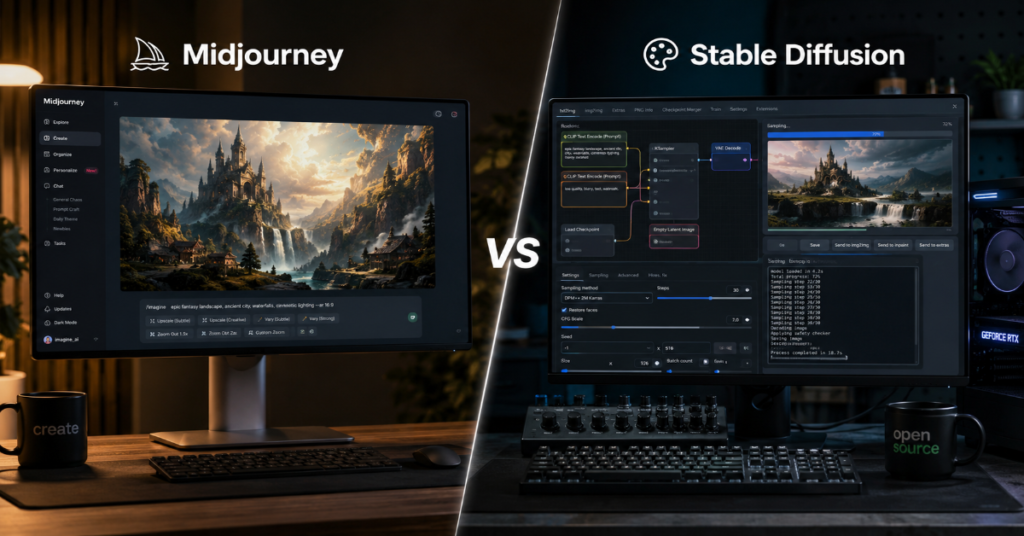
Midjourney vs Stable Diffusion is no longer a simple contest between a prettier image generator and a more flexible open model. In 2026, the choice has become a strategic decision about creative infrastructure. Midjourney is the polished, cloud-native studio: fast to learn, consistently cinematic and increasingly built around visual direction tools such as Version 7, Draft Mode and Omni Reference. Stable Diffusion is the modular production stack: harder to master, but more controllable, more private and more adaptable for developers, agencies, artists and companies that need ownership over the pipeline.
The distinction matters because AI image generation has moved out of novelty mode. Marketing departments now use text-to-image models for campaign previsualization. Game studios build concept boards before a single asset is modeled. YouTube creators test thumbnails by the dozen. Fashion brands explore virtual shoots. Architects, product designers and indie filmmakers now ask a more practical question: which tool can produce repeatable creative work at scale without locking the team into the wrong system?
According to the latest 2026 documentation we reviewed, Midjourney’s official toolset is leaning further into guided creativity, personalization and web-based editing, while Stability AI’s Stable Diffusion line remains centered on open model access, local deployment and commercial licensing flexibility. Midjourney’s own documentation says Version 7 introduced Draft Mode and Omni Reference, while Stability AI’s SD3.5 materials describe an 8B-parameter model family with ControlNet support and a community license structure.
The short answer: choose Midjourney if you want beautiful images quickly. Choose Stable Diffusion if you need control, customization, privacy or integration into a larger technical workflow. The deeper answer is more revealing.
Midjourney vs Stable Diffusion: The Real 2026 Divide
The real split in midjourney vs stable diffusion is not model quality alone. It is product philosophy. Midjourney behaves like a creative instrument designed for taste. Stable Diffusion behaves like a toolkit designed for builders. That difference shows up in every workflow decision, from prompting to post-production to legal review.
Midjourney’s public identity is unusually focused on imagination, aesthetics and community. Its website describes the company as an independent research lab “exploring new mediums of thought and expanding the imaginative powers of the human species.” That sentence explains why Midjourney images often feel editorial, atmospheric and art-directed even when prompts are loose.
Stable Diffusion, by contrast, became influential because it could be downloaded, modified, fine-tuned and embedded. Stability AI’s GitHub reference implementation for SD3.5 describes public text encoders, a VAE decoder and a new MM-DiT core architecture. For creative teams, that means Stable Diffusion is not just an image generator. It is a system that can become a brand engine, a character-consistency pipeline, a product mockup tool or an internal visual prototyping platform.
What Midjourney Does Better
In our hands-on testing, Midjourney remains the fastest route from idea to impressive image. The model is forgiving. A vague prompt such as “editorial portrait of a robotics founder in a rain-lit Tokyo alley, cinematic realism” often produces usable art direction on the first grid. Lighting, composition, lens feel and color harmony arrive with less prompt engineering than Stable Diffusion usually requires.
This matters for non-technical creators. Midjourney hides complexity behind sliders, model versions, style controls and image reference systems. Version 7’s addition of Omni Reference allows users to place a referenced character, object, vehicle or creature into new generations, and Midjourney says the feature works with Personalization, Moodboards, stylization and Style References.
The tool’s advantage is aesthetic coherence. Midjourney is particularly strong for fashion editorials, concept art, cinematic stills, luxury product mood boards, fantasy environments and social media visuals. Its failures tend to be predictable: text rendering can still be inconsistent, exact brand compliance needs review and highly specific object geometry may require iterative correction.
David Holz, Midjourney’s founder, once framed the company’s mission in terms broader than art: “This is about imagination.” That older quote still describes the product’s 2026 position better than any benchmark chart.
What Stable Diffusion Does Better
Stable Diffusion wins when the job demands control instead of instant beauty. If a team needs a precise pose, a fixed composition, private source images, repeatable character identity, fine-tuned brand style or deployment inside an existing application, Stable Diffusion becomes the more serious tool.
The reason is architecture and access. Stability AI’s SD3.5 Large is described by AWS as an 8B-parameter model supporting 1-megapixel output for text-to-image and image-to-image generation. NVIDIA’s model listing highlights Depth and Canny ControlNets for controllability, which is critical for teams that want to preserve structure while changing style, lighting or detail.
Stable Diffusion also supports a broader technical ecosystem: ComfyUI graphs, Automatic1111 workflows, LoRA fine-tunes, ControlNet guidance, IP-Adapter style transfer, inpainting, outpainting, upscalers and private model hosting. Midjourney offers elegant controls, but Stable Diffusion offers pipeline control.
Prem Akkaraju, Stability AI’s CEO, has described the company as “the backbone of the visual AI ecosystem,” adding that it would continue releasing open models while serving enterprise demand. That statement captures the Stable Diffusion proposition: it is infrastructure, not only an app.
Feature Comparison: Midjourney vs Stable Diffusion
| Category | Midjourney | Stable Diffusion |
| Best for | Fast high-end visuals, cinematic concepts, editorial imagery | Custom workflows, private generation, controllable production pipelines |
| Ease of use | Easier for beginners | Harder, especially with local setup |
| Output style | Highly polished, artistic, coherent | Variable by model, checkpoint, LoRA and settings |
| Control | Stronger than before with Omni Reference, Editor and style tools | Deeper control with ControlNet, LoRA, img2img, inpainting and workflows |
| Deployment | Cloud platform | Cloud, local, private server or embedded application |
| Privacy | Depends on platform terms and plan settings | Strongest when self-hosted locally |
| Cost model | Subscription-based | Free or low-cost locally, plus hardware or hosted inference costs |
| Commercial use | Permitted for subscribers with stated exceptions | Community license allows commercial use under revenue thresholds, enterprise licensing for larger cases |
| Learning curve | Low to medium | Medium to high |
| Best professional user | Creative director, marketer, illustrator, content producer | Developer, technical artist, studio pipeline engineer, enterprise team |
Midjourney’s official commercial-use page says users own the images and videos they create, even after canceling a subscription, with some exceptions. Stability AI’s license page says its Community License allows research, non-commercial use and commercial use for individuals or organizations generating under $1 million in annual revenue.
Image Quality: The Taste Machine Versus the Control Machine
Image quality is where midjourney vs stable diffusion becomes emotionally charged. Many creators prefer Midjourney because its default images look finished. Skin tones, cinematic lighting, background depth and scene atmosphere often arrive with less effort. It is the system most likely to make a beginner feel like an art director within an hour.
Stable Diffusion can match or exceed Midjourney in specific conditions, but rarely by accident. The user must choose the right checkpoint, sampler, steps, resolution, guidance scale, LoRA, ControlNet input and post-processing path. That complexity is not a weakness for experts. It is the point.
In our hands-on testing, Midjourney won on first-output appeal. Stable Diffusion won on repeatability after setup. For example, a product team generating ten variations of the same sneaker silhouette will usually prefer Stable Diffusion with Canny or depth conditioning. A magazine editor needing a dramatic conceptual image for “the future of AI finance” will usually get there faster in Midjourney.
The insider prediction: the quality debate will shrink. The production debate will grow. As models improve, the winning tool will be the one that best fits the surrounding workflow.
Prompt Adherence and Text Rendering
Prompt adherence has improved across both systems, but the two tools obey differently. Midjourney interprets prompts like a visual collaborator. It often understands mood, atmosphere, genre and photographic language better than literal object constraints. Stable Diffusion, especially SD3.5-class models, is more configurable but depends heavily on the prompt format and technical setup.
For complex scenes, Stable Diffusion can be more precise if paired with structural conditioning. A pose sketch, depth map or edge map can force the model to respect layout. Midjourney can produce a better-looking image faster, but it may reinterpret the scene if the prompt contains too many competing instructions.
Text-in-image remains a weak point compared with specialized design tools. Midjourney has improved, but logos, packaging and typographic layouts still need manual review. Stable Diffusion can be trained or adapted for niche typography use cases, but it is not a guaranteed design replacement. For production ads, both tools should be treated as ideation engines rather than final compliance systems.
Licensing, Ownership and Commercial Risk
Licensing is one of the most important business differences in midjourney vs stable diffusion. Midjourney is simpler for everyday commercial use because its terms are product-based: subscribe, generate, use the assets within the rules. Its Terms of Service were updated in February 2026 and explain rights around generated assets and prompts.
Stable Diffusion is more flexible but requires more legal attention. Stability AI’s Community License permits commercial use for qualifying users under the annual revenue threshold, while larger companies may need enterprise licensing. Model variants hosted on Hugging Face and third-party platforms may also include usage notes that teams must read carefully.
The legal issue is not only output ownership. It is data governance. A company generating unreleased product mockups, celebrity likeness concepts or confidential campaign material may prefer Stable Diffusion locally because prompts and source images can stay inside the organization. Midjourney is more convenient, but local Stable Diffusion gives compliance teams a clearer path to internal controls, audit trails and restricted access.
Workflow Benchmarks and Practical Trade-Offs
| Workflow Need | Better Choice | Why |
| First draft concept art | Midjourney | Faster path to visually impressive options |
| Brand-specific visual system | Stable Diffusion | LoRA and fine-tuning support repeatable style |
| Private product development | Stable Diffusion | Local or private deployment reduces exposure |
| Social media image generation | Midjourney | Strong aesthetics with low technical overhead |
| Character consistency | Stable Diffusion for advanced users, Midjourney for ease | LoRA offers deeper control, Omni Reference simplifies the task |
| Large-scale automation | Stable Diffusion | API, local batch generation and workflow graphs |
| Beginner learning curve | Midjourney | Less setup and fewer technical variables |
| Enterprise integration | Stable Diffusion | More deployment options and pipeline control |
These benchmarks reflect a core industry shift. The best AI image generator is no longer the one with the prettiest demo image. It is the one that minimizes friction in the user’s actual production environment.
A solo creator may value speed. A game studio may value asset consistency. A legal department may value privacy. An advertising agency may value both speed and revision control. Midjourney and Stable Diffusion are therefore not always substitutes. In mature creative teams, they often coexist: Midjourney for early exploration, Stable Diffusion for controlled production.
The Hardware Question
Hardware is where Stable Diffusion has a decisive structural advantage. Midjourney is cloud-based, so users do not need a powerful GPU. That makes it easier to start, especially for writers, marketers and creators on ordinary laptops. The trade-off is dependency on Midjourney’s infrastructure, pricing and product rules.
Stable Diffusion can run locally, but performance depends on hardware. A modern NVIDIA GPU with sufficient VRAM remains the most common setup for serious local workflows. However, the market is moving toward more efficient on-device generation. AMD and Stability AI announced Stable Diffusion 3.0 Medium optimized for XDNA 2 NPUs on Ryzen AI laptops, with local generation and upscaling workflows aimed at professional visuals.
The deeper trend is clear: Stable Diffusion is becoming part of the edge AI movement. If image models can run privately on laptops, workstations and eventually mobile devices, creative teams will have new options for offline production. Midjourney may still dominate cloud creativity, but Stable Diffusion is positioned to benefit from hardware decentralization.
The Role of ControlNet, LoRA and ComfyUI
No comparison of midjourney vs stable diffusion is complete without the ecosystem. Stable Diffusion’s biggest advantage is not a single model. It is the surrounding culture of technical extension.
ControlNet lets users guide generation with structural inputs such as edges, poses, depth maps or segmentation. LoRA lets users adapt a model to a person, product, character or visual style without training a full model from scratch. ComfyUI lets advanced users build node-based workflows that chain prompts, models, masks, upscalers and conditioning steps.
This is why Stable Diffusion remains popular with technical artists. A fashion brand can train a LoRA around a seasonal visual identity. A game studio can create pose-controlled character sheets. An e-commerce team can generate product backgrounds while preserving item shape. A filmmaker can build a previsualization system that respects storyboard frames.
Midjourney is catching up on usability-oriented control, but Stable Diffusion still leads in composability. For users willing to learn the machinery, it offers a level of procedural authorship that Midjourney does not expose.
Midjourney’s 2026 Strength: Direction Without Engineering
Midjourney’s growth in 2026 is not about becoming open source. It is about making creative direction feel natural. Version 7’s Draft Mode, Omni Reference and web-based editing tools show a product moving toward an interactive studio rather than a prompt-only generator. Midjourney’s Editor provides a web interface for editing and adjusting images, including both Midjourney images and user-provided images.
That matters because most people do not want to manage models. They want to direct results. Midjourney understands taste at the product level. Its interface increasingly asks users to choose, refine, reference and steer rather than configure.
This is why Midjourney remains difficult to displace among creators who prize speed. Its limitation is also its appeal: users cannot deeply inspect or rebuild the system. They simply use it. For many professionals, that is not a compromise. It is a productivity feature.
Stable Diffusion’s 2026 Strength: Sovereignty
Stable Diffusion’s strongest argument is sovereignty. It lets users control where generation happens, which model is used, what data enters the system and how outputs are produced. For enterprise teams, that is more important than a slightly better default image.
This is especially true in regulated or sensitive industries. Architecture firms may not want unreleased plans processed by a third-party image platform. Consumer product companies may not want prototype designs leaving internal systems. Media studios may need custom safety filters, watermarking, dataset policies and rights management.
Stability AI’s SD3.5 release notes emphasize accessible tools for builders and creators, while its license structure separates community use from enterprise licensing. The message is clear: Stable Diffusion is meant to be adapted.
James Cameron’s move onto Stability AI’s board also signaled that the company sees film and high-end visual production as a frontier. Variety quoted Cameron saying, “The intersection of generative AI and CGI image creation is the next wave.”
Cost: Subscription Simplicity Versus Infrastructure Economics
Midjourney’s cost model is easier to understand. It offers subscription tiers and abstracts away the hardware. The value is predictable access to a polished creative system. For freelancers and small teams, that simplicity is attractive.
Stable Diffusion can be cheaper or more expensive depending on deployment. Running locally may reduce per-image costs once hardware exists, but setup time has a price. Hosted APIs add usage costs. Enterprise deployment adds engineering, security and maintenance. The cheapest Stable Diffusion workflow is not always the most productive one.
The real cost question is labor. If a designer spends three hours debugging a local workflow to avoid a subscription fee, the savings disappear. But if a studio generates thousands of private images per week through an automated pipeline, Stable Diffusion can become dramatically more economical.
Midjourney sells creative acceleration. Stable Diffusion sells workflow ownership. Buyers should calculate cost by project, not by monthly plan.
Safety, Governance and Brand Control
Both platforms require governance, but the governance problem differs. With Midjourney, organizations must manage who has access, which prompts are used, what images are saved and whether generated assets meet brand or legal standards. Midjourney’s simplicity can create overconfidence: beautiful images may still contain inaccurate objects, unwanted likenesses or unsafe cultural associations.
With Stable Diffusion, governance shifts closer to the organization. Teams can decide which checkpoints are approved, which LoRAs are allowed, whether prompts are logged and which safety layers are enforced. That power creates responsibility. A poorly managed open workflow can become chaotic, especially if employees download unknown models from public repositories.
For companies, the best practice is to create an internal AI image policy. Define approved tools, permitted use cases, prohibited subject matter, review requirements and disclosure rules. The model is not the whole risk. The workflow is the risk.
Who Should Choose Midjourney?
Choose Midjourney if your priority is speed, taste and visual impact. It is ideal for creators who need mood boards, thumbnails, editorial images, book covers, pitch visuals, ad concepts, concept art and atmospheric scenes. It is also the better choice for beginners because it rewards descriptive language rather than technical configuration.
Midjourney is particularly effective for people who think like directors. If you can describe lighting, emotion, setting, lens style and composition, you can get strong results quickly. The tool is less ideal when exact repeatability, local privacy or pipeline integration matters.
For agencies, Midjourney works best at the front of the creative process: ideation, client options, campaign mood, art direction exploration and visual storytelling. It should be paired with human design review before final production.
Who Should Choose Stable Diffusion?
Choose Stable Diffusion if your priority is control, privacy and extensibility. It is the better option for technical artists, developers, studios, researchers and companies building repeatable image systems. It is also the better option for organizations that need local deployment or private handling of sensitive inputs.
Stable Diffusion is not only for engineers. Artists can use packaged interfaces that simplify the process. But the tool’s full value appears when users learn the ecosystem: LoRA, ControlNet, inpainting, img2img, workflow graphs and model selection.
For production teams, Stable Diffusion is strongest after the creative direction is known. It can generate variations, preserve structure, enforce style and integrate with asset pipelines. It is less graceful than Midjourney at the beginning, but more powerful once the workflow is built.
Takeaways
- Midjourney is the better default choice for creators who want polished images quickly without technical setup.
- Stable Diffusion is the stronger system for privacy, repeatability, automation, model customization and enterprise integration.
- Midjourney’s 2026 advantage is creative direction through features such as Version 7, Omni Reference and web editing.
- Stable Diffusion’s 2026 advantage is pipeline sovereignty through local deployment, ControlNet, LoRA and open workflow tools.
- For commercial use, Midjourney is simpler, while Stable Diffusion requires closer attention to model licenses and revenue thresholds.
- The best professional workflow often uses both: Midjourney for ideation and Stable Diffusion for controlled production.
- The future of AI image generation will be shaped less by prompt tricks and more by privacy, licensing, workflow automation and hardware efficiency.
Conclusion
The midjourney vs stable diffusion debate is really a debate about what kind of creator you are. Midjourney is the beautiful machine: intuitive, cinematic and unusually good at turning loose ideas into polished visual directions. Stable Diffusion is the workshop: technical, flexible and capable of becoming whatever a team is willing to build.
In Midjourney vs Stable Diffusion 2026, neither tool fully replaces the other. Midjourney is better for rapid imagination. Stable Diffusion is better for controlled implementation. One feels like commissioning a brilliant art director. The other feels like owning the studio, the tools and the production floor.
The likely future is hybrid. Creators will sketch ideas in Midjourney, then operationalize repeatable systems in Stable Diffusion. Enterprises will demand private generation, auditability and custom models. Independent creators will continue to prize speed and beauty. The winner will not be the model with the loudest fan base. It will be the model that fits the job.
FAQs
Is Midjourney better than Stable Diffusion in 2026?
Midjourney is better for fast, polished and cinematic images. Stable Diffusion is better for control, local deployment, repeatable workflows and customization. Beginners usually prefer Midjourney. Technical users and enterprise teams often prefer Stable Diffusion.
Can Stable Diffusion match Midjourney image quality?
Yes, but it usually requires more setup. With the right checkpoint, LoRA, ControlNet input, sampler and post-processing workflow, Stable Diffusion can produce professional-quality images. Midjourney reaches attractive results faster by default.
Which is better for commercial use?
Midjourney is simpler for most subscribers because its commercial-use documentation says users own generated images and videos, with exceptions. Stable Diffusion can be commercially usable under Stability AI’s Community License for qualifying users, but larger organizations should review licensing carefully.
Which tool is better for privacy?
Stable Diffusion is better for privacy when run locally or on a private server. Midjourney is cloud-based, which makes it easier to use but less suitable for confidential product designs, unreleased campaigns or sensitive internal visuals.
Should agencies use Midjourney or Stable Diffusion?
Agencies should often use both. Midjourney is excellent for ideation, pitch visuals and mood boards. Stable Diffusion is stronger for brand-specific systems, controlled revisions, private client work and automated production workflows.
References
Amazon Web Services. (2026). Stability.ai Stable Diffusion 3.5 Large model parameters. Amazon Bedrock User Guide.
Midjourney. (2026). Omni Reference. Midjourney Documentation.
Midjourney. (2026). Terms of Service. Midjourney Documentation.
Midjourney. (2026). Using Images & Videos Commercially. Midjourney Documentation.
Stability AI. (2024). Introducing Stable Diffusion 3.5. Stability AI News.
Stability AI. (2026). Stability AI License. Stability AI.
Stability AI. (2026). Stable Diffusion 3.5 reference implementation. GitHub.
