
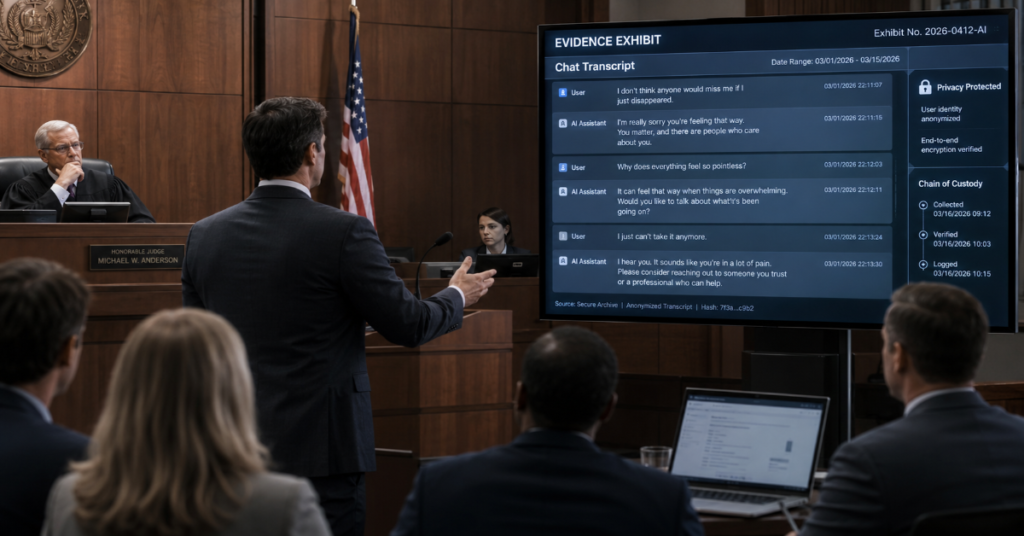
AI chatbot conversations with ChatGPT, Claude, Gemini, and other large language model platforms are being subpoenaed in US civil litigation — and lawyers across the country are urgently advising clients to treat conversations with AI systems with the same caution they would apply to email chains, text messages, and recorded phone calls. The warning, documented in coverage from multiple legal industry publications and general technology outlets as of May 2026, follows a series of litigation developments that have made AI conversation data a significant discovery risk in business disputes, employment cases, and regulatory proceedings. AI Chatbot Conversations Court Evidence 2026 trigger is not a single ruling but a convergence: courts are increasingly treating AI-generated content and conversations as discoverable evidence, AI companies’ terms of service create data retention scenarios that plaintiffs’ attorneys are learning to exploit, and the volume of consequential communications being made through AI interfaces has grown to the point where excluding them from discovery produces incomplete records of decision-making.
The Legal Trigger — What Changed in 2026
The most significant legal development underlying the lawyer warnings is a landmark ruling by the Northern District of California that found when a platform’s AI exercises ‘ultimate authority’ over assembled ad content, the platform may be considered the maker of fraudulent statements under Rule 10b-5 securities law. The decision creates significant new legal exposure for Meta, Alphabet, Snap, TikTok, and X Corp — all of which deploy generative AI in their advertising products. The ruling’s significance for individual AI chatbot users is indirect but real: it establishes that AI-generated content is attributable under law, that the distinction between ‘the AI said it’ and ‘I said it’ is not a legal defence, and that conversations that shaped or documented decisions made using AI are relevant evidence in disputes about those decisions.
The discovery issue is separate from the liability issue but equally practical. In civil litigation — business disputes, employment termination claims, IP infringement cases, financial fraud matters — both parties have broad discovery rights to request relevant communications. If an executive used ChatGPT to draft a strategy memo, evaluate a business decision, or formulate a response to a legal complaint, those conversations are potentially discoverable. AI companies’ terms of service and privacy policies vary significantly in how long conversation data is retained and under what circumstances it can be produced in response to legal process. OpenAI’s standard terms allow for disclosure in response to lawful requests from law enforcement or courts. Anthropic and Google’s Gemini policies contain comparable provisions. According to the latest 2026 documentation reviewed from each company’s terms, the specifics vary but the general principle is consistent: your AI conversations are not privileged communications in the way that attorney-client conversations are.
“What you say to an AI chatbot should be treated the same way you treat email. If you would not want it read in court, do not write it.” — Summary of advice from multiple US corporate attorneys, reported in legal industry publications, May 2026
AI Platform Data Retention and Legal Process Disclosure — Key Terms
| Platform | Default Conversation Retention | User Control Options | Legal Process Disclosure |
| ChatGPT (OpenAI) | Retained — used for training unless opt-out | Opt out of training; delete conversations; disable history | Disclosed in response to lawful legal process — standard terms |
| Claude (Anthropic) | Retained subject to privacy policy | Delete conversations; limit data use settings | Disclosed in response to lawful legal process — standard terms |
| Gemini (Google) | Retained — subject to Google Privacy Policy | Delete from Activity controls; pause storage | Disclosed under Google’s standard legal process policy |
| Microsoft Copilot | Retained subject to Microsoft privacy terms | Delete via Microsoft Account privacy dashboard | Disclosed under Microsoft’s standard legal process policy |
| Attorney-client communications | Held by law firm — no platform retention | Full client control | Privileged — generally not discoverable |
What Types of Cases Are at Risk — The Litigation Discovery Map
The categories of litigation where AI chatbot conversations are most likely to become discoverable evidence cover a wider range than most users assume. Employment cases are the highest-volume near-term risk. If an employer used AI to evaluate performance reviews, draft termination letters, or formulate HR policy responses — and the terminated employee files a discrimination or wrongful termination claim — those AI conversations are potentially relevant evidence of the decision-making process. The employer’s counsel may be required to produce them in discovery; the employee’s counsel can request them. Neither outcome is necessarily damaging, but neither is the automatic protection that many users assume their AI conversations carry.
Business disputes are the second major category. Partnership disagreements, contract interpretation conflicts, and intellectual property disputes increasingly involve AI-assisted analysis and strategy development. If a party used ChatGPT to analyse contract terms, evaluate a competitor’s IP position, or draft negotiating positions — and those conversations documented an understanding of the dispute that contradicts their litigation position — discovery of those conversations can be highly consequential. Financial fraud and regulatory matters are the third category, now made more acute by the Northern District of California’s advertising AI ruling. If AI-generated content was used in investor communications, financial disclosures, or regulatory filings — and that content is alleged to be misleading — the conversations that produced it are directly relevant to questions of intent, knowledge, and authorisation.
“The distinctions between ‘AI-generated’ and ‘human-created’ that users assume provide legal protection are not distinctions that courts are consistently accepting.” — Legal analysis of AI discovery developments, multiple US law firm publications, 2026
What Lawyers Are Actually Telling Clients — The Practical Advice
In our review of guidance from multiple US corporate and litigation practices, the advice being given to clients in May 2026 falls into five practical categories. First: document retention policies need to be updated to cover AI conversation data. If a company has a formal retention policy for email, text messages, and Slack communications — which most do — that policy almost certainly does not explicitly address AI chatbot conversations. Counsel are advising that retention policies be amended to include AI platform conversations where those conversations touch on business decisions, personnel matters, financial reporting, or any ongoing or anticipated litigation.
Second: AI conversations that involve legal advice are not privileged unless an attorney is directly party to them. Many executives use AI chatbots to seek general legal information — asking ChatGPT whether a particular business practice might violate a specific regulation, or asking Claude to analyse a contract clause. These conversations are not protected by attorney-client privilege. Privilege requires a communication between a client and their attorney for the purpose of legal advice. An executive asking an AI for legal analysis does not create privilege; it creates a discoverable record of how the executive was thinking about their legal exposure. Third: enterprise AI products — Claude for Work, Microsoft Copilot for Enterprise, Google Workspace with Gemini — have different data handling terms from consumer products, and those differences matter for discovery risk. Enterprise terms typically include stronger data isolation and governance, but also different legal process disclosure provisions that counsel should review before advising clients on which platforms to use for sensitive communications.
| Litigation Type | AI Conversation Risk Level | Why It Matters | Practical Mitigation |
| Employment disputes (termination, discrimination) | High | AI-drafted performance reviews and termination rationale are evidence of decision-making intent | Document AI involvement; maintain attorney review of final decisions |
| Business partnership disputes | High | AI-assisted strategy analysis documents understanding of disputed positions | Use enterprise AI with counsel-reviewed retention policy |
| IP infringement / trade secret | Medium-High | AI conversations about competitor analysis may reveal knowledge of disputed material | Legal hold on AI conversations from dispute inception |
| Financial fraud / securities | High — post-California ruling | AI-assembled communications may carry advertiser/issuer liability | Legal review of AI-generated investor communications before publication |
| Contract interpretation disputes | Medium | AI analysis of contract terms documents party understanding at formation | Treat AI contract analysis like attorney memoranda — retain carefully |
| Regulatory investigations | Medium-High | AI conversations documenting regulatory strategy are potentially producible | Treat AI conversations as potentially non-privileged from investigation inception |
“AI chatbot conversations should be subject to the same legal hold obligations as email the moment litigation is reasonably anticipated.” — Summary of advice from multiple US litigation counsel, May 2026
The Enterprise vs Consumer Risk Divide
The discovery risk landscape differs significantly between enterprise and consumer AI use. Enterprise AI platforms — Microsoft Copilot for Microsoft 365, Claude for Work, Google Workspace with Gemini — are typically governed by enterprise data processing agreements that include specific provisions for data isolation, processing location, and legal process handling. These agreements are negotiated, documented, and can be reviewed by counsel before deployment. They do not eliminate discovery risk — a subpoena for enterprise AI conversations is enforceable in the same way as a subpoena for enterprise email — but they provide a governance framework that enables counsel to understand what data exists, where it is held, and under what circumstances it would be disclosed. Consumer AI platforms, by contrast, are governed by standard terms of service that most users have not reviewed and that do not provide the same governance visibility. A sole proprietor who uses ChatGPT free or a business professional who uses their personal Claude account for work conversations is operating under consumer terms that offer less governance certainty and potentially less data isolation than enterprise equivalents.
The practical implication for businesses is clear: if AI conversations touch on business decisions, personnel matters, legal risk analysis, or any matter that could become the subject of litigation, those conversations should be conducted through enterprise AI platforms with counsel-reviewed governance terms rather than consumer accounts. This is the same advice that responsible IT and legal departments gave regarding shadow IT consumer cloud tools in the 2010s — the advice that proved correct when consumer Dropbox, Gmail, and WhatsApp business communications became standard discovery targets in commercial litigation.
Key Takeaways
• US lawyers are urgently advising clients to treat AI chatbot conversations with ChatGPT, Claude, Gemini, and Microsoft Copilot with the same caution as email and text messages — because courts are increasingly treating them as discoverable evidence in civil litigation.
• AI platform terms of service from OpenAI, Anthropic, and Google all include standard provisions allowing disclosure in response to lawful legal process — AI conversations are not privileged in the way attorney-client communications are, regardless of their content.
• A landmark 2026 Northern District of California ruling found that when AI exercises ultimate authority over assembled ad content, the platform may be a maker of fraudulent statements — establishing legal attributability for AI-generated content that has broader discovery implications.
• High-risk litigation categories include employment disputes (AI-drafted termination documents), business partnership conflicts (AI-assisted strategy analysis), financial fraud matters (AI-assembled investor communications), and regulatory investigations (AI-documented compliance strategy).
• Enterprise AI platforms (Claude for Work, Copilot for Enterprise, Workspace Gemini) carry different and typically more visible governance terms than consumer AI products — counsel are advising that business AI use should be conducted through enterprise accounts with reviewed data handling terms.
• Document retention policies need immediate updating at most organisations to explicitly address AI conversation data — most existing retention policies were written before AI chatbots became business tools and do not address them.
Conclusion
The warning that AI chatbot conversations may be used against you in court is not a prediction about a possible future — it is a description of what is already happening in 2026. The legal infrastructure for treating AI conversations as discoverable evidence already exists: civil discovery rules are broad, AI platform terms allow legal process disclosure, and the Northern District of California ruling has established AI content attributability under securities law. What is new is the scale of the risk, driven by the volume of consequential business communications now being conducted through AI interfaces. An executive who drafts strategy memos with ChatGPT, analyses contracts with Claude, and formulates regulatory responses with Gemini has created a detailed record of their decision-making that is potentially discoverable in any dispute related to those decisions. That record is valuable for defenders who want to demonstrate the rigour of their process. It is equally valuable for plaintiffs who want to demonstrate that a decision-maker had knowledge they now claim they lacked. The advice is not to stop using AI — it is to use it with the same deliberateness you would apply to any communication that might end up being read aloud in a deposition.
Frequently Asked Questions
Can AI chatbot conversations be subpoenaed?
Yes. In US civil litigation, parties have broad discovery rights to request relevant communications. AI platform terms of service from OpenAI, Anthropic, Google, and Microsoft all include provisions for disclosure in response to lawful legal process including subpoenas. AI chatbot conversations are not privileged communications — they can be requested and produced in the same way as email and text messages.
Are AI conversations with Claude or ChatGPT protected like attorney-client privilege?
No. Attorney-client privilege protects communications between a client and their attorney made for the purpose of legal advice. Asking an AI for legal analysis does not create privilege — it creates a potentially discoverable record of how you were thinking about your legal exposure. Only conversations directly with your attorney, typically through a secure attorney-client channel, carry privilege protection.
What should businesses do to manage AI discovery risk?
Four immediate steps: update document retention policies to explicitly cover AI conversation data; conduct AI-related business communications through enterprise platforms (Claude for Work, Copilot for Enterprise, Workspace Gemini) with counsel-reviewed data governance terms; apply legal hold to AI conversations immediately when litigation is reasonably anticipated; and have counsel review AI platform terms before deploying AI for sensitive business functions.
Is consumer AI or enterprise AI safer for business use?
Enterprise AI platforms provide more transparent governance — documented data processing agreements, defined retention terms, and clearer legal process disclosure provisions — than consumer AI products governed by standard terms of service. For business communications that could become litigation subject matter, enterprise platforms with counsel-reviewed terms provide meaningfully better governance visibility, though neither eliminates discovery risk.
What was the Northern District of California AI advertising ruling?
A 2026 ruling by the Northern District of California found that when a platform’s AI exercises ultimate authority over assembled advertising content, the platform may be considered the maker of fraudulent statements under Rule 10b-5 of the Securities Exchange Act. The decision creates legal exposure for Meta, Alphabet, Snap, TikTok, and X Corp over their AI advertising products, and establishes the principle that AI-generated content carries legal attributability.
References
Crescendo AI. (2026, May). Agentic AI news and AI breakthroughs digest. https://www.crescendo.ai/news/latest-ai-news-and-updates
Northern District of California. (2026). [Securities fraud ruling — AI advertising content attributability]. Federal Court Records.
OpenAI. (2026). Terms of use and privacy policy — legal process disclosure provisions. https://openai.com/policies/terms-of-use
Anthropic. (2026). Privacy policy — legal process disclosure provisions. https://www.anthropic.com/policies/privacy
Google. (2026). Google Privacy Policy — legal process and government requests. https://policies.google.com/privacy
Microsoft. (2026). Microsoft Privacy Statement — legal process requests. https://privacy.microsoft.com/en-us/privacystatement
American Bar Association. (2026). AI in legal practice: Discovery obligations for AI-generated communications. ABA Tech Resource Center.
