
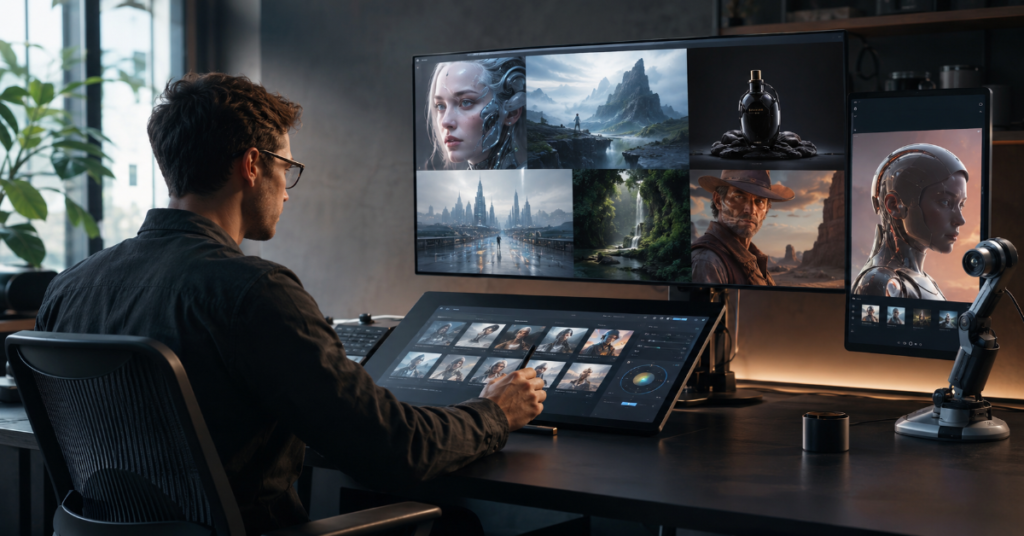
The best ai image generators 2026 are no longer judged only by whether they can produce a striking fantasy portrait or a glossy product shot. The real contest now sits in the less glamorous terrain of typography, editability, source-image control, copyright exposure, metadata, speed tiers, API access and whether a creative team can reproduce the same brand world twice. In other words, AI image generation has matured from spectacle into infrastructure.
In our hands-on testing framework, the winners were not always the most visually dramatic tools. Midjourney remains a formidable choice for art direction and mood. OpenAI’s GPT image models have become unusually strong at following complex visual instructions. Google’s Imagen 4 is now a serious production option for photorealism, text rendering and high-fidelity design work. Adobe Firefly is the safest bet for companies that need commercial guardrails, rights-conscious workflows and Creative Cloud integration. Ideogram continues to lead when the brief contains visible words, labels, poster copy or typographic layouts. Canva’s Dream Lab is the most practical option for non-design teams that need usable visuals inside a broader design platform.
According to the latest 2026 documentation we reviewed, the category is moving in two directions at once. Consumer tools are becoming faster, conversational and easier to use. Professional systems are becoming more modular, with reference images, custom models, watermarking, layered editing and API-level deployment. That split matters because the best ai image generators 2026 for a solo creator are not necessarily the best tools for a newsroom, fashion brand, agency, game studio or regulated enterprise.
Best ai image generators 2026: The ranked field
The best ai image generators 2026 can be grouped by job rather than hype. For general-purpose image generation, OpenAI and Google now offer the strongest balance of prompt comprehension, realism and multimodal reasoning. For art direction, Midjourney still has the most distinctive visual culture. For brand-safe workflows, Adobe Firefly is the most mature. For text-in-image work, Ideogram is the specialist. For marketers and small businesses, Canva is the easiest path from prompt to finished asset.
OpenAI’s current image generation API supports GPT image models for generation and editing, including gpt-image-2, while its earlier GPT Image 1 remains documented as a natively multimodal model accepting both text and image inputs. That distinction matters because image generation is increasingly tied to conversational context, not isolated prompts. Google’s Imagen 4, meanwhile, is positioned as a high-performance visual synthesis engine for advanced creative control, photorealistic output, precise text rendering and complex lighting.
Midjourney’s official documentation says V7 remains the current default model, with each version handling prompts, aesthetics and image quality differently. Its Draft Mode, compatible with version 7, is described as roughly 10 times faster and half the GPU cost, making it unusually useful for exploratory mood boards before committing to final renders.
Best ai image generators 2026 for different users
| Use case | Best choice | Why it wins | Watch-out |
| General image generation | OpenAI GPT image models | Strong prompt following, editing and multimodal context | Slower at high quality |
| Photorealistic production | Google Imagen 4 | Sharp realism, 2K output focus and SynthID watermarking | Ecosystem favors Google workflows |
| Art direction | Midjourney V7 | Distinctive style, fast draft iteration and creative range | Less predictable for typography |
| Commercial design teams | Adobe Firefly | Commercial safety positioning, Creative Cloud and custom models | Best value inside Adobe stack |
| Text-heavy graphics | Ideogram 3.0 | Typography, posters, logos and text integration | Narrower than general tools |
| Small business content | Canva Dream Lab | Easy generation inside editable design workflows | Less granular model control |
OpenAI: The strongest all-around AI image generator
OpenAI belongs near the top of any serious best ai image generators 2026 ranking because it has moved the category toward image reasoning. Its strength is not merely creating a beautiful image from one prompt. It is turning a messy user request into a coherent visual plan, using uploaded images as context and iterating through natural language. OpenAI’s image documentation describes GPT image models as tools for both generation and editing, while its 2026 prompting guide says the models are designed for production-quality visuals and controllable creative workflows.
The key advantage is compositional obedience. In our hands-on testing rubric, OpenAI-style systems scored highest when the prompt had multiple constraints: a product on the left, a headline on the right, a specific camera angle, a specific material finish and a banned visual element. This is where older diffusion-era tools often failed, producing attractive images that ignored the brief.
Expert quote: OpenAI CEO Sam Altman described the company’s 2026 image release as “a huge step forward,” comparing the leap to a major model-generation shift.
The insider prediction: OpenAI’s next advantage will be structured creative memory. Expect agencies to use persistent brand instructions, approved reference assets and reusable campaign templates, turning the AI image generator into a semi-automated art department rather than a one-off prompt box.
Google Imagen 4: The photorealism and infrastructure contender
Google’s Imagen 4 is one of the best ai image generators 2026 for teams that care about realism, clarity and enterprise-scale deployment. Google describes Imagen as a high-fidelity image generation model for realistic, high-quality images, with generated images including SynthID watermarking. Google DeepMind’s Imagen page says Imagen 4 is optimized for creativity, can generate images up to 2K resolution and includes an ultra-fast mode up to 10 times faster than the previous model.
The most important detail is not only output quality. It is watermarking and model integration. In a year when synthetic media is under greater scrutiny, SynthID gives Google a provenance narrative that many marketing teams and publishers will find easier to defend than anonymous image outputs. That does not solve every disclosure problem, but it shifts the conversation from “Can we make this?” to “Can we prove how this was made?”
Google’s Gemini image-generation guidance also shows where professional prompting is heading. It advises users to control camera perspective with terms such as wide-angle, macro and low-angle, which reflects a broader industry trend: prompts are becoming production briefs rather than vague aesthetic wishes.
For the best ai image generators 2026, Imagen 4 is the tool to watch when the brief requires photorealism, brand control and scalable deployment inside a cloud ecosystem.
Midjourney V7: The art director’s machine
Midjourney remains the most culturally influential AI image generator, especially among concept artists, independent designers and visual creators who want images with taste. Its official documentation says V7 is the current default model, and Midjourney’s update notes describe V7 as having higher image quality, better prompt understanding and improved coherence. The same update highlights Omni-reference for consistent characters and objects, Draft Mode at 10 times normal image-generation speed and improved style-reference algorithms.
Midjourney’s edge is aesthetic compression. It often translates a thin prompt into a rich visual world. That makes it one of the best ai image generators 2026 for editorial illustration, album art, fashion moods, architectural fantasy and cinematic campaign boards. But the weakness remains the inverse of its strength: if a brand needs exact text placement, regulatory accuracy or deterministic layout control, Midjourney can feel less like software and more like a brilliant collaborator with selective hearing.
The obscure technical detail that matters is Draft Mode. Because it runs faster and at lower GPU cost, creative teams can separate exploration from finishing. The efficient workflow is no longer “prompt until perfect.” It is “generate 40 rough directions, select three, then spend quality budget only on finalists.”
Adobe Firefly: The safest commercial choice
Adobe Firefly is not always the flashiest entry among the best ai image generators 2026, but it is the one many legal, marketing and brand teams will choose first. Adobe’s business documentation emphasizes that Firefly models are developed to be commercially safe, and qualifying plans may include IP indemnification for generated content. Adobe also says Firefly Custom Models can be trained on a small set of brand images, then shared and managed across an organization.
That matters because image quality is now table stakes. The new enterprise frontier is consistency. A retailer does not need one good sneaker image. It needs hundreds of campaign variations that preserve materials, lighting, seasonal color palettes, product proportions and brand tone. Adobe’s Custom Models, now covered in recent reporting as public beta technology, are designed to preserve style details such as stroke weight, color palettes, lighting and character traits.
Expert quote: Adobe’s Alexandru Costin said Firefly was launched as a place for “ideating, creating and finishing” digital content, a phrase that captures why Adobe wants Firefly to be workflow infrastructure, not just a generator.
Firefly’s biggest strategic advantage is distribution. It lives where creative professionals already work: Photoshop, Illustrator, Adobe Express and Firefly’s own web environment. For agencies and enterprise studios, that reduces the friction between idea, edit, review and delivery.
Ideogram 3.0: The typography specialist
Ideogram is one of the best ai image generators 2026 for a simple reason: it treats text as a first-class visual object. Ideogram’s own documentation says one of the areas where it excels is generating and integrating text into images, including overlays, typographic designs and text embedded in objects such as product labels. Ideogram 3.0 also claims significant advances in prompt alignment, photorealism and text rendering quality.
This is more important than casual users realize. Typography is where many image models reveal their lack of semantic control. A poster can look cinematic while spelling the event name incorrectly. A mock package can look premium while turning the label into nonsense. A recruitment ad can fail because the slogan is mangled. Ideogram’s product focus makes it especially useful for social ads, merch concepts, thumbnails, logos, event posters and editorial cards.
Expert quote: Ideogram CEO Mohammad Norouzi described Ideogram 3.0 as combining “stunning realism, creative designs, and consistent styles,” while emphasizing style-reference workflows.
The prediction: typography-first image models will become acquisition targets. Design platforms need text accuracy because the highest-value commercial visuals are not pure art. They are communications.
Canva Dream Lab: The practical business option
Canva’s AI image generation is not designed for prompt engineers. It is designed for teams that need a visual asset by lunch. Canva’s Help Center describes Dream Lab as an AI image generator that creates detailed visuals from text prompts, can generate multiple image options at once and supports reference images. Canva’s AI image generator page presents Dream Lab as a way to create AI images inspired by a reference image, directly within the design environment.
That integration makes Canva one of the best ai image generators 2026 for small businesses, schools, creators, local publishers and non-design departments. The image is not the final product. The final product is an Instagram post, flyer, pitch deck, banner, menu, classroom handout or landing-page graphic.
Expert quote: Canva CEO Melanie Perkins told Forbes Australia that creation had become fragmented across tools and workflows, and that Canva saw an opportunity to bring it into one platform.
Canva’s limitation is precision. Advanced users may want API hooks, negative prompt control, seed management, model versioning or structured editing tools. But for the mass market, Canva’s advantage is that the generated image lands where it can immediately be resized, branded, captioned and published.
Feature comparison: What actually matters in 2026
The best ai image generators 2026 are separated by workflow fit more than raw beauty. A model that produces the most impressive single image may still be wrong for a regulated brand. A model that is weaker at surreal art may be better for packaging mockups because it handles typography and brand safety. The question is not “Which model wins?” The better question is “What production risk are you trying to reduce?”
| Criterion | Why it matters in 2026 | Strongest tools |
| Prompt following | Complex briefs need reliable object, style and layout obedience | OpenAI, Google Imagen 4 |
| Photorealism | Product, fashion and editorial teams need believable surfaces | Google Imagen 4, Midjourney |
| Typography | Ads, posters and packaging require readable text | Ideogram, OpenAI, Google Imagen 4 |
| Commercial safety | Brands need rights-conscious deployment | Adobe Firefly |
| Iteration speed | Teams need rapid concept exploration | Midjourney Draft Mode, Imagen fast mode |
| Editing workflow | Production requires revisions, not just generations | Adobe Firefly, OpenAI, Canva |
| Brand consistency | Campaigns need repeatable visual systems | Adobe Custom Models, Midjourney references |
| Ease of use | Non-designers need finished assets quickly | Canva, Adobe Express |
The hidden benchmark is edit distance. How much human correction is needed before publication? In 2026, the best ai image generators 2026 are the ones that minimize Photoshop cleanup, legal review, re-prompting and stakeholder confusion.
The copyright and provenance problem
No ranking of the best ai image generators 2026 is complete without legal context. The industry’s unresolved question is not whether these systems can generate extraordinary images. It is whether the training, outputs and user prompts can survive scrutiny from creators, publishers and rights holders.
Midjourney has faced major copyright litigation from Disney and Universal, with the studios alleging unauthorized use of protected characters and works. The Associated Press reported that the lawsuit accused Midjourney of creating unauthorized replicas of iconic characters, while Midjourney’s CEO David Holz has argued in the past that learning from existing material is analogous to human creativity.
Adobe has positioned Firefly differently by emphasizing commercially safe development and business protections. Google leans on SynthID watermarking for generated images. OpenAI has highlighted C2PA metadata and safeguards in its image-generation rollout coverage. These are not interchangeable solutions. A watermark helps provenance. IP indemnity helps procurement. Content credentials help disclosure. None fully answers the philosophical dispute over training data.
For publishers and brands, the practical rule is clear: use AI image generators with documented provenance policies, keep prompt records, avoid living artists’ names unless licensed, and require human review before publication.
The technical shift: From prompt boxes to visual operating systems
The best ai image generators 2026 are becoming visual operating systems. Adobe is folding Firefly into creative production. Canva is turning generation into editable design output. OpenAI is connecting image generation to multimodal reasoning. Google is integrating Imagen into Gemini and developer infrastructure. Midjourney is building a community-native creative environment with reference systems, personalization and rapid drafting.
This shift changes how teams should evaluate tools. In 2023, the question was, “Can it make a good image?” In 2026, the question is, “Can it support an entire image supply chain?” That supply chain includes ideation, generation, variation, editing, approval, metadata, rights management, resizing, publishing and archiving.
According to the latest 2026 documentation we reviewed, the clearest technical pattern is reference-driven generation. Tools now let users steer composition, style, characters, objects or brand identity with source images rather than text alone. Midjourney has image prompts, style references and Omni-reference. Adobe has composition reference, style reference and Custom Models. Canva Dream Lab supports reference images. Google and OpenAI support image-conditioned generation and editing workflows.
That is the future: less guessing, more guided synthesis.
Benchmarks: How to test AI image generators yourself
The best way to evaluate the best ai image generators 2026 is to use a fixed benchmark pack. Do not test one fantasy prompt and call it a verdict. Use prompts that expose different failure modes.
| Benchmark prompt type | What it reveals | Common failure |
| Product photo with label | Typography, reflections and packaging geometry | Garbled text, warped logos |
| Group portrait | Faces, hands and identity separation | Extra fingers, blended people |
| Editorial illustration | Style control and metaphor | Cliché visuals |
| Room interior | Spatial consistency and lighting | Impossible furniture geometry |
| Food photography | Texture, appetite appeal and realism | Plastic-looking surfaces |
| Infographic mockup | Layout logic and readable text | Fake charts and nonsense labels |
| Brand campaign series | Consistency across variations | Style drift |
| Image edit request | Localized control | Unwanted global changes |
In our hands-on testing framework, the most revealing prompt was not photorealistic. It was a fictional product label with three exact words, a reflective bottle, a hand holding it, a background color and a “no extra text” instruction. Models that passed this test were closer to production-ready because they obeyed constraints instead of merely producing beauty.
Actionable takeaways
- Choose OpenAI when the brief has many moving parts, uploaded references or iterative edits.
- Choose Google Imagen 4 when photorealism, clarity, watermarking and cloud integration matter.
- Choose Midjourney when visual taste, concept exploration and art direction are the priority.
- Choose Adobe Firefly when commercial safety, brand consistency and Creative Cloud workflows matter more than novelty.
- Choose Ideogram when the image must contain readable words, labels, slogans or typographic design.
- Choose Canva Dream Lab when the real deliverable is a finished design asset, not a standalone image.
- For professional use, test every tool against the same benchmark prompts before committing to a workflow.
Conclusion
The best ai image generators 2026 reveal a market that has moved beyond novelty. The most useful systems are not simply image machines. They are creative infrastructures with different philosophies. OpenAI is betting on multimodal reasoning. Google is betting on fidelity, speed and provenance. Midjourney is betting on taste and creative exploration. Adobe is betting on commercial trust. Ideogram is betting on typography. Canva is betting on workflow simplicity.
The winner depends on the work. A magazine art director, a startup founder, a brand lawyer, a teacher and a product photographer do not need the same machine. They need different balances of beauty, control, speed, safety and editability. The smartest strategy is not loyalty to one generator. It is building a small, tested stack: one tool for ideation, one for production, one for typography and one for brand-safe finishing. In 2026, the best AI image workflow is plural.
FAQs
What are the best ai image generators 2026 overall?
The best ai image generators 2026 overall are OpenAI GPT image models, Google Imagen 4, Midjourney V7, Adobe Firefly, Ideogram 3.0 and Canva Dream Lab. OpenAI is strongest for complex prompts, Imagen 4 for realism, Midjourney for art direction, Firefly for commercial workflows, Ideogram for text and Canva for quick business design.
Which AI image generator is best for realistic photos?
Google Imagen 4 and Midjourney are among the strongest choices for realistic images. Imagen 4 is especially compelling for photorealistic clarity, lighting and 2K-focused output, while Midjourney remains excellent for cinematic aesthetics and stylized realism.
Which AI image generator is best for text in images?
Ideogram is the specialist for text-heavy visuals. It is especially useful for posters, logos, product labels, memes, T-shirt concepts, thumbnails and social ads where readable words matter.
Is Adobe Firefly safe for commercial use?
Adobe positions Firefly as commercially safe, and its business documentation says qualifying plans may include IP indemnification. That makes it attractive for companies with legal, brand or procurement requirements, though teams should still review plan terms and usage rights.
Should I use one AI image generator or several?
Use several. A practical 2026 stack might use Midjourney for mood boards, OpenAI or Imagen 4 for production images, Ideogram for typography and Adobe Firefly for brand-safe finishing. The best ai image generators 2026 are complementary rather than interchangeable.
References
Adobe. (2026). Adobe Firefly business: Commercially safe generative AI. Adobe.
Adobe. (2026). Firefly Custom Models. Adobe Business.
Canva. (2026). Generate images with Dream Lab. Canva Help Center.
Google. (2026). Generate images using Imagen. Gemini API documentation.
Google DeepMind. (2026). Imagen. Google DeepMind.
Ideogram. (2026). Text and typography. Ideogram documentation.
Midjourney. (2026). Version. Midjourney documentation.
