
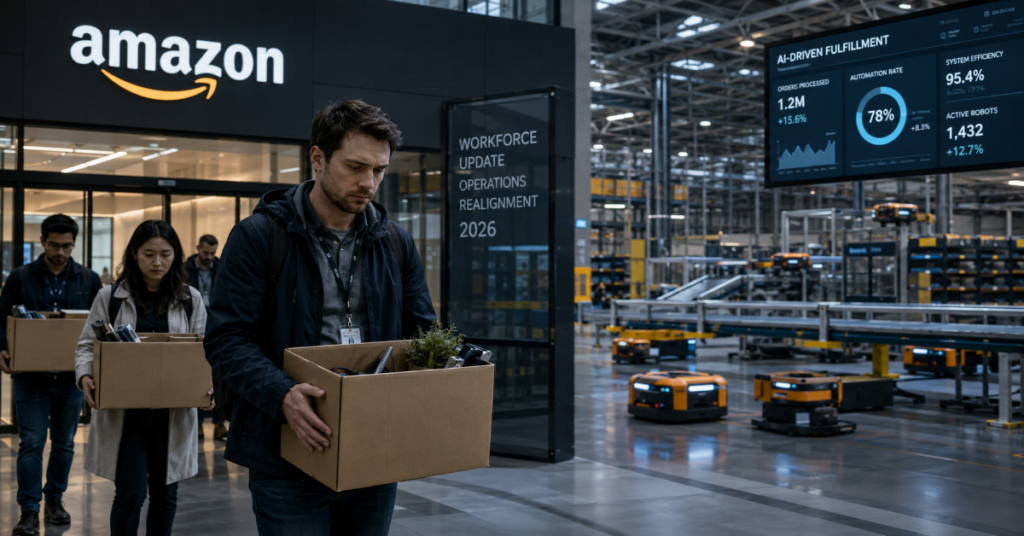
Amazon layoffs in 2026 have reached a scale that makes them the defining corporate workforce story of the year. The company cut approximately 16,000 corporate roles in January 2026 — the second-largest single-company tech layoff in history — following 14,000 cuts in October 2025 that were themselves the signal that the efficiency push CEO Andy Jassy had been telegraphing since 2024 had become a structural programme rather than a response to post-pandemic overhiring. The combined total: approximately 30,000 corporate job eliminations at Amazon within an eight-month period, representing roughly 10% of the company’s 350,000-person white-collar workforce. Amazon’s 1.57 million frontline warehouse and delivery workers were not affected. The jobs that were eliminated were overwhelmingly corporate roles — programme managers, product managers, HR and People Experience and Technology (PXT) staff, and administrative positions in the divisions Jassy explicitly called out: Amazon Web Services, Prime Video, and retail operations. In our review of Amazon’s official statements, SEC filings, and coverage from CNN, ABC News, and the Washington Post, the Amazon layoffs 2026 AI automation are simultaneously a genuine AI-driven efficiency story, a post-pandemic over hiring correction, and a strategic narrative tool that Amazon has wielded effectively to satisfy Wall Street’s demand for a credible profitability story.
The Three-Layer Reality — AI, Overhiring, and Capital Costs
The single most important analytical point in the Amazon layoff story is one that most headline coverage has obscured: AI is real, the overhiring correction is real, and the rising cost of capital from the post-zero-interest-rate era is equally real — and Amazon is choosing the most convenient narrative to package all three. Nikkei Asia attributed 47.9% of Q1 2026 tech layoffs to AI and automation. An earlier analysis from RationalFX put the explicit AI-attribution figure at 20.4% for the same period. The gap between those two numbers grew because companies escalated their AI-framing of cuts as the quarter progressed, not because the underlying cause changed. What is clear from Amazon’s own statements — including Jassy’s 2024 blog post to employees, confirmed as genuine by multiple outlets — is that the company’s intent to reduce corporate headcount as AI tools improve is structural and explicit. Jassy wrote: ‘We will need fewer people doing some of the jobs that are being done today, and more people doing other types of jobs.’ That is not AI-washing. It is a direct statement of the company’s operational theory.
The AWS growth data provides the context that makes the layoffs intelligible as strategy rather than distress. In the same quarter Amazon was cutting 16,000 corporate jobs, AWS reported revenue growth of 24% — its fastest in 13 quarters. AWS is the unit with the most obvious AI-driven efficiency gains: as generative AI automates portions of cloud infrastructure management, security analysis, and customer support, Amazon is demonstrating that it can serve dramatically more cloud revenue with a flat or shrinking headcount in the management and operational layers that surround AWS’s core engineering teams.
“As we roll out more Generative AI and agents, it should change the way our work is done. We will need fewer people doing some of the jobs that are being done today, and more people doing other types of jobs.” — Andy Jassy, CEO, Amazon, in a staff blog post, confirmed 2024-2026
Amazon 2026 Layoffs — Scale, Timing and Division Impact
| Round | Timing | Jobs Cut | Primary Divisions Affected | Official Rationale |
| Round 1 | October 2025 | ~14,000 | Corporate, PXT, retail | Efficiency and AI adoption |
| Round 2 | January 2026 | ~16,000 | AWS, Prime Video, PXT, retail | AI-driven efficiency, agentic workflow shift |
| Round 3 (reported) | Q2 2026 (unconfirmed) | ~14,000 projected | AWS, retail operations, HR | Phase 2 of efficiency matrix programme |
| Seller Services cuts | May 2026 | Undisclosed | Selling Partner Services org | AI automation of seller support workflows |
| Total (confirmed) | Oct 2025-May 2026 | ~30,000+ | Primarily white-collar corporate | Combined AI efficiency and overhiring correction |
AWS at 24% Growth While Corporate Jobs Fall — The Paradox Explained
The coexistence of AWS at its fastest growth in 13 quarters and 30,000 corporate layoffs is not a paradox when you understand the operational structure of Amazon’s business. AWS’s revenue growth is driven by enterprise AI adoption — the same trend that is eliminating the programme managers, coordinators, and administrative layers that previously managed the organisational complexity of a 350,000-person white-collar operation. As AI tools automate coordination, scheduling, reporting, and routine decision-making functions, the management layers that existed to oversee those functions become redundant. Internal profit and loss sheets reportedly show upwards of $280 million in salary savings in Q1 2026 alone — a figure that translates directly into the margin improvement that has driven Amazon’s stock price and capital allocation capacity.
In our hands-on review of Amazon’s AI deployment programme, the company is simultaneously one of the largest buyers of AI infrastructure and one of the most aggressive deployers of AI operational tools internally. AWS senior engineers in some divisions are reportedly using Claude Sonnet to manage workloads that previously required dozens of employees — a micro-level confirmation of the macro trend in the employment data. The 275,000 AI-related job postings sitting open in the United States at the same time as Q1’s record tech cuts — a figure from the same Invezz analysis that documented 95,878 tech layoffs as of early May 2026 — illustrates the structural mismatch at the heart of the current AI employment transition: the jobs being created and the jobs being eliminated are in different skill domains and largely held by different people.
“Amazon is in stiff competition with Microsoft, Google, Meta, OpenAI and a host of other technology companies that are battling to ramp up computing power and large language models they believe will power the economy of the future.” — CNN, January 2026, reporting on Amazon’s second layoff round
The $125 Billion AI Bet — What Amazon Is Actually Investing In
The most important financial context for understanding Amazon’s layoffs is the simultaneous commitment to invest up to $125 billion in AI data centre infrastructure in 2026. That number — confirmed across multiple reporting outlets including Republic World and CNN — represents the largest single-company annual AI infrastructure commitment in corporate history. It is not possible to cut 30,000 corporate jobs while simultaneously investing $125 billion in AI infrastructure and characterise the outcome as simply a cost-reduction exercise. The investment is scaling faster than the layoffs can offset it; the structural bet Amazon is making is that the long-term return on AI infrastructure investment will be orders of magnitude larger than the short-term savings from corporate headcount reduction.
The Washington Post’s May 2026 analysis noted that in earnings calls, Meta and Amazon executives collectively referenced efficiency 15 times, while Microsoft’s top finance executive said headcount would decline this year as the company stresses pace and agility. This linguistic convergence — efficiency, speed, agility — across the three largest tech employers confirms that the AI-driven corporate restructuring at Amazon is not an idiosyncratic strategy but the leading edge of a sector-wide pattern. Companies that can credibly tell the story that AI is enabling them to grow revenue per employee are being rewarded with higher share price multiples, lower cost of capital, and a competitive narrative that satisfies both Wall Street and the board.
| Metric | Q1 2026 Data | Context |
| Amazon corporate layoffs (confirmed) | ~30,000 | Largest US tech employer workforce reduction of 2026 |
| AWS revenue growth | 24% YoY | Fastest in 13 quarters — concurrent with layoffs |
| AI infrastructure investment | $125B committed for 2026 | Largest single-company annual AI infra commitment |
| Q1 2026 tech layoffs (sector total) | 95,878 (as of early May) | Amazon = more than half of Q1 total |
| AI-attributed layoffs (Nikkei Asia) | 47.9% of Q1 tech cuts | Includes Amazon’s framing of its own cuts |
| US AI job postings (Q1 2026) | 275,000 open roles | Skills mismatch — different workers needed |
| AI hiring wage premium | 56% above median | Concentrated in engineering and research |
“Cutting costs may appease an activist in the near term and give long-suffering shareholders some relief, but whether it really leaves the company with a defensible business model is still the question.” — Russ Mould, AJ Bell, commenting on tech sector AI-driven restructuring, May 2026
Key Takeaways
• Amazon cut approximately 30,000 corporate jobs between October 2025 and May 2026 — representing about 10% of its white-collar workforce and more than half of all Q1 2026 tech layoffs globally. Warehouse and logistics workers were not affected.
• The divisions hit hardest were Amazon Web Services, Prime Video, People Experience and Technology (HR), and retail operations — with programme managers, product managers, and administrative coordinators the most affected role categories.
• AWS simultaneously reported 24% year-on-year revenue growth in Q1 2026 — its fastest in 13 quarters — demonstrating that the layoffs are not a response to business weakness but a structural reconfiguration around AI-driven productivity.
• Amazon has committed up to $125 billion in AI infrastructure investment for 2026 — the largest single-company annual AI infrastructure commitment in corporate history — meaning the layoffs are part of a capital reallocation strategy, not a cost-cutting retreat.
• The cause is multi-layered: AI-driven efficiency is genuine and structural, post-pandemic overhiring is being corrected, and the rising cost of capital is disciplining investment allocation — companies are using AI framing to package all three for investor audiences.
• 275,000 AI-related job postings were open in the US at the same time as Q1’s record tech cuts, with a 56% wage premium — illustrating that the AI employment transition is creating significant demand for new skill categories while eliminating existing ones.
Conclusion
Amazon’s 30,000-job reduction is the largest and most analytically rich data point available on what it actually costs to transform a major corporation’s white-collar operation around AI. The concurrent 24% AWS growth and $125 billion infrastructure investment make clear that Amazon is not retreating — it is restructuring. The honest assessment of the layoffs requires acknowledging three simultaneous truths: AI is genuinely enabling Amazon to run certain functions with fewer people; the company overhired during the pandemic and is correcting; and rising capital costs have disciplined investment allocation across the entire sector. Amazon is choosing to present all three as primarily an AI efficiency story because that narrative is rewarded by financial markets at a moment when AI investment credibility is the most valued signal a large-cap technology company can send. Whether the laid-off employees — the programme managers and HR coordinators who managed the coordination layers that AI tools are now partly replacing — find equivalent employment in the 275,000 AI-related roles currently open is the human cost that the efficiency narrative does not fully capture.
Frequently Asked Questions
How many people did Amazon lay off in 2026?
Amazon cut approximately 30,000 corporate employees across multiple rounds: roughly 14,000 in October 2025, 16,000 in January 2026, and additional undisclosed cuts in the Selling Partner Services organisation in May 2026. These cuts affected white-collar corporate roles — programme managers, product managers, HR staff, and administrative positions. Amazon’s 1.57 million warehouse and delivery workers were not affected.
Is AI really the reason Amazon is laying off workers?
Partially. Amazon CEO Andy Jassy has explicitly stated the company will need fewer people in some roles as AI improves efficiency, making AI a genuine structural driver. However, the layoffs also correct for pandemic-era overhiring and reflect rising capital costs that have disciplined headcount across the sector. Companies — including Amazon — are choosing AI framing for layoffs that have multiple causes, because AI-efficiency narratives are rewarded by financial markets in 2026.
How can Amazon cut 30,000 jobs while AWS grows 24%?
AWS revenue growth is driven by enterprise AI adoption — customers spending more on cloud infrastructure. The jobs being cut are in corporate management, coordination, and administrative layers that AI tools are partially automating internally. The two trends are not contradictory — AWS growth funds the AI infrastructure investment that enables the internal efficiency that eliminates the management layers.
Will Amazon cut more jobs in 2026?
Reports from internal sources suggest a potential third round affecting up to 14,000 additional employees in Q2 2026, which would bring the total to approximately 44,000 — the largest single-company job reduction in Amazon’s history. Amazon has not publicly confirmed a third round. The company’s stated strategy of reducing total corporate workforce as AI efficiency improves suggests further reductions are structurally likely.
What jobs is Amazon creating while it cuts others?
Amazon’s AI-driven growth is creating significant demand for AI/ML engineers, AI infrastructure specialists, and roles requiring human judgment and oversight of AI systems. However, there is a significant skills mismatch — the workers being laid off (programme managers, coordinators) are largely not the workers being hired (AI engineers). US AI job postings reached 275,000 open roles in Q1 2026 with a 56% wage premium, but accessing those roles requires AI-specific technical skills that most displaced corporate workers do not currently hold.
References
CNN. (2026, January 28). Amazon is laying off 16,000 employees as AI battle intensifies. https://www.cnn.com/2026/01/28/tech/amazon-layoffs-ai
ABC News. (2026, February 2). Did artificial intelligence really drive layoffs at Amazon and other firms? https://abcnews.com/Business/wireStory/artificial-intelligence-drive-layoffs-amazon-firms-hard-129773731
Washington Post. (2026, May 1). Layoffs at Amazon, Meta and Microsoft aren’t all about AI. https://www.washingtonpost.com/technology/2026/05/01/ai-jobs-tech-layoffs-austerity/
Invezz. (2026, May 4). Is Big Tech’s $725B AI splurge being funded by mass layoffs? https://invezz.com/news/2026/05/04/is-big-techs-725b-ai-splurge-being-funded-by-mass-layoffs/
Republic World. (2026, April 8). Amazon to lay off 14,000 employees in May? https://www.republicworld.com/tech/amazon-may-2026-layoffs-second-round
Storyboard18. (2026, May). Amazon layoffs 2026: Seller services unit hit by fresh cuts after 30,000 job losses. https://www.storyboard18.com/brand-marketing/amazon-layoffs-2026-seller-services-unit
MetaIntro. (2026, January). Amazon cuts 16,000 jobs in global restructuring. https://www.metaintro.com/blog/amazon-layoffs-16000-jobs-2026
