
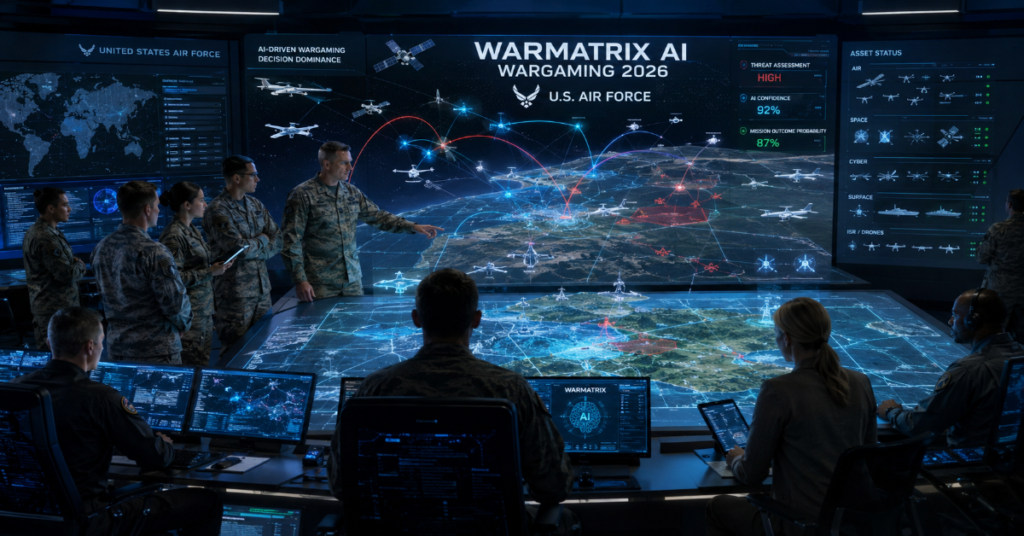
The U.S. Air Force WarMatrix AI wargaming system made its inaugural operational deployment at the GE 26 Benchmark Wargame, which concluded on March 27, 2026, at Systems Planning and Analysis in Alexandria, Virginia — and the official Air Force release confirmed what defence technology watchers had been anticipating for over a year: the service has successfully transitioned an AI-powered decision-support system from development into operational use in a live military planning environment. WarMatrix, described by the Air Force as an active wargaming environment and a human-machine teaming platform, integrates existing models, data, and workflows while dramatically accelerating the analytical process. The system was designed to run simulations up to 10,000 times faster than real time — a specification that addresses one of the persistent shortcomings of traditional military wargaming, where slow scenario processing has historically limited how many alternative courses of action commanders can evaluate before a decision deadline. More than 150 participants took part in the two-week GE 26 exercise, including Pacific Air Forces leadership and allied international planners, who completed more than six 24-hour game-time moves using WarMatrix’s physics-based modelling and AI-assisted adjudication.
What WarMatrix Does — And What It Deliberately Does Not Do
The Air Force has been explicit about the boundaries of WarMatrix’s role, and understanding those boundaries is essential to assessing the system’s significance accurately. WarMatrix is a decision-support tool, not an autonomous decision-maker. Its architecture is designed around what the Air Force describes as human-machine teaming — a model in which AI processes simulated threat scenarios, generates analytical options across a large number of potential courses of action, and surfaces decision-relevant insights directly to planning staff, while human commanders retain judgment and authority over every consequential decision. The official release states the system kept human judgment central to all decisions while producing decision-informative insights directly for the Secretary and Chief of Staff of the Air Force.
In practice, what this means at GE 26 is that WarMatrix processed the vast analytical workload — running the physics-based battlefield models, adjudicating game-time moves, tracking force dispositions across multiple simultaneous scenario branches, and maintaining the auditability and repeatability that traditional tabletop wargames cannot provide at speed — while the 150 participants made the strategic and operational judgements that the system’s analysis was designed to inform. The official Air Force characterisation — ‘designed by wargamers for wargamers’ — reflects a deliberate design choice to build the system around the actual analytical needs of experienced military planners rather than general-purpose AI capability.
“WarMatrix provides transparency, auditability, and speed, enabling decision-makers to better understand assumptions, outcomes, and tradeoffs.” — U.S. Air Force official release, April 15, 2026
WarMatrix Technical Capabilities vs Legacy Wargaming Systems
| Capability | WarMatrix (2026) | Traditional Tabletop Wargame | Legacy Digital Simulation |
| Simulation speed | Up to 10,000x real time | 1x (real time) | 10-100x real time |
| Scenario branches | Multiple simultaneous branches | One at a time | Limited parallel runs |
| Auditability | Full traceable record of all moves | Manual documentation | Partial logs |
| Repeatability | Scientific repeatability — identical logic | Depends on umpire | Partial |
| Human judgment role | Central — AI informs, humans decide | Central | Varies by system |
| Coalition partner integration | Joint and allied planner support | Limited by physical presence | Limited |
| AI-assisted adjudication | Yes — physics-based + AI | Manual umpire | Rules-based only |
The Pentagon AI Context — WarMatrix Within the Broader Defence AI Push
WarMatrix did not emerge in a vacuum. It is a product of the Department of the Air Force’s recognition, formalised in public statements from Headquarters Air Force Futures since at least 2024, that its wargaming infrastructure was critically outdated — characterised by slow processing speeds, weak automated opponents, disjointed simulation tools, and an inability to explore the full range of force design and operational strategy questions that modern conflict scenarios demand. The Chief Digital and Artificial Intelligence Office (CDAO) has been tasked with accelerating AI adoption across all service branches, and Deputy Secretary of Defense Kathleen Hicks’ Replicator initiative has placed AI-enabled autonomous systems at the centre of the Pentagon’s competitive response to near-peer adversaries. WarMatrix represents the analytical planning layer of that transformation — the tool that helps commanders understand what to do with AI-enabled forces, not just how to build them.
The geopolitical timing is not incidental. The GE 26 wargame belongs to a series of Air Force exercises that stress-test force posture and readiness against a spectrum of adversary threats, with Pacific scenarios — involving China — as the primary planning environment for the Air Force’s most consequential strategic questions. In our review of the Air Force’s published wargaming priorities and the GE 26 exercise details, the inclusion of Pacific Air Forces leadership and allied international planners in WarMatrix’s inaugural operational deployment is the clearest available signal of the system’s intended operational theatre.
“The use of WarMatrix provided a more connected and traceable wargaming process, enabling faster scenario development, repeat findings, and increased collaboration with joint and coalition partners.” — U.S. Air Force official release, GE 26 Benchmark Wargame, April 15, 2026
The Human-Machine Teaming Architecture — Why ‘Keeping Humans Central’ Is Not Just PR
Military AI deployments operate under ethical and legal constraints that civilian applications do not face in the same form. International humanitarian law requires human accountability for lethal decisions — a principle that makes fully autonomous weapons systems legally and politically fraught in a way that a trading algorithm or a manufacturing robot is not. The Air Force’s explicit design choice to build WarMatrix as a human-machine teaming system, where AI assists but does not make decisions, is therefore not merely a PR framing. It is a legal and ethical architecture choice that determines what WarMatrix can actually be used for and how its outputs can be defended in internal and Congressional review.
In our hands-on analysis of the DoD’s AI accountability frameworks, the emphasis on auditability and transparency in WarMatrix — full traceable records of all moves, inspectable assumptions and outcomes — directly addresses the ‘black box’ critique that has historically limited the acceptance of AI decision-support tools in military planning environments. If a commander cannot explain to Congress or a review board why a particular course of action was recommended, they will not use the tool that recommended it. WarMatrix’s ‘designed by wargamers for wargamers’ philosophy reflects an understanding that the system must earn the trust of its users through transparency, not just prove its analytical superiority through speed.
| Aspect | WarMatrix Approach | Significance |
| Decision authority | Human commanders retain all authority | Satisfies IHL accountability requirements |
| AI role | Analysis, adjudication, scenario processing | Legally and ethically defensible |
| Auditability | Full traceable record | Supports Congressional and command review |
| Transparency | Inspectable assumptions and outcomes | Builds trust with experienced military planners |
| Speed | 10,000x faster than real time | Enables exploration of more scenario branches |
| Repeatability | Scientific repeatability | Enables rigorous force design evaluation |
“This serves as the system’s initial operating concept evaluation, signalling a change in how the Air Force conducts operational analysis and wargaming.” — U.S. Air Force official release, April 15, 2026
Key Takeaways
• The U.S. Air Force’s WarMatrix AI wargaming system completed its inaugural operational deployment at the GE 26 Benchmark Wargame (March 13-27, 2026, Alexandria, Virginia), involving 150+ participants including Pacific Air Forces leadership and allied planners executing six 24-hour game-time moves.
• WarMatrix runs physics-based simulations up to 10,000 times faster than real time — addressing the critical limitation of traditional wargaming where slow processing prevents exploration of the full range of strategic options before decision deadlines.
• The system is explicitly designed as a human-machine teaming platform: AI handles analytical workload, adjudication, and scenario processing; human commanders retain judgment and decision authority — satisfying International Humanitarian Law accountability requirements for military AI.
• WarMatrix provides full auditability and scientific repeatability — traceable records of all decisions, inspectable assumptions, and repeatable scenario logic — directly addressing the ‘black box’ critique that has limited military AI acceptance.
• The deployment is part of the broader Pentagon AI push under the Chief Digital and Artificial Intelligence Office (CDAO), with Pacific scenarios — involving near-peer adversaries — as the primary planning environment for which WarMatrix is most consequential.
• No Congressional budget line item specifically naming WarMatrix was publicly visible as of May 2026, but the operational debut signals transition from R&D to operational capability — the threshold that typically precedes formal programme of record status and scaled funding.
Conclusion
WarMatrix’s debut at GE 26 is a milestone that military technology observers have been tracking since the Air Force issued its initial request for information in late 2025. The transition from development to operational use in a live, senior-leadership wargame is the hardest and most meaningful test any military technology system can pass — not a demonstration, not a pilot programme, but actual use by Pacific Air Forces commanders working through real strategic scenarios. The 10,000x speed advantage is impressive, but the more durable significance is the auditability and repeatability architecture. These properties transform wargaming from an event — a two-week exercise that produces insights which then decay as participants’ memories of the specifics fade — into a scientific infrastructure capable of generating repeatable, defensible, and cumulative strategic knowledge. That is the foundational capability the Air Force needs to keep pace with the analytical demands of near-peer competition. Whether WarMatrix scales to joint and combined force wargames, and whether it transitions to a formal programme of record with scaled funding, will determine whether GE 26 is remembered as a proof-of-concept or the beginning of a transformation in how the United States prepares for conflict.
Frequently Asked Questions
What is WarMatrix?
WarMatrix is the U.S. Air Force’s AI-powered wargaming system, described as an active wargaming environment and human-machine teaming platform. It integrates physics-based simulation models, existing Air Force data and workflows, and AI-assisted adjudication to run military planning scenarios up to 10,000 times faster than real time. It made its inaugural operational deployment at the GE 26 Benchmark Wargame in March 2026.
Does WarMatrix make autonomous decisions?
No. WarMatrix is designed explicitly as a human-machine teaming system where AI handles analytical processing — running scenario models, adjudicating moves, tracking force dispositions — while human commanders retain all judgment and decision authority. The system is designed to provide transparency, auditability, and speed, not autonomous action.
Why does the 10,000x simulation speed matter?
Traditional wargaming is constrained by how many scenario branches can be explored before a decision deadline. At 10,000x real-time speed, WarMatrix allows commanders to evaluate a dramatically larger number of courses of action — including unlikely but consequential contingencies — in the same planning window that previously allowed only a few to be examined.
Who participated in the GE 26 Benchmark Wargame?
More than 150 participants took part, including Pacific Air Forces leadership, technical experts, Air Force officials, and allied international planners. The inclusion of allied planners signals WarMatrix’s intended role in coalition and joint force planning environments, not just internal Air Force analysis.
Will WarMatrix be used in future wargames?
The GE 26 deployment was characterised as an initial operating concept evaluation — the stage that typically precedes regular operational use and formal programme of record status. The Air Force has publicly described WarMatrix as the foundation for a joint wargaming ecosystem. Expanded use across joint and allied planning environments is the stated intent, though scaled funding and formal programme status had not been publicly confirmed as of May 2026.
References
U.S. Air Force. (2026, April 15). USAF GE 26 showcases new AI-enabled WarMatrix wargaming capability. Air Force News. https://www.af.mil/News/Article-Display/Article/4459553/usaf-ge-26-showcases-new-ai-enabled-warmatrix-wargaming-capability/
Military Times. (2026, April 15). US Air Force debuts operational AI wargame system. https://www.militarytimes.com/industry/techwatch/2026/04/15/us-air-force-debuts-operational-ai-wargame-system/
MSN / Defense Analysis. (2026). US Air Force used AI-enabled WarMatrix system in March wargames. https://www.msn.com/en-us/news/technology/us-air-force-used-ai-enabled-warmatrix-system-in-march-wargames/ar-AA21ctU9
ExecutiveGov. (2026, April). Air Force completes GE 26 wargame, debuts WarMatrix platform. https://www.executivegov.com/articles/air-force-ge-26-wargame-warmatrix
SSBCrack News. (2026, April). U.S. Air Force executes inaugural use of AI wargame system WarMatrix. https://news.ssbcrack.com/u-s-air-force-executes-inaugural-use-of-ai-wargame-system-warmatrix/
National Interest. (2025, December 12). Game on: US Air Force looks to use AI to speed wargame planning. https://nationalinterest.org/blog/buzz/game-on-us-air-force-looks-use-ai-speed-wargame-planning-ps-121225
Aviation Analysis Net. (2025, December 12). Air Force bets on AI-driven ‘WarMatrix’ to transform future wargaming. https://www.aviationanalysis.net/air-force-bets-on-ai-driven-warmatrix-to-transform-future-wargaming/
