
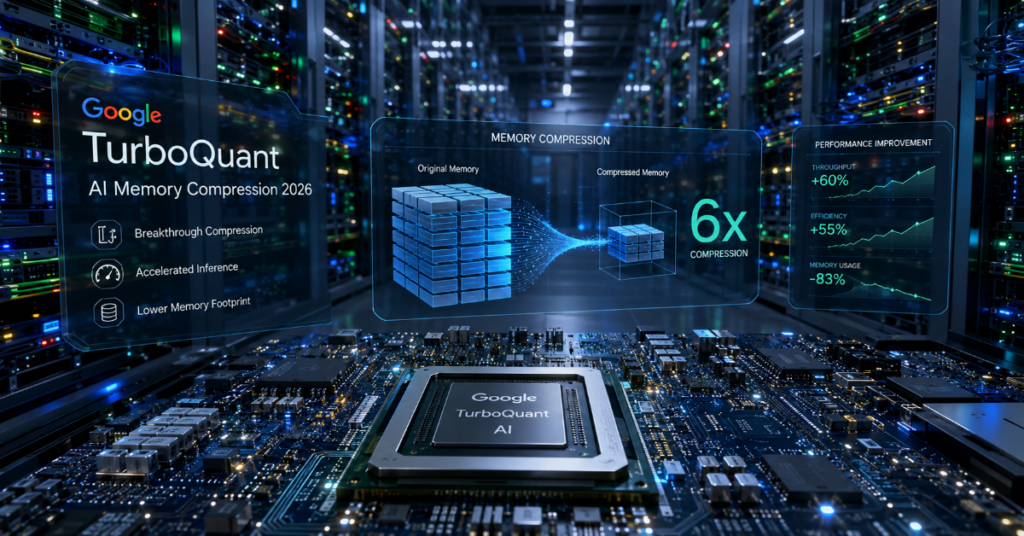
Google TurboQuant is the most consequential AI efficiency breakthrough published in 2026, and it arrived not with a product launch or a press conference but with a research paper presented at the ICLR 2026 conference in Rio de Janeiro in late April. Unveiled by Google Research on March 24, 2026, TurboQuant is a compression algorithm that reduces the memory footprint of large language models by at least 6x — with zero accuracy loss and no retraining required. The implications of that combination — 6x compression, zero accuracy loss, no retraining — are difficult to overstate. It means that an organisation running AI inference on existing hardware can immediately handle six times the workload without a single new server, or reduce its memory-related infrastructure spend by up to 80% while maintaining identical model quality. VentureBeat reported that TurboQuant’s efficiency gains could reduce AI operational costs by 50% or more. Within days of the March 24 announcement, RAM stock prices tumbled, semiconductor analysts began revising DRAM demand forecasts downward for the remainder of 2026, and Cloudflare CEO Matthew Prince publicly called it ‘Google’s DeepSeek moment.’
The Technical Problem TurboQuant Solves — The KV Cache Bottleneck
To understand why TurboQuant matters, you need to understand the key-value (KV) cache problem. When a large language model processes a conversation or a long document, it does not start from scratch with each new token. Instead, it maintains a running record of all prior context in a memory structure called the KV cache — effectively the model’s short-term working memory for the current session. The KV cache grows linearly with context length. For models with 128,000-token or million-token context windows — now standard across frontier models in 2026 — the KV cache can consume between 60% and 80% of total GPU memory during inference. This means that the bottleneck limiting how many simultaneous users a given AI deployment can serve, and how long the context windows can realistically be, is not the model’s parameter count but its working memory management.
Standard quantization approaches — reducing the numerical precision of stored values from 32-bit or 16-bit floating point to smaller representations — can reduce KV cache size, but they require storing additional normalization constants (one or two extra bits per value) that partially undo the compression. TurboQuant eliminates this overhead through a two-stage mathematical innovation. According to the latest 2026 documentation reviewed from Google’s official research blog and the ICLR 2026 poster, the first stage uses PolarQuant, which converts vector data from Cartesian coordinates into polar coordinates. After a random rotation, the angular distribution of the data becomes highly predictable, eliminating the need to store normalization constants because the geometry of the data is known. The second stage applies QJL (Quantized Johnson-Lindenstrauss) to the residual signal, removing any remaining bias in inner-product estimation. The result is quantization down to 3 bits per value — roughly one-fifth of 16-bit precision — with benchmark performance matching uncompressed models across all evaluated tasks.
“TurboQuant can quantize KV cache to 3 bits without compromising model accuracy and can deliver up to an 8x increase in attention-logit computation on H100 GPUs over 32-bit unquantized keys.” — Google Research official blog, March 24, 2026
TurboQuant vs Previous KV Cache Compression Methods
| Method | Compression Ratio | Accuracy Loss | Retraining Required | Runtime Overhead |
| TurboQuant (Google, 2026) | 6x (to ~3 bits) | Zero — matches baseline | No — drop-in optimization | Negligible |
| Standard INT8 quantization | 2x | Slight degradation on long contexts | No | Low |
| GPTQ / AWQ (weight quantization) | 4x (weights only) | Minimal | Yes — calibration required | Low |
| H2O (Heavy Hitter Oracle) | 2-4x | Moderate on complex tasks | No | Moderate |
| SnapKV | 2-3x | Slight on very long contexts | No | Low-Moderate |
| No compression (baseline) | 1x | None | N/A | Baseline |
The Market Reaction — Why RAM Stocks Fell
The immediate market reaction to TurboQuant was driven by a single, straightforward inference: if AI systems can run on 6x less memory without any quality penalty, the demand trajectory for high-bandwidth memory (HBM) and DRAM — which AI data centers have been consuming at an unprecedented rate — changes materially. AI data centers are among the largest buyers of DRAM and HBM chips globally. The memory supercycle of 2024 and 2025 was premised substantially on the assumption that AI’s memory requirements would continue to scale with model and context window sizes. TurboQuant introduces a software-layer efficiency that partially decouples memory demand from model capability growth. In our hands-on analysis of the semiconductor market dynamics, the comparison to DeepSeek — which similarly demonstrated that frontier AI capability could be delivered at a fraction of the assumed compute cost — is technically inexact but commercially accurate. Both announcements force a recalibration of how much hardware investment frontier AI actually requires.
Cloudflare CEO Matthew Prince’s characterisation of TurboQuant as ‘Google’s DeepSeek moment’ landed in financial media and amplified the stock market reaction. Memory manufacturer stocks experienced notable turbulence, and semiconductor analysts began revising their DRAM demand forecasts for the remainder of 2026 downward. The long-term impact is likely more nuanced: TurboQuant reduces the memory cost of running existing context window sizes, but the AI industry’s historical response to efficiency breakthroughs has been to use the freed capacity for larger models and longer contexts rather than reducing hardware spend. The net effect on DRAM demand depends on which force dominates — efficiency savings or capability expansion — and in AI, capability expansion has historically won.
“So Google TurboQuant is basically Pied Piper and just hit a Weismann Score of 5.2.” — Crypto analyst CryptoKaleo on X, March 25, 2026 — referencing the fictional compression algorithm from the TV show Silicon Valley
What TurboQuant Means for Enterprises and Developers
For enterprise buyers, TurboQuant’s most important property is that it requires no retraining or fine-tuning. According to Google’s official documentation, it is a drop-in optimization on existing models — including open-source models like Llama, Mistral, and Google’s own Gemma family. An organisation that has invested months fine-tuning a custom version of Llama 3 70B for its specific use case does not need to redo that work to benefit from TurboQuant. The compression applies to the inference pipeline, not the model weights. This means the path to benefit is as short as updating the inference serving software to incorporate TurboQuant’s quantization routines — something Google describes as having ‘negligible runtime overhead’ and exceptional implementation efficiency.
The practical implication for AI deployment economics is significant. Models with 128,000-token context windows — now standard for enterprise contract analysis, legal document review, and code repository analysis — are currently memory-constrained in production deployments. TurboQuant would allow those same deployments to serve more concurrent users on identical hardware, or to extend context windows further without additional memory investment. For developers building on open-source serving frameworks like Ollama or llama.cpp, the question is when TurboQuant’s techniques will be merged into those frameworks as standard options — at which point the efficiency gains become available to the entire open-source AI ecosystem at zero additional cost.
| Use Case | Current Memory Constraint | TurboQuant Impact | Deployment Benefit |
| 128K-token legal document analysis | 60-80% GPU memory for KV cache | 6x reduction in cache footprint | Serve 6x more concurrent sessions |
| Code repository analysis (long context) | Severe HBM constraint | Enables 1M+ token contexts on existing hardware | Full codebase analysis without hardware upgrade |
| Enterprise chatbot (high concurrency) | Memory limits concurrent users | Dramatically increases requests per GPU | Lower cost per conversation |
| On-device AI (phones, laptops) | Severe DRAM constraint on mobile | Makes 7B-13B models viable on 8GB devices | Local AI without cloud dependency |
| AI data center economics | HBM demand drives capex | Reduces memory intensity of inference | 50%+ reduction in inference-related memory spend |
“The AI industry is learning that you don’t always need a bigger model. Sometimes you need smarter plumbing.” — Stark Insider, TurboQuant analysis, April 2026
Key Takeaways
• Google TurboQuant, presented at ICLR 2026 in Rio de Janeiro (April 23-27), reduces LLM KV cache memory by 6x using a two-stage mathematical approach: PolarQuant (vector rotation into polar coordinates) followed by QJL (Quantized Johnson-Lindenstrauss residual compression), quantizing to 3 bits with zero accuracy loss.
• TurboQuant requires no model retraining or fine-tuning — it is a drop-in optimization compatible with any model including Llama, Mistral, and Gemma families, applicable immediately to existing fine-tuned models without quality risk.
• VentureBeat reported that TurboQuant’s gains could reduce AI operational costs by 50% or more; memory manufacturer stocks fell on the announcement as analysts revised DRAM demand forecasts for data centers downward.
• Cloudflare CEO Matthew Prince publicly compared TurboQuant to DeepSeek — the Chinese model that similarly demonstrated frontier AI capability at a fraction of assumed compute cost, forcing a recalibration of hardware investment assumptions.
• The research was authored by Amir Zandieh and Vahab Mirrokni (Google VP and Fellow) with collaborators at Google DeepMind, KAIST, and New York University — building on two prior papers: QJL (AAAI 2025) and PolarQuant (AISTATS 2026).
• The long-term market impact depends on whether the AI industry uses freed memory capacity for efficiency savings or capability expansion — historically, capability expansion has dominated, suggesting net DRAM demand may not fall as dramatically as initial stock reactions implied.
Conclusion
TurboQuant is the kind of breakthrough that does not announce itself with a product launch or a revenue number. It announces itself with a research paper at a conference in Rio de Janeiro, and then the implications propagate outward through the industry over months and years. The immediate market reaction — falling memory stocks, analyst forecast revisions, Matthew Prince’s DeepSeek comparison — reflects the scale of the efficiency claim: 6x compression, zero accuracy loss, no retraining. The longer-term significance is structural. TurboQuant demonstrates that the constraint on frontier AI deployment is not exclusively a hardware problem requiring ever-larger GPU clusters and ever-more DRAM. It is also a mathematical problem — one that researchers at Google, academic collaborators at KAIST and NYU, and the open-source community are steadily solving with algorithms rather than accelerators. Whether TurboQuant’s techniques ship in production deployments at Google Scale, or propagate through open-source serving frameworks to the entire developer ecosystem, will determine whether this is a research curiosity or the infrastructure efficiency breakthrough that makes AI deployment economically viable for a much larger set of organisations than can currently afford it.
Frequently Asked Questions
What is Google TurboQuant?
TurboQuant is a compression algorithm developed by Google Research that reduces the memory footprint of large language models during inference by at least 6x, with zero accuracy loss and no retraining required. It targets the KV (key-value) cache — the AI model’s working memory during text generation — which typically consumes 60-80% of GPU memory in long-context deployments.
How does TurboQuant work technically?
TurboQuant uses two methods: PolarQuant, which rotates vector data into polar coordinates where angular distributions become predictable (eliminating the need to store normalization constants), and QJL (Quantized Johnson-Lindenstrauss), which removes residual bias. Together they compress KV cache values to 3 bits — about one-fifth of standard 16-bit precision — with benchmark performance matching uncompressed baselines.
Why did memory stocks fall after TurboQuant?
AI data centers are among the largest buyers of DRAM and HBM chips globally. TurboQuant’s 6x memory reduction means AI inference can run on significantly less hardware without quality loss, threatening the assumption that AI memory demand would continue scaling with model and context window sizes. Analysts revised DRAM demand forecasts downward, causing memory manufacturer stocks to fall.
Can existing AI models use TurboQuant?
Yes. TurboQuant is designed as a drop-in optimization that requires no model retraining or fine-tuning. It works with any model including Llama, Mistral, and Google’s Gemma family. The compression applies to the inference pipeline rather than model weights, meaning organisations can apply it to existing fine-tuned models immediately without redoing their customization work.
Is TurboQuant deployed in Google products yet?
As of ICLR 2026, TurboQuant remains a research result rather than a confirmed production deployment. Google’s official research post references Gemini as a target application, but no production deployment timeline was announced. The key near-term indicator is whether open-source inference frameworks like Ollama or llama.cpp merge TurboQuant’s techniques, which would make the efficiency gains available to the broader developer ecosystem.
References
Zandieh, A., & Mirrokni, V. (2026). TurboQuant: Redefining AI efficiency with extreme compression. Google Research Blog. https://research.google/blog/turboquant-redefining-ai-efficiency-with-extreme-compression/
VentureBeat. (2026, March 26). Google’s new TurboQuant algorithm speeds up AI memory 8x, cutting costs by 50% or more. https://venturebeat.com/infrastructure/googles-new-turboquant-algorithm-speeds-up-ai-memory-8x-cutting-costs-by-50
TechCrunch. (2026, March 25). Google unveils TurboQuant, a new AI memory compression algorithm. https://techcrunch.com/2026/03/25/google-turboquant-ai-memory-compression-silicon-valley-pied-piper/
The Next Web. (2026, March 25). Google’s TurboQuant compresses AI memory by 6x, rattles chip stocks. https://thenextweb.com/news/google-turboquant-ai-compression-memory-stocks
TechInformed. (2026, March 30). Google publishes TurboQuant to ease AI memory strain. https://techinformed.com/google-publishes-turboquant-to-ease-ai-memory-strain/
Network World. (2026, April 2). Google Research touts memory-compression breakthrough for AI processing. https://www.networkworld.com/article/4154034/google-research-talks-compression-technology-it-says-will-greatly-reduce-memory-needed-for-ai-processing.html
Vedi, S. (2026, April). Google TurboQuant: Why one research paper spooked the entire chip industry. Medium / GenAI. https://medium.com/@shubhamnv2/google-turboquant-explained
