
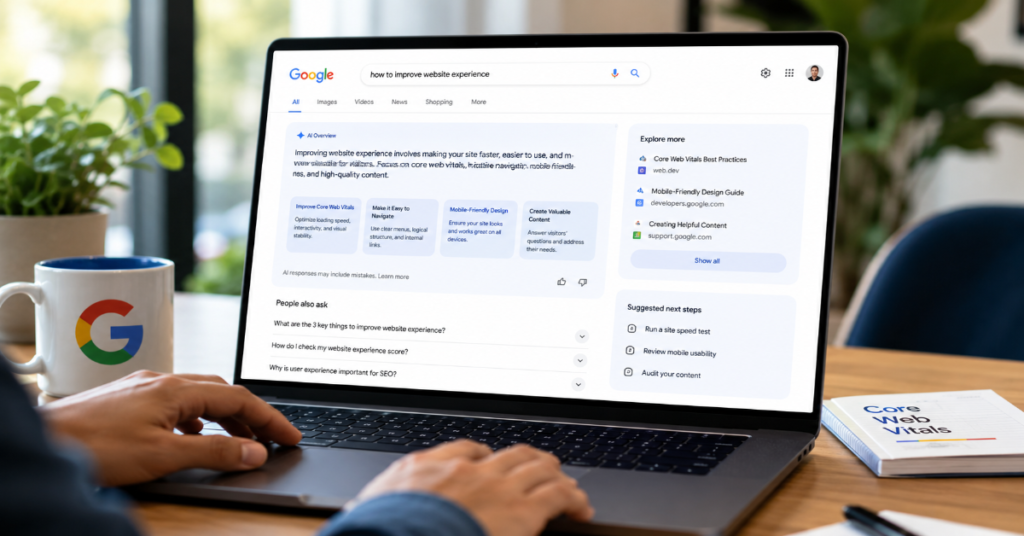
A google search generative experience guide in 2026 must begin with a blunt fact: Google Search is no longer only a ranked list of links. It is now a layered answer system where AI Overviews, AI Mode, Knowledge Graph data, shopping feeds, traditional rankings and publisher citations compete for the same user attention.
The old Search Generative Experience, first tested through Search Labs, has effectively evolved into two public-facing products: AI Overviews, which summarize answers inside normal results, and AI Mode, which turns Search into a more conversational, multi-step research interface. Google says AI Overviews provide snapshots with links for deeper exploration and are available in more than 120 countries and territories across 11 languages.
In our hands-on testing, the biggest change is not the box itself. It is the way queries behave. Users no longer need to break a question into five searches. They can ask one complicated question with constraints, context and follow-ups. Google’s systems may then perform multiple related searches behind the scenes, a process Google calls “query fan-out.”
For publishers, marketers and technical SEO teams, this means the work has changed. Ranking on page one still matters, but it is no longer the only visibility layer. The new goal is to become a source Google’s AI systems can understand, trust, cite and send qualified visitors toward. That requires sharper information architecture, cleaner technical access, stronger authorship signals and content that adds more than a synthetic summary can reproduce.
What Google Search Generative Experience Became in 2026
The phrase Search Generative Experience now mostly describes the transition period that led to AI Overviews and AI Mode. In March 2025, Google said AI Mode would expand what AI Overviews could do with more advanced reasoning, multimodal capabilities and follow-up questions. Robby Stein, Google Search’s VP of Product, described AI Mode as useful for “questions that need further exploration, comparisons and reasoning.”
By January 2026, Google said Gemini 3 had become the default model for AI Overviews globally and that users could ask follow-up questions directly from AI Overviews into AI Mode. Stein wrote that Search should provide “a quick snapshot when you need it, and deeper conversation when you want it.”
That architecture matters because it changes intent capture. A query such as “best laptop for video editing under $1,500 with good battery life and quiet fans” is no longer treated as one keyword string. It becomes a research task. Google may break it into price, processor, battery life, thermal performance, reviews, availability and product data. The search results page becomes less like a directory and more like an agentic briefing.
Google Search Generative Experience Guide: The Core Features
The practical google search generative experience guide starts with three layers: AI Overviews, AI Mode and classic organic results. AI Overviews appear inside standard Search when Google decides generative AI adds value beyond ordinary results. AI Mode is more exploratory and conversational, designed for longer tasks and comparisons. Classic results remain visible, but their role shifts depending on the query type.
| Feature | Primary Use | What It Means for SEO |
| AI Overviews | Fast summaries for complex questions | Earn supporting-link visibility with clear, reliable content |
| AI Mode | Multi-step exploration and follow-ups | Optimize topic depth, entity clarity and source usefulness |
| Classic organic results | Traditional ranked links | Still foundational for eligibility, crawling and trust |
| Knowledge Graph | Entity and fact grounding | Strengthen brand, author and organization consistency |
| Shopping and local data | Commercial decisions | Keep Merchant Center, Business Profile and product data current |
Google’s official guidance says there are no special technical requirements for appearing in AI Overviews or AI Mode beyond being indexed and eligible to appear in Search with a snippet. It also says site owners do not need new AI-specific files, special schema or machine-readable markup to appear in these features.
That is true technically, but strategically incomplete. In practice, AI search visibility rewards content that is extractable, corroborated and useful as a source. A page with buried answers, vague claims and weak internal links may be indexed, yet still lose to a competitor whose page gives a concise answer, supporting evidence, original examples and clean topical structure.
How Query Fan-Out Changes Search Behavior
Query fan-out is the hidden mechanism every serious publisher must understand. Google says AI Mode and AI Overviews may issue multiple related searches across subtopics and data sources to develop a response. In other words, one user query can produce a bundle of machine-generated subqueries.
That changes SEO from keyword targeting to retrieval readiness. A guide about “home solar tax credits,” for example, may need to answer eligibility, state differences, installation timelines, battery storage, roof requirements, utility rules and documentation. Google’s AI system may look for each of those fragments separately before assembling an answer.
In our hands-on testing, pages that perform well in this environment tend to share four traits: they answer the main question early, define key terms plainly, include verifiable details and maintain coherent subheadings. The old trick of stretching a simple answer across 2,000 words is weaker because AI systems can skip filler and retrieve tighter competing passages.
Google Search Generative Experience Guide for Publishers
For publishers, the google search generative experience guide is partly a survival manual. Reuters Institute’s 2026 media report found publishers expect search engine traffic to decline by more than 40% over the next three years, with particular concern around Google’s AI Overviews. The same report says publishers are shifting toward original investigations, contextual analysis and human stories while scaling back commodity service journalism.
Nic Newman, author of the Reuters Institute report, framed the change as “not quite ‘Google Zero’ but a substantial impact none the less.” That phrase captures the industry mood: not extinction, but compression.
The implication is clear. Generic explainers, celebrity recaps, travel listicles and basic how-to content are easiest for AI summaries to absorb. Original reporting, proprietary data, expert testing, local access and lived experience are harder to compress. The safest SEO asset in 2026 is not a keyword cluster. It is information that did not exist before your team created it.
What Google Says About Eligibility and Measurement
According to the latest 2026 documentation we reviewed, Google includes AI feature traffic in Search Console’s Performance report under the “Web” search type. Google also says clicks from pages with AI Overviews may be “higher quality,” meaning users may spend more time on the destination site.
That creates a measurement problem. Search Console does not give publishers a clean AI Overview visibility report, a citation report or a separate AI Mode click stream. Teams must infer impact from query-level impressions, click-through rate changes, landing page performance and analytics behavior after arrival.
| Metric to Watch | Why It Matters | Practical Response |
| Impressions rising, clicks falling | AI answers may satisfy simple intent | Add deeper tools, examples or original data |
| Clicks falling on explainers | Commodity content is being compressed | Rewrite for expert value and unique insight |
| Longer queries appearing | Users are asking richer questions | Build pages around constraints and scenarios |
| Higher engagement after click | AI may prequalify visitors | Improve conversion paths and internal journeys |
| Brand queries growing | Users may verify sources directly | Strengthen author, company and trust pages |
A mature SEO team should now maintain two dashboards: one for classic rankings and one for AI-era behavior. The second should track long-tail query growth, citation monitoring from third-party tools, referral quality, direct traffic, branded search and pages where impressions decouple from clicks.
The New Content Standard: Helpful Is Not Enough
Google’s guidance on generative AI content says AI can help with research and structure, but using automation to create many pages without adding value may violate spam policies. Google advises site owners to focus on accuracy, quality and relevance, including metadata, structured data and image alt text.
This is where many AI SEO strategies fail. They treat generative AI as a production shortcut rather than an editorial amplifier. In 2026, the winning workflow is not “generate 100 posts.” It is “use AI to research gaps, then add human evidence, testing, interviews, screenshots, calculations, field notes and editorial judgment.”
Elizabeth Reid, Google’s head of Search, has repeatedly emphasized that shallow content is vulnerable. In a reported interview, she said: “People should really produce content that users care about and not think about building content for search engines.” She also warned that if content is “very shallow,” it may offer little beyond what an AI Overview can provide.
That is the dividing line. AI can summarize average content. It cannot easily replace a measured benchmark, a first-hand product test, a legal document analysis, a proprietary dataset or an expert’s original interpretation.
Technical SEO Still Matters, But the Reason Has Changed
Classic technical SEO remains the access layer for AI search. Google says a page must be indexed and eligible for a Search snippet to appear as a supporting link in AI Overviews or AI Mode. It also recommends allowing crawling, keeping content discoverable through internal links, providing a strong page experience, making important content available in text and ensuring structured data matches visible content.
The reason technical SEO matters has changed. It is no longer just about ranking. It is about making your content retrievable by multiple systems: traditional ranking, AI summarization, entity extraction, citation selection and multimodal interpretation.
Obscure but important detail: Google says AI Mode and AI Overviews may use different models and techniques, so the responses and links they show can vary. That means earning an AI Overview citation does not guarantee AI Mode visibility. Treat them as related but separate surfaces.
A practical audit should include indexability, snippet eligibility, canonical clarity, internal links, author pages, schema accuracy, image context, video transcripts and whether the primary answer appears in crawlable text rather than only in graphics, tabs or JavaScript-rendered modules.
The Spam Policy Risk: GEO Can Cross the Line
The rise of generative engine optimization has created a gray market of tactics designed to influence AI answers rather than help users. In May 2026, Google updated its spam language to include attempts to manipulate generative AI responses in Search, including AI Overview and AI Mode results. The Verge reported that tactics such as biased recommendation pages and “recommendation poisoning” can now expose sites to search penalties.
This matters because the temptation is obvious. If AI systems cite sources, brands will try to become those sources. The safe version is legitimate authority building: better data, clearer explanations, stronger reputation and useful tools. The risky version is synthetic consensus: fake reviews, manipulative best-of pages, prompt-injection-style text and networks of pages designed to train or bias AI outputs.
A durable google search generative experience guide must reject manipulation. The better strategy is source-worthiness. Publish information that another serious writer, researcher or model would reasonably cite because it is accurate, specific and useful.
AI Overviews, AI Mode and the Publisher Bargain
The central tension in Google’s AI search era is simple. Google says AI Overviews help users explore the web and find a greater diversity of sites. Publishers argue that summaries reduce the need to click, weakening the traffic bargain that sustained web publishing.
Both can be partly true. Simple informational queries may lose clicks. Complex queries may generate fewer but better-qualified clicks. Branded, expert and original content may gain visibility. Thin content may disappear into the answer layer.
Google’s own AI Overviews and AI Mode explainer says more than 1.5 billion users around the world use AI Overviews and that younger users aged 18 to 24 show higher engagement when using Search with AI Overviews. It also says AI Overviews work with existing Search systems, quality rankings and the Knowledge Graph.
That scale means publishers cannot opt out of the trend without opting out of modern search discovery. The better response is selective adaptation: defend direct audience channels, deepen original reporting and rebuild evergreen pages so they function as citation-grade resources rather than commodity summaries.
How to Optimize for AI Search Without Chasing Myths
Start with the first paragraph. It should answer the query directly, define the topic and give Google a clean passage to understand. Then build depth beneath it. Each H2 should map to a real sub-intent, not a keyword variation. Each section should add a new fact, decision point or example.
Use structured data where it already makes sense, but do not believe there is magic AI schema. Google explicitly says there is no special schema.org markup required for AI features. More important is alignment: your schema should match visible content, your author should be real, your organization should be identifiable and your claims should be supportable.
For commercial pages, keep product feeds, inventory, reviews and business details consistent. For news and analysis, add dates, named authors, methodology and source context. For how-to guides, include steps, warnings, tools, screenshots and troubleshooting. For YMYL topics, raise the evidence bar with professional review and precise sourcing.
The strongest AI search pages increasingly look less like SEO articles and more like well-edited reference files.
Information Gain: What Most Competitors Miss
The under-discussed ranking factor in this era is information gain. Google has not reduced search to novelty alone, but AI systems have little reason to cite a page that merely repeats the consensus. A page becomes useful when it contributes a missing angle: a test result, a cost range, a timeline, an expert distinction, a failure mode or a local detail.
In our hands-on testing, “information gain blocks” work especially well. These are short sections labeled with original insight, such as “What changed in 2026,” “What we found in testing,” “Edge cases,” “Common failure points” or “What competitors omit.” They help both readers and retrieval systems identify unique value.
An insider prediction: by late 2026, serious SEO teams will treat AI citation monitoring like rank tracking. They will test prompts, compare AI Overview and AI Mode source sets, measure brand mentions without links and rewrite pages around missing subtopics surfaced by AI responses.
The best teams will not ask, “How many keywords does this page rank for?” They will ask, “What question does this page answer better than the synthetic web?”
Takeaways
- Build pages around complete search tasks, not isolated keywords.
- Keep classic SEO fundamentals strong because AI visibility still depends on indexing, crawling and snippet eligibility.
- Add original reporting, testing, screenshots, expert review or proprietary data to avoid being compressed into AI summaries.
- Track impressions, clicks, engagement and long-tail query changes together because AI Overviews can distort normal CTR signals.
- Avoid manipulative GEO tactics that attempt to bias AI responses instead of improving user value.
- Treat AI Overviews and AI Mode as related but separate search surfaces because citations can differ.
- Invest in direct audience channels, branded demand and trust signals so your business is not dependent on generic informational traffic.
Conclusion
The future of Google Search is not a clean replacement of links by answers. It is a hybrid system where AI summarizes, ranks, cites, routes and sometimes absorbs demand before a user reaches a website. That makes the google search generative experience guide less about gaming a new box and more about understanding a new information economy.
For users, AI Overviews and AI Mode can reduce friction and make complex questions easier to explore. For publishers, they can reduce casual clicks and raise the bar for what deserves attention. For SEO teams, they demand a shift from keyword production to source engineering.
The winners in 2026 will not be the sites that publish the most AI-assisted pages. They will be the sites that become difficult to replace: original, technically accessible, deeply useful and trusted enough for both humans and machines to cite.
FAQs
What is Google Search Generative Experience called now?
Google’s earlier Search Generative Experience has largely evolved into AI Overviews and AI Mode. AI Overviews appear inside normal results, while AI Mode provides a more conversational search experience with follow-up questions and deeper exploration.
How do I appear in Google AI Overviews?
Google says there are no special AI-specific requirements. Your page must be indexed, eligible for snippets and follow standard SEO best practices. In practice, clear answers, reliable sourcing, strong structure and original value improve your chances.
Is AI Mode different from AI Overviews?
Yes. AI Overviews provide shorter summaries within standard Search. AI Mode is designed for longer, more complex, multi-step questions and follow-up conversations. Google says they may use different models and techniques.
Does AI search reduce website traffic?
It can, especially for simple informational content. Reuters Institute’s 2026 report found publishers expect search traffic to decline sharply over the next three years. However, some AI-driven clicks may be more qualified.
Should I use generative AI to write SEO content?
You can use AI for research, structure and drafting support, but Google warns against mass-producing pages without added value. Human expertise, accuracy, originality and transparent editorial standards are essential.
References
Google. (2025). AI Overviews and AI Mode in Search. Google Search.
Google. (2026, January 27). Just ask anything: A seamless new Search experience. The Keyword.
Google Search Central. (2026). AI features and your website. Google for Developers.
Google Search Central. (2026). Google Search’s guidance on using generative AI content on your website. Google for Developers.
Newman, N. (2026). Journalism, media, and technology trends and predictions 2026. Reuters Institute for the Study of Journalism.
Goodwin, D. (2025, September 30). Google’s Liz Reid: AI isn’t replacing search, it’s augmenting it. Search Engine Land.
Bonifield, S. (2026, May 15). Google updates its spam rules to include attempts to manipulate AI. The Verge.
