
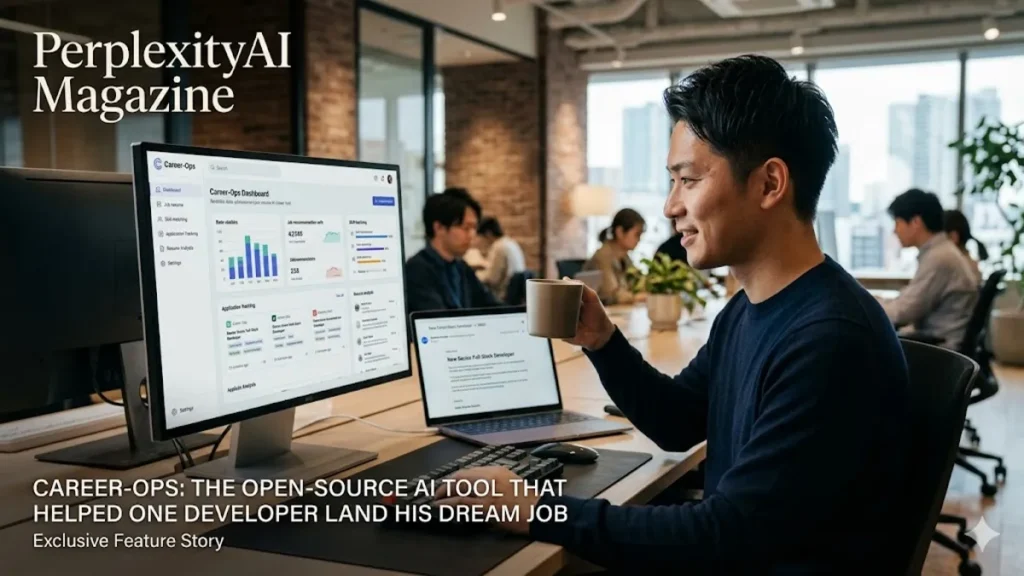
SAN FRANCISCO, CA — In a move that has sent shockwaves through the tech recruitment industry, Santiago Fernández de Valderrama, a veteran developer and former startup founder, has open-sourced the very tool that ended his own job search. The system, dubbed Career-Ops, leveraged the reasoning capabilities of Claude Code to evaluate more than 740 job offers across 45 elite tech firms, including Anthropic, OpenAI, and Stripe.
The project, which surged to over 8,000 stars on GitHub within 24 hours of its release on April 5, 2026, represents a shift from “spray-and-pray” automation toward a high-precision, “quality-first” application strategy. By week two of his job search, Fernández realized that manually tailoring resumes for senior AI roles was a full-time bottleneck. He chose to automate the analytical labor, ultimately landing a Head of Applied AI role after the tool identified the most compatible opportunities.
“I no longer apply to jobs; a multi-agent system evaluates them,” Fernández stated. “The AI does the heavy analytical lifting—scoring, tailoring, and tracking—so I can focus entirely on the human decision of where I actually want to work.”
Technical Architecture: 14 Modes of Precision
Unlike simple “auto-apply” bots that risk blacklisting by spamming recruiters, Career-Ops is built as a sophisticated command center. It operates through 14 distinct “skill modes” within the Claude Code environment, each governed by specific rules and logic.
- Autonomous Scanning: Using Playwright, the tool crawls career portals and APIs (Greenhouse, Lever, Ashby) to find new listings daily.
- 10D Scoring Engine: Every role is scored on an A–F scale across ten dimensions, including technical stack fit, compensation alignment, and interview probability.
- Dynamic PDF Generation: Instead of using a static template, the system uses Puppeteer to render bespoke, ATS-optimized resumes that front-load relevant keywords and reorder experience bullets based on the specific job description.
- Terminal Dashboard: Built with Go and the Bubble Tea framework, it provides a “mission control” view of the applicant’s pipeline, deduplicating leads and tracking progress.
A Rapid Setup for Senior Talent
The tool’s rapid viral success is attributed to its “developer-first” approach. Setup takes approximately 15 minutes for those comfortable with a terminal. Users clone the repository, install dependencies like Node.js and Playwright, and customize a profile.yml with their professional “archetypes” and salary requirements.
Once configured, a single command—/career-ops {URL}—triggers the full pipeline: reading the job post, generating a custom resume, and preparing the application materials for a final human review.
Expert Analysis: The End of the “SDR-Style” Job Hunt
Career-Ops marks a turning point in professional labor mobility. For years, HR departments have used AI to filter out candidates; now, candidates are using AI to filter out companies. This “asymmetric information” gap is closing.
What makes Career-Ops significant is its focus on “Human-in-the-Loop” (HITL) design. By emphasizing high-fit scoring over mass-volume applications, it actually solves a problem for recruiters: it reduces the noise of unqualified applicants. However, as these tools become mainstream, we expect a “cat-and-mouse” game between AI job hunters and AI recruitment filters. We are moving toward a future where “Applying for a job” is essentially an automated negotiation between two AI agents, leaving the final human interview as the only non-algorithmic step in the process.
CHECK OUT:
AI Models Lie and Cheat to Prevent Deletion: New Study
Frequently Asked Questions (FAQs)
1. Is Career-Ops a bot that applies to jobs while I sleep?
No. It is a “decision-support” tool. While it can automate form-filling via Playwright, the creator strongly advises a “Human-in-the-Loop” approach where you review the AI’s evaluation and custom resume before hitting submit.
2. Where can I find the source code?
The official repository is hosted on GitHub at github.com/santifer/career-ops. It is free and open-source under the MIT license.
3. Do I need a paid AI subscription to use it?
Yes. Career-Ops is built on Claude Code. You will need an active Anthropic API key or a Claude Pro/Max subscription to run the reasoning engine that powers the evaluations.
4. Can this tool be used for non-technical roles?
While the default “portals” and “archetypes” are optimized for tech and AI roles, the tool is highly customizable. By editing the Markdown profile and YAML configuration, it can be adapted for any industry.
5. How does it handle ATS (Applicant Tracking Systems)?
It generates single-column, standard-font PDFs (using Space Grotesk and DM Sans) that are designed to be easily parsed by major ATS platforms. It also dynamically injects 15–20 keywords extracted directly from the job description.
