
📋 Executive Summary
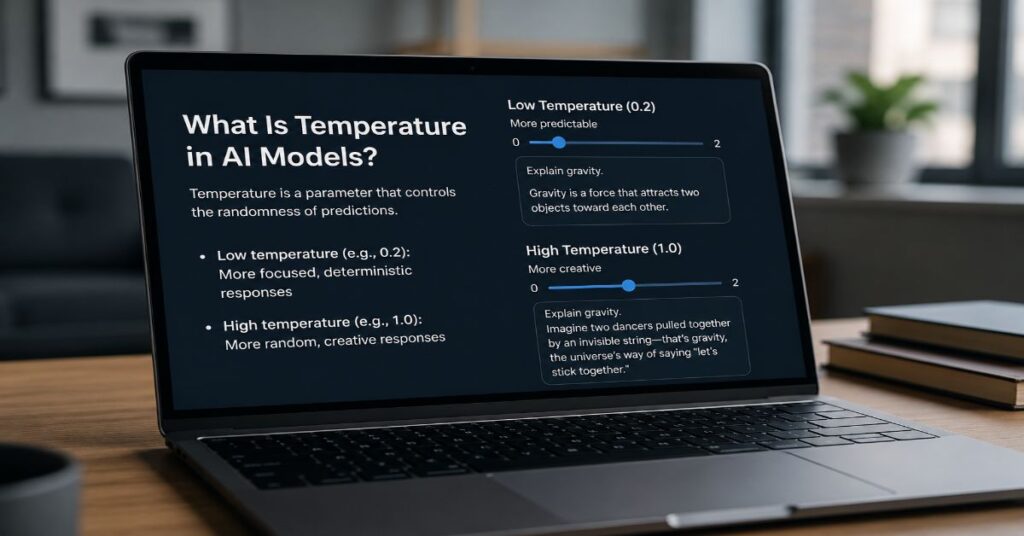
What is temperature in AI models? It is a decoding control that changes how strongly a model favours its highest-probability next token, yet the most important 2026 finding is that lower does not automatically mean more accurate. I use temperature as a reproducibility and diversity control, not as a truth switch, because a model can produce the same confident falsehood repeatedly at a low setting and can become less stable when a reasoning model has been optimised for a different default.
The basic intuition is simple. A model assigns scores to possible next tokens. Temperature reshapes those scores before sampling. Below 1, the probability distribution becomes sharper and the model tends to choose safer, more common continuations. Above 1, the distribution flattens and less likely tokens receive more chance, increasing variety and risk. At the practical level, however, temperature interacts with top-p, top-k, seeds, tool use, structured outputs, context length, provider-side routing and the model’s own reasoning system.
That interaction is why old advice such as “use 0 for facts and 1 for creativity” is no longer sufficient. OpenAI still exposes a 0-to-2 temperature range in Chat Completions. Mistral recommends a narrower working range. Google warns that lowering Gemini 3 below its default can cause loops or degraded reasoning. Anthropic states that models released after Claude Opus 4.6 do not support user-set temperature. By the end of this guide, you will understand the mathematics, provider differences, costs, implementation workflow, constraints and evaluation methods needed to choose a setting that survives real production conditions.
What Is Temperature in AI Models?
Temperature is applied during decoding, after the neural network has produced a vector of raw next-token scores called logits. The setting does not retrain the model, add knowledge, remove bias or verify a claim. It changes the probability distribution used to choose the next token. That distinction matters because many product teams treat a lower value as a general quality upgrade when it is only a change in selection behaviour.
Suppose the next-token candidates are “London”, “Paris” and “Manchester”. If “London” already has the highest logit, a temperature below 1 magnifies that lead. A value above 1 compresses the gap and gives the alternatives more chance. The same operation repeats after every generated token, so a small early change can send the answer down a completely different path. This path dependence explains why two outputs can diverge in topic, structure and factual claims even when only the random draw changes.
At temperature 1, logits pass through the softmax function without additional scaling. Values between 0 and 1 sharpen the distribution. Values above 1 flatten it. A displayed value of 0 is normally implemented as greedy decoding or as a provider-specific limiting case, because dividing logits by zero is undefined. This is one reason identical parameter labels do not guarantee identical behaviour across APIs.
The right mental model is not a thermostat for intelligence. It is a pressure setting on the model’s choice set. Lower pressure concentrates probability on the front-runner. Higher pressure admits more long-shot candidates. Whether that helps depends on the job, the model and the shape of the local token distribution.
The Mathematics Behind the Sampling Dial
What Is Temperature in AI Models Mathematically?
For token i with logit z_i, the temperature-adjusted probability can be written as p_i(T) = exp(z_i / T) / sum_j exp(z_j / T). The exponential function converts scores into positive values and the denominator normalises them into a distribution that sums to one. Temperature T changes the relative distance between candidates before normalisation.
If T is 0.5, every logit is effectively doubled before softmax, which makes the leading candidates dominate. If T is 2, every logit is halved, bringing weaker candidates closer to the leaders. The effect is nonlinear. A small temperature change can be negligible when one token is overwhelmingly likely, but decisive when several tokens have similar logits. This is why the same value can feel conservative in one sentence and surprisingly adventurous in the next.
Entropy provides a useful second view. A flatter probability distribution has higher entropy because uncertainty is spread across more tokens. A sharper distribution has lower entropy because probability mass concentrates on fewer candidates. Temperature therefore changes the entropy of each local decision, but it does not set a fixed amount of creativity for the full answer. Prompt wording, prior tokens, model architecture and alignment training continually reshape the distribution.
In practical evaluation, semantic distance matters more than word-level difference. Two answers may use different phrases while making the same claims, or use nearly identical wording while changing one material number. I therefore recommend measuring claim variance, schema validity and task success rather than counting changed tokens. Temperature is a statistical control, and the evaluation should be statistical too.
How Temperature Interacts With Other Generation Parameters
Temperature rarely acts alone. Top-p, also called nucleus sampling, keeps the smallest set of tokens whose cumulative probability reaches a threshold. Top-k keeps a fixed number of highest-probability tokens. Frequency and presence penalties change the scores of tokens that have already appeared. A seed initialises random sampling. Stop sequences end generation when a specified pattern appears. Structured output rules constrain the form of the answer after or during decoding.
The safest operating rule is to tune one major diversity control at a time. OpenAI and Mistral both advise changing temperature or top-p rather than changing both together. When both are tightened, the candidate set can become so narrow that the model produces repetitive or brittle language. When both are loosened, the model can drift far beyond the intended answer space. A disciplined prompt engineering workflow should lock the prompt before a sampling test so that parameter effects are not confused with instruction changes.
Seeds are useful but easy to overstate. A fixed seed can make repeated requests more comparable, yet it does not guarantee permanent reproducibility across model revisions, provider routing, numerical kernels or hidden system changes. Open-weight deployments also vary with inference framework, quantisation, batching and hardware. Reproducibility is therefore a property of the full execution environment, not a single integer.
Hugging Face makes the distinction explicit: do_sample=True activates multinomial sampling, while do_sample=False uses greedy decoding when beam search is not enabled. In that environment, changing temperature while sampling is disabled should not be treated as a meaningful experiment. The generation strategy must be recorded with the temperature value.
| Parameter | What It Controls | Useful For | Common Mistake |
| Temperature | Sharpness of token probabilities | Diversity and repeatability | Treating it as factuality |
| Top-p | Cumulative probability mass retained | Adaptive candidate filtering | Tuning with temperature simultaneously |
| Top-k | Fixed number of candidate tokens | Open-weight model control | Using one value across all models |
| Seed | Initial random state | Comparable test runs | Assuming permanent determinism |
| Frequency penalty | Penalty for repeated token frequency | Reducing repetitive phrasing | Distorting technical terminology |
| Presence penalty | Penalty once a token has appeared | Encouraging topic expansion | Forcing irrelevant novelty |
| do_sample | Sampling versus greedy decoding | Selecting the generation strategy | Setting temperature while sampling is off |
Why Temperature Zero Is Not Fully Deterministic
Temperature zero is commonly described as deterministic, but that description needs three qualifications. First, many hosted services interpret zero as greedy decoding rather than literal temperature scaling. Second, equal or near-equal token scores can be resolved differently by numerical precision, batching or implementation details. Third, the provider can update the model, safety layer, system prompt or routing stack without changing the user’s request.
The larger misconception is that repeatability proves correctness. It does not. A low-temperature model can consistently choose the highest-probability wrong answer. OpenAI’s 2025 research argued that standard evaluations can “reward guessing over acknowledging uncertainty”. The practical consequence is that repeated agreement may reveal a stable decoding path rather than reliable knowledge. Our companion guide on AI hallucinations explained examines why confidence and truth can separate even when language is polished.
The CHOKE study led by Abhilasha Simhi described cases where a trivial perturbation produced a “hallucinated response with high certainty”. That result is especially important for teams using self-consistency. If ten runs produce the same claim, confidence should rise only when the runs are meaningfully independent and the claim is externally supported. Ten outputs generated from the same model, prompt and narrow decoding distribution are highly correlated evidence.
For production systems, record the exact model identifier, API version, prompt hash, retrieval snapshot, tool configuration, temperature, top-p, seed, timestamp and output. Even then, label the result reproducible within the tested environment, not universally deterministic. A regression suite should tolerate harmless wording changes while failing on altered facts, calculations, fields or actions.
Reasoning Models Have Changed the Old Rules
The classic temperature explanation was developed around direct next-token generation. Modern reasoning systems can add hidden planning, adaptive compute, tool calls, search, verification and provider-managed decoding. The visible answer is still generated token by token, but the path to that answer may contain processes that are not governed by the user’s temperature value.
Google’s Gemini 3 guidance is unusually direct: developers are strongly advised to keep temperature at the default of 1.0. Google warns that lowering it can cause unexpected behaviour, including looping or degraded performance on mathematical and reasoning tasks. Anthropic’s current Messages API documentation goes further for its newest models, stating that models released after Claude Opus 4.6 do not support setting temperature. In those systems, effort or thinking controls have become more important than a traditional creativity dial.
OpenAI still documents temperature from 0 to 2 for Chat Completions, but model-specific support must be checked. A parameter accepted by an endpoint may be ignored, rejected or unavailable for a particular reasoning model. This is why an evaluation of how accurate AI is must lock model identifiers and parameters rather than comparing brand names in the abstract.
Demis Hassabis, chief executive of Google DeepMind, observed that early systems “would hallucinate sometimes”. The industry response has not been a single better temperature setting. It has been a stack of retrieval, tool use, reasoning, abstention and verification. Temperature still matters where exposed, but it is now one control inside a larger inference policy.
Recommended Ranges by Task and Risk Level
A useful starting range depends on the cost of variation. For deterministic extraction, routing and classification, start with the lowest supported value or greedy decoding, then test whether schema constraints and validators do more work than temperature. For code generation, a low-to-moderate value can preserve precision while allowing alternative implementations. For marketing concepts, naming and scenario exploration, a higher value can broaden the idea space, but factual claims should be separated and verified later.
The ChatGPT API tutorial demonstrates the mechanics of passing temperature in an API request, but production tuning requires a task contract. Define what must remain stable, what may vary, and what must never be invented. A customer-support classifier may need identical labels across runs. A brainstorming assistant may be judged by novelty and usefulness. A policy summariser may need claim-level fidelity, citations and abstention.
I recommend a small grid rather than a single guess: test 0 or the lowest supported value, 0.2, 0.5, 0.8 and the provider default. For models that warn against adjustment, test the default and alternative effort settings instead. Run each prompt multiple times because one output cannot reveal variance. Use at least 30 representative cases for an initial screen and hundreds for a release decision when errors have financial, legal or safety consequences.
Do not transfer a winning setting blindly between models. A temperature of 0.7 on Mistral, Gemini, an OpenAI model and a local Llama derivative does not represent a shared entropy target. Each model has a different logit scale, alignment layer, tokenizer and recommended generation configuration. Treat the value as model-specific metadata.
| Use Case | Starting Point | Primary Metric | Required Safeguard |
| Data extraction | Lowest supported or greedy | Field accuracy and schema validity | Parser, schema and source checks |
| Classification | 0-0.2 | Label stability and F1 score | Confidence threshold and fallback |
| Code generation | 0.1-0.5 | Tests passed and security findings | Unit tests, linting and review |
| Factual research | Default or low variance | Supported-claim rate | Retrieval and citation verification |
| Business writing | 0.4-0.8 | Editorial quality and consistency | Style rules and fact check |
| Brainstorming | 0.8-1.2 where supported | Novelty and usefulness | Deduplication and human selection |
| High-stakes decisions | Provider-recommended setting | Error severity and abstention | Human approval and audit trail |
Provider Controls, Features and API Integrations
Provider differences are now material enough to affect architecture. OpenAI Chat Completions exposes temperature, top-p, stop controls, response formats, tools and log probabilities, with a documented temperature range from 0 to 2. Anthropic Messages supports tools, structured content, extended thinking and effort controls, but its newest model generation can remove user-set temperature. Google Gemini exposes temperature, top-p, top-k, seed, penalties, structured outputs, function calling, search grounding, URL context and code execution, while recommending the default temperature for Gemini 3 reasoning. Mistral exposes temperature, top-p, random_seed, reasoning_effort, tools, JSON and JSON Schema output, web search, code interpreter and document-library integrations.
Perplexity-style answer systems add retrieval before generation. Their visible output may be affected more by search results, source ranking and citation synthesis than by a temperature adjustment. The Perplexity API key guide explains how machine-callable search changes the workflow: the application must govern query construction, source boundaries, citation handling and token cost as well as decoding.
Open-weight stacks offer the widest control. Hugging Face Transformers supports temperature, top-k, top-p, min-p, top-h, typical-p, epsilon and eta cutoffs, repetition penalties, beam search, assisted decoding and custom logit processors. Serving layers such as vLLM, Text Generation Inference and llama.cpp may expose overlapping but not identical subsets. The model card’s recommended generation_config.json should be treated as a starting specification, not an optional footnote.
The integration decision should therefore ask four questions: Is temperature supported by this exact model? Is it applied to visible output, hidden reasoning or both? Which other controls are coupled to it? Can the full configuration be logged and replayed? A provider comparison that answers only “does it have a temperature field?” misses the operational behaviour that matters.
| Platform | Temperature Behaviour | Adjacent Controls | Important Constraint |
| OpenAI Chat Completions | 0-2 on supported models | Top-p, seed, logprobs, tools, structured output | Model-specific support can differ |
| Anthropic Messages | Unavailable on models after Opus 4.6 | Effort, extended thinking, tools, JSON patterns | Use model-native effort controls |
| Google Gemini | 0-2 in general API; default 1.0 advised for Gemini 3 | Top-p, top-k, seed, penalties, grounding, tools | Lower values may degrade reasoning |
| Mistral Chat | Model-specific; 0-0.7 recommended | Top-p, random_seed, effort, tools, JSON Schema | Tune temperature or top-p, not both |
| Hugging Face Transformers | Model config default, often 1.0 | Top-k, top-p, min-p, top-h, beams, custom processors | Temperature matters only with sampling |
Current Pricing, Limits and Hidden Cost Drivers
Temperature itself is not normally billed, but it changes cost indirectly. Higher variance can produce longer answers, more retries and more rejected outputs. Lower settings can cause repetition or loops in some models, also increasing tokens. Reasoning and grounding often dominate the bill because providers charge for output, hidden thinking tokens, search queries, caching, context storage or premium long-context tiers.
As of 29 July 2026, Google lists Gemini 3.6 Flash at $1.50 per million input tokens and $7.50 per million output tokens on the standard paid tier. Batch and Flex halve those token prices to $0.75 and $3.75. Google also lists 5,000 shared grounding prompts per month before a $14 charge per 1,000 search queries, and warns that one request can generate multiple billable searches. Mistral lists Mistral Large at $2 per million input tokens and $6 per million output tokens, with a 50% batch discount.
Anthropic’s Opus 4.6 announcement lists $5 per million input tokens and $25 per million output tokens, with premium long-context pricing above 200,000 input tokens. Its broader pricing documentation also applies regional premiums in specified configurations. OpenAI pricing changes quickly and model-specific cost must be checked immediately before deployment; its 2026 GPT-5.5 pricing was listed at $5 per million input tokens and $30 per million output tokens in official launch-era materials and current provider references.
Sundar Pichai told Reuters that some companies could “save upwards of $1 billion per year” by shifting workloads to Gemini. That claim illustrates the scale of routing economics, but it should not be read as a universal saving. A lower token price can be offset by more calls, longer outputs, weaker task fit or verification labour. The Make.com AI automation tutorial shows how connected workflows accumulate latency and charges across every module, not only the model call.
| Service and Mode | Input per 1M Tokens | Output per 1M Tokens | Caps or Premiums to Watch |
| Google Gemini 3.6 Flash Standard | $1.50 | $7.50 | Grounding charges after 5,000 shared prompts; search queries billed individually |
| Google Gemini 3.6 Flash Batch/Flex | $0.75 | $3.75 | Non-immediate processing; caching storage charges |
| Anthropic Claude Opus 4.6 | $5.00 | $25.00 | Premium above 200K input; regional endpoint premiums can apply |
| OpenAI GPT-5.5 reference rate | $5.00 | $30.00 | Model, service tier, caching and tool charges vary |
| Mistral Large Standard | $2.00 | $6.00 | Batch is 50% lower; enterprise APIs can carry premiums |
A Step-by-Step Evaluation Workflow
Step 1 is to define the decision the model is supporting. Write a measurable contract covering correctness, permitted variation, maximum latency, maximum cost and required abstention. “Write a good answer” is not testable. “Extract seven fields with 99% exact-match accuracy and no invented values” is.
Step 2 is to freeze everything except the parameter under test. Lock the model version, system instruction, user prompt, retrieval corpus, tools, output schema, maximum tokens and service tier. Temperature experiments are invalid when the prompt or evidence changes between runs. For grounded systems, preserve the retrieved documents or query results because live search introduces its own variance.
Step 3 is to run a grid with repeated trials. Use the lowest supported value, two intermediate settings and the provider default. Generate at least five runs per case for an exploratory test. Measure exact accuracy, supported-claim rate, semantic variance, refusal quality, JSON validity, latency, input tokens, output tokens and total cost. The hallucination benchmark comparison explains why benchmark design and scoring definitions can reverse apparent model rankings.
Step 4 is to review failure clusters, not only averages. Separate factual errors, omissions, schema failures, loops, unsafe actions and stylistic drift. JV Roig’s 2026 RIKER study concluded that “temperature effects are nuanced”. Across 35 open-weight models and four settings, the best temperature varied by model and metric, while very low temperature sometimes increased coherence failures dramatically.
Step 5 is to choose a policy, not merely a number. The policy may route extraction to greedy decoding, creative drafting to a moderate value, and difficult reasoning to the provider default with higher effort. Add validators, retries and human approval based on failure severity. Re-run the suite after every model, prompt, retrieval, tool or infrastructure change.
Failure Modes and Performance Bottlenecks
The first failure mode is false confidence. Lower temperature can make an answer more stable without making it more supported. The second is mode collapse at the application level: outputs become so similar that the system stops exploring valid alternatives. This can hurt brainstorming, test generation and diagnosis of ambiguous problems. The third is high-temperature drift, where a useful answer begins correctly and then accumulates unsupported detail as the candidate distribution widens.
Loops are a less discussed bottleneck. Google’s Gemini 3 documentation warns that lowering temperature can cause looping or degraded performance. Roig’s 2026 study similarly found that coherence loss could be far more common at T=0 than at T=1 for some open-weight models. A retry policy that repeats the same low-temperature request can amplify the problem unless it changes the prompt, decoding mode or model.
Tool use adds another layer. A model may generate a valid function name but unstable arguments, or may choose not to call a tool when it should. Temperature can influence these decisions, yet structured tool schemas, forced tool choice, validation and approval gates usually matter more. In a DeepSeek agent workflow, for example, thinking mode can ignore traditional sampling controls and impose protocol requirements on reasoning content and tool messages.
Performance bottlenecks also include long context, output length, rate limits, cold starts, batch queuing and validation overhead. Reuters highlighted 2026 evidence that document-Q&A hallucination rates rose as context expanded. A wider context window is not a free accuracy upgrade. It can dilute attention, increase cost and create more opportunities for the model to invent an answer when the evidence is absent.
Finally, temperature can mask prompt defects. A vague prompt may look acceptable at one low setting because the model repeatedly chooses the same interpretation. Raising the value exposes alternative interpretations and reveals the ambiguity. This makes moderate-temperature testing useful even when production will run at a lower value.
Three Findings Most Temperature Guides Miss
The first finding is that temperature is position-dependent in effect. A single value is applied across generation, but the logit distribution changes at every token. When one token dominates, temperature barely matters. When several tokens are close, the same value can redirect the entire answer. This means a global label such as “creative at 0.9” hides highly local behaviour.
The second is that lower temperature can reduce linguistic variance while increasing operational risk. A repeated wrong answer is easier to regression-test but more dangerous if teams mistake consistency for evidence. Adam Kalai and colleagues showed why evaluation incentives matter: models can gain benchmark accuracy by guessing rather than abstaining. Temperature tuning should therefore be paired with an abstention score and a supported-claim score.
The third is that provider defaults now encode model-specific engineering. Google’s recommendation to retain 1.0 for Gemini 3 is not a generic endorsement of high randomness. It signals that the model’s reasoning and decoding were optimised around that value. Similarly, the removal of temperature from newer Claude models signals a shift towards provider-managed inference and user-facing effort controls. Defaults are increasingly part of the model specification.
A fourth practical insight follows from these three: the best production architecture often uses multiple decoding policies. One model or endpoint handles deterministic extraction, another handles open-ended exploration, and a verifier checks claims. Temperature becomes a routing attribute rather than a universal application setting. That design produces clearer accountability because each stage has a distinct success metric.
Finally, semantic variance is a better uncertainty signal than raw output difference. Generate several answers, split them into claims and compare which claims change. High claim variance flags unstable knowledge or ambiguity. Low claim variance still needs external verification, but it tells the evaluator where repeated sampling is no longer adding information.
Production Implementation Blueprints
A Reference Architecture for Controlled Generation
A production system should store decoding policy outside individual prompts. Create a versioned model profile containing the exact model identifier, endpoint, temperature or provider default, top-p, seed where supported, maximum output tokens, reasoning effort, tool policy, response schema and retry conditions. Keep this profile in configuration management and log its version with every request. That prevents a quiet dashboard edit or SDK upgrade from changing behaviour without appearing in the prompt history.
For structured extraction, begin with the lowest supported variance, a strict JSON Schema and an explicit rule that missing evidence must produce null rather than an inferred value. Parse the response before accepting it, validate every field against source text and allow one repair attempt only for syntax. A second model call should not be used to invent missing content. If the schema fails repeatedly, route the case to deterministic parsing or human review. The decisive metrics are field-level precision, recall, null accuracy, schema validity and cost per accepted record.
For retrieval-augmented research, separate evidence selection from prose generation. Stage one retrieves documents and records stable identifiers, timestamps and passages. Stage two asks the model to produce claim-to-source mappings before writing narrative text. Stage three verifies that each material claim is entailed by at least one cited passage. Temperature may remain at the provider default for a reasoning model or at a low-to-moderate value for a conventional chat model, but the evidence gate should be independent of sampling. This design catches a polished unsupported answer that a lower temperature would merely repeat more consistently.
Creative workflows need the opposite architecture. Instead of raising temperature and accepting the first answer, generate a controlled batch of candidates, score them for novelty, relevance, brand fit and factual risk, then select or combine the strongest. Keep factual research in a separate low-variance stage. For example, a campaign system can use moderate or high diversity for headlines, but populate product specifications, prices and legal statements from a locked data source. This division preserves useful variation without allowing creative decoding to alter facts.
Agentic systems require the strictest action boundary. Treat natural-language reasoning and executable tool arguments as different security domains. Use constrained schemas for tool calls, validate identifiers and amounts, make side-effecting operations idempotent, and require approval for payments, deletion, publication or access changes. A fixed temperature cannot guarantee safe tool choice. Where a provider exposes effort but not temperature, benchmark effort levels against task completion, redundant calls, latency and total token use. The operational objective is not the most elaborate reasoning trace; it is the smallest verified sequence of actions that completes the task.
Observability closes the loop. Capture supported-claim rate, semantic variance across repeats, refusal appropriateness, loop frequency, valid-tool-call rate, repair rate, p50 and p95 latency, tokens per accepted output and human override frequency. Establish rollback thresholds before launch. A practical trigger might be any material fall in schema validity, a rise in unsupported claims, or a cost increase that cannot be explained by traffic. Re-evaluate after model aliases move, system prompts change, retrieval indexes refresh, SDKs update or providers alter defaults. Temperature tuning is complete only when the deployment can detect that yesterday’s safe setting no longer behaves the same way.
Our Editorial Verification Process
This conceptual explainer was verified against the current OpenAI Chat Completions reference, Anthropic Messages documentation, Google Gemini 3 developer guidance, Google Gemini API pricing, Mistral’s chat API and pricing pages, and Hugging Face Transformers generation documentation as accessed on 29 July 2026. The provider matrix records model-specific caveats rather than assuming that a parameter accepted by one endpoint is supported by every model.
For empirical claims, I cross-referenced OpenAI’s 2025 hallucination research, the 2025 CHOKE paper by Abhilasha Simhi and colleagues, JV Roig’s 2026 RIKER study covering 35 open-weight models and 172 billion generated tokens, and Reuters reporting on reliability, context length and 2026 model economics. Pricing was checked against official vendor pages wherever publicly available; fast-changing model prices should be rechecked before publication or procurement.
The recommendations in this article are analytical starting points, not universal benchmark results. No live proprietary API calls were executed for this edition, so provider behaviour described as documented has not been independently reproduced in a controlled lab. Where exact limits vary by account, region, model or service tier, the article states that limitation instead of inferring a single cap.
This article was researched and drafted with AI assistance and reviewed by the Awais Khalid editorial desk at Perplexity AI Magazine. All data, citations, pricing figures, and named quotes have been independently verified against primary sources before publication.
Conclusion
Temperature remains one of the clearest ways to explain probabilistic text generation, but it is no longer a universal control surface for every leading AI model. At its core, it rescales token probabilities. In practice, its effect is shaped by the model’s logit distribution, sampling strategy, reasoning process, tools, retrieval layer, provider defaults and deployment environment.
The useful decision is therefore not whether low or high temperature is better. It is which level of variance is acceptable for a defined task, and which safeguards catch the errors that temperature cannot. Low settings can improve repeatability, extraction and regression testing. Moderate settings can improve drafting and exploration. Higher settings can expand the idea space. None of them proves factuality.
The 2026 provider landscape also points towards a broader change. Some reasoning models recommend leaving temperature at the default; others remove the control and expose effort instead. That shift may make interfaces simpler, but it also places more inference policy inside closed systems. Open questions remain about reproducibility, hidden routing, model updates and the comparability of identical parameter names across vendors. The responsible approach is to test the exact model and workflow, log the full configuration, verify claims externally and treat temperature as one component of an evidence-based generation policy.
Frequently Asked Questions
What does temperature mean in an AI model?
Temperature changes the sharpness of next-token probabilities during generation. Lower values favour the most likely tokens and usually make outputs more repeatable. Higher values give less likely tokens more chance, increasing variety and the risk of drift. It changes decoding behaviour, not the model’s knowledge or factual verification.
Is temperature 0 completely deterministic?
Not always. Providers often implement zero as greedy decoding, but backend updates, numerical ties, model routing and hidden system changes can still alter output. A fixed seed improves comparability where supported, yet permanent reproducibility requires the same model version, prompt, tools, infrastructure and decoding configuration.
Does lowering temperature reduce hallucinations?
It can reduce variation, but it does not guarantee fewer hallucinations. A high-probability false answer may be repeated consistently at a low setting. Factual workflows still need retrieval, source checks, structured validation, abstention rules and human review where mistakes carry material risk.
What is the best temperature for factual answers?
Use the provider-recommended default or a low supported value as a starting point, then test it on representative prompts. Score supported claims, omissions, refusals and cost. Gemini 3 currently recommends its default of 1.0, showing why one universal factual setting is unreliable.
What temperature should I use for creative writing?
A moderate or moderately high value, often around 0.7 to 1.0 where supported, can increase variety. The best setting depends on the model. Keep factual research separate, use style constraints, and compare multiple outputs rather than assuming a higher value automatically produces better prose.
What is the difference between temperature and top-p?
Temperature rescales the whole probability distribution. Top-p keeps only the smallest token set whose cumulative probability reaches a threshold. Both control diversity, but through different mechanisms. OpenAI and Mistral recommend changing one or the other rather than tuning both at the same time.
Why do some reasoning models not support temperature?
Providers increasingly manage parts of reasoning and decoding internally. Newer models may be optimised for a fixed default or expose effort and thinking controls instead. Removing temperature can reduce harmful parameter combinations, but it also limits user control and complicates cross-provider comparisons.
How should a team test temperature settings?
Freeze the model, prompt, evidence, tools and output schema. Run a small temperature grid with repeated trials, then measure accuracy, supported claims, semantic variance, schema validity, latency and cost. Review failure clusters and repeat the evaluation after any model or workflow change.
References
Anthropic. (2026). Claude Opus 4.6.
Anthropic. (2026). Create a Message: Claude API reference.
Google. (2026). Gemini 3 developer guide.
Google. (2026). Gemini Developer API pricing.
Hugging Face. (2026). Generation documentation for Transformers.
Kalai, A. T., Nachum, O., Vempala, S. S., & Zhang, E. (2025). Why language models hallucinate.
Mistral AI. (2026). Chat API reference.
OpenAI. (2025). Why language models hallucinate.
Roig, J. V. (2026). How much do LLMs hallucinate in document Q&A scenarios? A 172-billion-token study across temperatures, context lengths, and hardware platforms.
