
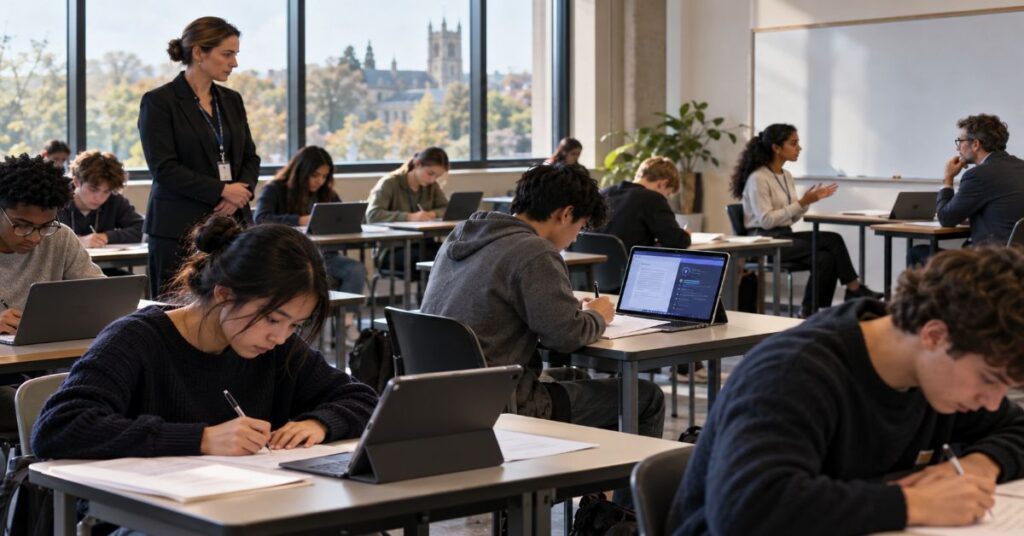
Schools are changing exams because of AI in 2026 by reducing the weight of unsupervised take-home work, bringing more assessment back under controlled conditions, adding oral defence and process evidence, and—in some courses—allowing AI deliberately so that students must show judgement rather than merely produce a polished answer. The sharpest change is not a return to one old exam model; it is the separation of two questions that traditional assessment often mixed together: what can a student do without assistance, and what can the same student do responsibly with powerful digital tools?
That separation is becoming necessary because AI is now ordinary student infrastructure. Pew Research Center reported in February 2026 that 59% of US teenagers believe AI-assisted cheating happens at least somewhat often at their school. In UK higher education, HEPI found that 95% of undergraduates use AI in at least one way, 94% use generative AI for assessed work, and 65% say assessment has changed significantly in response. Those figures cover different education systems and age groups, but they point in the same direction: assessment rules written for a pre-generative-AI environment are under pressure.
The response is more varied than the phrase “AI-proof exam” suggests. New South Wales has imposed a hard cap on senior-school take-home assessment. England’s regulator is strengthening coursework authenticity while taking a precautionary approach to AI in high-stakes marking. Cambridge International is expanding digital exams and AI-assisted marking for selected mock components while keeping human verification. The International Baccalaureate, meanwhile, explicitly rejects a blanket ban on AI and argues that assessment should evolve as the technology becomes part of everyday life.
The result is a new assessment architecture. Secure, timed and oral formats are being used to establish individual competence. Portfolios, drafts and teacher checkpoints make the learning process visible. AI-enabled tasks test source checking, model criticism and decision-making. Schools are also discovering the trade-offs: oral exams are labour-intensive, surveillance can create inequity, AI detection is unreliable, and a handwritten exam can protect authenticity while measuring a narrower range of skills. The strongest 2026 reforms therefore redesign evidence of learning rather than simply adding more policing.
Why 2026 Became an Assessment Inflection Point
Generative AI did not create academic misconduct, but it changed the economics of producing plausible schoolwork. A student can now generate an essay, code solution, worked explanation or presentation in seconds and then iteratively refine it. That makes polished output a weaker proxy for independent understanding whenever the task is completed outside monitored conditions.
The scale is visible in student perception and institutional behaviour. Pew’s 2026 teen survey found that 34% of US teenagers say AI cheating happens extremely or very often at their school, with another 25% saying it happens somewhat often. England’s Ofqual, meanwhile, published coursework-integrity resources after its chief regulator raised concerns about generative AI in non-exam assessment. The regulator’s March 2026 briefing noted that 1,125 students lost an entire GCSE or A level in 2025 across malpractice cases, while nearly 2,000 had marks deducted. Those sanctions were not all AI cases, but they show how seriously qualification systems treat authenticity once assessment contributes to a final credential.
The deeper issue is validity. An assessment is valid only if the resulting score supports the interpretation educators attach to it. If a take-home essay is meant to demonstrate a pupil’s reasoning and writing but an AI system can produce most of the visible artefact, the marker may be grading a mixture of student capability, tool capability and editing skill without knowing the proportions. Mauricio G. Villena, Dean and Professor at Diego Portales University, put the problem sharply in a July 2026 HEPI essay: “If so much assessed work can be produced by a machine, the assessment was probably not measuring what we thought.”
That is why the leading response is moving from product-only assessment towards evidence-rich assessment. Schools are asking not just for the final answer but for intermediate reasoning, source choices, revisions, oral explanation and transfer to a new problem. AI can still be present, but it becomes harder for the student to outsource the whole cognitive task invisibly.
For a student-facing view of that boundary, see our guide to student AI study habits, which separates legitimate study support from submission of AI-generated work.
Take-Home Work Is Losing Its Monopoly
The clearest school-level policy change in 2026 comes from the New South Wales Education Standards Authority (NESA). From Term 4, 2026 for HSC courses, schools can include only one take-home assessment task per course and it can carry no more than 15% of the school-based assessment weighting. Preliminary courses follow from Term 1, 2027. NESA explicitly links the rule to managing generative AI and protecting the integrity of the HSC credential.
This is more consequential than an AI detector mandate. It changes the assessment mix itself. Instead of trying to prove after submission whether a home-produced artefact is authentic, the system limits how much the final grade can depend on work completed where teacher observation is weak. Schools can still use take-home projects, but the highest-stakes evidence is pushed towards conditions where authorship is easier to establish.
England is not adopting the same numerical cap, but its direction is comparable. Ofqual’s September 2026 guidance tells schools and colleges that students must not submit AI-produced work as their own, that permitted AI use must be acknowledged, and that centres should follow awarding-body rules designed to ensure authenticity. In public comments, Chief Regulator Sir Ian Bauckham has been direct: “using AI to produce coursework is cheating.” He has also indicated that coursework rules may need stronger referencing and teacher check-ins where authenticity becomes difficult to establish.
The policy lesson is not that homework is obsolete. Low-stakes home practice remains valuable precisely because it can be exploratory. What is changing is the evidentiary burden placed on unsupervised output. A useful design rule is to separate practice from certification: allow more freedom during learning, then require stronger proof of independent competence when a task contributes materially to a credential.
That distinction is also central to our explainer on whether AI use in homework counts as cheating, where the rule turns on whether AI supports learning or substitutes for the assessed work.
| Assessment Type | AI Risk | What It Proves Best | 2026 Direction |
| Unsupervised take-home essay | High authorship ambiguity | Extended research and drafting | Lower weighting or stronger process evidence |
| Timed written exam | Lower hidden-AI risk | Unaided recall, reasoning and writing | Retained for secure certification |
| Oral defence | Low outsourcing risk during questioning | Understanding, explanation, adaptability | Growing as an authenticity check |
| Portfolio with checkpoints | Moderate, but traceable | Process, revision and sustained work | Growing where teachers can verify stages |
| AI-permitted task | Explicit rather than hidden | Judgement, verification and AI literacy | Growing in selected subjects and courses |
What This Means for Classroom Design
Teachers will increasingly need two versions of a task: a learning version and an evidentiary version. The learning version can allow collaboration, AI tutoring and revision. The evidentiary version should reveal whether the student can explain, adapt or reproduce the essential skill under conditions appropriate to the subject. That second task does not always need to be a traditional exam; it can be a short oral check, supervised writing sample, practical demonstration or fresh problem completed in class.
Oral Defences Are Returning—But They Are Not a Silver Bullet
Oral assessment has returned to the centre of the AI debate because it makes understanding observable in real time. A teacher can ask a student to explain a claim, justify a source, solve a variant of a problem or respond to an unexpected challenge. The value is not that speech is magically cheat-proof; it is that adaptive follow-up questions are difficult to outsource without the student revealing the depth of their own understanding.
The pattern is visible beyond schools. Reporting in 2026 described universities bringing back viva-style assessments and proctored exams after take-home formats became easier to compromise. New South Wales schools have also used oral assessment as part of their response to AI-assisted cheating. Lecturer Nicole Brownlie summarised the attraction and the limitation in August 2026: oral exams can test knowledge more directly, but they are “not a foolproof solution.”
The limitations matter. Oral exams take staff time, can amplify anxiety, may disadvantage some multilingual learners or students with communication-related disabilities, and can become inconsistent if different candidates receive questions of unequal difficulty. They also require careful record keeping and rubrics when the result contributes to a high-stakes grade.
The most scalable model is therefore not a full viva for every subject. It is a short verification layer attached to higher-risk work. A student who submits a research report might face five minutes of questions on the evidence and method. A coding student might be asked to change one function live. A literature student might defend why one quotation matters to the argument. The purpose is sampling, not interrogation: a small amount of adaptive questioning can reveal whether the submitted artefact is connected to genuine understanding.
Schools Are Grading the Process, Not Only the Product
One of the strongest information-gain shifts in 2026 is the move from “show me the answer” to “show me how this answer came to exist”. Process evidence can include outlines, source logs, drafts, teacher conferences, lab notebooks, version history, annotated feedback and reflective commentary. None is decisive alone, but together they create a chain of evidence that is harder to fabricate convincingly at the last minute.
This approach also reduces dependence on AI detectors. Detection systems can be a signal, but they cannot establish authorship reliably enough to carry the entire decision. A teacher who knows a student’s earlier work, can see the document history, can inspect sources and can ask the student to explain a central decision has a richer evidentiary picture than a single probability score.
For a closer look at the evidence teachers actually use, our article on how teachers investigate AI-written work explains why detector scores are only one signal among several.
The change aligns with current research. A 2026 study of AI-resilient assessment design highlighted original data collection, personal reflection and demonstration of process as ways to preserve academic integrity while preparing students for AI-rich environments. Another 2026 paper argued that assessment should move from artefacts towards processes because a polished final product can increasingly be generated without corresponding learning.
For students, this can feel like more documentation, so the design has to be proportionate. The goal should not be surveillance theatre. Requiring twenty screenshots of every prompt may create workload without improving validity. Better evidence is educationally meaningful: a rationale for why a source was trusted, a note explaining what feedback changed, or a short comparison between the student’s first answer and the AI’s suggestion. These artefacts measure judgement, not merely compliance.
A Practical Three-Layer Evidence Model
A robust 2026 assessment can use three layers: the final artefact, the process trail and a verification moment. The final artefact shows what was produced. The process trail shows how the student developed it. The verification moment—oral, practical or supervised—tests whether the student can still explain and transfer the learning. When all three point in the same direction, the school has stronger evidence without pretending any single method is perfect.
Some Exams Now Allow AI on Purpose
The second half of the 2026 story is easy to miss if assessment reform is framed only as anti-cheating. Some educators are deliberately putting AI inside the task. The purpose is to test capabilities that matter when AI is available: writing effective instructions, evaluating model output, checking evidence, recognising hallucinations, improving weak answers and deciding when not to use the tool.
The International Baccalaureate has been explicit about this direction. Matt Glanville, Director of Assessment, argues that AI will “become part of our everyday lives”, like calculators, translation tools and spell-checkers, and that education therefore has to adapt rather than pretend the technology can be banned permanently. The important distinction is between authorised assistance and misrepresented authorship.
A striking 2026 example came from IIM Bangalore, where 78 MBA students built and used their own course-grounded chatbots during a midterm. The exercise did not ask whether students could avoid AI; it assessed how effectively they could configure a constrained system, work with course materials and solve problems through it. That is higher education rather than school-level examination, but it illustrates a model likely to influence senior secondary and vocational assessment: the tool can be part of the environment while human judgement remains the assessed capability.
Students also need disclosure rules when AI is permitted; our guide to AI disclosure in assessed writing maps the difference between support, acknowledgement and misrepresented authorship.
This creates a two-column future for exams. In one column are “AI-off” tasks designed to establish foundational competence. In the other are “AI-on” tasks designed to establish augmented competence. Mixing the two without labelling them creates confusion. Separating them produces more informative results: a school can see what the learner knows unaided and how well the learner operates when modern tools are available.
| Mode | AI Rule | Typical Task | Capability Measured |
| AI-off | No generative assistance during task | Timed essay, calculation, oral explanation | Independent knowledge and reasoning |
| AI-limited | Specified tools or sources only | Open-book research with controlled assistant | Source use and bounded problem-solving |
| AI-on | AI explicitly permitted and documented | Critique, improve or verify model output | AI literacy, judgement and verification |
| Hybrid | AI used in preparation, not final verification | Portfolio plus viva or supervised follow-up | Process quality plus independent ownership |
How Schools Are Changing Exams Because of AI in 2026
The most durable change is this dual assessment model. Schools increasingly need an unaided baseline for literacy, numeracy, subject knowledge and reasoning, plus selected AI-permitted assessments for verification, synthesis and tool judgement. A single score cannot always represent both capabilities fairly.
Digital Exams Are Growing, but “Digital” Does Not Mean “AI-Run”
AI and digital assessment are often discussed as if they were the same transition. They are not. Moving an exam from paper to screen can improve logistics, accessibility and question design without giving an AI system authority over the student’s score. That distinction is central to current regulatory practice.
Cambridge International began its first digital IGCSE and AS & A Level exam series in 2026 after research using its Digital Mocks Service found little overall difference in student performance between screen and paper modes. The organisation is also extending AI-assisted marking in selected digital mock components, but it states that every AI mark is verified and uncertain responses go to a human examiner.
Ofqual is even more cautious for regulated high-stakes qualifications in England. Its January 2026 working paper says using AI as the sole mechanism for determining a student’s mark does not comply with current regulations. In September parliamentary evidence, Sir Ian Bauckham said that where a sophisticated judgement is needed, student work must be marked by an expert human marker. This is an important counterweight to simplistic claims that exam boards are about to automate teachers out of assessment.
For schools, the operational implication is to separate three questions: how the student receives the task, how the response is secured, and who or what judges it. A screen-based exam can still be tightly controlled. An AI tool can assist moderation or flag uncertain cases without issuing the final grade. And a human marker can use digital evidence more efficiently without surrendering accountability.
AI-Assisted Marking Is Being Treated as Quality Assurance, Not an Autonomous Judge
Assessment reform is not only changing what students do. It is also changing the machinery behind marking, moderation and question development. Regulators and awarding bodies see genuine efficiency opportunities, but 2026 policy draws a hard line around final high-stakes judgement.
Ofqual’s “Principles of AI use in marking” frames the issue around validity, transparency, fairness and accountability. Sir Ian Bauckham told Parliament in January that AI can support quality assurance, reduce costs and improve efficiency “upstream” in the qualification system. By September he was equally clear that unassisted AI marking would not be permitted in the near term, because regulated qualifications must remain a reliable representation of student achievement.
Cambridge International provides a concrete middle model. Its Digital Mocks Service uses AI-assisted marking against the same scheme used by examiners, then verifies the result and sends uncertain responses to humans. The design principle is confidence routing: automate or accelerate low-ambiguity work, escalate uncertainty and retain human responsibility.
Schools adopting classroom AI marking should apply the same logic at lower stakes. AI can generate formative feedback, compare a response to a rubric or suggest misconceptions. But a teacher should be cautious about turning that output directly into consequential grades, especially where creative reasoning, language nuance or atypical approaches matter. The educational cost of a fast wrong judgement can be larger than the time saved.
The same human-in-the-loop principle appears in our practical overview of AI tools for teachers, where classroom usefulness depends on teachers retaining control of learning and evaluation.
| Use of AI in Assessment | Potential Benefit | Primary Risk | Responsible 2026 Pattern |
| Generate practice feedback | Fast iteration for students | Confident but inaccurate advice | Teacher corroboration for important decisions |
| Assist rubric matching | Consistency on structured criteria | Missed nuance or bias | Human review and sampled auditing |
| Flag uncertain responses | Focus examiner attention | False positives | Escalation, not automatic penalty |
| Issue final high-stakes mark alone | Speed and scale | Validity, fairness and accountability failure | Generally rejected by current English regulation |
Different Subjects Need Different AI-Resilient Exams
A common mistake is to redesign every subject around the same integrity mechanism. The risk profile of an English essay is not the same as a chemistry practical, a programming task, a design portfolio or a mathematics proof. The strongest reforms start with the capability the subject is meant to certify and then choose evidence AI cannot easily obscure.
For essay-heavy subjects, short supervised writing and oral defence can be paired with longer researched work. For mathematics and sciences, changing a familiar problem into a novel variant can reveal whether the student understands the method rather than merely possessing a solution. Practical sciences can weight observation, lab decisions and interpretation of original data. Computing can use live code modification or debugging. Creative subjects can preserve sketches, iterations and critique. Languages can combine prepared writing with spontaneous conversation.
This is also where AI-permitted assessment can add value. In subjects where professionals will routinely use AI, a task can ask students to compare two model outputs, locate factual errors, improve a weak explanation or document why they rejected a generated recommendation. The measured skill becomes disciplinary judgement rather than prompt fluency alone.
The key is cognitive ownership. Our related analysis of which subjects benefit most from AI reaches the same conclusion from the learning side: AI helps most when it generates feedback and practice while the student still performs the core thinking.
Subject Fit Matters More Than a Universal Ban
A tool that is harmful when it completes the exact skill being assessed may be useful when it supplies material for criticism. In mathematics, asking AI for the answer can remove practice; asking the student to diagnose a subtly wrong AI proof can increase reasoning. In history, generating an essay can hide authorship; comparing an AI summary against primary sources can test sourcing and interpretation. The same technology can either hollow out or deepen an assessment depending on task design.
Fairness, Accessibility and Workload Are the Hard Part
Every stronger authenticity control creates a second-order effect. More supervised assessment requires rooms and invigilators. More oral assessment requires staff time. More process evidence creates marking and storage work. Restricting take-home tasks can disadvantage students who demonstrate knowledge better through extended projects. Requiring live oral defence can disadvantage others unless reasonable adjustments are built in.
AI access itself is unequal. Some students have paid models, faster devices, private tutoring on prompting or quiet spaces for home study. Others rely on free tiers, shared devices or school-managed accounts with tighter restrictions. An AI-permitted assessment can therefore become an access test unless the school standardises the available tool and conditions.
There is also a false-accusation risk. A detector score should not become an invisible second exam that students did not agree to take. The better model is procedural: treat automated signals as one piece of information, then check source quality, drafts, version history, prior work and the student’s ability to explain the submission. The goal is to establish authenticity, not to catch a particular writing style.
A safer student workflow is described in AI revision without copying answers, which ends AI-assisted study with a closed-book check rather than treating fluent output as proof of learning.
Schools also need to protect pupils’ data. England’s Department for Education updated generative-AI product safety standards in January 2026 and its support materials in May. Assessment systems should therefore be evaluated not only for cheating prevention but for data handling, age suitability, transparency and the risk of exposing pupil work to models or suppliers unnecessarily. Integrity controls that create new privacy problems are not robust controls.
What Schools Should Change Now: A Six-Control Assessment Stack
Schools do not need to replace every exam at once. A stronger strategy is to layer controls according to risk. The following stack is intentionally mixed: some controls prevent invisible outsourcing, while others redesign the task so outsourcing matters less.
First, classify each assessment by purpose. Is it practice, feedback, progression or certification? High-stakes certification needs stronger evidence than a homework exercise. Second, declare the AI condition before the task: prohibited, limited or permitted. Ambiguity encourages accidental misconduct and inconsistent enforcement. Third, ensure at least one component makes independent competence visible—supervised writing, oral explanation, practical performance or a fresh transfer problem.
Fourth, preserve meaningful process evidence for work completed over time. This should be light enough to teach good scholarly habits rather than create a compliance burden. Fifth, add verification to the highest-risk submissions. A short oral or practical check can often do more than an AI-detection score. Sixth, calibrate marking responsibility: AI may support feedback or moderation, but consequential grades need accountable human oversight wherever judgement is complex.
This stack also gives schools a better communication model. Students should know not merely what is banned, but why a particular mode is being used. Teachers should know what evidence is sufficient before escalating an integrity concern. Parents should know that using AI to learn is not automatically the same as using AI to impersonate learning. A clear architecture reduces both cheating opportunity and unnecessary suspicion.
| Control | Use It When | Avoid This Failure |
| Declare AI condition | Every assessed task | Students guessing what is allowed |
| Supervised component | Authorship matters to the grade | Over-reliance on home-produced output |
| Process evidence | Work develops over days or weeks | Treating a final document as the whole learning record |
| Oral/practical verification | High-risk or unusually polished work | Using detector scores as proof |
| Standardised AI access | AI is permitted in-task | Paid-tool advantage and inconsistent conditions |
| Human final judgement | Grades carry significant consequences | Unaccountable automated scoring |
A Decision Rule for Every New Assessment
Before approving a task, ask one question: if a capable AI system produced the visible answer, what independent evidence would still let the school judge the student? If the answer is “none”, the task is fragile. Add a process trail, supervised component, oral defence, original data or an AI-critical step until the student’s own competence becomes visible again.
What Does Not Work: Detector-First Policy, Blanket Bans and Nostalgia
Three responses look simple but fail under stress. The first is detector-first policy. Automated AI-writing indicators can support an investigation, but they cannot answer the pedagogical question of who understands the work. A school that equates a percentage score with guilt risks false accusations and encourages students to optimise for detector evasion instead of learning.
The second is the blanket ban. A ban may be appropriate inside a specific secure task, especially when foundational skill must be demonstrated unaided. As a whole-school learning strategy, however, it ignores the reality that students will encounter AI in further education and employment. The IB’s stance is instructive: it treats ethical AI use as something students need to learn, not a technology education can permanently exclude.
The third is nostalgia—the belief that handwriting automatically restores a golden age of valid assessment. Handwritten, invigilated exams are strong at verifying unaided performance under time pressure. They are weaker at measuring long-form research, revision, collaboration, multimedia communication and sustained problem-solving. Returning every subject to a closed-book paper would solve one authenticity problem by creating a validity problem elsewhere.
Principal Sheetal Labru captured the historical analogy in August 2026 with a deliberately simple line: “The calculator didn’t ruin us.” She used that history to argue that calculators ultimately shifted attention towards reasoning and application. Her argument does not mean AI is simply a calculator; generative systems can perform much more of the task. It does suggest the right question is not whether a tool makes work easier, but which human capability the assessment is meant to preserve and reveal.
Our Editorial Verification Process
This explainer was researched on 7 October 2026. We searched the live web for the target query “how schools are changing exams because of ai in 2026” and close variants, then reviewed prominent current results spanning news coverage, regulator guidance, school-policy changes, assessment-research papers and education commentary. Recurring SERP structures tended to focus on one response—oral exams, AI cheating, detector use or assessment redesign—without mapping the full assessment system from task design through marking. We therefore built the article around an evidence architecture: AI-off proof, process evidence, verification and AI-on assessment.
Primary verification centred on Ofqual and UK Department for Education guidance, NESA’s 2026 take-home assessment rule, International Baccalaureate assessment guidance, Cambridge International’s digital-exam and AI-assisted-marking material, Pew Research Center’s 2026 teen survey, HEPI’s Student Generative AI Survey 2026 and peer-reviewed 2026 research on assessment redesign. We treated higher-education examples as directional evidence, not proof that every school system has adopted the same practice.
The requested Perplexity AI Magazine sitemap endpoints were not retrievable through the browsing layer during this research session. Rather than invent sitemap entries, we verified seven live, indexed site articles with direct relevance to students, teachers, revision, academic integrity and AI-assisted learning, and used each once as an internal link in body sections. No commercial pricing matrix is included because this article is about assessment design rather than a paid software purchase decision.
This article was researched and drafted with AI assistance and reviewed by the Awais Khalid editorial desk at Perplexity AI Magazine. All data, citations, pricing figures, and named quotes have been independently verified against primary sources before publication.
Conclusion
AI is not ending exams. It is forcing schools to become more precise about what an exam is supposed to prove. The most visible 2026 changes—limits on take-home work, oral defences, supervised components, process evidence, digital exams and human-verified AI-assisted marking—are different answers to the same validity problem: a polished artefact no longer guarantees that the student performed the thinking behind it.
The strongest systems are therefore becoming deliberately mixed. They preserve secure, unaided assessment where foundational competence matters; they use portfolios and checkpoints where learning unfolds over time; and they introduce AI-permitted tasks where verification, critique and tool judgement are themselves legitimate educational outcomes. That mix is harder to administer than either a blanket ban or unrestricted use, but it produces more defensible evidence.
Open questions remain. Oral assessment has workload and equity costs. Digital monitoring can create privacy concerns. AI-assisted marking still needs robust evidence and human accountability. And policy will continue to lag fast-moving model capabilities in some jurisdictions. The durable principle is simpler than the technology: assessment should make the learner’s own reasoning visible. In 2026, schools are changing exams because that visibility can no longer be assumed from the final answer alone.
Frequently Asked Questions
How are schools changing exams because of AI in 2026?
Schools are reducing reliance on unsupervised take-home work, adding supervised or oral verification, collecting process evidence, and creating clearly labelled AI-off and AI-permitted tasks. The exact mix differs by jurisdiction, but the common goal is to make student understanding visible even when generative AI can produce polished answers.
Are schools bringing back oral exams because of AI?
Yes, some schools and universities are using oral exams or short viva-style checks to verify that students understand submitted work. They are useful because teachers can ask adaptive follow-up questions, but they are not a universal solution because they require staff time, consistent rubrics and accessibility adjustments.
Are take-home assessments being banned?
Not universally. New South Wales has limited senior-school courses to one take-home assessment worth no more than 15% of school-based assessment. Other systems are strengthening authentication rather than imposing the same numerical cap. Low-stakes homework and projects can still remain useful for learning.
Can students use AI during exams?
Sometimes. In secure assessments designed to prove independent skill, AI is typically prohibited. Other tasks may explicitly allow AI so students can be assessed on prompting, verification, source checking and judgement. The critical requirement is that the AI condition is declared in advance and applied consistently.
Can AI mark school exams in 2026?
AI can assist some marking and quality-assurance workflows, but current English regulation does not allow AI to be the sole mechanism for determining marks in regulated high-stakes assessment. Cambridge International is using AI-assisted marking in selected digital mocks with verification and human escalation for uncertain responses.
Are AI detectors reliable enough to prove cheating?
No single detector should be treated as definitive proof. Stronger investigations combine any automated signal with drafts, version history, source accuracy, prior student work, teacher knowledge and the student’s ability to explain the submission. The goal is to establish authorship and understanding through multiple forms of evidence.
Will handwritten exams become more common?
They may remain or return in some contexts because supervised handwriting makes hidden AI assistance harder. But a wholesale return to handwritten exams would narrow what schools can assess. Many systems are combining secure written tasks with oral, practical, portfolio and AI-enabled formats instead.
What should teachers change first?
Start by labelling each assessed task as AI-prohibited, AI-limited or AI-permitted. Then make sure any high-stakes task includes independent evidence of learning—such as a supervised component, oral check, practical demonstration, original data or process trail—rather than relying on a final take-home artefact alone.
SEO Metadata
SEO Title: AI Is Rewriting School Exams in 2026
Meta Description: Discover how schools are changing exams because of ai in 2026 through oral defences, supervision, evidence and redesign.
APA References
Bauckham, I. (2026). AI: We all must do more to prevent coursework cheating. Schools Week.
Cambridge International Education (2026). Continuing our AI-assisted marking development for digital mock exams. Cambridge International.
Higher Education Policy Institute (2026). Student Generative Artificial Intelligence Survey 2026. HEPI.
International Baccalaureate (2026). Artificial intelligence in IB assessment and education: a crisis or an opportunity?. International Baccalaureate.
NSW Education Standards Authority (2026). New limit on take-home assessment tasks from Term 4 2026. NSW Government.
Ofqual (2026). Principles of AI use in marking. GOV.UK.
Pew Research Center (2026). How teens use and view AI. Pew Research Center.
UNESCO (2025). What’s worth measuring? The future of assessment in the AI age. UNESCO.
Vaghjee, G., & Vaghjee, H. (2026). Rethinking assessment in the age of AI: Towards authentic and AI-resilient practices. GenAI in Higher Education.
