
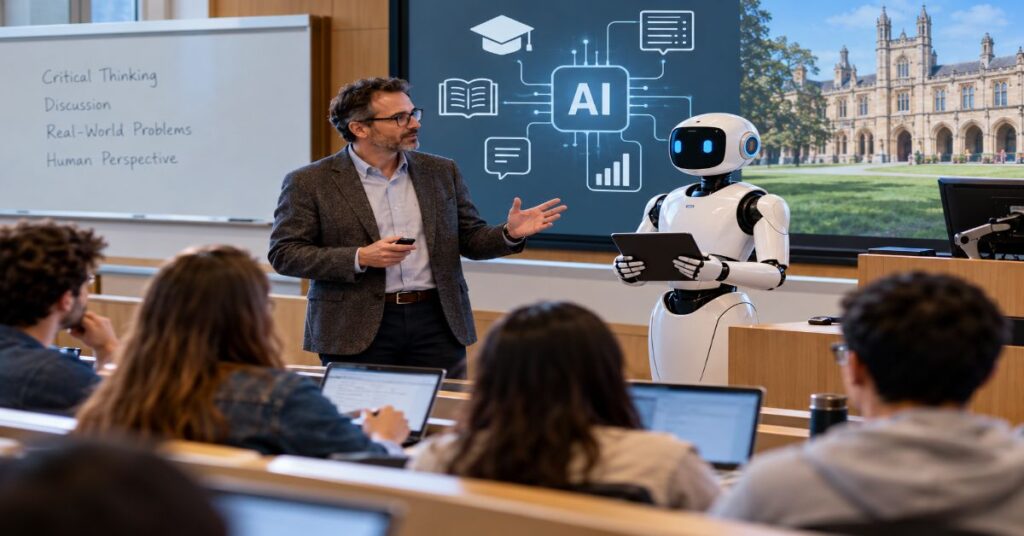
No, AI is unlikely to replace university lecturers as a profession, but it can replace a growing share of the tasks that once justified lecturer time—and that distinction is where the real employment risk now sits. In 2026, the strongest evidence points not to a clean human-versus-machine substitution, but to an unbundling of academic work: explanation, content production and first-pass feedback become cheaper, while judgement, supervision, assessment validity and human responsibility become more valuable.
The timing matters. HEPI’s Student Generative AI Survey 2026 found that 95% of surveyed full-time UK undergraduates used AI in at least one way and 94% used generative AI to help with assessed work. That means lecturers are no longer teaching in a world where AI is an optional extra. Students arrive with an always-available explainer, summariser, brainstorming partner and study assistant in their pocket.
That does not make a lecturer redundant. It changes what counts as scarce. A generic explanation of photosynthesis, contract law or regression analysis is no longer scarce. A lecturer who can diagnose why a specific student is reasoning badly, decide whether a source is trustworthy, design an assessment that demonstrates real capability, supervise a lab safely, challenge a weak argument in real time or take responsibility for a high-stakes academic decision remains much harder to substitute.
This article therefore asks a narrower and more useful question than most “will AI replace lecturers?” pages: which lecturer tasks can be automated now, which can be augmented, which remain institutionally non-delegable, and how might universities use AI under financial pressure? The answer is less comforting than “humans matter”, but more grounded than an arbitrary automation-risk score.
The Wrong Question Is Whether AI Can “Be a Lecturer”
Jobs disappear or change because employers reorganise bundles of tasks, not because a machine passes a theatrical imitation test. A university does not need an AI system to perform every duty of a lecturer before it can reduce the amount of human labour used to deliver a module. It only needs enough of the workload to become cheaper, centralised or scalable.
That is why binary replacement claims miss the mechanism. A language model may not be able to chair an exam board, take legal responsibility for a safety decision, supervise a chemistry lab and mentor a distressed postgraduate. Yet it may still draft lecture slides, create examples, answer predictable questions, generate formative quizzes, summarise student misconceptions and produce a first version of feedback. If those activities consumed 30% of teaching time, a university can redesign staffing even though no full lecturer has been automated.
The 2026 paper Beyond Replacement: How AI Reconfigures Academic Roles makes this task-redistribution frame explicit. A June 2026 scoping review in Frontiers similarly found the literature converging on a shift in higher-education teachers toward facilitation, while retaining concerns about workload, anxiety, institutional policy and displacement. The direction is not “teacher disappears”; it is “teacher role is re-specified”.
This is also why a useful analysis must separate technical capability from institutional authority. AI may be technically capable of producing a grade recommendation, but a university may still require a named academic to moderate it. It may explain a clinical scenario fluently, but it cannot hold a professional registration or carry the consequences of unsafe advice. Capability tells us what can be automated. Governance tells us what institutions will allow to be delegated.
| Lecturer Task | AI Capability in 2026 | Human Requirement | Likely Direction |
| Explaining established concepts | High | Low for basic explanations; higher for diagnosis of misconceptions | AI-first, lecturer escalates difficult cases |
| Lecture slides and examples | High | Human quality control and curriculum fit | Heavily automated preparation |
| Routine student queries | High | Escalation for ambiguity, welfare and policy | AI front door with human escalation |
| Structured marking | Medium–High | Moderation, fairness and accountability | Partial automation with review |
| Essay/dissertation feedback | Medium | Disciplinary judgement and authorship context | Draft assistance, human final judgement |
| Seminars and live debate | Medium | Responsive social and intellectual facilitation | Human-led, AI-supported |
| Research supervision | Low–Medium | Novelty, ethics, tacit knowledge, career mentoring | Human-led |
| Labs, studios and clinical teaching | Low–Medium | Safety, physical observation, professional standards | Human-led |
| Assessment design and validation | Medium | Institutional accountability and construct validity | Human-owned, AI-assisted |
What AI Already Does Better Than the Traditional Lecture
The strongest substitution pressure falls on one-way information delivery. AI can explain the same concept repeatedly, change the level of difficulty, translate terminology, generate analogies and respond at any hour. That does not prove the explanation is correct, but it does expose how little value there is in using expensive contact time merely to transmit stable information.
Michael Erkens, Rector Magnificus at Nyenrode Business University, told QS in June 2026 that “contact time has become too expensive to spend on information transfer.” That is a sharper threat to the old lecture than any humanoid robot. If students can get an acceptable first explanation from a phone, scheduled human time has to do something the phone cannot.
The implications extend to preparation. An experienced lecturer can use AI to draft multiple explanations, generate case variations, build formative questions and produce differentiated examples in minutes. Our related guide to AI tools for teachers in 2026 shows how current platforms already target lesson planning, quizzes, rubrics and differentiated materials. The efficiency gain is real, even when the lecturer must verify the result.
Students are also constructing their own tool stacks. Our 2026 student AI stack separates research, explanation, writing, revision and lecture capture because no single tool is best at every task. That matters for lecturer replacement: the competitor is not one perfect “AI professor”. It is a collection of specialised systems that together eat into the routine edges of teaching.
The defensible response is not to insist that human explanations are always superior. They are not. A tired lecturer repeating a standard answer to the twentieth student can be less patient, less available and less adaptive than a well-configured tutor. The human advantage appears when explanation becomes diagnosis: Why is this student making this error? Which misconception is underneath it? What should be challenged rather than clarified? Those are teaching decisions, not text-generation tasks.
Where Replacement Risk Is Highest
Risk is uneven across academic employment. A permanent research-active professor, a teaching-only lecturer, an adjunct delivering a standard module and a clinical supervisor may all be called “lecturers” in ordinary conversation, but their task bundles are very different. The easiest work to compress is standardised, repeatable, asynchronous and weakly tied to a specific person’s judgement.
This makes casual and teaching-only roles more exposed than the profession-wide headline suggests. Recorded lectures, centrally produced module shells, shared question banks and AI-assisted student support allow institutions to increase the number of learners served per academic. The job loss mechanism is therefore often indirect: fewer paid hours, fewer parallel seminar groups, larger cohorts per lecturer or a smaller number of academics overseeing AI-mediated learning.
Conversely, tasks become more resilient when they involve physical presence, accreditation, high-consequence judgement or relationships that matter over time. A design critic who understands a student’s portfolio trajectory, a doctoral supervisor who knows the field’s unwritten standards, or a nursing educator observing a student’s behaviour with a patient contributes context that is not contained in a prompt.
The recent international study of synthetic avatars is revealing here. Among 173 higher-education stakeholders, intention to adopt lecturer-like synthetic avatars was relatively low, while respondents raised concerns about labour exploitation, automation for cost-cutting, degraded human relationships, equity and validity. The technology can mimic presence; stakeholder trust does not automatically follow.
Assessment Is the Pivot Point
Assessment is where the replacement debate becomes institutional rather than cosmetic. If AI can produce a plausible essay, solve a routine problem set and generate a competent presentation, then universities cannot simply preserve the same assessments and add stronger policing. They have to decide what evidence of learning is actually non-delegable.
Mauricio G. Villena, Dean and Professor at Diego Portales University, argues for “verifiable judgment”: students should be able to evaluate evidence, reason under uncertainty and defend their decisions. His July 2026 HEPI essay makes the uncomfortable point that if a machine can produce a large share of the assessed output, the assessment may not have been measuring what educators thought it was measuring.
This is why oral defences, supervised problem-solving, iterative portfolios, studio critique, demonstrations and viva-style questioning are likely to grow. These formats do not ban AI; they make the student’s own understanding observable. A student may use ChatGPT to prepare, but must still explain why a source is credible or defend a methodological choice live.
Our guide to responsible AI in academic writing uses the same boundary: assistance can reduce friction, but the student must retain authorship, provenance and the ability to defend the final argument. For lecturers, that means the job shifts from marking polished surfaces toward designing evidence of thinking.
There is also a quality risk in automating marking too aggressively. Australian universities are already debating limited AI use in grading, and critics warn of “verification drift” when humans begin to trust machine outputs without meaningful review. If both student work and feedback are machine-generated, the institution can create a closed loop of fluent text with weak evidence that anyone learned anything.
| Assessment Format | AI Can Assist | What Still Has to Be Verified | Replacement Implication |
| Multiple-choice / structured quiz | Question generation, scoring, item analysis | Item validity, bias, curriculum alignment | High automation potential |
| Essay | Rubric mapping, language feedback, first-pass comments | Authorship, reasoning quality, evidence use, disciplinary nuance | AI drafts feedback; academic remains accountable |
| Oral defence / viva | Practice questions, transcript summary | Student’s live reasoning and ownership | Low substitution potential |
| Lab / clinical demonstration | Simulation, checklists, analytics | Safety, physical performance, professional judgement | Low substitution potential |
| Portfolio / iterative project | Progress summaries, pattern detection | Development over time, authenticity, reflective judgement | Augmentation more likely than replacement |
The Human Work AI Makes More Valuable
A useful way to identify durable lecturer value is to ask what becomes more important as generated information becomes abundant. Four categories stand out: judgement, relationship, responsibility and environment.
Judgement means deciding what matters when rules are incomplete. AI can generate ten plausible interpretations of a case. A lecturer must decide which distinction is intellectually important, where uncertainty should remain visible and what standard of evidence the discipline accepts. That is partly knowledge, but it is also tacit calibration built through years of research and practice.
Relationship matters because learning is not only information transfer. Students reveal confusion, ambition, avoidance and loss of confidence through patterns that are easier to notice across repeated human contact. Dr Philip Xiu, Honorary Senior Lecturer at the University of Leeds, argues that AI can restore faculty time to “mentorship, modelling, professional identity” rather than administration. His point is important because the strongest case for AI in education may be not replacing the educator but removing low-value friction around the educator.
Responsibility is even harder to automate. A model can recommend a grade, flag a struggling student or suggest a clinical explanation. Someone still has to own the decision. Universities are credentialing institutions. Their value depends on the claim that a named programme, governed by accountable humans, has verified a student’s capability.
Environment includes the social and physical conditions of learning: a seminar where disagreement changes the direction of discussion, a laboratory where safety matters, a studio where a lecturer sees how a student works, or a clinical placement where professional behaviour is observed. AI can enrich these environments, but the environment is not reducible to the text exchanged inside it.
AI Platforms Universities Are Actually Buying
Replacement pressure is not theoretical because universities are already procuring institutional AI. The platforms differ in pricing transparency and in whether they are designed as general assistants, productivity layers or learning tools. The table below records only publicly confirmed September 2026 information; where a vendor does not publish an institutional price, it is marked as such rather than estimated.
| Platform / Education Offering | Public 2026 Price | Relevant Capabilities | Important Limit or Governance Point |
| ChatGPT Edu | Institutional price not publicly listed | Campus AI assistant; text/vision reasoning; data analysis; enterprise controls; education deployment | Contract pricing; universities still need policy, assessment redesign and staff training |
| Google Workspace Education Plus | $6/user/year for Education Plus; qualifying Fundamentals available at no charge | Gemini in Classroom and Workspace features; higher limits in Gemini Notebook | Feature access varies by edition and limits |
| Google AI Pro for Education | $20/user/month annual or $24 monthly; $15 annual for qualifying Education Plus purchases of 50–999 licences | Expanded premium Gemini models/features across Workspace and Gemini Notebook | Paid add-on; procurement does not solve pedagogy or assessment validity |
| Microsoft Copilot Chat / Study and Learn | No additional cost with eligible Microsoft 365 Education A1/A3/A5 licences | Secure chat, file uploads; Study and Learn with guided questions, quizzes, flashcards and scaffolded practice | Requires Copilot Chat access; institutional controls apply |
| Microsoft 365 Copilot academic offering | $18/user/month | Microsoft Graph grounding, in-app productivity assistance, agents, management and analytics | Higher-cost productivity layer; not a substitute for academic accountability |
The pricing itself creates a second-order effect. Once a university pays for an institution-wide AI layer, managers have an incentive to seek measurable productivity gains. Those gains may appear first as reduced preparation time or faster student support, but over time they can influence workload allocation and staffing models.
This is not unique to one vendor. OpenAI says hundreds of universities are working with ChatGPT Edu; Google bundles no-cost AI tools into qualifying education editions and sells a premium education add-on; Microsoft includes Study and Learn with eligible education licences. The market direction is clear: AI capability is moving from an optional browser tab into managed campus infrastructure.
Why “AI Tutor” Does Not Equal “University Lecturer”
The phrase AI tutor can create conceptual confusion. Tutoring is one part of university teaching, and a narrow tutor can be excellent without replacing the institution or the lecturer. A system optimised to coach a student through calculus does not automatically know what should be in the curriculum, whether the learning outcome is defensible, or how the course fits accreditation requirements.
Current education products are increasingly designed around learning rather than answer delivery. Microsoft’s Study and Learn agent, for example, uses scaffolded conversations, flashcards and quizzes and explicitly aims to keep the learner doing the thinking. Students can also build source-grounded revision systems; our ChatGPT study-guide workflow and Microsoft Copilot study-guide guide show how these systems can organise notes and generate practice without eliminating the need for a teacher or assessor.
This distinction matters because a lecturer performs at least three layers of work above tutoring. First, the lecturer helps define the intellectual target: what is worth learning and why. Second, the lecturer interprets evidence of learning across a cohort and adapts teaching. Third, the lecturer participates in the institution’s certification process. An AI tutor can support all three; it does not inherently possess authority over any of them.
The near-term risk is therefore not that a university appoints “Professor GPT” and dismisses the department. It is that tutoring, office-hour questions and revision support move to AI by default, leaving fewer human contact hours unless the institution deliberately protects and redesigns them. The educational outcome will depend on what universities do with the time and money saved.
Student Behaviour Is Already Forcing the Redesign
Students do not need to wait for institutional strategy. They already use AI to explain concepts, summarise readings, structure ideas, search the web, draft and revise. HEPI’s 2026 survey makes the scale visible: 68% of respondents considered AI skills essential to thrive in today’s world, yet only 48% felt teaching staff were helping them develop those skills.
That gap changes the lecturer’s job in two directions. Lecturers must teach disciplinary knowledge, but they also increasingly have to teach how to interrogate AI inside the discipline: what counts as a reliable source, which shortcuts erase essential practice, when a model is likely to hallucinate, and how to disclose assistance. A generic digital-literacy workshop cannot replace subject-specific judgement.
The exam-preparation trend illustrates the pressure. Students are already using models to mine past papers and identify recurring topics; our report on students using Gemini to predict exam questions shows why pattern-rich assessments are particularly exposed. If a model can reverse-engineer the assessment blueprint from previous papers, departments need broader question banks and more authentic evaluation rather than simply warning students not to use AI.
There is also a social consequence. If every student can obtain instant private help, lecturers may see fewer basic questions in class but more difficult questions at the boundary of understanding. That could make academic work more demanding rather than less. The lecturer becomes an escalation layer for ambiguity, critique and exception handling—the same pattern seen when automation enters other knowledge professions.
The Labour Risk Comes From Economics, Not Just Capability
A profession can be resilient in principle and still experience job losses. Universities facing financial pressure may use AI not because it teaches better, but because it changes the cost structure of teaching. That is the part of the debate that optimistic “AI will never replace the human touch” arguments often understate.
Imagine a first-year module with eight seminar leaders, one module convenor and hundreds of repetitive student queries. If AI reduces preparation and support workload, the institution has several choices: preserve staffing and deepen contact, keep staffing flat while increasing enrolment, or reduce paid teaching hours. The technology does not determine which path is chosen; governance and finance do.
This is why labour protections and workload models matter. The 2025 synthetic-avatar study found explicit stakeholder concern that automation could be used for institutional cost-cutting and exploitation of academic labour. In September 2026, York University workers in Canada were publicly seeking protections against AI tutors being used to reduce or replace staff. The question has already moved from speculation into collective bargaining.
The highest-risk scenario is an institution that treats education as content distribution plus credential processing. In that model, AI makes both functions cheaper. The lowest-risk scenario is an institution that competes on supervised practice, intellectual community, research participation, mentoring and credible assessment. AI makes the contrast between these models more visible.
What Happens to Different Types of Lecturers
The replacement question is too broad unless it distinguishes disciplines and roles. A historian teaching large survey modules, an engineering lecturer running laboratories, a clinical educator, a doctoral supervisor and a coding instructor face different automation surfaces.
| Lecturer Context | Most Automatable Work | Most Defensible Human Work | Net 2026 Exposure |
| Large introductory lecture course | Slides, explanations, FAQ support, quizzes, routine feedback | Assessment design, seminars, misconception diagnosis, moderation | Medium–High task change |
| Humanities seminar / writing course | Draft feedback, source orientation, example generation | Interpretation, argument challenge, oral defence, contextual judgement | Medium task change |
| STEM lecture + problem class | Worked examples, formative practice, coding assistance | Error diagnosis, advanced reasoning, lab/safety supervision | Medium task change |
| Laboratory / studio teaching | Preparation, simulation, documentation | Physical observation, safety, craft judgement, critique | Low–Medium substitution |
| Clinical / professional education | Case generation, knowledge checks, documentation support | Patient safety, ethics, professional behaviour, licensure-linked judgement | Low substitution, high augmentation |
| Postgraduate / doctoral supervision | Literature mapping, drafting support, admin | Originality, field judgement, ethics, research strategy, career sponsorship | Low substitution |
Recent lecturer research supports this heterogeneity. A September 2026 survey of 150 Cambodian lecturers found positive perceptions of AI use alongside concerns about reduced human interaction, trust, insufficient training and technical support. The conclusion is not that one profession has one risk level, but that adoption depends on infrastructure, discipline, institution and the exact task being delegated.
Pakistan offers a useful institutional signal too. In September 2026, the Higher Education Commission reported training more than 332 faculty members in AI literacy across teaching, learning, research and assessment. That investment assumes lecturers remain central actors in AI-enabled universities. The policy response is capacity-building, not planning for lecturer-free campuses.
Three Scenarios for Universities Through 2030
Forecasts should be treated cautiously because model capability, regulation and university finances can change faster than academic planning cycles. Still, three scenarios help clarify what “replacement” could mean without pretending to predict a single outcome.
| Scenario | Operating Model | Effect on Lecturer Numbers | Educational Risk |
| Augmentation-first | AI removes admin and routine tutoring; saved time is reinvested in seminars, supervision and feedback | Stable or modestly changed staffing | Depends on staff training and verification, but preserves human contact |
| Efficiency-first | AI support allows larger cohorts and fewer parallel teaching hours | Teaching-only and casual roles shrink; remaining staff oversee more students | Reduced contact, verification drift, uneven support |
| Unbundled platform university | Central content + AI tutoring + small layer of academic moderators and assessors | Substantial reduction in conventional teaching roles | High risk if credential value and learning evidence weaken |
The first scenario is technically plausible today and educationally attractive, but it requires universities to resist converting every time saving into headcount reduction. The second is probably the most realistic pressure point because it can happen incrementally. A department does not announce that AI has replaced lecturers; it simply leaves a vacant post unfilled, enlarges tutorial groups or centralises content production.
The third scenario is possible in some low-cost or highly standardised markets, especially where students primarily seek flexible access to a credential. Yet it also creates the hardest trust problem: if the majority of learning, practice and feedback is machine-mediated, what exactly is the institution certifying, and how does it demonstrate that the graduate—not the model—can perform?
That trust question is why predictions based only on model capability are incomplete. Universities sell more than explanations. They sell selection, structure, facilities, community, supervision, assessment and a credential whose meaning depends on reliable verification.
How Lecturers Can Make Their Work Harder to Substitute
The useful response for academics is not to become faster content generators than AI. That competition is already lost. The stronger strategy is to move visible effort toward work where context, trust and accountable judgement are the product.
First, redesign contact time around live reasoning. Use lectures for framing and difficult synthesis, but move routine explanations to pre-class resources and AI-supported preparation. In class, make students compare claims, defend decisions, critique sources and solve problems where the answer is not obvious.
Second, own assessment redesign. Departments need academics who can decide what evidence of capability still means when generative systems are ubiquitous. Lecturers who can build oral checkpoints, staged submissions, authentic tasks and defensible rubrics are solving an institutional problem that AI itself cannot resolve.
Third, become the human escalation layer. Let AI answer the predictable question, then make it easy for students to bring uncertainty, conflict and high-stakes decisions to a person. This preserves scarce academic time for the cases that need judgement.
Fourth, develop AI literacy without confusing tool fluency with expertise. A lecturer should know what current systems can do, how student workflows actually look, where privacy and provenance risks appear and how outputs should be verified. Our guide to ChatGPT for students is useful here because it shows the student side of the workflow lecturers are now governing.
Finally, make tacit expertise visible. Explain why you reject a source, how you recognise a weak research question, what makes an argument persuasive in the discipline and how experienced judgement differs from pattern completion. The more teaching is framed as “here are my slides”, the easier it is to automate. The more it exposes expert reasoning, the harder it is to substitute.
Our Editorial Verification Process
This explainer was researched as a task-level analysis rather than a simple automation-risk score. We reviewed the current search landscape for “will AI replace university lecturers”, including opinion pieces, job-risk pages, 2025–2026 peer-reviewed studies, higher-education policy analysis and current education-product documentation. We compared recurring claims against primary or first-party evidence where available, especially HEPI’s 2026 student survey, peer-reviewed higher-education research, official university-sector sources and vendor education documentation.
For technology and pricing claims, we checked current official pages for ChatGPT Edu, Google Workspace for Education / Google AI Pro for Education and Microsoft Copilot in Education. We recorded public prices only where the vendor publishes them; ChatGPT Edu institutional pricing is therefore described as not publicly listed rather than estimated. We also separated technical capability from institutional delegation: an AI system being able to draft feedback is not treated as evidence that a university can safely or legally delegate final academic judgement.
The sitemap.xml, sitemap_index.xml and post-sitemap.xml endpoints specified in the production brief could not be retrieved through the browsing layer during research. Internal links were therefore selected only from verified, live, indexed Perplexity AI Magazine pages with direct semantic relevance to AI in education, student use, academic writing, teacher tools and study workflows. No sitemap contents were guessed.
This article was researched and drafted with AI assistance and reviewed by the Awais Khalid editorial desk at Perplexity AI Magazine. All data, citations, pricing figures, and named quotes have been independently verified against primary sources before publication.
Conclusion
AI is unlikely to replace university lecturers in the simple sense of removing academics from higher education, but it is already replacing enough routine work to change staffing economics and the definition of good teaching. That makes complacency risky. A lecturer whose visible contribution is mostly transferring stable information, producing slides and answering repeatable questions is more exposed than one whose work centres on judgement, supervision, assessment integrity, live intellectual challenge and professional responsibility.
The central uncertainty is institutional, not technological. Universities can use AI savings to deepen human contact or to reduce it. They can automate preparation so lecturers spend more time mentoring, or automate preparation and then increase student-to-staff ratios. Both futures use the same tools.
The most credible evidence in 2026 therefore supports a reconfiguration thesis: AI compresses information work and raises the premium on verifiable human judgement. The lecturer role survives by becoming less like a broadcaster and more like a designer of learning, examiner of capability, research mentor and accountable expert. Whether that produces better universities or simply cheaper ones will depend on decisions institutions are making now.
Frequently Asked Questions
Will AI replace university lecturers?
No. AI is more likely to replace specific lecturer tasks than the entire profession. Routine explanations, content preparation, first-pass feedback and some structured marking are highly exposed, while supervision, live discussion, assessment validity, physical teaching environments and accountable academic judgement remain much harder to delegate.
Which university lecturer tasks are most at risk from AI?
Standard content delivery, slide creation, quiz generation, routine student questions, summarisation and parts of structured feedback are the clearest automation targets. Risk rises when work is repeatable, digital, high-volume and weakly dependent on a specific academic’s judgement.
Can AI grade university essays?
AI can compare text with rubrics, identify patterns and draft feedback, but final essay grading raises problems of validity, bias, context and accountability. In high-stakes assessment, a university still needs defensible human moderation and a clear policy describing what the system is allowed to do.
Will universities employ fewer lecturers because of AI?
Some may. AI does not need to replace every lecturer duty to reduce employment. Institutions can increase cohort sizes, centralise course production or cut casual teaching hours if automation reduces preparation and support workload. The outcome depends on financial and governance choices, not capability alone.
Are AI tutors as good as university lecturers?
For narrow explanation and practice, an AI tutor can be highly available and adaptive. A university lecturer performs a broader role: setting intellectual standards, diagnosing misconceptions, supervising research, facilitating debate, protecting assessment validity and taking responsibility for consequential academic decisions.
What should lecturers learn to stay relevant?
Lecturers should develop practical AI literacy, assessment-redesign skills, source verification, live facilitation, mentoring and the ability to make expert reasoning visible. Trying to beat AI at producing routine content is less defensible than specialising in judgement and interaction.
Could an AI avatar deliver lectures instead of a human?
Technically, synthetic avatars can deliver prepared material and answer some questions. A 2025 international stakeholder study found relatively low intention to adopt these systems and concerns about labour exploitation, cost-cutting, trust and degradation of human relationships. Delivery is only one part of lecturing.
Does AI make a university degree less valuable?
It can reduce the scarcity of information, but degree value also comes from credible assessment, structure, facilities, networks, supervision and recognised certification. Universities that cannot show how they verify student capability may face a stronger value challenge than those that redesign learning around judgement and practice.
References
- Higher Education Policy Institute. (2026, March 12). Student Generative Artificial Intelligence Survey 2026.
- Roe, J., Perkins, M., Somoray, K., Miller, D., & Furze, L. (2025). Can synthetic avatars replace lecturers? An exploratory international study of higher education stakeholder perceptions. International Journal of Educational Technology in Higher Education, 22, 71.
- Mota, F. B., Cabral, B., Pinto, C. D., Braga, L. A. M., Comarú, M. W., & Lopes, R. M. (2026). The evolving role of higher education teachers in the age of artificial intelligence: A scoping review. Frontiers in Education, 11.
- Ghorbani, A., & Blankesteijn, M. L. (2026). Beyond replacement: How AI reconfigures academic roles. Foresight and STI Governance, 20(3).
- Xiu, P. (2026, June 2). Dr Philip Xiu on teaching in an AI-enabled world. Elsevier Faculty Hub.
- Lane, C. (2026, June 10). Will AI replace the knowledge part of higher education? QS Insights Magazine.
- Villena, M. G. (2026, July 14). Verifiable judgment: What AI actually demands of universities. Higher Education Policy Institute.
- Google for Education. (2026). Compare Google Workspace for Education editions.
- Microsoft. (2026). Microsoft 365 Copilot in Education.
