
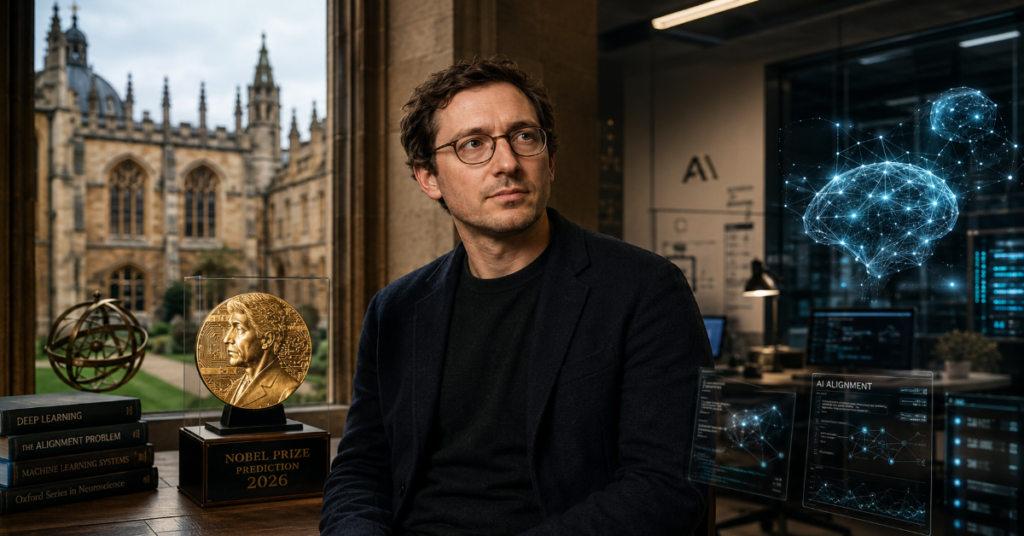
Jack Clark’s Oxford lecture is the most consequential public statement made by a sitting frontier AI company executive in 2026 — and it is consequential not because the predictions are sensational, but because Clark has operational visibility into the capabilities of the most advanced AI systems ever built, and he is telling the world what he actually believes those systems will do next. Clark, co-founder of Anthropic and the author of Import AI, one of the most-read AI policy newsletters in the world, delivered the 2026 Cosmos Lecture at the University of Oxford on May 20 under the title Change is inevitable. Autonomy is not. The lecture, delivered to an audience at the Institute for Ethics in AI, made six predictions about the near-term trajectory of artificial intelligence: a Nobel Prize-worthy scientific discovery by AI working with humans within twelve months; bipedal robots assisting tradespeople within two years; companies run entirely by AI generating millions in revenue within eighteen months; a sixty-plus percent probability that AI will be able to design its own successors by end of 2028; a warning that extinction risk from advanced AI has not gone away; and a comparison of humanity’s current preparedness for AI to its catastrophic failure to prepare for COVID-19. The context that makes each of these predictions a genuine news event rather than science fiction: Jack Clark Anthropic Oxford AI Nobel predictions are not the views of a science futurist or a speculative commentator. They are the internal timeline of a company approaching a nine-hundred-billion-dollar valuation, building what it describes as the most capable and most dangerous AI model ever created.
The Nobel Prediction — What 12 Months Actually Means
Clark’s prediction that AI will work with humans to make a Nobel Prize-winning discovery within twelve months from May 2026 — placing the target window at approximately May 2027 — is not a vague aspiration. He framed it as an operational assessment based on what he can see inside Anthropic’s research, the capabilities of Claude Mythos (Anthropic’s most advanced model, not publicly released), and the trajectory of scientific AI deployments across the research community. The same week as the Oxford lecture, OpenAI’s internal model autonomously disproved an eighty-year-old mathematical conjecture using novel algebraic number theory tools that human mathematicians had not applied to the problem in decades of active work. That mathematical achievement is not Nobel-eligible — Nobel Prizes are awarded in Physics, Chemistry, Medicine, Literature, Peace, and Economics — but it demonstrates a form of autonomous cross-domain conceptual synthesis that is directly relevant to scientific discovery in Nobel-eligible fields.
In chemistry and medicine, which are the Nobel Prize categories where AI has the most direct near-term relevance, AlphaFold 3 (from Google DeepMind) won the 2024 Nobel Prize in Chemistry for protein structure prediction — a validation that AI contributions to science can reach Nobel level. Isomorphic Labs, the DeepMind spinout built on AlphaFold, expects its first clinical trials of AI-designed drug candidates by end of 2026. Anthropic’s partnership with the Gates Foundation, announced May 14, 2026, targets vaccine candidate screening for polio, HPV, and eclampsia using Claude. Clark’s twelve-month window is aggressive but not unfounded: the rate of AI-assisted scientific discovery is accelerating across every quantifiable metric, and the capability of frontier models to autonomously generate and evaluate scientific hypotheses is the specific advance that the Erdos proof most directly demonstrates.
“There is a non-zero chance AI could kill everyone on the planet. That risk hasn’t gone away. And I think it is important to clearly state that — not as a reason to stop, but as a reason to be very serious about how we proceed.” — Jack Clark, Co-founder, Anthropic, 2026 Cosmos Lecture, University of Oxford, May 20, 2026
Jack Clark Oxford Lecture — All Six Predictions and Their Timelines
| Prediction | Timeline | Probability / Framing | Evidence This Week |
| AI and humans make a Nobel Prize-worthy discovery | Within 12 months (by May 2027) | Stated as expected, not probabilistic | OpenAI autonomous Erdos proof; AlphaFold Nobel precedent |
| Bipedal robots assist tradespeople | Within 2 years (by 2028) | Stated as expected | Figure AI, Boston Dynamics, Tesla Optimus all in deployment testing |
| AI-only companies generating millions in revenue | Within 18 months (by late 2027) | Stated as expected | Agentic coding revenue ($2.5B Claude Code ARR); operator agents in production |
| AI capable of designing its own successors (recursive self-improvement) | By end of 2028 | 60%+ probability | Karpathy hired to use Claude to accelerate Claude pretraining; Anthropic Institute paper on ‘intelligence explosion’ |
| Extinction risk from AI persists | Ongoing — not time-bound | Non-zero probability, explicitly real | Claude Mythos cyber-offensive capabilities (April 2026); White House EO cancelled |
| Vast economic and social disruption even without extinction scenario | Next few years | Clark’s ‘most conservative’ prediction | 101,000 tech layoffs in 2026; AI-driven workforce restructuring across all sectors |
The Recursive Self-Improvement Prediction — The Intelligence Explosion Is Official Anthropic Doctrine
The prediction that is generating the most discussion — and the most concern among AI safety researchers — is Clark’s 60 percent probability estimate that by end of 2028 we will have an AI system capable of designing its own successors. This is the concept known in AI safety literature as recursive self-improvement: an AI system that can improve its own capabilities, which in turn improve its capacity to improve itself further, creating a feedback loop that could accelerate AI capability at a rate that human oversight cannot match. The phrase intelligence explosion was coined by mathematician I.J. Good in 1965 and has been associated with theoretical AI safety concern since the 1990s. What is new — and what makes Clark’s statement a genuine news event — is that it is now in an official Anthropic research document, the Anthropic Institute’s published research agenda, attributed to Anthropic researchers, with a specific probability estimate and a specific timeframe.
The operational connection is direct and visible. Andrej Karpathy joined Anthropic’s pretraining team on May 19, 2026 — one day before Clark’s Oxford lecture — with a specific mandate to build a team that uses Claude to accelerate pretraining research. This is recursive self-improvement in its early, controlled form: a frontier AI model contributing to the research process that produces the next, more capable version of itself. Clark is not predicting something abstract. He is describing the trajectory of work that Anthropic is actively and deliberately doing. The sixty percent probability estimate for end of 2028 means that, in Clark’s operational assessment, we are now closer to a world where AI autonomously improves itself than to a world where it does not — and that transition will happen within thirty months.
“We have not ever encountered a technology that has this property, where it can make a better version of itself without people. By the end of 2028, it is more likely than not that we have an AI system where you could say to it: make a better version of yourself.” — Jack Clark, Co-founder, Anthropic, 2026 Cosmos Lecture, University of Oxford, May 20, 2026
The Duality That Defines Anthropic — Selling Capability While Warning About Risk
TIME Magazine’s coverage of the Oxford lecture, published May 22, captures the tension that defines Anthropic’s identity with unusual clarity. Jack Clark spent Thursday at Oxford warning that AI could kill everyone on the planet and calling for pandemic-style institutional preparedness. The previous day, his colleague Dario Amodei was in London helping launch Claude Code to commercial customers and announcing partnerships with PwC, the Gates Foundation, and European enterprise clients. The company is simultaneously building and deploying what it believes is potentially civilisation-threatening technology, and providing the most candid public accounting of those risks of any frontier AI company. Clark’s Oxford lecture is not a marketing exercise. He is telling an academic audience at the Institute for Ethics in AI — people who are professionally sceptical of AI company self-promotion — that the risks are real, the timelines are short, and most of the world is in denial about both.
The comparison Clark made to COVID-19 preparedness is pointed. The pandemic demonstrated that knowing a risk exists and preparing for it are not the same thing. Epidemiologists had warned for decades that a novel coronavirus pandemic was plausible and potentially catastrophic. The institutional response when it arrived was reactive, fragmented, and inadequate. Clark’s argument is that humanity is repeating the same pattern with AI: the risk is visible, the researchers closest to the technology are warning about it, and the institutional response — as demonstrated by the White House cancelling its voluntary AI safety executive order at the last minute under pressure from Musk, Zuckerberg, and Sacks — is moving in the opposite direction from preparation. His framing of this as a choice about whether to be reactive or proactive is the core governance argument that Anthropic has been making since its founding, now delivered from an Oxford podium with a specific timeline attached.
Key Takeaways
• Jack Clark, co-founder of Anthropic, delivered the 2026 Cosmos Lecture at Oxford University on May 20, 2026, making six specific near-term predictions about AI’s trajectory based on what he described as operational visibility into frontier model capabilities, not theoretical speculation.
• Clark predicted AI will work with humans to produce a Nobel Prize-worthy scientific discovery within 12 months — placing the target at approximately May 2027 — in the same week that OpenAI’s internal model autonomously disproved an 80-year-old mathematical conjecture.
• His most alarming prediction: a 60 percent probability that by end of 2028, AI will be able to design its own successors — recursive self-improvement — which Clark called an intelligence explosion that is now in official Anthropic research documents, not just safety theory.
• Clark explicitly stated there is a non-zero chance AI could kill everyone on the planet, and that this risk has not gone away despite commercial progress — making him the most senior AI company executive to publicly restate existential risk with a specific timeframe attached.
• The lecture lands in a week where: Anthropic is approaching its first quarterly profit, Karpathy joined to use Claude to train Claude (early recursive self-improvement), OpenAI disproved a major mathematical conjecture, and the White House cancelled its AI safety executive order under tech CEO pressure.
• Clark compared humanity’s current AI preparedness to its failure to prepare for COVID-19, warning that reactive responses to AI risks will prove catastrophic — and calling for pandemic-style institutional readiness before, not after, the capabilities he is predicting arrive.
Conclusion
Jack Clark’s Oxford lecture is not optimistic. It is not pessimistic. It is the specific operational view of a person who works daily with the most capable AI systems ever built, who co-founded the company producing them, and who has been tracking and publishing about AI capability trajectories since 2016. The predictions are extraordinary — Nobel-level scientific discovery within twelve months, AI-led companies within eighteen, recursive self-improvement within thirty — and they arrive in a week when the evidence for AI’s expanding capabilities is not abstract. An OpenAI model just disproved an 80-year-old conjecture autonomously. Anthropic’s own team is using Claude to train the next Claude. The commercial deployments are generating billions in quarterly revenue. Clark’s warning about extinction risk is not the dramatic flourish of a safety pessimist — it is the judgement of someone who has seen Claude Mythos find thousands of zero-day vulnerabilities in every major operating system and concluded that the capability trajectory has not been accompanied by adequate preparation. The twelve months that follow his Oxford lecture will tell us whether his prediction about Nobel-level science was right. The thirty months that follow will tell us whether his prediction about recursive self-improvement was right. Both timelines are now running.
Frequently Asked Questions
What did Jack Clark predict at Oxford?
Clark made six predictions at the 2026 Cosmos Lecture at Oxford on May 20: AI and humans will make a Nobel Prize-worthy discovery within 12 months; bipedal robots will assist tradespeople within 2 years; AI-only companies generating millions in revenue will exist within 18 months; there is a 60%+ probability AI will design its own successors by end 2028 (recursive self-improvement); extinction risk from AI has not gone away; and vast economic disruption is his most conservative prediction.
Does Jack Clark think AI could kill everyone?
Yes. Clark explicitly stated there is a non-zero chance AI could kill everyone on the planet, and emphasised that this risk has not gone away despite commercial progress. He did not describe this as the most likely outcome, but stated it is a real and ongoing risk that must be taken seriously, and compared the current level of preparedness to the world’s inadequate preparation for COVID-19.
What is recursive self-improvement and why does Clark’s prediction matter?
Recursive self-improvement is the theoretical concept of an AI system that can improve its own capabilities, which in turn improve its capacity to improve itself further, creating an accelerating feedback loop. Clark predicts a 60%+ probability this will be achievable by end of 2028. It matters because Anthropic now has this in official research documents, and the company is actively using Claude to help train the next Claude — which is recursive self-improvement in its earliest controlled form.
Is Clark’s Nobel prediction consistent with what OpenAI demonstrated?
Directionally yes. OpenAI announced the same day that an internal model autonomously disproved an 80-year-old mathematical conjecture — demonstrating cross-domain scientific reasoning at a level that had not previously been achieved autonomously. Mathematical proof is not directly Nobel-eligible, but the same cross-domain autonomous reasoning capability that enabled the Erdos proof is directly relevant to the experimental scientific discoveries in chemistry, medicine, and physics that win Nobel Prizes.
Why is the Oxford timing significant?
The Oxford lecture on May 20, 2026 coincided with OpenAI’s Erdos proof, Andrej Karpathy’s second day at Anthropic (hired to use Claude to accelerate Claude’s own training), the White House cancelling its AI safety executive order, and Anthropic approaching its first quarterly operating profit. Clark was not speaking into a vacuum — he was contextualising a week in which almost every major AI story confirmed the timeline he was predicting.
References
Clark, J. (2026, May 20). Change is inevitable. Autonomy is not. [2026 Cosmos Lecture, University of Oxford, Institute for Ethics in AI].
The Guardian. (2026, May 20). Anthropic co-founder: AI will make Nobel Prize-winning discovery within 12 months. https://www.theguardian.com/technology/2026/may/20/anthropic-jack-clark-oxford-ai-predictions
TIME Magazine. (2026, May 22). Anthropic sells Claude’s promise while warning about AI’s dangers. https://time.com/article/2026/05/22/anthropic-claude-code-jack-clark-ai-safety/
TechCentral.ie. (2026, May 22). Anthropic co-founder says AI-enabled breakthrough worthy of a Nobel Prize possible within a year. https://www.techcentral.ie/anthropic-co-founder-predicts-that-ai-will-within-a-year/
AI Weekly. (2026, May 22). Jack Clark predicts AI Nobel Prize win in 12 months. https://aiweekly.co/alerts/jack-clark-predicts-ai-nobel-prize-win-in-12-months
ResultSense. (2026, May 21). Jack Clark: AI will help win a Nobel within 12 months. https://www.resultsense.com/news/2026-05-21-jack-clark-anthropic-ai-nobel-prize-prediction/
Build Fast with AI. (2026, May 22). AI news today — May 23, 2026: 12 biggest stories. https://www.buildfastwithai.com/blogs/ai-news-today-may-23-2026
