
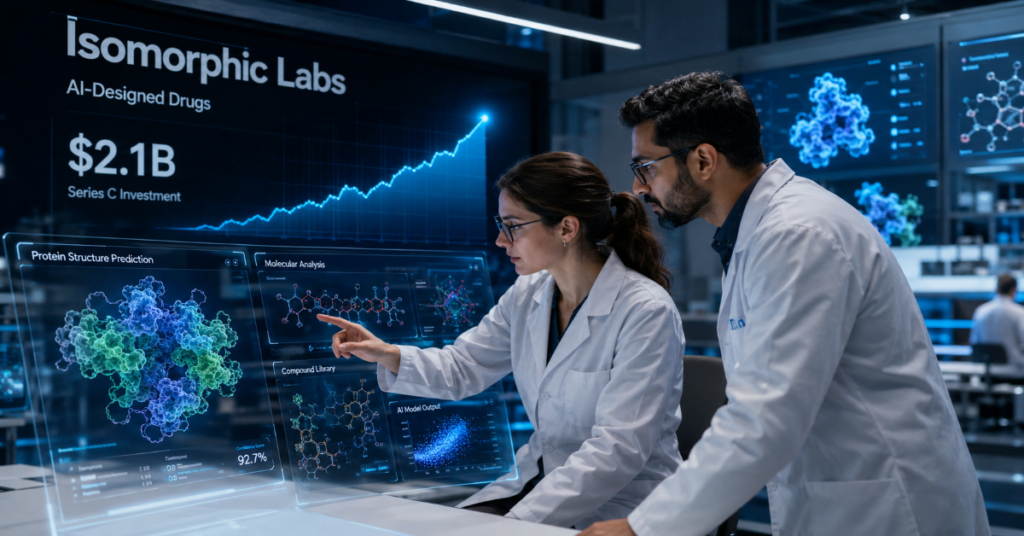
Isomorphic Labs raised $2.1 billion in a Series B funding round on May 12, 2026, led by existing investor Thrive Capital for the second consecutive round, with participation from Alphabet, GV (Google Ventures), CapitalG, and significant new investors including Abu Dhabi’s MGX, Singapore’s Temasek, and the UK Sovereign AI Fund. The round is one of the largest private financings in AI drug discovery history. Isomorphic Labs is the DeepMind spinout built to commercialise AlphaFold — the protein structure prediction system whose creators Sir Demis Hassabis and John Jumper shared the 2024 Nobel Prize in Chemistry. Hassabis, who is simultaneously the CEO of Isomorphic Labs and the head of Google DeepMind, described the funding as a massive vote of confidence from a diverse group of top-tier international investors in our AI-first approach to drug design and development. The round brings total outside capital raised by Isomorphic to approximately $2.6 billion, following a $600 million Series A in May 2025. Isomorphic now expects its first clinical trials by the end of 2026 — a timeline delayed from Hassabis’s earlier target of having AI-designed drugs in trials by end of 2025, but an advancement that represents the first time a drug designed by Alphabet-backed AI is expected to reach human testing.
What AlphaFold and IsoDDE Actually Do — The Science Behind the Capital
To understand why $2.1 billion flowed into Isomorphic in May 2026, you need to understand what AlphaFold changed about drug discovery — and what Isomorphic’s proprietary platform, IsoDDE, adds on top of it. AlphaFold’s breakthrough, recognised by the Nobel Committee in 2024, was the ability to predict the three-dimensional structure of proteins from their amino acid sequence with extraordinary accuracy. Before AlphaFold, determining protein structure required years of laboratory work using techniques like X-ray crystallography. AlphaFold reduced that to hours of computation. This matters for drug discovery because drugs work by binding to proteins — typically blocking a protein’s function or enabling it to work differently. To design a drug that binds to a target protein, you need to know the protein’s shape. AlphaFold made that knowledge computationally accessible at scale for essentially every known protein.
Isomorphic’s IsoDDE platform goes beyond AlphaFold. AlphaFold 1 and AlphaFold 2 were published openly. AlphaFold 3 was published in Nature but with restricted code access. IsoDDE is fully proprietary and is described on Isomorphic’s website as unlocking a new frontier beyond AlphaFold. The shift mirrors the broader AI landscape: as models approach direct commercial value, the openness tends to disappear in favour of proprietary systems with durable competitive moats. IsoDDE integrates protein structure prediction with molecular design and binding affinity prediction — the ability to design molecules that will bind to a target protein with the right characteristics for a drug, predict how well they will bind, and screen millions of candidates computationally before committing to laboratory testing. According to the latest 2026 documentation reviewed from Isomorphic’s investor communications and independent analyses, the platform represents a unified computational drug design system whose predictive accuracy is claimed to surpass AlphaFold 3 across the range of design and prediction tasks relevant to drug discovery.
“This funding round is a massive vote of confidence from a diverse group of top-tier international investors in our AI-first approach to drug design and development. Now that we have shown our approach is fundamentally sound, our focus is on scaling our technology to its full potential.” — Sir Demis Hassabis, CEO, Isomorphic Labs, May 12, 2026
Isomorphic Labs Series B — Investor Breakdown and Strategic Significance
| Investor | Type | Geography | Strategic Signal |
| Thrive Capital | VC (Series A and B lead) | US | Conviction investor — led both rounds; AI-focused |
| Alphabet | Corporate / Parent | US | Strategic continuity — access to DeepMind and Google AI |
| GV (Google Ventures) | Corporate VC | US | Google ecosystem alignment and co-investment |
| CapitalG | Alphabet growth fund | US | Later-stage Alphabet vehicle — signals growth readiness |
| MGX | Abu Dhabi sovereign wealth | Middle East | Geographic broadening; Middle East AI infrastructure bet |
| Temasek | Singapore sovereign wealth | Southeast Asia | Asia-Pacific capital and distribution access |
| UK Sovereign AI Fund | Government-backed VC | United Kingdom | UK government AI infrastructure strategic investment |
The Clinical Trial Timeline — What the 2026 Target Means
Isomorphic’s disclosure that it expects first clinical trials by end of 2026 is the most commercially significant element of the announcement, and it should be read carefully. Hassabis’s original public target was to have AI-designed drugs in clinical trials by end of 2025. The 2025 target was not met. The revised end-of-2026 target represents a one-year delay, and Isomorphic has not yet disclosed which disease area the first clinical trial will focus on — a notable omission for a company that has raised $2.6 billion. MedCity News observed that unlike typical biotech fundraising announcements, Isomorphic’s Series B included no disclosure about its pipeline, lead drug candidates, or the diseases being targeted. The biopharmaceutical community has seen this pattern before: Altos Labs launched with $3 billion in 2022 and outlined only a broad vision. The absence of pipeline specifics does not mean the pipeline is empty — it means Isomorphic is treating its drug discovery work as commercially sensitive and not yet at the stage where disclosure serves the company’s interests.
The cancer and immune disorder focus areas that Isomorphic mentioned at its Series A — where internal programmes were described as mainly in oncology and immunology — remain the most likely areas for the first clinical programme, though these have not been reconfirmed. The $2.1 billion raised will be used, according to the official announcement, to develop and deploy IsoDDE at scale, build out the drug pipeline toward clinical testing, and recruit AI, engineering, drug design, and clinical talent. The talent requirement for clinical phase work explains why Isomorphic needed to spin out from DeepMind rather than stay within the Google structure: drug discovery requires chemists, pharmacologists, and biologists, not just machine learning researchers and product managers. Building a clinical-stage team inside an AI research lab would have been structurally incompatible with DeepMind’s talent model.
“Now that we have shown our approach is fundamentally sound, our focus is on scaling our technology to its full potential. This capital injection allows us to build out our drug design engine at scale, driving us forward in our mission to solve all disease.” — Sir Demis Hassabis, CEO, Isomorphic Labs, May 12, 2026
The Broader AI Drug Discovery Landscape — Why $2.1 Billion Is Not Unusual
Isomorphic’s $2.1 billion round is large by any standard, but it is not aberrant in the context of AI drug discovery in 2026. Recursion Pharmaceuticals, which applies AI to biological data for drug discovery with a different technology approach from Isomorphic, operates at a market capitalisation of several billion dollars as a public company. Insilico Medicine has signed a $2.75 billion deal with Eli Lilly. Novo Nordisk partnered with OpenAI in April 2026 for full-pipeline AI integration. The scale of capital flowing into AI drug discovery reflects the commercial thesis that is now broadly accepted: AI dramatically reduces the cost and timeline of early-stage drug discovery, and even marginal improvements in the probability of a drug candidate successfully reaching clinical trials translate into hundreds of millions of dollars of value per programme at the scale a large pharmaceutical company operates.
Where Isomorphic occupies a distinctive position is in the depth of its scientific foundation. AlphaFold is not a marketing tool — it is a Nobel Prize-winning scientific breakthrough that the broader research community uses as ground truth for protein structure data. Isomorphic’s ability to build proprietary drug design capability on top of that foundation, while simultaneously benefiting from Alphabet and DeepMind’s ongoing research, positions it differently from AI drug discovery companies that are applying machine learning to biological data without comparable scientific depth. The investor roster for the Series B — sovereign wealth funds from Abu Dhabi, Singapore, and the UK alongside the Alphabet ecosystem — reflects the conviction that this scientific foundation is a durable competitive advantage, not merely a strong product.
| Company | AI Drug Discovery Approach | Stage | Latest Capital Event (2026) |
| Isomorphic Labs | IsoDDE — unified computational drug design; AlphaFold foundation | Pre-clinical — first trials expected end 2026 | $2.1B Series B — May 12, 2026 |
| Recursion Pharmaceuticals | Biological data + ML for target discovery | Clinical — multiple programmes | Public company — active |
| Insilico Medicine | Generative AI for molecular design | Clinical — Phase 2 in multiple indications | $2.75B deal with Eli Lilly |
| Novo Nordisk (OpenAI) | Full-pipeline AI integration for GLP-1 and diabetes | Clinical — established pipeline | Partnership — April 2026 |
| Daiichi Sankyo (Imagene AI) | Multimodal AI for biomarker discovery | Clinical — oncology focus | Partnership — 2026 |
“Demis Hassabis described the goal as using AlphaFold and Isomorphic to solve all disease.” — R&D World, citing Hassabis’s remarks at the World Economic Forum 2026, Davos, January 2026
Key Takeaways
• Isomorphic Labs, the Google DeepMind spinout built on Nobel Prize-winning AlphaFold protein structure prediction technology, raised $2.1 billion in a Series B on May 12, 2026 — led by Thrive Capital with Alphabet, GV, CapitalG, MGX (Abu Dhabi), Temasek (Singapore), and the UK Sovereign AI Fund.
• Total outside capital raised by Isomorphic is now approximately $2.6 billion, following a $600 million Series A in May 2025. The round values Isomorphic at an undisclosed amount but represents one of the largest financings in AI drug discovery history.
• Isomorphic expects its first clinical trials by end of 2026 — delayed one year from CEO Demis Hassabis’s original target of end 2025, and notable for the absence of disclosed pipeline specifics about which disease areas the first trial will address.
• Isomorphic’s IsoDDE platform is claimed to surpass AlphaFold 3 across the range of design and prediction tasks relevant to drug discovery, integrating protein structure prediction with molecular design and binding affinity prediction in a fully proprietary system.
• The capital will fund IsoDDE development at scale, clinical-stage drug pipeline advancement, and recruitment of AI, engineering, drug design, and clinical talent — the latter requiring the organisational separation from DeepMind that makes Isomorphic a standalone company.
• The investor roster represents a geographic broadening of Isomorphic’s capital base: Abu Dhabi (MGX), Singapore (Temasek), and the UK Sovereign AI Fund join the existing US and Alphabet investors — signalling international institutional conviction in AI-designed drugs as a near-term commercial category.
Conclusion
Isomorphic Labs’ $2.1 billion Series B is the clearest signal yet that institutional investors now view AI drug discovery as a near-term commercial category — not a research project with uncertain timelines, but a business with a defined technology, a credible scientific foundation, and a path to clinical-stage milestones that can be measured and verified. AlphaFold’s Nobel Prize legitimises the scientific approach in a way that no marketing investment can replicate. The proprietary IsoDDE platform creates the commercial moat that open-source AlphaFold alone cannot provide. The investor roster — sovereign wealth from three continents alongside the Alphabet ecosystem — reflects the breadth of conviction. The missing element, which the market will focus on through the Isomorphic Labs Funding 2026 DeepMind AlphaFold, is the first disclosed clinical programme: what disease, what molecule, what timeline, and what early efficacy signal Isomorphic can put in front of the biomedical community to demonstrate that the computational promise of IsoDDE translates into drugs that work in human patients. That disclosure, when it comes, will either validate the $2.6 billion bet or reset expectations about how quickly the science can be translated into medicine.
Frequently Asked Questions
What is Isomorphic Labs?
Isomorphic Labs is a London-based AI drug discovery company spun out of Google DeepMind in 2021. It is led by Sir Demis Hassabis, who is also the co-founder and CEO of DeepMind. Isomorphic builds on AlphaFold — the protein structure prediction system that won the 2024 Nobel Prize in Chemistry — with a proprietary platform called IsoDDE that integrates protein structure prediction with molecular design and drug candidate screening.
What is AlphaFold and why does it matter for drug discovery?
AlphaFold is an AI system developed by Google DeepMind that can predict the 3D structure of proteins from their amino acid sequence with extraordinary accuracy. Before AlphaFold, determining protein structure required years of laboratory work. Drug discovery depends on protein structure because drugs work by binding to specific proteins. AlphaFold made accurate protein structure data computationally accessible at scale, dramatically reducing the time and cost of the early stages of drug design.
Who invested in Isomorphic Labs’ $2.1 billion round?
The Series B was led by Thrive Capital (which also led the $600M Series A). Existing investors Alphabet, GV (Google Ventures), and CapitalG participated. New investors include MGX (Abu Dhabi sovereign wealth), Temasek (Singapore sovereign wealth), and the UK Sovereign AI Fund — representing a geographic broadening across the US, Middle East, Southeast Asia, and Europe.
When will Isomorphic have AI-designed drugs in clinical trials?
Isomorphic expects its first clinical trials by end of 2026 — delayed one year from CEO Demis Hassabis’s original 2025 target. No specific disease area or drug candidate has been publicly disclosed. The company has stated that internal programmes have historically focused on oncology and immunology, but has not confirmed which programme will enter the clinic first.
How is Isomorphic different from other AI drug discovery companies?
Isomorphic’s differentiation rests on two foundations: the scientific credibility of AlphaFold (Nobel Prize 2024) and the proprietary IsoDDE platform, which is claimed to surpass AlphaFold 3 in drug design prediction tasks. Unlike companies applying general ML to biological data, Isomorphic has a specific scientific breakthrough at its core. It also benefits from its relationship with Alphabet and DeepMind, giving it ongoing access to advances in AI research that competitors cannot easily replicate.
References
Bloomberg. (2026, May 12). DeepMind spinout Isomorphic Labs raises $2.1 billion to design drugs with AI. https://www.bloomberg.com/news/articles/2026-05-12/deepmind-spinout-isomorphic-labs-raises-2-1-billion-to-design-drugs-with-ai
R&D World. (2026, May 13). Alphabet spinoff Isomorphic Labs raises $2.1 billion in quest to solve all disease. https://www.rdworldonline.com/alphabet-spinoff-isomorphic-labs-raises-2-1-billion-in-quest-to-solve-all-disease-with-ai-based-drug-discovery-tools/
MedCity News. (2026, May). This TechBio startup just raised $2B without disclosing a single detail about its drugs. https://medcitynews.com/2026/05/isomorphic-labs-techbio-startup-ai-drug-discovery-alphabet-google-deepmind/
Reuters. (2026, May 12). Google-backed Isomorphic raises $2.1 billion to scale AI-driven drug discovery. US News. https://money.usnews.com/investing/news/articles/2026-05-12/google-backed-isomorphic-raises-2-1-billion-to-scale-ai-driven-drug-discovery
Sifted. (2026, May). DeepMind spinout Isomorphic Labs raises $2.1bn. https://sifted.eu/articles/isomorphic-labs-2-1bn
Tech.eu. (2026, May 13). Isomorphic Labs lands $2.1BN investment. https://tech.eu/2026/05/13/isomorphic-labs-lands-2-1bn-investment/
KELO-AM. (2026, May 12). Google-backed Isomorphic raises $2.1 billion to scale AI-driven drug discovery. https://kelo.com/2026/05/12/google-backed-isomorphic-raises-2-1-billion-to-scale-ai-driven-drug-discovery/
