
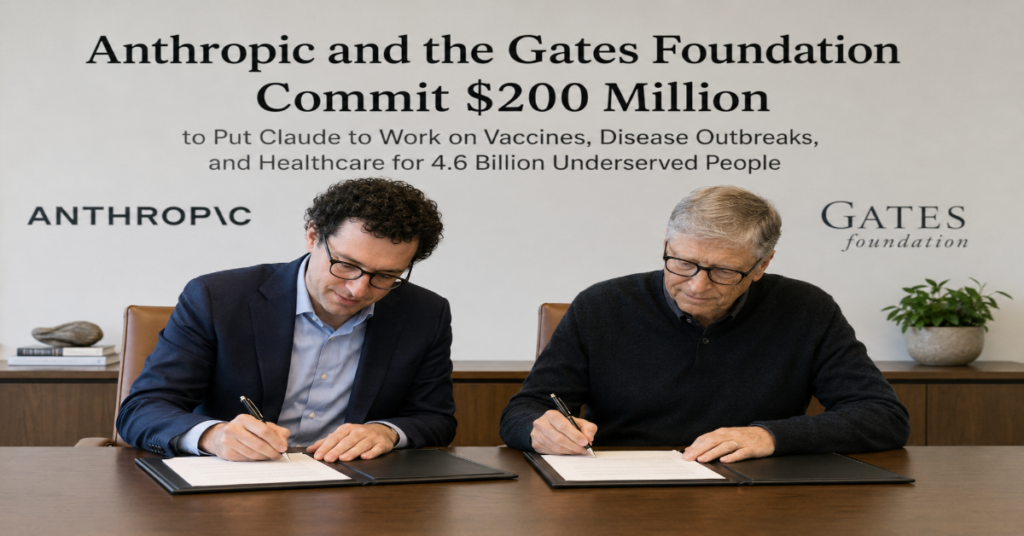
Anthropic and the Bill and Melinda Gates Foundation announced a four-year, $200 million partnership on May 14, 2026 — structuring the commitment as grant funding, Claude usage credits, and technical engineering support for programmes in global health, life sciences, education, and economic mobility operating in the US and internationally. The partnership covers four distinct programme areas, but the largest and most immediate focus is global health in low- and middle-income countries, where approximately 4.6 billion people lack access to essential health services according to the Gates Foundation’s own data. The Anthropic Gates Foundation deal is being led through Anthropic’s Beneficial Deployments team, which provides Claude credits and engineering support to partners in health, education, and economic mobility — domains where, as Anthropic’s official statement put it, markets alone will not provide sufficient access. The funding structure is designed to be measured and published rather than simply announced: Anthropic has committed to sharing more about its Beneficial Deployments approach and the outcomes of the programmes it backs, and the first public goods from the partnership — including model benchmarks and datasets for AI math tutoring — are scheduled for release later in 2026.
The Global Health Programmes — Vaccines, Outbreak Detection, and Disease Modelling
The global health component of the Anthropic Gates Foundation partnership is the most concrete and operationally immediate. Anthropic will work with the Gates Foundation and its network of partner organisations to accelerate vaccine and therapy development for diseases that the global health community has identified as both high-burden and underserved by commercial pharmaceutical R&D. The initial disease focus includes polio, HPV (human papillomavirus), and eclampsia and preeclampsia. The selection criteria are explicit: polio is a disease the Gates Foundation has made a decades-long commitment to eradicate globally and which requires ongoing vaccine development to address emerging resistance patterns. HPV causes approximately 350,000 deaths annually, with 90% occurring in low- and middle-income countries where HPV vaccination coverage remains low and cervical cancer screening is limited. Eclampsia and preeclampsia are the leading causes of maternal mortality in many developing countries, affecting an estimated 5% to 8% of pregnancies globally.
The specific technical application Anthropic and the Gates Foundation are pursuing is computational screening of vaccine and therapy candidates before pre-clinical development. In pharmaceutical development, the pre-clinical stage — where candidate molecules are tested in cell and animal models before human trials — is where the majority of drug development failures and costs are concentrated. Computational screening uses AI to evaluate millions of molecular candidates against target proteins and predict which ones are most likely to be safe, effective, and manufacturable before committing resources to physical laboratory testing. Claude is already being used by scientists at partnering institutions to analyse large datasets, detect research patterns, and screen potential drug and vaccine candidates — the partnership formalises and expands this capability with Gates Foundation programme design and funding infrastructure.
“Together, we will explore how AI can make it faster and easier for scientists to screen potential vaccine candidates, including vaccines that protect against diseases like polio, computationally before moving into pre-clinical development.” — Anthropic official partnership statement, May 14, 2026
Anthropic-Gates Foundation Partnership — Programme Areas and Focus
| Programme Area | Geography | Key Initiatives | Target Impact |
| Global health — vaccines | Low- and middle-income countries | Computational vaccine candidate screening; polio, HPV, preeclampsia focus | Faster pre-clinical pipeline; reduced discovery cost |
| Health data and outbreak detection | Sub-Saharan Africa, South Asia, Latin America | Health ministry decision support; outbreak detection; disease modelling | Faster government response to epidemic threats |
| Disease modelling (IDM) | Global — malaria and TB priority | Claude + Institute for Disease Modeling for treatment deployment forecasts | Better resource allocation for malaria, tuberculosis |
| African language accessibility | Sub-Saharan Africa | Data collection, labelling, public release for African-language AI models | AI that works for African-language populations |
| K-12 education | US, sub-Saharan Africa, India | AI tutoring tools; AI math tutoring benchmarks and datasets | Educational outcomes improvement at scale |
| Economic mobility | US and international | Programmes to encourage economic opportunity through AI access | Labour market participation and skills development |
The Institute for Disease Modeling — Where AI Meets Malaria and Tuberculosis Response
One of the most technically specific components of the Anthropic Gates Foundation partnership is the integration of Claude with the Institute for Disease Modeling (IDM), a research group within the Gates Foundation that has been a cornerstone of global infectious disease response for more than two decades. IDM builds computational models of how diseases spread and how interventions affect transmission rates — models that inform decisions about where to deploy vaccines, bed nets, treatment programmes, and health workers in countries with limited resources and imperfect data. These models are computationally intensive, data-hungry, and require continuous calibration against incoming epidemiological data. The current bottleneck is not the quality of the models — IDM’s disease models are among the most sophisticated in the world — but the speed and expertise required to interpret model outputs, calibrate parameters when new data arrives, and translate model results into operational recommendations that health ministries can act on.
Anthropic’s integration of Claude with IDM’s modelling infrastructure is designed to address all three bottlenecks: faster interpretation of model outputs, automated calibration assistance, and translation of technical results into plain-language operational recommendations for health ministry officials who are not computational modellers. For malaria — which still causes more than 600,000 deaths annually, the majority in sub-Saharan Africa — the timing of when and where to deploy seasonal malaria chemoprevention, insecticide-treated nets, and indoor residual spraying campaigns is a decision that IDM’s models are uniquely positioned to inform. If Claude can make those model outputs actionable faster and for a broader range of decision-makers, the potential impact on malaria mortality is measurable in lives saved per year.
“Together, we will explore how AI can support frontline healthcare workers through diagnosis, treatment navigation, workforce deployment, supply chain management, and outbreak detection.” — Anthropic and Gates Foundation joint statement, May 14, 2026
The Language Accessibility Initiative — African Languages and AI Equity
One area of the Anthropic Gates Foundation partnership that received less attention in initial coverage but carries significant long-term implications is the language accessibility programme. A major focus is African languages, where current AI systems — including Claude — have demonstrated substantially weaker performance than in European languages. The reason is structural: AI language models are trained on text data, and the volume of digitised, high-quality text in African languages is a fraction of what exists in English, Spanish, French, or Mandarin. The result is that AI tools that are already transforming healthcare, education, and economic access in English-speaking contexts are either unavailable or significantly less capable for the populations that most need them.
The partnership plans to enhance data collection and labelling for African-language datasets and release the results publicly — making them available to any AI lab or researcher working on African-language models. The Gates Foundation’s citation of 4.6 billion people lacking access to essential health services is not an abstract number: the majority of those people live in countries where English is not the primary language, and where AI health tools built on English-language models will underperform unless the language gap is explicitly addressed. Publicly releasing the datasets from this initiative is an unusual commitment from a commercial AI company — Anthropic is foregoing the proprietary advantage that these datasets could provide in favour of accelerating progress across the broader AI ecosystem in languages where commercial incentives have historically been insufficient.
| Disease / Domain | Annual Death Toll | Population at Risk | AI Application |
| HPV / Cervical cancer | ~350,000 deaths/year | Primarily LMIC women — low vaccination coverage | Vaccine candidate screening; screening programme optimisation |
| Polio | Near-eradication — outbreak risk ongoing | Unvaccinated children globally | Computational variant analysis; deployment modelling |
| Eclampsia / Preeclampsia | ~70,000 maternal deaths/year | 5-8% of pregnancies globally | Risk prediction; early detection support |
| Malaria | ~600,000 deaths/year | Sub-Saharan Africa primarily | IDM outbreak modelling; intervention deployment timing |
| Tuberculosis | ~1.3 million deaths/year | Global — high burden in South Asia, Africa | IDM modelling; treatment adherence support |
“This commitment is central to Anthropic’s efforts to extend the benefits of AI in areas where markets alone will not.” — Anthropic official announcement, May 14, 2026
Key Takeaways
• Anthropic and the Bill and Melinda Gates Foundation announced a $200 million, four-year partnership on May 14, 2026, structured as grant funding, Claude usage credits, and technical engineering support across global health, life sciences, education, and economic mobility.
• The largest programme component focuses on global health in low- and middle-income countries, where approximately 4.6 billion people lack access to essential health services. Initial disease focus: polio, HPV, and eclampsia/preeclampsia — diseases with high burden in LMICs and insufficient commercial pharmaceutical R&D investment.
• Claude will be integrated with the Gates Foundation’s Institute for Disease Modeling (IDM) to improve malaria and tuberculosis treatment deployment forecasts, making computational model outputs faster and more actionable for health ministry officials.
• A major language accessibility initiative will collect, label, and publicly release African-language datasets to improve AI model performance in languages where current systems — including Claude — perform substantially below English-language capability.
• Education components target K-12 outcomes in the US, sub-Saharan Africa, and India, with AI math tutoring benchmarks and datasets scheduled for public release in 2026 as the first measurable deliverable from the partnership.
• Anthropic committed to publishing outcomes from the partnership and its broader Beneficial Deployments programme — a governance commitment that distinguishes this from typical corporate social responsibility announcements by creating a measurable accountability framework.
Conclusion
The Anthropic Gates Foundation partnership is the most substantive alignment between a frontier AI company and a major global health institution to date. The Gates Foundation’s credibility is not abstract — it has contributed to saving more than 80 million lives through Gavi, the Global Fund, and its disease eradication programmes over the past 25 years. Anthropic’s commitment to deploy Claude for vaccine candidate screening, outbreak detection, disease modelling, and African-language accessibility is specific enough to be measurable and ambitious enough to be meaningful. The $200 million structure — grant funding plus usage credits plus engineering support — is more operationally substantive than a typical philanthropic cash donation, because it commits Anthropic’s technical staff alongside the financial resources. The test will come when Anthropic publishes the outcomes it has committed to sharing: vaccine candidates screened, diseases modelled, languages improved, children’s educational outcomes changed. If those outcomes match the ambition of the announcement, this partnership will establish a new standard for how AI companies engage with global health challenges. If they do not, the $200 million will be remembered as well-intentioned but insufficient.
Frequently Asked Questions
What did Anthropic and the Gates Foundation announce?
On May 14, 2026, Anthropic and the Gates Foundation announced a $200 million, four-year partnership to deploy Claude across global health, life sciences, education, and economic mobility programmes. The commitment includes grant funding, Claude usage credits, and technical engineering support. The largest focus is global health in low- and middle-income countries where 4.6 billion people lack access to essential health services.
What diseases will the partnership focus on?
Initial disease focus includes polio, HPV (which causes approximately 350,000 deaths annually, 90% in LMICs), and eclampsia/preeclampsia (the leading cause of maternal mortality in many developing countries). The partnership will also work on malaria and tuberculosis through Claude’s integration with the Gates Foundation’s Institute for Disease Modeling (IDM).
How will Claude help with vaccine development?
Claude will be used for computational screening of vaccine and therapy candidates before pre-clinical development — evaluating millions of molecular candidates against target proteins to predict which are most likely to be safe, effective, and manufacturable before committing resources to physical laboratory testing. Scientists are already using Claude to analyse large datasets, detect research patterns, and screen potential vaccine candidates.
What is the African language accessibility initiative?
The partnership includes collection, labelling, and public release of African-language datasets to improve AI model performance in languages where current AI systems — including Claude — significantly underperform relative to English. These datasets will be released publicly, not kept proprietary, to benefit the broader AI ecosystem building tools for African-language populations.
How is this different from other tech company philanthropy?
The structure is operationally substantive rather than primarily financial: Anthropic commits engineering staff and technical support alongside funding, targets specific diseases and populations with measurable outcomes, integrates Claude with the Gates Foundation’s Institute for Disease Modeling for real operational impact, and commits to publicly publishing outcomes from the programme — creating an accountability framework that most corporate philanthropy lacks.
References
Anthropic. (2026, May 14). Anthropic forms $200 million partnership with the Gates Foundation. https://www.anthropic.com/news/gates-foundation-partnership
PYMNTS. (2026, May 14). Anthropic and Gates Foundation form $200 million health-focused pact. https://www.pymnts.com/partnerships/2026/anthropic-gates-foundation-form-200-million-dollar-health-focused-pact/
Slashdot. (2026, May 14). Anthropic forms $200 million partnership with the Gates Foundation. https://news.slashdot.org/story/26/05/14/1648206/anthropic-forms-200-million-partnership-with-the-gates-foundation
Pulse2. (2026, May 14). Anthropic $200 million partnership with Gates Foundation. https://pulse2.com/anthropic-200-million-partnership-with-gates-foundation/
Benzinga. (2026, May). Anthropic and Bill Gates Foundation commit $200 million to AI for healthcare and education. https://www.benzinga.com/markets/private-markets/26/05/52592572/anthropic-and-bill-gates-foundation-commit-200-million-to-ai-for-healthcare-and-education
Grey Journal. (2026, May 14). Anthropic, Gates Foundation launch $200M AI partnership. https://greyjournal.net/news/anthropic-gates-foundation-200-million-ai-partnership/
Reuters. (2026, May 14). Anthropic, Gates Foundation commit $200 million to AI for global health. Reuters Health.
