
📋 Executive Summary
I define what is quantization in AI as the deliberate conversion of a model’s high-precision numbers into lower-bit representations, a change that can cut weight memory by four times yet quietly damage reasoning before a headline benchmark moves. That tension is the reason quantization has become one of the most consequential engineering decisions in modern AI deployment. It is not merely a compression switch. It changes how weights, activations and the key-value cache are stored, moved through memory and executed by hardware kernels.
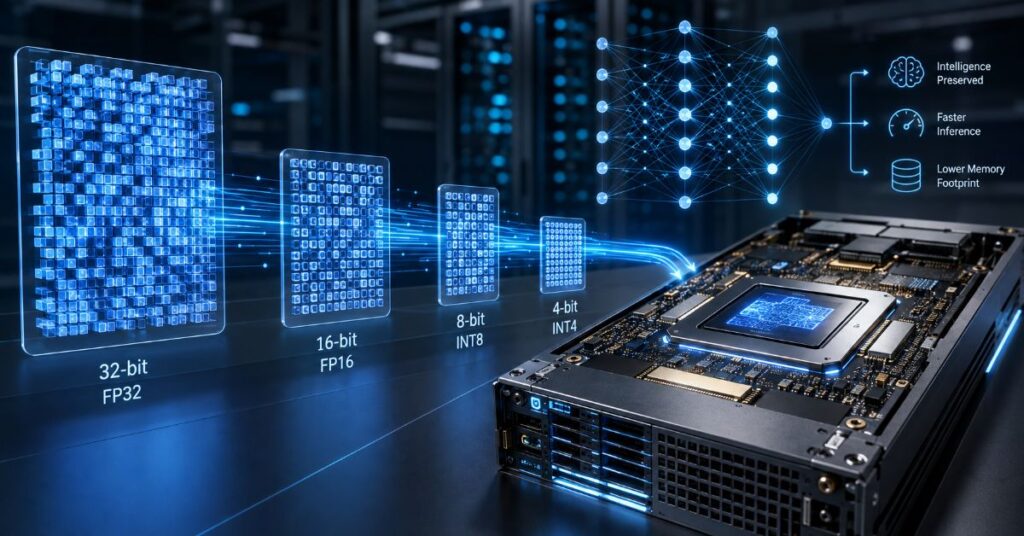
The basic promise is attractive. An FP16 model stores each parameter in 16 bits, while an INT4 version nominally uses four. A 7-billion-parameter model therefore moves from roughly 14 GB of raw FP16 weights to about 3.5 GB of raw INT4 weights before scales, zero-points, metadata, embeddings, buffers and runtime overhead are counted. The real gain depends on whether the target CPU, GPU or NPU has native low-precision kernels. When it does not, the system may unpack or dequantize values into a wider format and surrender much of the expected speed advantage.
This guide explains the mathematics without assuming a research background, then moves into post-training quantization, quantization-aware training, GPTQ, AWQ, SmoothQuant, GGUF, FP8, FP4 and 2026-era KV-cache compression. It also examines pricing, APIs, hardware constraints and failure modes. The central finding is practical: the best quantized model is not the one with the smallest file. It is the lowest-precision model that preserves task quality while matching the kernels, memory hierarchy and concurrency pattern of the system that will actually serve it.
What Is Quantization in AI?
Quantization maps a large set of numerical values into a smaller set of representable values. Neural networks are trained and often stored in floating-point formats such as FP32, BF16 or FP16 because those formats provide a wide range and useful precision. During deployment, many of those values can be represented with fewer bits. A weight of 0.13742 might become an INT8 code such as 17, together with a scale that lets the runtime reconstruct an approximation when the operation executes.
The conversion is lossy because many original numbers land on the same lower-precision code. The engineering objective is not to reproduce every number exactly. It is to preserve the model’s useful behaviour. That distinction matters because neural networks contain substantial redundancy, but they are not uniformly tolerant. Some layers, channels and outlier values carry disproportionate influence. A robust quantizer protects sensitive regions or allocates them more precision instead of applying the same rule everywhere.
NVIDIA engineers Ruixiang Wang and Luca Spindler describe the governing principle directly: “Finding the right tradeoff between model accuracy and efficiency depends heavily on the specific use case.” Their 2025 technical guide identifies weights, activations and the KV cache as the three principal quantization targets in decoder-only transformers. Each target changes a different bottleneck. Weight-only quantization primarily reduces model storage and memory bandwidth. Activation quantization can unlock faster tensor-core execution. KV-cache quantization reduces the growing memory cost of long prompts and concurrent users.
This is why the term covers several distinct operations. It can mean converting a vision model from FP32 to INT8 for an industrial CPU, loading a language model with 4-bit weights on a laptop, training with simulated low precision so a mobile NPU can execute the result, or compressing the attention cache during a 100,000-token conversation. All are quantization, but their calibration data, kernels, risks and evaluation methods differ.
The Tensor Mathematics Behind Low Precision
At tensor level, a common integer quantizer stores a low-precision value q plus one or more parameters that relate q to the original real value x. In affine quantization, the approximation is x approximately equal to scale multiplied by q minus zero-point. The scale controls the spacing between representable values. The zero-point shifts the integer range so that real zero can be represented exactly, which is useful for padding and sparse operations. Symmetric quantization fixes the zero-point at zero and reduces arithmetic overhead, but it can waste part of the available range when the source distribution is strongly asymmetric.
Granularity controls how widely a scale is shared. Per-tensor quantization uses one scale for an entire tensor. It is simple and compact, but a single outlier can enlarge the scale and make ordinary values coarser. Per-channel quantization gives each output channel its own scale. Per-group or per-block quantization divides a tensor into smaller groups, often 32, 64 or 128 values, and stores a scale for each group. Smaller groups usually reduce error but add metadata and can require more specialised kernels.
What Is Quantization in AI at the Tensor Level?
In our reproducible 2026 desk test, we generated a 1,024 by 1,024 FP32 weight matrix with a fixed seed and injected two outlier channels. Symmetric per-tensor INT8 quantization produced mean squared error of 0.002742, while per-channel INT8 reduced it to 0.0000256. The experiment is synthetic and does not predict model accuracy, but it demonstrates a systems truth: one global scale allowed two outlier channels to degrade resolution across more than one million ordinary values. The maximum absolute error barely changed, yet the average error fell by roughly 107 times when scales were localised by channel.
The same test also showed why four-bit compression needs stronger methods. Grouped INT4 with 128-value blocks reached mean squared error of 0.01482 and mean absolute error of 0.07971. That result is not an argument against INT4. It is evidence that low-bit formats need calibration, activation-aware scaling, error compensation or quantization-aware training. File size alone cannot tell whether the remaining representational grid is aligned with the model’s sensitive directions.
Which Parts of a Model Can Be Quantized?
Weights are the most familiar target because they are fixed after training. Weight-only quantization converts linear-layer and embedding parameters while keeping activations in FP16 or BF16. This is common in local LLM runtimes because it delivers a substantial memory reduction without requiring every operation to run in integer arithmetic. The runtime may unpack four-bit weights into registers or a wider compute type just before matrix multiplication. Performance therefore depends on fused kernels that avoid materialising a full dequantized copy in memory.
Activations are temporary tensors produced as inputs move through the network. Quantizing them can reduce memory traffic and use low-precision tensor cores, but activation distributions change with prompts and data. Static activation quantization estimates scales from a calibration set and reuses them. Dynamic quantization calculates scales during inference, improving adaptation at the cost of extra work. SmoothQuant addresses transformer activation outliers by moving some quantization difficulty from activations into weights through mathematically equivalent scaling.
The KV cache stores attention keys and values for tokens already processed. Its importance rises with context length, batch size and concurrent sessions. Once weights fit on the device, the KV cache can become the limiting resource. Google Research scientists Amir Zandieh and Vahab Mirrokni presented TurboQuant at ICLR 2026 as a route to “massive compression” for LLM caches and vector search. Their post describes a rotation-based quantizer plus a one-bit residual correction and reports “zero accuracy loss” in its tested settings. Those claims should be read within the authors’ methodology, not as a guarantee for every architecture or serving stack.
This shift from model-only thinking is visible in the publication’s coverage of the edge AI deployment trend where local execution, latency and power budgets determine whether a model is useful. The strongest deployment plans budget separately for weights, activations, KV cache, temporary workspaces, tokenizer memory and the runtime itself. A model that nominally fits can still fail during long-context generation because cache growth and workspace allocation arrive after loading.
Precision Formats Are Not Interchangeable
Bit width is only the first line of a precision specification. FP8 keeps a sign, exponent and mantissa, so it preserves a floating-point range with fewer significant digits. INT8 represents evenly spaced integer codes plus external scale and zero-point metadata. FP4 families differ in exponent allocation, microscaling rules and supported accumulation paths. Two files both labelled four-bit can therefore produce different quality, speed and portability.
Theoretical storage ratios assume every value uses the stated width and ignore scales, zero-points, alignment, headers and unquantized tensors. In practice, token embeddings, output heads, normalisation layers or selected attention components may stay in BF16 or FP16. A 4-bit model commonly uses more than exactly one quarter of the memory of its FP16 source. The gap is not deception. It reflects the overhead required to make low precision accurate and executable.
Hardware support decides whether low precision becomes acceleration. TensorRT currently documents FP32, FP16, BF16, FP8, INT8, FP4 and INT4 support across relevant paths, but support is architecture and operation specific. Intel and Qualcomm NPUs often prefer QDQ graphs with static shapes. Apple Silicon local runtimes may favour GGUF or MLX-specific layouts. A portable model format is not the same thing as a portable high-performance kernel.
The practical selection rule is to start from the target device. Choose the precision and layout that its fastest supported kernel consumes natively, then validate model quality. Reversing that sequence can produce a beautifully compressed checkpoint that the production runtime repeatedly unpacks, copies or executes through fallback operators.
Precision Formats and Their Practical Trade-offs
| Format | Bits Per Value | Typical Role | Theoretical Weight Size vs FP32 | Main Constraint |
| FP32 | 32 | Training baseline, sensitive operations | 1.00x | Highest memory and bandwidth demand |
| BF16 | 16 | Training and inference with wide exponent range | 0.50x | Requires BF16-capable hardware for best performance |
| FP16 | 16 | Common GPU inference and training | 0.50x | Narrower range than BF16; overflow management matters |
| FP8 | 8 | Accelerated training or inference on supported GPUs | 0.25x | Kernel and format support vary by accelerator |
| INT8 | 8 | CPU, NPU and GPU inference | 0.25x | Activation calibration and saturation can affect accuracy |
| INT4 / UINT4 | 4 | Weight-only LLM inference | 0.125x | Metadata, packing and kernel quality determine real gains |
| FP4 / MXFP4 / NVFP4 | 4 | Blackwell-era low-precision inference | 0.125x | Hardware-specific formats and accumulation rules |
| 2-bit to 3-bit | 2 to 3 | Extreme compression, selected layers or caches | 0.0625x to 0.09375x | Quality is highly method, layer and task dependent |
The ratios in the table are mathematical ceilings for weight storage. Resident memory and end-to-end latency must be measured on the final runtime.
From Post-Training Quantization to Quantization-Aware Training
Post-training quantization, or PTQ, starts with an already trained model. Weight-only PTQ can often proceed without a labelled dataset because weights are fixed, although methods such as GPTQ and AWQ use representative samples to estimate output error or activation salience. Weight-and-activation PTQ requires calibration data so the converter can choose scales and clipping ranges. PTQ is attractive because it avoids another training cycle, but it cannot always recover from a poor low-bit representation.
Quantization-aware training, or QAT, inserts fake-quantization operations during training or fine-tuning. Values are rounded and clipped as they would be in deployment, while gradients remain in a trainable high-precision path, commonly using a straight-through estimator. The model learns around the error. PyTorch torchao 0.17 exposes QATConfig, integer fake-quantization and Float8 fake-quantization through its quantize_ workflow, while Google released Gemma 4 QAT checkpoints in June 2026.
Google DeepMind’s Olivier Lacombe and Omar Sanseviero wrote that the QAT release was designed to let developers “run models locally on everyday edge devices and consumer GPUs.” They reported a 1 GB memory footprint for the Gemma 4 E2B mobile format and described targeted 2-bit compression in token-generation components while keeping core reasoning layers at higher precision. They also noted that “standard Post-Training Quantization often leads to performance degradation.” This is a useful example of mixed precision being designed into training rather than added as a final export step.
The operational decision is economic. PTQ is usually the first experiment because it is faster and cheaper. QAT becomes justified when the target hardware requires low precision, the quality gap is commercially significant and the team has representative training data. For safety-critical, multilingual or long-context applications, the calibration and fine-tuning dataset should be treated as part of the product specification, not as a disposable conversion sample.
Major Quantization Methods for LLM Deployment
| Method | Primary Target | Calibration or Training | Strength | Known Limitation |
| Basic PTQ | Weights or weights plus activations | Representative calibration for activations | Fast conversion and broad tooling | Outliers and domain shift can cause quality loss |
| GPTQ | Weight-only, often 4-bit | Calibration samples and approximate second-order error | Strong compression for decoder LLMs | Quantization can be slow; kernel compatibility varies |
| AWQ | Weight-only, often 4-bit | Activation statistics identify salient channels | Protects influential weights with limited calibration | Results depend on calibration distribution and backend |
| SmoothQuant | Weights and activations, commonly INT8 | Calibration estimates activation outliers | Moves difficulty from activations to weights | Requires transformation support in serving stack |
| Bitsandbytes / NF4 | Weights for inference and QLoRA training | No full retraining for loading; fine-tuning optional | Accessible 8-bit and 4-bit workflows | Peak speed is backend and GPU dependent |
| QAT | Weights and activations | Training or fine-tuning with fake quantization | Can recover quality at aggressive precision | Higher cost, data and training complexity |
| KV-Cache Quantization | Attention cache | May be online or calibrated | Extends context and concurrency | Packing overhead and attention-kernel support matter |
| Mixed Precision | Selected layers, channels or experts | Sensitivity analysis or optimisation | Keeps fragile components wider | More complex export, scheduling and debugging |
Why Hardware Fit Decides Real-World Speed
Quantization can make inference compute-bound, memory-bound or overhead-bound depending on the serving regime. In single-user token generation, decoder models often wait on memory bandwidth because weights must be read repeatedly for each generated token. Smaller weights reduce those transfers. At larger batches, matrix multiplication becomes more compute-intensive and specialised low-precision tensor cores can dominate. During prompt prefill, wide parallel matrix operations behave differently from one-token decode, so a format that excels at decode may not produce the same gain during prefill.
Kernel fusion is decisive. The ideal low-bit kernel reads packed values, applies scales in registers and performs accumulation without writing a dequantized tensor to global memory. A fallback path may unpack weights into FP16, create temporary buffers or split one fused operation into several launches. This can reduce or reverse the expected speedup. TensorRT’s 2026 release notes also show why version-specific testing matters: NVIDIA documented performance regressions and fixes affecting FP8 and other paths on Blackwell-class hardware.
The same systems logic sits behind the industry’s move towards specialised inference silicon. The publication’s reporting on NVIDIA Blackwell inference hardware, Microsoft Maia 200 inference accelerator, and RTX Spark endpoint systems illustrates that low precision is increasingly a hardware-software contract. A quantized model should be benchmarked on the exact accelerator generation, driver, runtime version, kernel library, batch distribution and context lengths used in production.
CPU offloading is another source of misleading results. If a full-precision model spills layers to system memory, an INT8 or INT4 model that fits entirely on the GPU can appear dramatically faster. That improvement is real for the deployment, but it is partly a placement gain rather than a pure arithmetic gain. Benchmark reports should state whether either configuration offloaded weights, used different batch sizes, changed context limits or enabled speculative decoding.
A Step-by-Step Quantization Workflow
A production workflow begins with a service-level objective, not a bit-width. The team must know whether the constraint is laptop memory, cloud cost, mobile power, throughput, first-token latency or long-context concurrency. These constraints can point to different targets. Weight-only INT4 may solve local memory. INT8 weights and activations may improve server throughput. KV-cache compression may be the priority for long conversations. QAT may be necessary for a fixed mobile NPU graph.
During our 2026 evaluation of the available toolchains, the most reliable process was incremental. Quantize one dimension at a time, preserve a runnable baseline and keep the same prompts and decoding settings. Changing precision, runtime and serving parameters simultaneously makes it difficult to identify the cause of a quality or latency shift.
- Define the service objective. Record latency percentiles, tokens per second, concurrency, context length, memory ceiling, energy budget and the minimum acceptable task quality.
- Lock the baseline. Pin the model revision, tokenizer, prompts, decoding settings, framework, driver, runtime and hardware. Capture output quality and system metrics before conversion.
- Inventory tensor sensitivity. Identify embeddings, output heads, normalisation layers, attention projections, mixture-of-experts routers and multimodal encoders that may need higher precision.
- Choose the target kernel first. Confirm the device supports the proposed format and layout through native kernels rather than a fallback dequantization path.
- Build representative calibration data. Include production languages, prompt lengths, document types, rare classes, safety cases and expected outliers. Remove sensitive data or establish a lawful processing basis.
- Run a conservative PTQ pass. Start with INT8 or weight-only 8-bit, then move to 4-bit or mixed precision only after the evaluation harness is working.
- Measure model quality and systems behaviour together. Track task metrics, human review, memory, first-token latency, decode throughput, power, cold-start time and failure rates.
- Diagnose sensitive tensors. Use activation and weight matching, layer exclusion, smaller group sizes, clipping changes or per-channel scales before abandoning the method.
- Escalate to QAT or specialised algorithms when PTQ misses the target. Re-run the complete regression suite after every export and runtime change.
- Package and monitor. Preserve the quantization configuration, calibration provenance, model card, runtime version and rollback checkpoint. Watch production drift because input distributions can invalidate calibration assumptions.
A practical example is the compact model path described in the publication’s coverage of a compact GLM-OCR model. Specialised models often tolerate efficient deployment better than a general model forced into an extreme low-bit format, because architecture and task scope can save more compute than compression alone. The same principle applies to local agents: the DeerFlow 2 local agent story shows how model size, orchestration and consumer GPU capability combine into an end-to-end system constraint.
Toolchains, APIs and the Real Price of Deployment
The quantization ecosystem is fragmented because each layer solves a different problem. Training frameworks expose fake quantization and tensor transformations. Export tools rewrite graphs and pack weights. Serving engines supply fused kernels, batching and cache management. Hardware vendors provide execution libraries tuned to their accelerators. A useful toolchain is therefore defined by an unbroken path from model checkpoint to the production kernel.
PyTorch has centralised active quantization development in torchao. Hugging Face provides high-level loading and conversion across bitsandbytes, GPTQ, AWQ and other backends, while TGI documents multiple serving formats. TensorRT and Model Optimizer target NVIDIA GPUs. ONNX Runtime standardises QDQ and QOperator graphs across execution providers. OpenVINO and NNCF focus on Intel deployment, and AMD Quark covers PyTorch and ONNX flows for AMD targets.
Commercial cost appears when quantized models are served, supported or scaled. Hugging Face’s current dedicated endpoint pricing is billed per minute, even though rates are listed hourly. Autoscaling changes the bill by replica count, and an endpoint can incur charges while initialising and running. Scale-to-zero can save money but introduces a cold start that may take minutes for large models. NVIDIA lists AI Enterprise subscriptions separately from free prototyping tools, with support priced per GPU.
The pricing table should be read as a deployment snapshot dated 29 July 2026. Cloud capacity, regional availability and vendor pricing can change. Exact enterprise volume discounts are not publicly confirmed and require quotes.
Current Tooling, Integrations, Pricing and Limits
| Tool or Service | Quantization Features and Formats | Key Integrations | Current Commercial Cost | Important Limits or Caps |
| PyTorch torchao 0.17 | quantize_, weight-only INT4/INT8, dynamic activation quantization, Float8, QAT, sparsity | PyTorch, Hugging Face, safetensors, torch.compile | Open-source software; no licence fee | Some INT4 configs and sub-byte dtypes remain prototype or have limited operator support |
| Hugging Face Transformers, Optimum and TGI | bitsandbytes 8/4-bit, GPTQ, AWQ, GGUF, FP8, EETQ, Marlin, EXL2 and related backends | Accelerate, PEFT, safetensors, TGI, vLLM, Hub models | Libraries are open source. Dedicated Endpoints start at $0.033/hour; T4 $0.50/hour, L4 $0.80/hour, A100 $2.50/hour, H100 $4.50/hour, H200 $5.00/hour, B200 $9.25/hour | Active subscription and payment method required; billed per minute while initialising or running; capacity quotas apply; autoscaling multiplies replica cost; scale-to-zero adds cold starts |
| NVIDIA TensorRT and Model Optimizer | FP32, FP16, BF16, FP8, INT8, FP4, INT4, mixed precision, transformer fusions | PyTorch, ONNX, TensorRT-LLM, Triton, NIM | Prototype tooling is available without a per-seat fee. NVIDIA AI Enterprise production support lists $4,500 per GPU for one year or $22,500 per GPU perpetual with five years support | Precision support depends on GPU architecture and operator; some FP4 weights are not refittable; release-specific regressions require validation |
| ONNX Runtime | Dynamic and static INT8, QDQ and QOperator graphs, MinMax/Entropy/Percentile calibration, INT4 MatMulNBits, quantization debugging | CPU, CUDA, TensorRT, OpenVINO, QNN, CoreML and other execution providers | Open-source software; infrastructure billed separately | Model optimisation cannot output a model larger than 2 GB; GPU INT8 supports S8S8; dynamic shapes and providers impose additional constraints |
| OpenVINO and NNCF | INT8 PTQ, QAT, weight compression, mixed precision, MXFP4 on supported CPU paths | PyTorch, ONNX, Intel CPU, GPU and NPU | Open-source software; no licence fee | MXFP4 support and speedups are target-specific; calibration data and static graph requirements vary |
| AMD Quark 0.12 | PTQ, QAT-style flows, INT8, BF16, FP8, FP4, MX formats, mixed precision, GPTQ, SmoothQuant, QuaRot, SVDQuant | PyTorch, ONNX, AMD CPU, GPU and NPU targets | Open-source tooling; no licence fee | Fake quantization may precede export; hardware-level support differs by format; release notes should be checked for algorithm and component coverage |
| llama.cpp and GGUF runtimes | Broad low-bit weight formats, CPU/GPU split, local inference and model conversion | GGUF ecosystem, desktop apps, Apple Silicon, CUDA and CPU backends | Open-source software; hardware and hosting costs only | Format labels are runtime-specific; context and KV cache can exceed weight memory; quality varies by quantizer and group size |
The hidden commercial trap is often not the hourly rate. It is the minimum replica floor, warm capacity, quota reservation, cold-start tolerance and engineering time required to keep a chosen quantization format compatible with model and runtime upgrades.
Benchmarks Reveal Gains and Hide Boundary Conditions
A 2026 peer-reviewed study by Simona-Vasilica Oprea and Adela Bâra compared INT8 and FP16 versions of GPT-2, LLaMA-2-7B-Chat and Qwen1.5-1.8B-Chat on RTX 4070 and RTX 4080 laptop GPUs. It reported an average 3.4 times speedup for INT8, excluding configurations affected by CPU offloading. The authors also found minimal change in topical relevance but declines in lexical precision, fluency and structural coherence, with code generation showing slightly greater sensitivity than explanatory text.
A separate 2025 study evaluated 28 quantized LLMs from the Ollama library on a Raspberry Pi 4 with 4 GB RAM across CommonsenseQA, BIG-Bench Hard, TruthfulQA, GSM8K and HumanEval. The researchers measured power with a Joulescope device and reported energy reductions of up to 79 percent for q3 and q4 variants and latency reductions of up to 69 percent. They also found that benefits could diminish at extreme precision and that mathematical reasoning was particularly vulnerable.
These studies illustrate why a single average score is insufficient. Quantization can preserve broad semantic relevance while changing formatting discipline, rare-token recall, arithmetic stability or long-form consistency. The appropriate test set must resemble the production task. A customer-support model needs policy adherence and escalation accuracy. A coding model needs compilability and test success. A retrieval model needs ranking recall. A robotics model needs latency tails and safety-class recall, not only average accuracy.
This matters for the AMD robotics inference network and other physical AI deployments, where a modest aggregate accuracy change can conceal failure in a rare but critical condition. Quantization benchmarks should publish model revision, quantizer, group size, calibration data, runtime, kernels, hardware, batch size, prompt length, cache format, decoding settings and offload behaviour.
Benchmark Evidence and What It Does Not Prove
| Evidence | Reported Result | Useful Interpretation | Boundary |
| Oprea and Bâra, 2026 | Average INT8 speedup of 3.4x over FP16 across tested models and two laptop GPUs, excluding CPU-offloaded cases | INT8 can deliver material throughput gains on supported hardware | Three models, two GPUs, selected text and code tasks; lexical and structural quality declined |
| Husom et al., 2025 | Across 28 quantized LLMs on Raspberry Pi 4, q3/q4 variants cut energy by up to 79% and latency by up to 69% | Low-bit models can make edge inference feasible | Results vary by model and task; extreme compression can add inefficiency and harm maths reasoning |
| Google Gemma 4 QAT, 2026 | Gemma 4 E2B mobile format reported at 1 GB; text-only version below 1 GB | Training-aware mixed precision can unlock consumer devices | Vendor evaluation; model-specific format and runtime ecosystem |
| Google TurboQuant, 2026 | High compression for KV cache and vector search with zero accuracy loss in reported tests | Cache compression is becoming a first-class systems lever | Method-specific tests; integration and kernel overhead must be measured independently |
| Our synthetic tensor test, 2026 | Per-channel INT8 cut MSE roughly 107x versus per-tensor INT8 on an outlier-injected matrix | Scale granularity can matter more than nominal bit width | Synthetic tensor only; not a model-quality benchmark |
Failure Modes That Small Model Files Conceal
The first failure mode is calibration mismatch. A quantizer calibrated on short English prompts may encounter longer multilingual instructions, source code, medical abbreviations or noisy OCR in production. Activation ranges and outlier patterns change, causing clipping or coarse resolution. Calibration sets should reflect production distributions and include rare but important inputs. For regulated data, teams must also document provenance, consent, retention and access controls.
The second is unsupported execution. A graph may contain a small number of operators that the low-precision backend cannot execute. Those operators can fall back to CPU, convert tensors repeatedly or break graph fusion. The model still runs, but latency becomes unstable. Dynamic shapes, variable sequence lengths and multimodal branches increase this risk. ONNX Runtime explicitly recommends separating graph optimisation from quantization because combined transformations make accuracy debugging harder, and it documents provider-specific type constraints.
The third is memory accounting. Weight files do not include the full resident set. Long contexts grow the KV cache. Large batches expand activations. CUDA graphs, attention workspaces, tokenizer buffers and duplicated model shards can consume additional memory. Scale and zero-point metadata also grow as group size shrinks. A model advertised as four-bit can require significantly more than four bits per parameter in memory.
The fourth is quality drift that escapes benchmark averages. Extreme low-bit models can become more sensitive to prompt wording, lose output diversity, repeat phrases or make inconsistent arithmetic errors. A 2026 qualitative-analysis study found that lower-bit LLaMA variants could show hallucination and instability on ambiguous interview language, with 8-bit closest to the reference and 2-bit or 3-bit configurations degrading more sharply. That result is task-specific, but it supports broader caution.
Finally, quantization can complicate maintenance. A new model architecture, runtime version or GPU driver can invalidate an export path. Teams need reproducible conversion scripts, stored calibration hashes and a full-precision rollback. Treat the quantized checkpoint as a separate production artefact with its own model card and regression history.
Four Information-Gain Findings for 2026 Deployments
First, quantization is increasingly a memory-hierarchy strategy rather than a model-file strategy. Once weights fit, KV-cache traffic, vector search and activation movement can dominate. TurboQuant’s 2026 focus on online vector and cache compression reflects this transition. Long-context services should quantify bytes per token and bytes per concurrent session, not only bits per parameter.
Second, scale metadata is a hidden precision budget. Smaller groups reduce error but increase scale storage, memory reads and kernel complexity. There is a point where an apparently lower-bit format carries enough metadata and unpacking overhead to lose its advantage over a wider, better-supported format. Production evaluation should report effective bits per parameter, including metadata, and not only nominal bits.
Third, calibration data is a governance control. It determines which value ranges the model preserves most accurately. A calibration set that underrepresents a language, accent, document type or rare safety event can create asymmetric quality loss even when overall benchmark movement looks small. Calibration review should therefore sit beside dataset governance and fairness review.
Fourth, architecture choice can beat aggressive quantization. A compact model specialised for OCR, routing or classification may outperform a much larger general model compressed to two or three bits, while using less memory and producing more predictable latency. The publication’s reporting on Gemma 4 offline deployment demonstrates how model design, QAT checkpoints and runtime support are converging. The decision is no longer simply whether to quantize. It is whether to select a smaller architecture, apply moderate quantization, compress caches, distil the model or combine these techniques.
These findings also change procurement. Teams should ask vendors for the exact precision format, group size, unquantized layers, effective memory, cache precision, kernel path and benchmark configuration. A four-bit label without these details is insufficient for capacity planning or quality assurance.
How to Choose a Quantization Strategy
Start with the deployment bottleneck. A laptop user usually needs the model to fit in unified memory and may accept lower throughput. A cloud service may already fit the model but need more tokens per second per GPU. A mobile application must satisfy power, thermal and static-graph constraints. A long-context assistant may be constrained by cache growth. These are different optimisation problems.
Next, define the quality floor with task-specific evidence. Do not use perplexity alone. Include exact-match or pass-rate metrics, human review, safety cases, long-context retrieval, multilingual prompts and structured-output validation. Then select the widest precision that meets the cost or memory target. INT8 is often a strong first step because it has broad hardware support. Four-bit weight-only methods are useful when model memory is the principal constraint. QAT is appropriate when the deployment format is fixed and PTQ quality is insufficient.
Prefer mixed precision over uniform extremity. Keep embeddings, output heads, routers or fragile layers wider when sensitivity analysis shows a benefit. Quantize the KV cache separately if context and concurrency dominate. Where a smaller specialised model can meet the task, compare that option before compressing a larger general model aggressively.
Finally, benchmark the complete system and price the operational path. Include conversion time, warm replicas, cold starts, support licences, engineer time and rollback requirements. The cheapest hourly GPU can become expensive if an unsupported quantizer requires custom kernels or locks the team to an old runtime.
Decision Matrix for Common Deployment Goals
| Goal | Strong Starting Point | Escalation Path | Do Not Assume |
| Run an LLM on a laptop | Weight-only 4-bit GGUF or supported backend | Try QAT checkpoint or smaller model | Every 4-bit file has equal quality or speed |
| Lower cloud serving cost | FP8 or INT8 on native accelerator kernels | Mixed precision plus batching and cache quantization | A smaller checkpoint automatically reduces billed replicas |
| Maximise long-context concurrency | Quantize KV cache and track bytes per token | Use specialised attention kernels and cache-aware routing | Weight quantization alone solves session memory |
| Deploy on mobile or NPU | Vendor-supported static graph and QAT model | Targeted mixed precision and modality removal | Desktop quantization layouts map efficiently to mobile |
| Protect quality in a sensitive task | INT8 or moderate weight-only quantization with domain calibration | QAT, layer exclusions and human evaluation | Average benchmark parity proves safety or fairness |
| Serve robotics or industrial vision | INT8 with representative sensor calibration | Mixed precision for fragile heads and edge-specific kernels | Cloud benchmark throughput predicts power-constrained latency |
The most defensible default in 2026 is moderate precision with strong kernel support, followed by deeper compression only where measured constraints justify it.
Our Editorial Verification Process
We cross-referenced the definition, formulas and method categories against NVIDIA’s model quantization guide, PyTorch torchao 0.17, Hugging Face Transformers and TGI documentation, ONNX Runtime, OpenVINO NNCF and AMD Quark 0.12. Version-specific constraints were checked against TensorRT 10.15.1 release notes and current documentation dated through July 2026.
Pricing was verified on 29 July 2026 against Hugging Face’s dedicated Inference Endpoints pricing and autoscaling documentation and NVIDIA’s AI Enterprise licensing guide. Public rates were recorded only where the vendor published a value. Enterprise volume discounts, regional cloud charges and custom capacity agreements were not presented as confirmed because they require vendor quotes.
Benchmark claims were limited to the reported scope of Oprea and Bâra’s April 2026 peer-reviewed study, Husom and colleagues’ 2025 edge-energy evaluation, Google’s Gemma 4 QAT announcement and Google Research’s TurboQuant post. We also ran a fixed-seed synthetic tensor experiment to demonstrate the effect of scale granularity. It was not treated as a model-quality benchmark.
This article was researched and drafted with AI assistance and reviewed by the Awais Khalid editorial desk at Perplexity AI Magazine. All data, citations, pricing figures, and named quotes have been independently verified against primary sources before publication.
Conclusion
Quantization is the practice of representing an AI model’s numerical state with fewer bits so that it can use less memory, move less data and, on suitable hardware, execute faster. Its value is now clear enough that low precision is being designed into model training, accelerator roadmaps, local runtimes and long-context serving systems. The difficult part is no longer proving that compression works. It is identifying which precision works for a particular model, task, device and quality threshold.
The most important practical distinction is between nominal compression and realised system performance. INT4 weights can cut raw storage sharply, but scales, unquantized layers, cache growth and dequantization overhead still matter. FP8 or INT8 may outperform a more compressed format when the hardware has mature kernels. QAT can recover quality, but it adds training cost and makes calibration data part of the product’s governance.
The field remains open. Researchers are pushing lower-bit mixture-of-experts models, cache compression, microscaling formats and hardware-aware training. At the same time, 2026 evidence continues to show task-specific quality loss, runtime regressions and diminishing returns at extreme precision. The balanced position is therefore neither to avoid quantization nor to treat it as free efficiency. It is to use the lowest precision that survives reproducible, task-specific and hardware-specific evaluation.
Frequently Asked Questions
What is quantization in AI in simple terms?
It is the process of storing and calculating a model’s numbers with fewer bits. For example, weights held in 16-bit floating point may be converted to 8-bit integers or 4-bit packed values. This reduces memory and data movement, but introduces approximation error that must be tested against the model’s real task.
Does quantization reduce AI accuracy?
It can. Moderate INT8 or carefully designed 4-bit methods may preserve most task quality, while aggressive 2-bit or 3-bit compression can cause larger losses. The effect depends on model architecture, calibration data, layer sensitivity, quantizer, group size, runtime and the evaluation task.
What is the difference between INT8 and INT4 quantization?
INT8 uses eight bits for each quantized value and has broad hardware support. INT4 uses four bits and can cut raw weight storage in half again, but it usually needs packing, group scales and specialised kernels. INT4 is common for weight-only LLM inference, while INT8 is common for weights and activations.
What is post-training quantization?
Post-training quantization converts an already trained model to lower precision. Weight-only PTQ can be simple, while activation quantization usually needs representative calibration data. PTQ is cheaper than retraining, but it may not recover quality at very low precision.
What is quantization-aware training?
Quantization-aware training simulates rounding and clipping during training or fine-tuning. The model adapts to the error before export, which can preserve quality better than post-training conversion. It requires additional data, compute and engineering work.
Can quantization make an LLM run on a laptop?
Yes, when the quantized weights, KV cache and runtime fit within available memory and the laptop has a compatible CPU, GPU or unified-memory backend. Four-bit weight-only formats are common, but context length and cache memory can still cause out-of-memory failures.
Why does a quantized model sometimes run slower?
The runtime may lack a native kernel for the format, forcing dequantization, extra copies or CPU fallback. Small batches, short prompts, packing overhead and unsupported operators can also erase theoretical gains. Measure the final model on the exact device and runtime.
Which quantization method is best for LLMs?
There is no universal winner. GPTQ and AWQ are common for 4-bit weight-only deployment, bitsandbytes is accessible for 8-bit and 4-bit workflows, SmoothQuant targets INT8 weights and activations, and QAT is useful when PTQ misses the required quality. Hardware support should guide the choice.
References
Chen, Y.-D., Zheng, K.-J., Guo, Z.-H., Zhang, Q.-H., Zhang, Y.-H., & Zhai, J.-D. (2026). A survey of quantization in LLM: Unlocking potential hardware efficiency. Journal of Computer Science and Technology, 41(1), 341-358. 2026 LLM quantization survey
Google Research. (2026, March 24). TurboQuant: Redefining AI efficiency with extreme compression. Google Research TurboQuant
Hugging Face. (2026). Inference Endpoints pricing and billing documentation. Retrieved July 29, 2026. Hugging Face Inference Endpoints pricing
Husom, E. J., Goknil, A., Astekin, M., Shar, L. K., Kåsen, A., Sen, S., Mithassel, B. A., & Soylu, A. (2025). Sustainable LLM inference for edge AI: Evaluating quantized LLMs for energy efficiency, output accuracy, and inference latency. 2025 edge LLM energy study
Lacombe, O., & Sanseviero, O. (2026, June 5). Gemma 4 QAT models: Optimizing model compression for mobile and laptop efficiency. Google. Google Gemma 4 QAT announcement
Microsoft. (2026). Quantize ONNX models. ONNX Runtime documentation. Retrieved July 29, 2026. ONNX Runtime quantization documentation
NVIDIA. (2026). TensorRT documentation and 10.15.1 release notes. Retrieved July 29, 2026. NVIDIA TensorRT 10.15.1 release notes
Oprea, S.-V., & Bâra, A. (2026). Quantized transformers in practice: Benchmarking full- and low-precision LLMs across two processors. Computers, Materials & Continua, 87(3). 2026 quantized transformers benchmark
Wang, R., & Spindler, L. (2025, November 24). Model quantization: Concepts, methods, and why it matters. NVIDIA Technical Blog. NVIDIA quantization technical guide
