
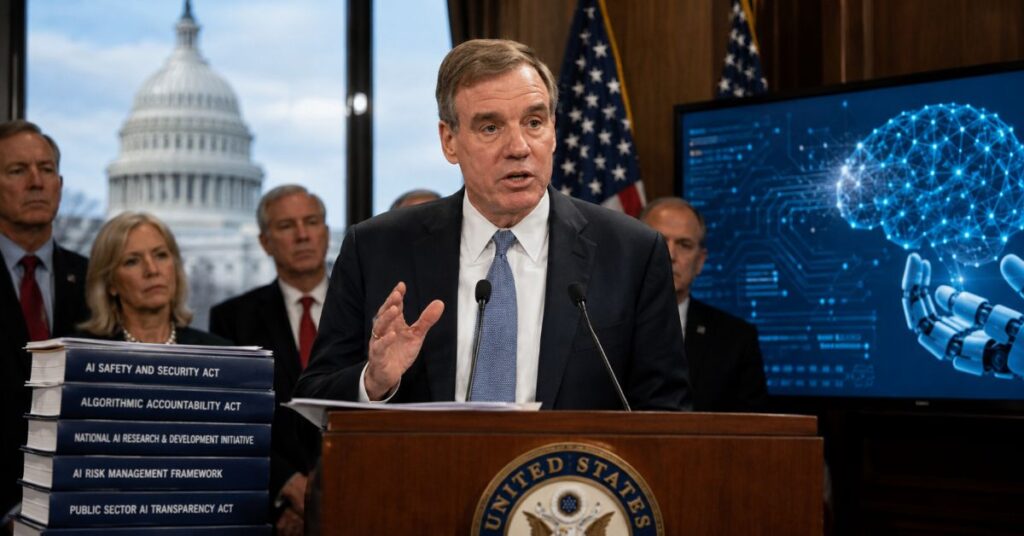
U.S. Senator Mark Warner has introduced the most sweeping AI legislative package to come out of Congress this year, a multi-bill framework that would force the most advanced AI models through mandatory government-backed safety testing before they reach the public.
Key Developments
- Sen. Mark Warner (D-VA) unveiled “A Framework for America’s AI Future” on July 22, 2026, a package of bills covering AI safety, competition, workers and national security
- The centerpiece Secure AI Development Act would require mandatory secure testing and independent safety evaluations for frontier AI models before commercial deployment
- A companion Data Center Tax Accountability and Disclosure Act would force large AI data centers to publicly disclose energy and water consumption
- The package also creates a National Workforce Transition Fund, financed by limiting certain AI data center tax breaks, to help retrain workers affected by automation
What Happened
Sen. Mark R. Warner (D-VA), vice chairman of the Senate Select Committee on Intelligence, unveiled “A Framework for America’s AI Future” on the Senate floor on July 22, 2026. The package brings together several individual bills addressing what Warner described as four priorities: building AI infrastructure responsibly, promoting competition and safety, preparing workers for economic disruption, and strengthening national security.
At its center is the Secure AI Development Act, which would establish a mandatory secure testing environment for the nation’s most advanced AI models before they can be commercially deployed, along with independent safety evaluations. Warner said the goal is to give Congress and federal agencies a way to catch risks before frontier systems reach the market rather than after.
The broader package also includes the Data Center Tax Accountability and Disclosure Act, requiring large AI data centers to publicly report their energy and water use, emissions and backup power reliance.
Beyond safety and infrastructure, the framework touches several other corners of AI policy at once. It includes the AI AGENT Act, which would set rights and responsibilities for consumer-facing AI agents operating on major online platforms; a plan to combat AI-generated child sexual abuse material and non-consensual intimate images; and a proposal creating accelerated undergraduate-to-Ph.D. pipelines in AI and related technical fields.
How the Testing Framework Would Work
Under the Secure AI Development Act, companies developing the most advanced, or “frontier,” AI models would be required to run them through a secure government-linked testing environment before release. The bill would also modernize how the federal government identifies and discloses AI-related cybersecurity vulnerabilities, improve information-sharing between agencies and AI developers, and create a voluntary incident-reporting system modeled on the aviation industry’s safety reporting framework.
A separate provision aims to strengthen protections against foreign adversaries attempting to steal or exploit U.S.-developed AI technology and its supply chains — language that echoes recent federal moves tightening control over who can access advanced AI systems.
That emphasis on export and access controls follows earlier federal action this year, including the export restrictions that briefly suspended access to Anthropic’s newest models, part of a wider pattern of Washington treating frontier AI systems as sensitive technology requiring federal oversight.
The bill does not specify a single testing body, leaving open questions about which federal agency or agencies would run the secure testing environment and how independent the safety evaluators would be from both government and industry. Those details are likely to be a central point of negotiation as the bill moves through committee, since the strength of any mandatory testing regime depends heavily on who controls it and what standards it applies.
The workforce side of the package works differently: rather than regulating AI directly, the proposed National Workforce Transition Fund would be financed by scaling back certain tax incentives currently available to AI data center operators, redirecting that revenue toward retraining programs, tuition assistance and workforce data modernization for workers displaced by automation.
Backstory
Warner has spent years building toward this moment. In 2023, he and Sen. Jerry Moran introduced legislation requiring federal agencies to follow NIST’s AI risk management framework. In 2024, Warner and Sen. Thom Tillis introduced an earlier Secure Artificial Intelligence Act focused narrowly on cybersecurity incident tracking. The new Secure AI Development Act builds directly on that groundwork, but adds mandatory pre-deployment testing — a significantly stronger requirement than the largely voluntary approach Congress has taken until now.
The federal push also arrives alongside a wave of state-level activity; more than a dozen states have advanced their own AI safety bills this year, creating pressure for Congress to set a single national standard before the regulatory landscape fragments further.
Warner’s home state of Virginia also has the largest concentration of data centers in the world, giving him a direct constituency interest in the disclosure requirements his package would impose on the industry. Virginia’s new two-year state budget already added a data center electricity consumption tax, charging operators for the power their facilities draw — a state-level precedent that appears to have shaped the federal disclosure requirements Warner is now proposing.
Warner has also been active on narrower AI issues in recent months, releasing a discussion draft in June 2026 on securing consumer-facing AI agents, work that has since been folded into the broader framework as the AI AGENT Act. That bill would direct the National Institute of Standards and Technology to develop interoperability standards so that AI agents acting on a person’s behalf can work consistently across different online platforms.
Reactions
“The only question is whether Congress is going to help shape that future or spend the next decade scrambling to catch up,” Warner said in announcing the package, arguing that America does not have to choose between AI leadership and basic safety rules.
Coverage of the rollout noted that Warner has increasingly positioned himself as one of Congress’s leading voices on AI policy, and that the framework doubles as a centerpiece of his 2026 reelection campaign in Virginia, where AI’s economic and infrastructure impact has become a defining local issue.
Industry and policy observers have generally welcomed the attempt at a comprehensive federal standard, even as they caution that a package this broad, touching everything from consumer AI agents to financial regulators to child-safety protections, will face a long road through committee before any of its individual bills reach a floor vote.
Legal and policy trackers covering the rollout have described it as one of the most detailed AI guardrail packages introduced in Congress to date, noting that its four-part structure gives lawmakers room to advance the less contentious pieces, such as data center disclosure, even if the mandatory testing provisions in the Secure AI Development Act prove harder to negotiate.
The Dispute
Skeptics point to Congress’s uneven record on tech legislation as reason for caution: previous AI oversight proposals, including Warner’s own 2024 bill, have stalled without reaching a vote. Because this framework is being introduced as a package of separate bills rather than a single unified law, each piece will need its own path through committee, and there is no guarantee that the mandatory testing requirement at the center of the Secure AI Development Act survives negotiations intact. Critics have also raised the familiar concern that safety testing mandates, if not carefully scoped, could slow down American AI developers relative to competitors operating under lighter-touch regimes abroad — a tension Warner’s own framing, that America can lead in both capability and security, is explicitly designed to address but has not yet resolved.
What Happens Next
The individual bills now move to relevant Senate committees for consideration, a process that could stretch well into 2027 given the package’s size. Its introduction also lands alongside separate executive-branch activity on AI security, including the White House’s national security directive on AI issued earlier this year, meaning any Warner-backed testing regime would need to be reconciled with rules the administration has already put in place.
The package’s national-security provisions also sit alongside the administration’s memo restricting vendor access to military AI systems, suggesting Congress and the White House are converging, from different directions, on the idea that frontier AI now warrants the kind of security scrutiny historically reserved for defense technology.
Why It Matters
Warner’s framework is the clearest sign yet that Congress intends to legislate mandatory, rather than voluntary, safety testing for the most powerful AI systems before they reach the public. If enacted, the Secure AI Development Act would mark one of the first binding pre-deployment testing requirements imposed on frontier AI developers at the federal level, shifting AI safety from a matter of company-led commitments to one of statutory obligation. Even if the package stalls in its current form, it sets a marker other lawmakers, and the industry, will now have to respond to.
Sources
1. Sen. Mark Warner — Warner Rolls Out Comprehensive AI Legislative Agenda (official press release)
2. Bloomberg Government — Top Senate Democrat Releases AI Package on Risks, Data Centers
