
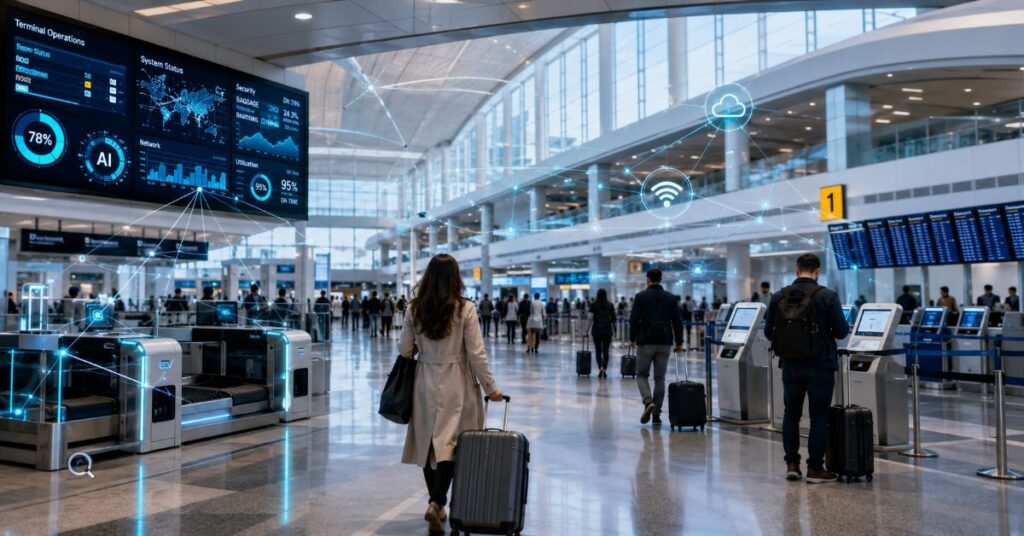
The largest international gateway to the United States is getting a new terminal, and its entire technology spine will be built on artificial intelligence. The New Terminal One at John F. Kennedy International Airport announced on July 14, 2026, that Tata Consultancy Services will serve as its strategic technology and innovation partner — the organisation responsible for building and managing the digital foundation that every passenger interaction, airline operation, and security function in the new terminal will run on.
This is not a contract to supply check-in kiosks or install a passenger information system. TCS’s mandate covers everything: passenger processing, baggage handling, terminal security, IT infrastructure management, enterprise application support, and cybersecurity. Underpinning all of it are two proprietary AI platforms — Cognix and ignio — that TCS will deploy to give the terminal real-time operational visibility and the ability to manage its own technology stack proactively, before failures affect passengers or airline partners.
🔱 Key Developments
- The New Terminal One at JFK International Airport named Tata Consultancy Services (TCS) as its strategic technology and innovation partner on July 14, 2026.
- TCS will deploy its proprietary Cognix and ignio AI platforms across passenger processing, baggage handling, terminal security, IT operations, enterprise applications, and cybersecurity.
- The terminal is part of the Port Authority of New York and New Jersey’s $19 billion JFK transformation programme and is targeting a 5-star Skytrax rating — the highest global airport designation, never held by a US airport.
- TCS reported consolidated revenues exceeding $30 billion for FY26. The JFK win is among its most visible aviation-infrastructure mandates globally and a flagship reference for Cognix and ignio.
What Was Announced
TCS and the New Terminal One announced their partnership simultaneously in New York and Mumbai on July 14, 2026. According to the official TCS press release via PRNewswire, TCS will support the delivery of ‘an intelligent, digitally-enabled guest experience’ at the terminal, ‘delivering cost efficiencies to airlines and transforming international travel at JFK.’ Jennifer Aument, CEO of the New Terminal One, described the collaboration as central to her organisation’s vision of creating ‘one of the world’s best’ international airport experiences. Amit Bajaj, President of TCS North America, said airports are ‘dynamic consumer ecosystems where operations, hospitality, retail, and personalization work together in real time’ and described the JFK mandate as an opportunity to build that future from the ground up. Neither party disclosed the specific contract value or duration.
What Cognix and ignio Actually Do
Cognix — Operational Intelligence
Cognix is TCS’s enterprise AI platform for operational visibility and decision support. In an airport context, it aggregates data from the terminal’s full operational environment — check-in queue depths, security checkpoint throughput, gate utilisation, baggage conveyor status, retail occupancy, maintenance alerts — and presents it in a unified operational view that allows terminal managers and airline partners to see, in near real time, what is happening across every part of the building. The analytical layer generates recommendations and alerts: a security queue likely to cause a missed connection in 40 minutes, a gate that has become available for a delayed inbound flight, a baggage belt showing anomalous throughput that may indicate an incipient failure. Cognix is designed to reduce reactive firefighting by giving decision-makers enough advance visibility to act before problems become passenger-affecting incidents.
ignio — Autonomous IT Operations
ignio is TCS’s AI platform for autonomous IT operations management — what the industry calls AIOps. In the terminal context, it monitors the technology stack itself: the hardware, software, network infrastructure, and application layer that Cognix and all the terminal’s other systems run on. ignio continuously analyses telemetry across that stack, builds predictive models of component behaviour, and identifies anomalies that indicate potential failures before they cause outages. When it identifies a problem it can resolve autonomously — a misconfigured service, a capacity threshold requiring reallocation, a routine security patch — it acts without waiting for a human operator to respond. When the issue requires human judgement, it surfaces the alert with context and recommended actions.
The JFK Context: A $19 Billion Transformation
The New Terminal One is one component of the Port Authority of New York and New Jersey’s $19 billion programme to rebuild JFK International Airport into a world-class gateway. The programme encompasses two new terminals, upgrades to two existing terminals, a new ground transportation centre, and an entirely redesigned roadway network. JFK currently handles roughly 60 million passengers per year and is the primary international gateway into the New York metropolitan area. The New Terminal One is designed to serve primarily international long-haul traffic and aspires to a five-star Skytrax rating — the highest global airport quality designation, never held by a US airport. Achieving it requires not just physical design quality but consistently superior service across every passenger touchpoint, which is precisely what TCS’s AI platforms are designed to enable.
Backstory: TCS’s Travel and Transport Practice
TCS’s Travel, Transport, and Hospitality practice serves airlines, airports, hotels, and logistics providers globally, and the firm’s ability to win the JFK mandate reflects a track record in complex, multi-stakeholder transport infrastructure engagements. The company has been explicit about positioning itself as what it describes as the world’s largest AI-led technology services company, with Cognix and ignio as flagship products across multiple industry verticals. The JFK win is a high-visibility reference deployment for both platforms in a sector — large international aviation infrastructure — where the combination of complexity, regulatory oversight, safety requirements, and public-facing service expectations creates exactly the kind of operational challenge AI-driven management is designed to address. The broader enterprise AI deployment picture, including how companies are navigating the AI control gap between CIO ambitions and operational reality, is directly relevant to a deployment of this scale.
What the Partnership Means for Airlines
One of the partnership’s explicit goals is delivering measurable cost efficiencies to airline partners. Airlines operating at JFK’s New Terminal One are the terminal’s primary commercial customers, and their willingness to route passengers through the terminal depends significantly on operational performance — on-time gate availability, fast baggage delivery, smooth passenger processing, and low ground-side disruption. Cognix’s operational visibility platform gives airline operations staff the same near-real-time view of terminal conditions that the terminal management team has, enabling faster decisions about gate assignments, boarding prioritisation, and irregular operations management. ignio’s IT operations platform reduces the risk of technology failures that cause delays and missed connections — failures whose direct costs fall partly on airlines through compensation obligations and passenger re-routing.
Reactions
Jennifer Aument, CEO of the New Terminal One, said New York City and global travelers deserve an international airport terminal that offers an extraordinary experience, and that with TCS as technology partner, the New Terminal One looks forward to earning its place among the world’s best, delivering a transformational guest experience for partner airlines and their customers. TCS’s Amit Bajaj described the project as one that is designed from the ground up to exceed the growing expectations of global travelers, with AI facilitating a seamless and reliable passenger experience and helping evolve the terminal into a state-of-the-art experiential zone that attracts global travelers and keeps them engaged.
Market reaction to the announcement was positive: TCS shares on Indian exchanges rose approximately 2 percent to an intraday high of ₹2,228, extending a five-session rally of roughly 5 percent that had already been building on the company’s Q1 FY27 earnings release. Analysts covering TCS noted that marquee wins like JFK provide high-visibility reference projects that TCS can leverage for similar airport modernisation bids globally, particularly as more airports worldwide pursue AI-enabled operations and passenger experience upgrades.
The Open Question: Can AI Handle Airport Complexity at Scale?
The most important unknown in the JFK-TCS partnership is one that cannot be answered until the terminal is operational at full passenger volumes: whether AI platforms that perform well in controlled integration testing and soft-opening conditions can maintain that performance through the irregular operations, peak-load surges, and multi-system cascade failures that characterise a major international airport during periods of disruption. Airlines, weather, security incidents, and equipment failures all interact in ways that are difficult to model comprehensively in advance, and the difference between a technology system that works under normal conditions and one that works under the worst conditions is precisely where airport operations technology has historically failed to deliver on its promises. TCS’s track record in complex transport infrastructure engagements is genuine, but no AI platform has yet been tested at the full operational complexity of a tier-one international gateway under real-world irregular operations at scale. JFK’s New Terminal One will be that test.
TCS’s mandate explicitly includes cybersecurity for the New Terminal One — a scope broader and more complex than most enterprise cybersecurity engagements. Airport IT environments intersect with border protection databases, airline reservation systems, biometric processing infrastructure, physical access control, and aircraft operations communications. A security failure in any of those layers carries consequences that extend beyond data loss into passenger safety and national security. TCS will manage cybersecurity across all technology systems at the terminal, integrating protection across the passenger-facing, operational, and infrastructure layers that its Cognix and ignio platforms span. The complexity of that mandate is directly relevant to the security vulnerabilities documented in enterprise AI deployments, as covered in our reporting on agentjacking attacks on AI agents operating in enterprise environments: an airport terminal whose AI platforms interact with multiple government and airline systems is exactly the kind of high-value, high-connectivity target that sophisticated threat actors prioritise.
What Happens Next
The implementation timeline is tied to the New Terminal One’s construction and opening schedule. TCS’s technology platforms will need to be integrated with systems operated by multiple airlines, US Customs and Border Protection, TSA, and the Port Authority’s own infrastructure — an integration scope that typically takes 18 to 36 months for a facility of this complexity. The first real test will come during the terminal’s soft-opening phase, when passenger volumes are managed up gradually before full commercial operation, giving TCS and the terminal team a window to identify and address integration failures before the terminal handles its full design passenger throughput.
Why It Matters
The JFK New Terminal One announcement is significant for a reason that goes beyond TCS’s commercial win. It represents an airport making the decision that AI should run its technology stack rather than simply assist the humans who run it. TCS’s Cognix and ignio platforms are being deployed not as advisory tools that surface information for human decision-makers, but as the operating system of the terminal’s digital infrastructure — with autonomous remediation capabilities and real-time closed-loop management. If that deployment succeeds at the scale of a major international airport, it establishes a template that every airport modernisation project planned over the next decade will reference.
Sources
TCS official press release via PRNewswire, July 14, 2026. Business Standard (India), July 14, 2026. The AI Journal, July 14, 2026. TCS FY26 annual report (consolidated revenues >$30 billion).
