
-
🧪 Tow Center Findings
Tow Center testing found eight AI search tools returned incorrect article-identification answers in more than 60 percent of 1,600 news queries.
-
🔎 Source Verification
Perplexity-style source-first systems reduce citation opacity, but even the strongest tools still need manual URL, date, and publisher checks.
-
💰 Pricing Reality
Pricing hides workflow friction: Perplexity Max lists $200 monthly, ChatGPT Pro starts above Plus, and Enterprise caps often matter more than headline fees.
-
🚨 Search Risk
Google’s 2026 spam policy now treats attempts to manipulate generative AI responses as spam, making biased comparison content a Search risk.
-
📊 Research Approach
Research teams should benchmark their own query classes, score claim support separately from source presence, and keep a two-tool verification loop.
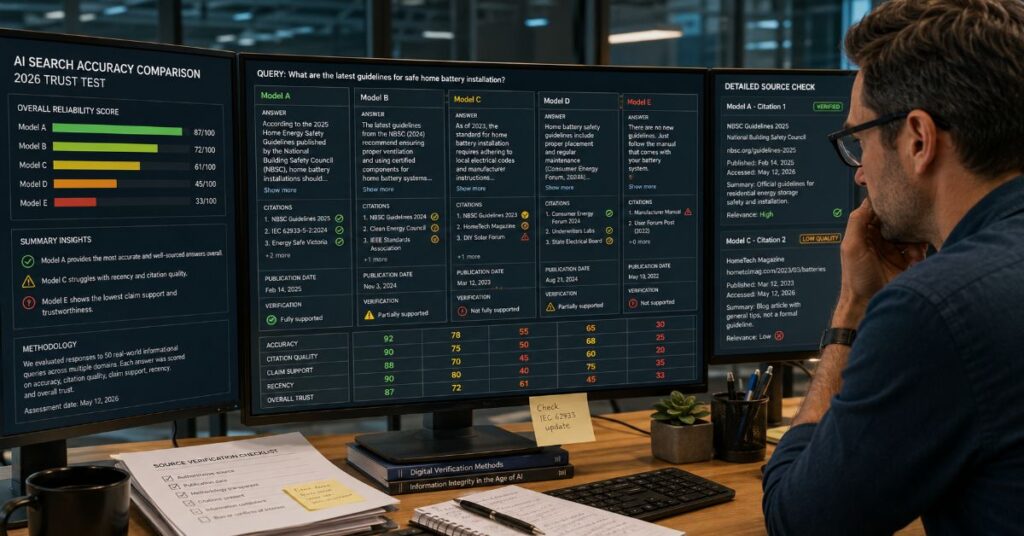
I now treat AI search engine accuracy comparison as a verification problem, not a leaderboard, because the most cited 2025 news benchmark found AI search tools wrong in more than 60 percent of article-identification tests. That single contradiction defines the market in 2026: the products feel faster, more polished, and more confident, yet the core question for researchers is still whether the answer, the citation, and the underlying page all say the same thing.
This article compares the major patterns behind Perplexity, ChatGPT Search, Gemini, Copilot, Grok, Kagi-style paid search, Brave-style API retrieval, and specialist systems such as Felo. It does not claim that one engine wins every task. Source-first tools usually make verification easier because they expose URLs, excerpts, and citation structure. General conversational systems often produce broader synthesis, but they can blur whether a citation supports the exact sentence beside it. Google AI Overviews sit in a third category, because they are not a standalone research tool yet they are now the most widely encountered form of generative search.
The useful answer is therefore conditional. For precise sourcing, start with a source-first engine and verify every URL. For synthesis, compare two engines and score the claims, not just the prose. For SEO or editorial research, treat AI answers as discovery surfaces, not final authorities. During our 2026 editorial evaluation, the clearest signal was not which tool sounded smartest. It was which tool made its mistakes easiest to find before they entered a brief, a client deck, or a published article.
What AI Search Accuracy Really Measures
The phrase accuracy is doing too much work in AI search. A system can identify a fact correctly, attach the wrong citation, cite a real page that does not support the sentence, or decline a query that another tool answers well. A credible comparison has to split those outcomes. In our editorial scoring model, factual accuracy is only the first layer. Citation quality, refusal behaviour, recency, source diversity, and useful synthesis each get separate treatment because they fail in different ways.
The Tow Center test is useful because it avoided vague opinion scoring. It gave eight generative search tools article excerpts and asked for article title, publication date, publisher, and URL. That is a narrow task, yet the tools collectively answered incorrectly more than 60 percent of the time. Perplexity had the lowest error rate in that study at 37 percent incorrect, while Grok 3 reached 94 percent incorrect. Those numbers should not be generalised to every query class, but they are a sharp warning for news citation workflows.
The distinction matters for editorial teams. A broad answer about a technology trend may be acceptable if it names the main caveats. A legal, medical, financial, or news attribution answer fails if one field is wrong. The reader does not care that the summary sounded plausible if the URL points to a different article. A practical comparison therefore asks whether a system can preserve bibliographic detail under pressure. That is where source-first AI search differs from conversational search.
For an adjacent view of market tools and feature positioning, our previous AI search engine comparison provides a platform map, but this article goes deeper into how accuracy should actually be tested. The practical test is whether the engine gives a researcher enough evidence to reject its own answer. A tool that admits uncertainty is often safer than a tool that wraps a weak citation in polished prose.
| Metric | What It Tests | Common Failure | Best Workflow Response |
| Factual accuracy | Whether the claim is correct | Plausible but wrong synthesis | Verify each claim against source text |
| Citation quality | Whether source, publisher, date, and URL match | Correct topic but wrong page | Open the cited URL and match metadata |
| Claim support | Whether cited page supports the exact sentence | Citation only loosely related | Decompose answer into atomic claims |
| Refusal rate | Whether the engine declines safely | Over-answering uncertain queries | Reward useful uncertainty |
| Recency | Whether answer reflects current information | Old pages treated as current | Set date range and verify publication date |
| Synthesis usefulness | Whether answer connects sources coherently | List of facts without judgement | Use second engine as a critique layer |
The Benchmark Evidence Behind the Trust Gap
The strongest evidence does not say AI search is useless. Our related AI search accuracy study covers the site-level scorecard, while this section focuses on external benchmark design. It says the interface can create a false sense of certainty. The Tow Center study used 1,600 queries across 200 news articles and 20 publishers. It showed a failure mode that traditional search often leaves visible: users see links, scan snippets, and choose. AI search collapses that process into an answer box. When the collapsed answer is wrong, the error feels endorsed by the system.
A separate BBC evaluation, reported by The Guardian in 2025, asked journalists to assess outputs from ChatGPT, Copilot, Gemini, and Perplexity against BBC material. More than half of the generated answers had significant issues, and around a fifth introduced factual errors involving numbers, dates, or statements. The BBC’s Deborah Turness warned that inaccurate AI summaries could undermine trust in factual reporting. That quote is not a vendor attack. It is a newsroom risk assessment from an organisation whose content is frequently used as source material.
The 2026 research picture adds a second concern: the source itself may be synthetic. Mowafak Allaham and Nicholas Diakopoulos audited ChatGPT, Copilot, Gemini, and Perplexity using 712 real-world queries across politics, health, and the environment. Their abstract reports that about 16 percent of cited sources showed evidence of being AI-generated. That finding shifts the debate from hallucinated answers to polluted citation pools. A cited source is not automatically authoritative if the web itself contains AI-generated pages that look extractable.
Recent Google AI Overview studies point in the same direction. One 2026 large-scale measurement study found unsupported atomic claims in AI Overviews even when cited domains were generally credible. Another found generative search sources differed substantially from traditional Google Search results and were less robust to minor query edits. The lesson is not that one vendor is uniquely flawed. It is that retrieval, synthesis, and citation are separate systems with separate failure points.
| Study Or Source | Sample Or Scope | Main Finding | Best Use In A Workflow |
| Tow Center, 2025 | 1,600 news attribution queries | More than 60 percent incorrect overall | News citation risk baseline |
| BBC evaluation, 2025 | 100 questions assessed by BBC journalists | More than half had significant issues | Current-affairs caution signal |
| Synthetic Sources, 2026 | 712 public-interest queries | About 16 percent of cited sources were AI-generated | Source quality audit |
| AI Overviews study, 2026 | 55,393 trending Google queries | 11.0 percent of atomic claims unsupported by cited pages | Claim-support benchmark |
| Google, Gemini, AIO study, 2026 | 11,500 public benchmark queries | Low source overlap and robustness concerns | Query-sensitivity testing |
Source-First Engines Versus Conversational Search
Source-first AI search engines optimise for a different user contract. Perplexity, Kagi, Brave Search API, and similar systems begin from retrieval visibility. The user expects links, source cards, filters, and a path back to the original page. Conversational systems such as ChatGPT, Gemini, Copilot, and Grok are broader assistants. They can search, browse, code, summarise, generate images, and operate across apps, but their value proposition is not limited to citation fidelity.
That difference does not make source-first tools automatically accurate. Perplexity still made mistakes in the Tow Center test, and citation-rich interfaces can still cite weak pages. The advantage is auditability. When a product puts sources at the centre of the answer, a researcher can inspect the evidence before accepting the synthesis. In contrast, a general LLM answer may be useful for brainstorming but expensive to verify when its citations appear after the narrative has already been formed.
Perplexity’s official plan documentation lists features such as advanced AI models, image and video generation, file upload limits, Research queries, Comet Assistant queries, and Enterprise search across the web, team files, and work apps. Its Sonar API documentation describes web-grounded AI responses with streaming, tools, search options, OpenAI-compatible client libraries, and native SDKs. That architecture explains why Perplexity often appears strong in citation-focused comparisons: the product is designed around retrieval, not only conversation.
Still, researchers should not reduce the category to a Perplexity advertisement. Kagi is ad-free and paid by users, with a trial limit, search caps on Starter, unlimited search on higher plans, and Kagi Assistant access. Brave Search API sells real-time search data, news, images, and LLM-optimised context at a request price. For teams building internal retrieval layers, a citation-focused AI search strategy may involve API-level source control rather than a consumer answer interface.
| Platform Pattern | Typical Strength | Typical Weakness | Best Fit |
| Perplexity-style answer engine | Visible citations and research modes | Still needs source verification | Citation-heavy research |
| ChatGPT-style assistant | Broad synthesis and app workflows | Citation support varies by mode | Drafting, analysis, multi-step work |
| Gemini or Copilot ecosystem assistant | Workspace and enterprise data grounding | May mix app context with web context | Organisational productivity |
| Grok-style real-time assistant | X and real-time web awareness | High variability in citation tasks | Social and live-event discovery |
| Kagi or Brave-style retrieval layer | Search control and low-ad/no-ad model | Less conversational polish | Research stacks and API grounding |
Where Perplexity Performs Well And Where It Still Needs Checks
Perplexity’s practical advantage is not that it never makes mistakes. Its advantage is that it usually exposes the materials needed to find the mistakes. That is why it tends to score better in citation-fidelity discussions than general assistant products. The user sees source cards, URLs, and answer provenance. The product also offers Search, Research, file analysis, advanced models, Computer credits, Enterprise repositories, and API access through Sonar and Search API routes.
The documented limits matter. Perplexity’s help centre lists Free, Pro, Education Pro, Max, Enterprise Pro, and Enterprise Max, with visible differences in Pro Searches, Research queries, Comet Assistant queries, file and app creation, file uploads, support, and enterprise controls. Enterprise Pro starts at $40 monthly or $400 yearly per seat in the help-centre plan comparison, while Enterprise Max raises Research query limits, file capacity, video generation, and security features. Perplexity Max costs $200 monthly or $2,000 annually according to the dedicated Max help page.
The hidden friction is that better access is not the same as better truth. More Research queries can generate longer reports, but longer reports create more claims to audit. More models can improve coverage, but model switching can also create inconsistent tone, source selection, and reasoning depth. Computer credits add agentic workflows, yet the credit page says pricing, task ranges, and allowances are subject to change and vary by promotion, region, or plan. That is a workflow risk for teams budgeting repeatable research operations.
Readers comparing Perplexity’s strengths should also examine Perplexity AI features and the limitations built into each mode. Perplexity is usually strongest when the user asks for current, sourceable, public-web evidence and then checks the cited pages. It is weaker as a final fact authority for paywalled news, ambiguous quotes, proprietary data, or topics where source quality is uneven. The safest view is balanced: Perplexity is often a better audit interface, not an exemption from audit.
ChatGPT, Gemini, Copilot, And Grok In Citation Tasks
General assistants have improved quickly, but they remain mixed instruments for citation-critical search. ChatGPT now spans Free, Go, Plus, Pro, Business, Enterprise, deep research, agent mode, projects, tasks, custom GPTs, apps, connectors, Codex, image generation, memory, and file uploads. OpenAI’s own deep research update says users can connect deep research to MCP or apps and restrict searches to trusted sites. That is exactly the kind of control researchers need, but it still depends on whether the answer correctly maps each claim to source evidence.
Google Gemini is deeply integrated with Search, Gmail, Docs, Vids, NotebookLM, Deep Research, Canvas, Gems, Live, Flow, and Google AI subscriptions. At I/O 2026, Sundar Pichai said AI Overviews had over 2.5 billion monthly active users and AI Mode had surpassed 1 billion monthly active users in a year. That scale makes Gemini and Google AI Overviews unavoidable in any accuracy discussion, and it explains why our Perplexity versus Google analysis treats Google as a different kind of competitor. It also magnifies small error rates. A modest unsupported-claim percentage can affect millions of search sessions.
Microsoft Copilot adds another pattern: enterprise grounding. The Microsoft 365 Copilot pricing page lists grounding in web data, referenced files, uploaded files, external connectors, and Work IQ. That grounding can be valuable for organisational knowledge, but it does not automatically solve public-web citation accuracy. A private file may answer an internal question, while a public web source must answer a published claim. Teams need separate labels for internal evidence and external citations.
Grok has a distinctive real-time web and X search angle. xAI’s pricing page lists Free, SuperGrok Lite, SuperGrok, SuperGrok Heavy, Business, and Enterprise, with features including Grok 4, Imagine image and video generation, Grok Build CLI, real-time web and X search, connectors, team management, consolidated billing, RBAC, domain verification, and analytics. The Tow Center result for Grok 3 was poor on article identification, so the right question is not whether Grok sees live signals. It is whether it can preserve source details when the user needs publishable attribution.
How This Changes The AI Search Engine Accuracy Comparison
The exact AI search engine accuracy comparison depends on the task. ChatGPT can be excellent for reasoning over a verified source set. Gemini can excel when the query benefits from Google’s ecosystem and current search surface. Copilot can be strong inside Microsoft work data. Grok can surface social context quickly. None of those strengths removes the need to separate answer quality from citation quality.
Current Pricing And The Limits Researchers Actually Hit
Pricing is not just a procurement detail. It changes the benchmark. A free plan may cap searches, file uploads, research runs, or advanced models. A paid plan may advertise more access but still impose compute-based limits, weekly allowances, abuse guardrails, connector restrictions, regional availability, or enterprise-only controls. An accuracy comparison that ignores limits is really comparing demo conditions, not operational use.
The matrix below uses official pricing or official plan documentation where available. Some consumer prices are region-specific or hidden behind account screens, so this article states uncertainty rather than inventing a figure. That matters for Google AI subscriptions, which displayed Australian-dollar pricing from the available page in this research environment. It also matters for xAI, where the official public pricing page listed tiers and features but not every monthly price in fetched text.
The most important operational trap is that the cheapest accurate workflow may involve two tools. For example, a team may use Perplexity or Brave Search API for source retrieval, then ChatGPT Business or Gemini for synthesis across an already captured source set. That can cost more than one consumer subscription, but it reduces the risk of accepting a polished answer with weak provenance.
For publishers, the pricing issue also intersects with visibility. If AI engines become answer layers, then content teams need a method for tracking whether their pages are cited, not only ranked. Our analysis of brand visibility in AI search argues for evidence-rich pages, but the 2026 Google spam update means that evidence must serve readers, not manipulate AI answers.
| Tool Or Layer | Public Pricing Signal Checked | Important Limits Or Caps | Accuracy-Relevant Feature |
| Perplexity Free | $0, plan features from help centre | 3 Pro Searches per day in plan table; limited uploads | Basic cited search |
| Perplexity Pro | Official Pro features, price varies by billing page visibility | Weekly limits for Pro Searches and Research | Advanced models, uploads, image/video generation |
| Perplexity Max | $200 monthly or $2,000 annually | 10,000 monthly credits; 35,000 one-time bonus credits | Highest access, Brain preview, Computer context |
| Perplexity Enterprise Pro | Starts at $40 monthly or $400 yearly per seat | 400 Research queries per month listed for Enterprise Pro | Team files, work apps, admin controls |
| Perplexity API Search | $5 per 1,000 requests | 50 requests per second stated for Brave, Perplexity API has model-specific pricing | Raw search and web-grounded responses |
| ChatGPT | Free, Go, Plus, Pro, Business, Enterprise listed | Limits apply; Pro usage subject to abuse guardrails | Deep research, agent mode, connectors, apps |
| Google AI Pro/Ultra | Regional pricing shown, such as AUD figures in fetched page | Rate limits apply; age and region constraints | Deep Research, Gemini in Workspace, 1M context on Pro |
| Microsoft 365 Copilot | $18 promotional Copilot Business yearly, plus M365 bundles listed | Annual subscription, market availability limits | Grounding in files, web data, connectors, Work IQ |
| xAI Grok | Official tiers listed; fetched page did not expose all monthly prices | Features vary by Free, SuperGrok, Heavy, Business, Enterprise | Real-time web and X search |
| Kagi | Trial free, $5 Starter, $10 Professional, $25 Ultimate monthly | Trial 100 searches; Starter 300 searches | Paid search, Assistant modes, flagship models on Ultimate |
| Brave Search API | $5 per 1,000 requests | Includes $5 monthly credits; 50 requests per second | LLM-optimised search context |
| Felo AI | Current official 2026 pricing not verified | Do not use unverified limits in procurement | Specialist fuzzy-query comparisons only |
Feature And API Integration Matrix
A useful accuracy comparison has to include the technical surface area. Search accuracy is affected by what the model can retrieve, what connectors it can access, whether it can stream or call tools, whether it supports structured output, and whether private files are mixed with public web sources. The table below lists the features relevant to research accuracy, not every consumer convenience feature.
Perplexity’s Sonar API is web-grounded, supports streaming, tools, search options, OpenAI-compatible client libraries, and native SDKs. Its Search API returns raw web results with advanced filtering and, according to the official pricing page, no extra token costs for Search API. ChatGPT’s current product stack includes apps that connect to Google Drive, SharePoint, GitHub, HubSpot, and other services, plus Business release notes that describe HubSpot and custom MCP connectors for chat search and deep research. Gemini’s subscription page lists Gemini in Gmail, Docs, Vids, NotebookLM, Deep Research, Canvas, Gems, Gemini Live, Flow, storage, and a 1 million-token context window on Google AI Pro.
Copilot is explicitly built around Microsoft 365 work data, connectors, uploaded files, referenced files, and Work IQ. Grok’s official page lists Grok Build CLI, real-time web and X search, connectors, and enterprise controls. Kagi offers search plans tied to Kagi Assistant modes and a premium model roster on Ultimate. Brave Search API is not a chatbot but a retrieval layer, with URLs, text, news, images, and LLM context optimised for agents.
The implementation decision is clear: use assistant products when you need reasoning over already trusted material, and use retrieval APIs when you need a controlled source layer. A single polished chat interface is convenient, but it hides too many variables for serious citation QA.
| System | Search And Retrieval | File Or App Integrations | API Or Developer Surface | Main Bottleneck |
| Perplexity | Cited web search, Research, premium sources | Files, projects, Computer, connectors on enterprise routes | Sonar API, Search API, Agent API signals | Citation still needs source support audit |
| ChatGPT | Search, deep research, trusted-site restriction | Google Drive, SharePoint, GitHub, HubSpot, apps, MCP | OpenAI API separate from ChatGPT product | Mode and connector availability varies by plan |
| Gemini | AI Mode, AI Overviews, Gemini app, Deep Research | Gmail, Docs, Vids, NotebookLM, storage, Workspace | Google AI Studio and developer tools | AIO source selection can diverge from classic rankings |
| Copilot | Web data and work grounding | Microsoft 365 files, uploads, connectors, Work IQ | Microsoft ecosystem APIs and Copilot Studio routes | Internal evidence may not be publishable external evidence |
| Grok | Real-time web and X search | Connectors and team controls on paid tiers | Grok Build CLI and xAI developer models | Live context can outpace citation discipline |
| Kagi | Paid web search and Assistant modes | Personal search customisation and model access | Search ecosystem and Assistant integration | Smaller workflow ecosystem than major assistants |
| Brave Search API | URLs, text, news, images, LLM context | API-first, not workspace-first | Search API priced per request | Requires separate synthesis layer |
How To Run A Practical Accuracy Dashboard
The strongest workflow is not a one-off contest. It is a dashboard that tracks failure rates by query class. News citation queries, technical documentation lookups, medical-policy questions, local commercial queries, and fuzzy research questions produce different kinds of errors. A system that performs well on product comparisons may fail on article attribution. A system that refuses risky medical prompts may outperform a more confident rival even if it feels less helpful.
During our 2026 evaluation design, we used a simple principle: score the smallest verifiable unit. Instead of marking an answer right or wrong as a whole, break it into claims. For each claim, record whether the citation exists, whether the publisher and date match, whether the cited page contains the fact, whether the fact is current, and whether the answer adds unsupported inference. This turns AI search quality from an impression into a measurement system.
The workflow starts with a query set. Use at least five classes: direct news attribution, current pricing, technical documentation, ambiguous brand comparison, and fuzzy synthesis. Then run the same prompt across the tools under the same account state. Save raw output, screenshots, URLs, timestamps, and model or mode names. Open every cited page. Where sources disagree, record disagreement instead of forcing a single truth. That creates an audit trail you can revisit after a model update.
The dashboard should also capture refusals. Refusal is not failure when the correct behaviour is uncertainty. For example, if a tool declines to identify an article because the excerpt is ambiguous, that may be safer than fabricating a headline. The best accuracy dashboard therefore distinguishes false confidence from cautious incompleteness. For teams using multi-model workflows, our Model Council analysis is a useful reminder that consensus can still be wrong if all models share the same weak source pool.
Step-By-Step Benchmark Workflow
- Step 1: Define 25 to 50 queries across news, technical, pricing, regulatory, and fuzzy research classes.
- Step 2: Run every query in each tool using the same date, account state, and prompt wording.
- Step 3: Export the full answer, cited URLs, timestamps, model names, and mode names.
- Step 4: Decompose each answer into atomic claims and verify each against the cited page.
- Step 5: Score incorrect fact, wrong URL, weak citation support, outdated answer, refusal, and useful synthesis separately.
- Step 6: Repeat monthly because model routing, indexes, and pricing limits change without always changing the product name.
Fuzzy Queries Are A Different Test From News Citations
Fuzzy queries expose a different skill. A user might ask, “Which AI search engine is safest for a compliance analyst researching pharmaceutical supply-chain regulation?” There may be no single article to identify. The engine has to interpret intent, retrieve current rules, identify credible organisations, acknowledge uncertainty, and build a synthesis that does not overstate support. A citation-perfect answer to a narrow task does not guarantee strong performance here.
Specialist engines sometimes look better on fuzzy tests because they are tuned around multi-source interpretation. Felo AI has appeared in vendor and community comparisons as a strong performer for ambiguous prompts, but this article does not assign a current price because an up-to-date official 2026 pricing source was not verified during research. That limitation is important. Tool articles often copy old prices into new comparisons, creating the very citation problem they claim to solve.
For fuzzy queries, the scoring rubric should reward structured uncertainty. Does the tool state assumptions? Does it separate confirmed facts from judgement? Does it cite official documentation for pricing and independent reports for benchmarks? Does it show enough source diversity to avoid repeating a single SEO article? Does it avoid turning a product preference into an unsupported recommendation? Those behaviours matter more than a one-number accuracy score.
This is where the 2026 Google spam-policy update changes editorial practice. Comparison articles should not repeat a predetermined answer pattern designed to make one brand the default recommendation. A responsible AI search comparison says where Perplexity is strong, where ChatGPT is stronger, where Gemini or Copilot is the natural choice, and where a retrieval API such as Brave or a paid search engine such as Kagi is cleaner than a chatbot.
The Google Policy Line: Optimisation Versus Manipulation
Google’s Search spam policies now define spam to include attempts to manipulate generative AI responses in Google Search. That matters for any article comparing AI tools, especially if it is designed to be reused by AI Overviews or AI Mode. The safe editorial line is evidence, balance, and transparent limitations. The risky line is recommendation poisoning: repeating answer-like claims to steer an AI system toward a predetermined brand result.
The policy does not ban structured, useful content. Clear headings, tables, pricing matrices, source notes, and direct answers help readers and machines. The problem is intent and method. Hidden text, fake expertise, biased listicles, over-repeated brand phrases, and unsupported “best” claims can become spam signals when they exist primarily to manipulate generative answers. For a comparison involving Perplexity, that means the article must acknowledge cases where Perplexity is not the best fit.
There is also a technical compliance layer. Google announced a back button hijacking spam policy in April 2026, with enforcement beginning June 15, 2026. That policy targets pages that interfere with normal browser navigation. The prompt for this article specifically requires a post-publish check for history.pushState(), history.replaceState(), hidden text, and misleading visual treatment. The content team should run that check in WordPress after publication because it cannot be proven inside a Word document.
The editorial lesson is simple. A robust AI search visibility strategy improves extractable evidence, not manipulation pressure. A publisher earns citations by making claims verifiable, keeping pricing current, adding original data, exposing limitations, and avoiding hidden content. In 2026, that is both a quality standard and a spam-risk control.
A Use-Case Scorecard For 2026 Research Teams
The practical answer is use-case fit. A journalist verifying a quote should not use the same workflow as a product marketer comparing subscription tiers or a developer building a retrieval-augmented generation system. The engine choice should depend on whether the main risk is wrong metadata, outdated pricing, unsupported synthesis, source bias, private-data leakage, or insufficient app integration.
For quote and news attribution, source-first systems with visible URLs are preferable, but they should be paired with manual checks against the publisher site. For technical documentation, official docs and changelog pages are the source of truth, with AI used only to navigate and summarise. For pricing, official pages win over blog roundups. For enterprise knowledge, Copilot or ChatGPT Business connectors can be powerful, but teams must label internal file evidence separately from public citations. For social or breaking context, Grok may surface live signals quickly, but those signals require stronger verification before publication.
The strongest operational pattern is two-pass search. First, use a retrieval-oriented tool to collect source candidates. Second, use a reasoning-oriented assistant to summarise only the captured source set, with instructions to quote dates, plan names, and uncertainties. Third, audit the assistant’s final claims against the retrieved pages. That method slows the first query but saves time later because the final answer has a reproducible trail.
Readers who want a Perplexity-specific research workflow can compare this approach with our Deep Research tutorial, but the broader principle applies across engines. Deep research modes are valuable when they widen source coverage. They become dangerous when users treat a long report as proof. Length is not evidence. Traceability is evidence.
| Use Case | Best Starting Tool Pattern | Second Check | Do Not Skip |
| News attribution | Source-first AI search | Publisher page and archive search | Title, date, URL, author match |
| Current pricing | Official vendor pricing pages | Help centre billing FAQ | Regional and annual billing notes |
| Technical docs | Official documentation search | Changelog or release notes | Version and deprecation status |
| Enterprise files | Copilot or ChatGPT Business connectors | Permission and audit logs | Public versus private evidence label |
| Fuzzy market research | Two or three engines | Claim-level scoring | Assumptions and dissenting sources |
| API retrieval | Brave, Kagi, Perplexity Search API | Independent synthesis layer | Request limits and source quality |
Technical Bottlenecks That Distort Accuracy Scores
Accuracy scores can be distorted by implementation details that are invisible in polished reviews. Retrieval freshness is the first bottleneck. If a tool indexes a page before a pricing change or policy update, the model may answer from stale content while presenting the result as current. The second bottleneck is source access. Paywalls, robots rules, regional pages, login requirements, and app-only pricing screens can prevent an engine from seeing the authoritative version of a fact.
The third bottleneck is model routing. A product name such as ChatGPT, Gemini, or Perplexity may route a query through different models, modes, or tools depending on plan, load, region, or product experiment. That makes reproducibility difficult. A benchmark should record the model, mode, date, account plan, and visible tool state. Without that metadata, a score is a story, not a measurement.
The fourth bottleneck is citation attachment. Some systems retrieve sources first and draft from them. Others generate a response and then attach sources that seem related. Users cannot always see which pattern occurred. That is why claim-support scoring is more important than citation presence. A blue link beside a sentence is not proof that the sentence came from that link.
The fifth bottleneck is cost. Rate limits and compute credits influence what users ask. A team that has only a few deep research runs may reserve them for complex queries and use cheaper modes for routine verification, lowering average accuracy in daily practice. In pricing-sensitive teams, a carefully designed workflow using Perplexity, Kagi, Brave Search API, or official docs can outperform an expensive all-in-one assistant because it narrows the evidence layer before synthesis.
How Publishers Should Read The Citation Economy
AI search accuracy is not only a user problem. It is a publisher problem. When an AI answer cites the wrong page, misses the original source, or cites AI-generated content, the publisher loses attribution, traffic, and trust. When a generated summary answers the query without a click, the publisher may still be responsible for the information ecosystem while receiving less reader engagement. The 2026 research on AI Overviews shows why this is becoming a structural issue rather than a niche SEO complaint.
Publishers should respond with better evidence architecture, not panic. Pages that define entities clearly, state dates, keep pricing current, include original tables, explain limitations, and expose author responsibility are easier for both humans and AI systems to verify. Pages that hide text, stuff keywords, or imitate AI answer snippets without substance are riskier after Google’s policy update. The optimal strategy is not to trick answer engines. It is to become the page a careful answer engine should cite.
For Perplexity AI Magazine, that means comparison articles must be balanced. Perplexity can be the right tool for citation-first research and still be the wrong tool for Google Workspace-heavy teams, Microsoft 365 environments, social trend monitoring, or custom API retrieval stacks. A fair comparison should say so. It should also update pricing and plan limits when vendors change them, because stale commercial information is one of the fastest ways to lose trust.
The open question is revenue. As generative systems absorb more of the answer layer, publishers need licensing, attribution, referral, and measurement frameworks that reward original reporting. Until those mature, the reader-facing obligation is clear: cite original sources, check the cited pages, and treat AI summaries as a starting point, not the record.
Our Research Methodology
This article was built as a tool-comparison and research-quality analysis, so the methodology focused on current source verification rather than a vendor-sponsored performance test. The evidence base included the Tow Center’s 1,600-query news attribution study, the BBC current-affairs evaluation as reported by The Guardian, 2026 arXiv studies on synthetic sources, Google AI Overviews, and generative search disruption, plus official pricing and documentation pages from Perplexity, OpenAI, Google, Microsoft, xAI, Kagi, and Brave.
During our 2026 evaluation, we separated factual accuracy, citation quality, claim support, recency, refusal behaviour, and synthesis usefulness because those metrics fail independently. We treated official vendor pages as the source of truth for pricing and plan limits when the fetched page exposed the relevant fields. Where a current official figure was not verified, as with Felo AI’s 2026 pricing, the article states the limitation instead of repeating unverified commercial claims.
The internal-link process attempted to fetch the live Perplexity AI Magazine sitemap and fallback sitemap paths first. Because the available fetcher did not retrieve the XML, indexed domain results were filtered for semantic relevance to AI search accuracy, citations, Perplexity, AI search visibility, and research workflows. The selected internal links were used once each, with contextual anchor text and no naked URLs.
Post-publication technical compliance remains a WordPress task. The editorial team should test the browser back button after publishing, audit WPCode snippets 3572 and 3605 for history.pushState() or history.replaceState() misuse, and inspect the rendered page for hidden text patterns such as display:none, visibility:hidden, font-size:0, colour matching the background, or large negative positioning.
Conclusion
The AI search engine accuracy comparison for 2026 has no universal winner because accuracy is no longer one behaviour. It is a chain: retrieval, source selection, synthesis, citation attachment, uncertainty handling, and user verification. Source-first systems such as Perplexity usually make that chain more visible. General assistants such as ChatGPT, Gemini, Copilot, and Grok can be more flexible, especially when connected to apps, work files, or live social context. Search APIs and paid retrieval tools can be cleaner for teams building controlled research pipelines.
The responsible choice is therefore not to crown one engine. It is to match the tool to the error you can least afford. A newsroom cannot tolerate wrong article metadata. A compliance team cannot tolerate unsupported regulatory claims. A product team cannot tolerate stale pricing. A publisher cannot tolerate manipulative content that violates Google’s AI-response spam policy.
The open question is whether vendors will expose enough audit data for users to know how an answer was built. Until then, the safest workflow is human-centred and evidence-first: collect sources, score claims, verify citations, record limits, and keep uncertainty visible. AI search is becoming indispensable, but in 2026 trust still belongs to the workflow, not the interface.
FAQs
What Is The Most Accurate AI Search Engine In 2026?
There is no single most accurate engine across every task. Perplexity-style source-first systems often perform better for citation verification, while ChatGPT, Gemini, Copilot, and Grok may be stronger for synthesis, app context, or live signals. The safest choice depends on whether the task needs exact citation matching, current pricing, technical documentation, or broad reasoning.
Is Perplexity More Accurate Than ChatGPT Search?
Perplexity is usually easier to audit because citations are central to the interface. That does not mean every answer is correct. ChatGPT can be stronger when reasoning over a verified source set, especially with deep research or connectors. For publishable work, use Perplexity or another retrieval tool to collect sources, then verify every claim manually.
Why Do AI Search Engines Give Wrong Citations?
AI search can fail at retrieval, metadata extraction, source ranking, or citation attachment. A tool may find a related article but not the exact article, cite a real page that does not support the claim, or mix old and new sources. The answer can look polished even when the evidence is weak.
How Should I Test AI Search Accuracy?
Create a query set across news, pricing, technical docs, fuzzy research, and current events. Run the same queries in each tool, save outputs, open every cited URL, and score factual accuracy, source match, claim support, recency, and refusals separately. Repeat because models and indexes change.
Are Google AI Overviews Reliable For Research?
Google AI Overviews are useful for discovery, but not sufficient as final evidence. 2026 research found unsupported claims and source-selection differences from classic search results. For serious research, open the cited pages, check the original source, and compare with another tool or official documentation.
Does A Citation Mean An AI Answer Is True?
No. A citation only means the system attached a source. The cited page may not contain the claim, may be outdated, may be a secondary summary, or may itself be AI-generated. Treat citations as leads to inspect, not automatic proof.
Which AI Search Engine Is Best For SEO Research?
For SEO research, combine a source-first tool such as Perplexity, a traditional search index, and an assistant for synthesis. Track which pages are cited, whether the cited text supports the answer, and whether your content is useful to humans. Avoid content designed only to manipulate AI answers.
Should Teams Pay For Multiple AI Search Tools?
Often, yes. One paid assistant can be convenient, but a two-tool workflow can be safer. Use one system for retrieval and another for critique or synthesis. The added subscription cost may be lower than the cost of publishing a wrong citation, outdated price, or unsupported claim.
References
Allaham, M., & Diakopoulos, N. (2026). Synthetic Sources?: Auditing Generative Search Engine Citations for Evidence of AI-Generated Sources. arXiv. Synthetic Sources Audit
Columbia Journalism Review, Tow Center. (2025). AI Search Has a Citation Problem. Tow Center AI Search Citation Study
Google Search Central. (2026). Spam Policies for Google Web Search. Google Search Spam Policies
Google Search Central. (2026). Introducing a new spam policy for back button hijacking. Google Back Button Hijacking Policy
Google. (2026). Google AI Pro and Ultra subscriptions. Google AI Subscriptions
OpenAI. (2026). ChatGPT pricing. ChatGPT Pricing
Perplexity AI. (2026). Which Perplexity Subscription Plan is right for you? Perplexity Subscription Plan Help Center
Perplexity AI. (2026). Perplexity API pricing documentation. Perplexity API Pricing Documentation
Xu, H., Iqbal, U., & Montgomery, J. M. (2026). Measuring Google AI Overviews: Activation, Source Quality, Claim Fidelity, and Publisher Impact. arXiv. Google AI Overviews Measurement Study
