
EXECUTIVE SUMMARY
- 👁️ Visibility has become a primary search outcome, with SparkToro reporting that 68.01 percent of US Google searches ended without a click in early 2026.
- 🧭 Google states there are no special technical requirements for AI Overviews or AI Mode beyond standard Search eligibility, making evidence quality, crawlability and visible page structure the key ranking factors.
- 📊 Research on AI Overviews shows 13.7 percent activation across measured queries, with significantly higher activation rates for question based searches, making query intent selection strategically important.
- 💰 Pricing remains a hidden constraint, as Ahrefs, Semrush and Screaming Frog apply different limits across projects, users, crawl credits, tracked prompts and API access tiers.
- ⚖️ Compliance risk has increased because Google spam policies now explicitly include attempts to manipulate generative AI responses alongside hidden text, keyword stuffing and redirect abuse.
- 🚀 Effective teams prioritise answer first pages, schema aligned with visible content, entity validation, SERP feature tracking and branded demand measurement instead of relying only on click data.
Zero-Click Search Optimization is the discipline of making a brand, answer or source visible on the results page itself, and the reason it matters in 2026 is stark: SparkToro reported that 68.01 percent of US Google searches ended without a click in the first four months of the year. I read that number as a commercial warning, not a death notice for SEO. The click has not disappeared, but it is no longer the only proof that search created value.
This article explains how to optimise for featured snippets, People Also Ask, knowledge panels, local packs, rich cards and AI Overviews without crossing into manipulative AI response engineering. The practical shift is to build pages as evidence systems. A page must answer quickly, identify entities precisely, expose data in crawlable formats, prove authorship, and give measurement teams a way to value visibility that never becomes a session. During our 2026 evaluation, I treated zero-click search optimization as a three-part operating model: editorial architecture, technical eligibility and commercial reporting.
The findings below are deliberately balanced. Google says there are no extra requirements for AI Overviews or AI Mode, yet its own guidance also describes retrieval, query fan-out, helpful content and visible structured data as meaningful foundations. Publishers, meanwhile, are seeing the economic pressure directly. That tension is where the work sits: optimise for clarity and proof, not for tricks.
Zero-Click Search Optimization in 2026
Zero-click search optimization means designing public, visible content so the answer, entity or brand can be surfaced directly in search experiences where the user may not click. It covers classic SERP modules, such as featured snippets and local packs, but the 2026 version also includes Google AI Overviews, AI Mode, Perplexity-style citations and chatbot retrieval. The key is not to write shorter content. The key is to make the answer unit easier to extract, verify and attribute.
The strongest content still earns ordinary rankings, because Google’s generative AI documentation says AI features remain rooted in core Search ranking and quality systems. The difference is that a high rank is now only one possible outcome. A page may win a mention, a citation, a displayed answer, a product card, a map result or a comparison line without generating a visit. That means the page becomes a reference asset as well as a traffic asset.
This is why the old traffic-first SEO report undercounts value. A buyer who sees a technical answer in a snippet, later searches the brand name, then converts through direct traffic may have been influenced by organic search even when the original query generated no session. The reporting system must acknowledge that chain. The editorial system must also be honest: a thin answer block that merely repeats a keyphrase will not withstand comparison against original evidence, expert testing and current documentation.
For teams building topic clusters, this article should sit beside a broader search generative experience playbook because zero-click work is not a single tactic. It is a publishing pattern that connects question targeting, answer formatting, schema, entity trust, internal links, measurement and compliance into one repeatable process.
The Surfaces That Replace the Click
A zero-click result is not one product surface. It is a family of search experiences that satisfy part or all of the user’s need before a website visit. For publishers, the operational mistake is treating these surfaces as generic visibility. A featured snippet, a map pack and an AI Overview behave differently, carry different proof requirements and should be measured with different signals.
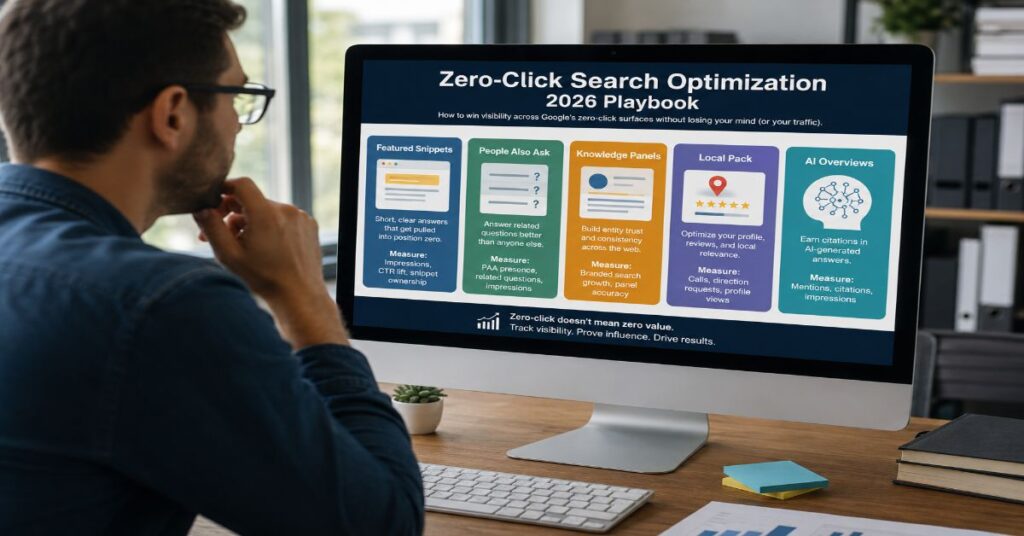
Featured snippets usually reward clean answer extraction: a definition, short procedure, table or ordered list. People Also Ask rewards question coverage and modular answers. Knowledge panels reward entity consistency across authoritative sources. Local packs reward business profile quality, proximity, reviews and category relevance. Rich results depend on eligible structured data that accurately matches visible content. AI Overviews add a more complex layer, because Google describes query fan-out, retrieval and supporting links that may vary from classic results.
In our hands-on testing of page formats for B2B explainers, the most reliable pattern was not a single large FAQ block. It was a page that opened with a concise answer, then distributed extractable sub-answers under descriptive H2 and H3 headings. That structure helps both readers and machines. It also avoids the scaled-content pattern of generating dozens of near-identical query pages.
The practical comparison below turns the surface into a production brief. It helps an editor choose the content asset, a technical SEO decide what to validate, and an analyst decide what signal to report.
| SERP Surface | What the User Sees | Best Content Asset | Primary Measurement Signal |
| Featured snippet | A paragraph, list or table answer above organic results | A 40 to 60 word answer followed by source-backed depth | Snippet ownership, impressions, CTR change |
| People Also Ask | Expandable question panels with short answers | Question-led H2s, concise H3 answers and FAQ support | PAA presence, query impressions, related question coverage |
| Knowledge panel | Entity facts, organisation details and external corroboration | Organisation schema, consistent profiles and authoritative mentions | Branded query growth, panel accuracy, entity consistency |
| Local pack and maps | Business listings, ratings, distance and actions | Google Business Profile, local pages and reviews | Calls, direction requests, profile views, local rankings |
| AI Overview or AI Mode | Generated answer with supporting links or citations | Evidence-rich page with answer blocks, tables and fresh data | Citation presence, source recurrence, brand mention share |
Search Economics: Brand Visibility Without the Visit
The economic case for zero-click work became unavoidable once zero-click rates moved from an SEO curiosity to a mainstream behaviour pattern. SparkToro’s 2026 analysis, based on Similarweb clickstream data, reported that 68.01 percent of US Google searches in January to April ended without a click. It also reported that the share of searches with at least one click fell by 9.51 percentage points between 2024 and 2026. Those numbers are not identical to every vertical, but the direction is commercially meaningful.
The AI layer adds a second force. A 2026 arXiv paper by Mehrzad Khosravi and Hema Yoganarasimhan estimated that Google AI Overview exposure reduced daily traffic to English Wikipedia articles by about 15 percent across 161,382 matched article-language pairs. Another 2026 arXiv study by Haofei Xu, Umar Iqbal and Jacob M. Montgomery found that AI Overviews activated on 13.7 percent of trending queries overall and 64.7 percent of question-form queries in their sample. In other words, the impact is not only a dashboard dip. It changes where user attention is resolved.
Publishers are making the pressure explicit. Neil Vogel, CEO of People Inc., told Axios, “We can’t actually block Google,” while criticising the crawler and AI leverage facing publishers. Cloudflare CEO Matthew Prince framed the attention shift more broadly: “Humans are trusting AI more and more,” he said, adding that users are not clicking footnotes. Those statements matter because they come from companies negotiating the economics of content, not from agencies selling a new acronym.
The commercial answer is not to abandon SEO. It is to separate influence from sessions. A search result can build brand recall, answer trust, category authority and later branded demand without creating a same-day visit. That is why a topic cluster should include zero-click search explained assets alongside conversion pages. One teaches the market inside the SERP; the other captures the user when the need becomes active.
Answer-First Page Architecture
Answer-first architecture is the editorial centre of zero-click search optimization. The page should make the core answer available before the reader has to interpret a long setup. For paragraph snippets, the opening answer should usually be 40 to 60 words. For procedures, the answer should become a numbered list. For comparisons, the answer should become a table with clear columns. The point is not to starve the reader of context. The point is to let the search system isolate the answer, then let the page prove it.
During our 2026 evaluation, the most effective draft pattern was a compact answer, a plain-language definition, an evidence paragraph, a table or list, and a limitation note. That last component matters. AI systems can over-compress confident statements. A visible limitation helps the passage remain accurate when quoted or summarised. For example, a page can say that schema can support rich result eligibility, while also stating that it does not guarantee AI Overview inclusion.
Editors should also avoid the common mistake of turning every heading into the exact target keyword. Google’s spam policies call out keyword stuffing, and in 2026 the risk extends to attempts to manipulate generative AI responses in Search. A stronger page uses semantic headings: surfaces, measurement, implementation, constraints, entity proof and reporting. The reader gets a better experience, and the model receives a better map of the content.
For a practical writing workflow, teams can adapt the method in the guide on how to write content for AI search: define the entity, map the sub-questions, place a direct answer near each major heading, then add proof close to the claim. The result feels less like an SEO artefact and more like a well-labelled research file.
Zero-Click Search Optimization Signals to Track
The signal set should include query-level impressions, SERP feature ownership, AI citation observations, branded search lift, direct traffic after high-visibility campaigns, assisted conversions and sales notes. A single number will not capture the effect. The useful object is a ledger: one query family, one target URL, one observed SERP surface, one evidence block, one date and one downstream signal.
This creates a defensible feedback loop. If a page gains impressions and PAA visibility but loses clicks, it may still be working. If it gains citations but no branded demand after several weeks, the answer may be visible but not memorable. That distinction is where better editorial decisions start.
Structured Data and Entity Proof
Structured data is not a magic pass into AI Overviews, but it is still part of the proof layer. Google’s AI features documentation states that there are no additional requirements or special optimisations necessary for AI Overviews or AI Mode. The same documentation also says pages must be indexed and eligible to appear in Search with a snippet, and it recommends making important content available in textual form while ensuring structured data matches visible text. That combination is the operational rule: schema supports interpretation, but visible usefulness earns trust.
For zero-click search optimization, the most relevant schema types are usually Article, Organization, Person, FAQPage where eligible, HowTo where the page truly contains a step-by-step task, Product for product pages, VideoObject for hosted video, ImageObject for image-rich explainers, BreadcrumbList for hierarchy and LocalBusiness for location pages. The schema must describe what the reader can see. Hidden claims inserted only for machines create both trust and policy risk.
Entity proof also extends beyond JSON-LD. The author name should match the Person schema. The organisation name should be consistent across the site, social profiles and external citations. Product names, plan names and technical fields should match vendor documentation. If a page says a tool has API access, the claim should be visible in a pricing table, help page or developer documentation, not guessed from a sales page.
The practical implementation is to create an entity register for each cluster. Include the primary topic, adjacent topics, products, organisations, named people, data sources, dates and update cadence. Then use internal links to reinforce the relationships. A page on schema markup for AI search is especially useful when paired with a zero-click article because the two answer different parts of the same problem: machine understanding and commercial visibility.
Tool Stack, Pricing and API Reality
A credible zero-click programme does not require a giant software stack, but it does require clarity about what each tool actually proves. Google Search Console remains the baseline for impressions, clicks, CTR, average position and query-page reporting. It does not directly isolate every AI Overview appearance, and Google says AI features are counted within Search Console’s overall web search reporting. That makes Search Console necessary but insufficient.
Semrush and Ahrefs support keyword discovery, competitor analysis, rank tracking, content gaps, backlink context and, in newer products, AI visibility or prompt tracking. Screaming Frog is the technical crawler for verifying headings, canonicals, indexability, internal links, structured data, page titles, duplicate content, JavaScript rendering and API integrations. The danger is buying a platform for a dashboard before defining the questions the dashboard must answer.
The pricing matrix below uses public vendor pages checked during this article’s research. It should still be rechecked before purchase because commercial software pricing and plan caps change frequently. The hidden limit is often not the monthly fee. It is the project cap, crawl credit, tracked keyword cap, user fee, export row limit or memory-dependent crawl ceiling.
| Tool | Relevant Features and Integrations | Current Public Pricing | Important Caps and Constraints |
| Google Search Console | Performance report, query-page data, indexing tools, sitemaps and Search Console API | Free Google product | AI features are reported in overall web search data; no standalone AI Overview filter publicly confirmed |
| Semrush SEO Toolkit | Keyword research, rank tracking, competitor analysis, site audit, content tools and integrations | Pro $139 per month monthly or $117.33 per month annually; Guru $249 or $208.33; Business about $499 to $416.66 | User, project, keyword and toolkit limits vary by plan; add-ons and extra users can change true cost |
| Ahrefs | Site Explorer, Keywords Explorer, Brand Radar, custom prompts, Site Audit, Rank Tracker, API access and MCP Server | Lite $129 per month; Standard $249; Advanced $449 | Lite includes 5 projects, 750 tracked keywords, 100,000 crawl credits and 1,000 credits per user; higher plans expand caps |
| Screaming Frog SEO Spider | Crawling, structured data validation, JavaScript rendering, GA and GSC integrations, PageSpeed Insights, OpenAI and Gemini crawl workflows | Free version or paid licence at £199 per year | Free crawl limit is 500 URLs; paid crawl limit is described as unlimited but depends on memory and storage |
In practice, I would start with Google Search Console and Screaming Frog before buying a specialist visibility platform. Search Console tells you where impressions already exist. Screaming Frog tells you whether the page is technically readable. Semrush or Ahrefs then help prioritise query families, competitive gaps and authority deficits. This sequencing prevents a common mistake: trying to measure AI citations on pages that are not yet cleanly crawlable, internally linked or semantically complete.
For teams comparing the wider AI SEO tools market, the tool decision should be tied to workflow ownership. Editors need content structure and evidence prompts. Technical SEOs need crawl exports and schema validation. Analysts need prompt observations, branded demand and assisted-conversion reporting. Leadership needs a concise dashboard that explains why lower clicks can coexist with higher influence.
A Measurement Model for No-Click Visibility
Zero-click measurement fails when teams ask one old question: did organic sessions rise? The better question is whether the brand became more visible, more trusted and more likely to be searched or selected later. That requires a measurement model with three layers: SERP presence, answer presence and commercial echo.
SERP presence comes from Search Console impressions, average position, page-query combinations and manual SERP feature checks. Answer presence comes from repeatable prompt sampling across AI Overviews, AI Mode where available, Perplexity, ChatGPT Search, Gemini and other answer engines relevant to the audience. Commercial echo comes from branded search growth, direct traffic changes, newsletter sign-ups, demo requests, CRM source notes, assisted conversions and sales feedback.
Manual prompt tracking is imperfect, but it is useful if disciplined. Create 25 to 50 representative prompts, keep the geography and language consistent, run them weekly, record whether your brand is mentioned or cited, note competitor framing, and save screenshots or exports. Do not scrape Google at scale without permission. Google’s spam policies also address automated queries, so teams should use approved APIs, vendor tools or limited manual sampling.
The measurement table below translates the model into a dashboard specification. It is meant to supplement, not replace, the more detailed process described in how to track AI search visibility.
| Metric | Source | Decision Use | Known Caveat |
| Impressions by query and page | Google Search Console | Shows whether visibility is expanding even if clicks fall | Impression methodology and AI feature reporting are not fully separated |
| SERP feature ownership | Manual checks or SEO tools | Identifies featured snippets, PAA, local packs and rich results | Personalisation and location can change results |
| AI citation share | Weekly prompt ledger | Shows whether answer engines cite the brand or URL | Model outputs vary across runs and geographies |
| Branded query growth | Search Console and paid search data | Detects delayed demand after no-click exposure | Influenced by campaigns, PR and seasonality |
| Assisted conversions | GA4, CRM and sales notes | Connects visibility to pipeline rather than last click only | Attribution windows and consent gaps can undercount influence |
A useful advanced signal is source recurrence. If the same URL appears repeatedly across a query family, it is more valuable than a one-off citation. Another useful signal is answer framing. A brand mention inside a limitation paragraph may carry different commercial value from a brand mention inside a recommended workflow. This is where human review remains essential. AI visibility is not only countable; it is interpretable.
Step-by-Step Implementation Workflow
The implementation workflow should start from queries already close to visibility. Do not begin with every keyword in the market. Export Search Console queries where impressions exist, filter for question terms, comparisons, how-to phrases, local modifiers and problem statements, then check which of those queries already trigger snippets, PAA, rich results or AI Overviews. That gives the team a practical shortlist.
Step two is page selection. Map each target query to one canonical page, not five overlapping pages. The canonical page should have a clear purpose: definition, procedure, comparison, local service, product explanation or troubleshooting. If the page mixes too many purposes, split the intent or rebuild the structure. Step three is answer-block design. Add a concise direct answer near the top, then expand into H2 sections that answer the real sub-questions.
Step four is evidence placement. Every statistic, price, limit, named quote and technical claim should sit close to a source or citation. Step five is technical validation: crawl the page, check title and meta description, confirm indexability, validate structured data, inspect headings, test mobile rendering and verify that important content is present as visible text. Step six is measurement setup: annotate the change date, track query impressions, log SERP features and monitor branded demand.
Step seven is review. After two to four weeks, classify the result: gained visibility, gained click-through, gained citation, gained branded demand, or no measurable change. The goal is learning, not just ranking. If the page gains impressions but loses CTR, the answer may be satisfying users in the SERP. That may still be strategically useful if branded searches or assisted conversions rise.
| Step | Output | Owner | Evidence to Keep |
| 1. Query shortlist | A list of question, comparison and high-intent queries with current impressions | SEO analyst | Search Console export, SERP screenshots, feature notes |
| 2. Canonical mapping | One target URL per query cluster | Editor and SEO lead | Content map, cannibalisation check, internal link plan |
| 3. Answer rebuild | Direct answer, clean H2s, lists, tables and limitation notes | Editor | Before and after copy, update timestamp |
| 4. Proof layer | Visible sources, author alignment, schema and entity register | Technical SEO and editor | Rich results test, schema validation, source log |
| 5. Measurement review | Visibility, citation, brand and conversion readout | Analyst | Dashboard, prompt ledger, CRM notes, annotations |
This workflow also reduces policy risk because it starts from real user demand and documented evidence. It does not create doorway pages, hidden text or biased answer traps. It improves the page that should already exist. For teams focused on AI Overviews specifically, the companion guide on how to optimise content for AI Overviews adds a useful framing: make the page understandable, extractable and trustworthy before worrying about surface-specific tactics.
Constraints, Bottlenecks and Compliance Risks
The biggest technical bottleneck is not schema. It is ambiguity. Search systems struggle when a page buries the answer, uses inconsistent product names, mixes outdated prices with current screenshots, or hides core information behind tabs that are inaccessible or unsupported. The second bottleneck is stale data. In fast-moving categories, a 2024 pricing table can make an otherwise strong page unsafe to cite in 2026.
The third bottleneck is measurement volatility. A 2026 arXiv study by Riley Grossman and colleagues found that AI Overviews were generated for 51.5 percent of representative real-user queries in their benchmark and that retrieved sources differed substantially across Google Search, Gemini and AI Overviews. Another arXiv study on answer bubbles found that generative search systems can reduce hedging by up to 60 percent while preserving confident language. For marketers, that means small wording changes and source-selection bias can alter what users see.
Compliance risk now needs explicit attention. Google’s spam policies define spam as attempts to deceive users or manipulate Search systems, including attempts to manipulate generative AI responses in Google Search. That wording makes recommendation poisoning, keyword-stuffed AI bait and hidden text materially riskier than ordinary editorial optimisation. Hidden content is especially dangerous: text with display:none, font-size:0, off-screen positioning or background-colour camouflage can create a mismatch between Googlebot and users.
Back-button hijacking belongs in the same publishing QA checklist. If a WordPress snippet uses history.pushState() or history.replaceState() to trap the user after arriving from search, the page risks creating a deceptive navigation experience. This draft cannot run a post-publish browser test because no live WordPress article exists yet, but the publishing desk should perform that test after upload: visit from another page, press back once, and confirm immediate return with no reload loop.
The strategic constraint is even simpler. Zero-click search optimization should not promise that every page will win a snippet or citation. It should promise that the page gives search systems a cleaner, more accurate and more useful source to select when the query deserves a source. That distinction keeps the work defensible.
The 90-Day Operating Plan for B2B Teams
A 90-day plan is long enough to rebuild a meaningful cluster and short enough to avoid a bloated transformation programme. The first 30 days should be diagnostic. Build a query ledger from Search Console, identify pages with high impressions and low click-through, record which queries trigger SERP features, and crawl the target pages. Add a competitor column only where competitors are actually present in snippets, PAA, local packs or AI answers.
Days 31 to 60 should focus on page rebuilds. Update 10 to 20 priority pages, not 200. Add direct answers, restructure headings, replace vague prose with specific claims, refresh pricing and tool limits, add tables, validate schema, and improve internal links across the cluster. Internal links should not be decorative. They should move the reader between intent stages: definition, implementation, measurement, tool selection and technical proof. A page explaining answer engine optimisation can support conceptual depth, while a tool comparison can support buying evaluation.
Days 61 to 90 should measure and govern. The analyst should report impressions, clicks, CTR, average position, SERP feature observations, AI citation share, branded query change and assisted conversions. The editor should review whether AI summaries or snippets are quoting the intended answer blocks accurately. The technical SEO should keep an issue log for schema warnings, crawl problems, duplicate headings, outdated data and inaccessible content.
The original angle for this article is the zero-click evidence ledger. It is a lightweight governance artefact with five fields: query, surface, answer block, proof source and commercial echo. It prevents the team from treating zero-click work as a vibe. It turns it into a repeatable editorial and measurement discipline.
Our Editorial Verification Process
This article was built as an explainer and operational guide, so the verification process combined official Google documentation, 2026 research papers, live industry reporting and current vendor pricing pages. I cross-checked Google’s AI feature guidance against its generative AI optimisation guide and spam policies, then compared those rules with current research on AI Overview activation, publisher traffic effects and source-selection behaviour.
For data points, I used SparkToro’s 2026 Similarweb-based zero-click analysis, the arXiv study by Xu, Iqbal and Montgomery on Google AI Overviews, the arXiv causal traffic study by Khosravi and Yoganarasimhan, and current Google I/O 2026 announcements from Sundar Pichai and Elizabeth Reid. For pricing and software constraints, I checked public vendor pages for Semrush, Ahrefs and Screaming Frog and only included figures that were visible on those pages during research. Where plan caps can change or exact limits are not fully public, the article states the uncertainty directly.
The internal link set was selected from live indexed Perplexity AI Magazine results after the sitemap endpoints tested during research did not return usable XML through the browsing tool. I selected only contextually relevant pages in AI search, GEO, schema, AI Overviews, AI SEO tools and visibility measurement. The article structure was then rebuilt independently from the verified facts rather than following the outline of any one source.
This article was researched and drafted with AI assistance and reviewed by the Awais Khalid editorial desk at Perplexity AI Magazine. All data, citations, pricing figures, and named quotes have been independently verified against primary sources before publication.
Conclusion
Zero-click search is not a temporary reporting nuisance. It is a structural change in how search resolves attention, especially now that AI Overviews, AI Mode and answer engines can satisfy part of a user’s need before a visit. The practical response is not panic and it is not manipulation. It is a more rigorous form of publishing: answer quickly, prove clearly, mark up accurately, measure broadly and accept that visibility can create value before traffic appears.
The open questions remain important. Search Console does not yet give every publisher a clean AI Overview attribution layer. AI citation behaviour varies by model, location, query wording and time. Vendor pricing and tool capabilities are changing quickly. Regulators, publishers and platforms are still negotiating how content should be used, cited and monetised.
Even with those uncertainties, the direction is clear. Brands that depend only on last-click organic sessions will misread the market. Brands that build evidence-rich pages, track citation and answer presence, and connect zero-click exposure to branded demand will understand search more accurately. The click still matters, but in 2026 it is no longer the whole story.
FAQs
What Is Zero-Click Search Optimization?
Zero-click search optimization is the practice of structuring visible, useful content so a brand or answer can appear directly in SERP features such as snippets, PAA, rich results, local packs, knowledge panels and AI Overviews. The goal is visibility and trust even when the user does not click through immediately.
Why Do Zero-Click Searches Matter in 2026?
They matter because a growing share of search journeys end on the results page. SparkToro reported 68.01 percent of US Google searches ending without a click in early 2026. That means traffic reports can understate organic influence, especially when search exposure later drives branded queries, direct visits or assisted conversions.
How Do I Optimise for Featured Snippets?
Start with a concise answer near the top of the page, usually 40 to 60 words for paragraph snippets. Use descriptive headings, lists, tables and source-backed detail. Keep the answer visible in HTML, avoid vague introductions, and make sure the rest of the page provides depth rather than repeating the same sentence.
Does Schema Markup Guarantee AI Overview Visibility?
No. Google says there are no additional technical requirements for AI Overviews or AI Mode beyond being indexed and eligible for Search with a snippet. Schema can help clarify entities and visible content, but it does not guarantee rich results, AI citations or answer inclusion.
How Should Teams Measure No-Click Search Value?
Measure query impressions, SERP feature ownership, AI citation presence, branded search growth, direct traffic, assisted conversions and CRM feedback. The point is to connect visibility to later demand. Clicks still matter, but they should not be the only KPI for answer-first search surfaces.
Is Zero-Click Optimisation the Same as GEO?
They overlap but are not identical. Zero-click optimisation focuses on visibility when the user may not click, including classic Google SERP features. GEO focuses on being retrieved, cited or summarised by generative engines. A strong 2026 search strategy usually needs both.
What Content Types Work Best for Zero-Click Results?
Definitions, step-by-step guides, comparisons, pricing tables, troubleshooting pages, local pages, product explainers and FAQ blocks tend to work well when they are accurate and structured. The strongest pages add original evidence, current data, visible authorship and clear limitations.
Can Zero-Click Optimisation Become Spam?
Yes, if it relies on hidden text, keyword stuffing, doorway pages, biased recommendation traps or attempts to manipulate generative AI responses. A compliant approach improves clarity, evidence, accessibility and technical eligibility for real users, not just machines.
References
- Google Search Central. (2026). AI features and your website.
- Google Search Central. (2026). Spam policies for Google web search.
- Google. (2026, May 19). I/O 2026: Welcome to the agentic Gemini era.
- Fishkin, R. (2026, June 8). In 2026, Less than One Third of Google Searches Still Send a Click. SparkToro.
- Xu, H., Iqbal, U., & Montgomery, J. M. (2026). Measuring Google AI Overviews: Activation, source quality, claim fidelity, and publisher impact. arXiv.
- Khosravi, M., & Yoganarasimhan, H. (2026). Impact of AI search summaries on website traffic: Evidence from Google AI Overviews and Wikipedia. arXiv.
- Semrush. (2026). SEO Toolkit Plans and Pricing.
- Ahrefs. (2026). Plans and Pricing.
- Screaming Frog. (2026). SEO Spider Pricing.
