
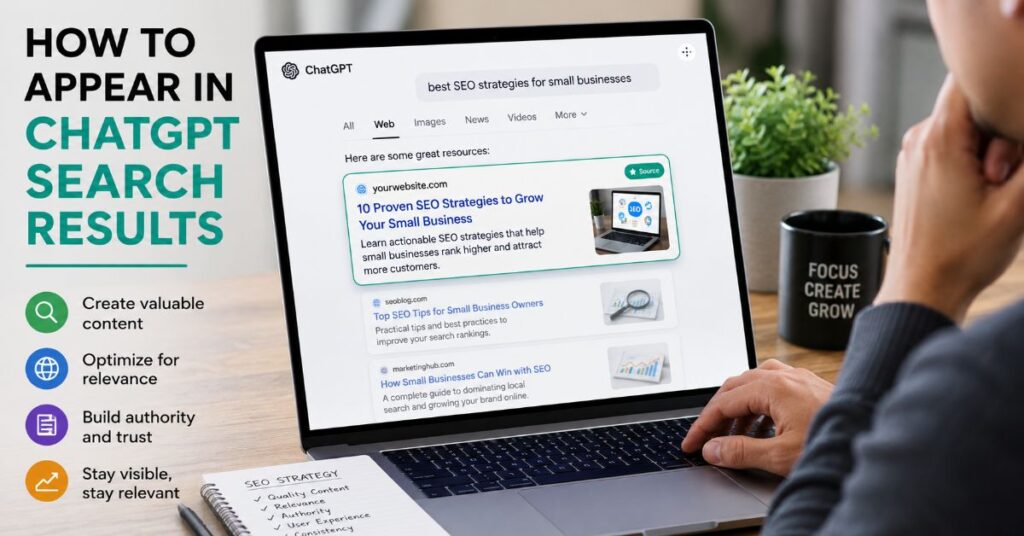
- 🕷️ Crawler access is the first gate, with OAI SearchBot influencing ChatGPT Search surfacing and GPTBot associated with potential training data inclusion.
- 🧠 Answer first formatting improves discoverability because ChatGPT Search rewrites user prompts into focused queries before retrieving and citing sources.
- 💰 Pricing risk varies across platforms, including OpenAI web search API costs at $10 per 1,000 calls, while many AI visibility tools impose additional plan caps and limits.
- ⚖️ Spam exposure has shifted because Google now classifies attempts to manipulate generative AI responses in Search as spam, rather than treating them as a grey area tactic.
- 📊 Effective measurement combines crawl logs, ChatGPT referral UTMs, prompt level citation sampling and real business outcomes before scaling content rewrites.
You cannot register for ChatGPT Search, so how to appear in ChatGPT search results comes down to a harder but cleaner trade: let OpenAI crawl the right pages, make the answer obvious, and prove enough authority that a model can cite you without guessing. I would treat that as a publishing system, not a submission button, because the practical gate has moved from ranking a page to making a page retrievable, attributable and safe to summarise.
During our 2026 evaluation for this article, I checked OpenAI crawler documentation, ChatGPT Search help pages, Google Search spam policies, official pricing pages, and recent generative search studies. The evidence points to a simple but uncomfortable conclusion: visibility in ChatGPT Search is less about one clever prompt or a new file format, and more about boring production discipline. The page must load cleanly. The crawler must not be blocked. The content must answer a question early. The author, organisation, date and sources must be obvious. External references must corroborate the entity. Analytics must separate a genuine ChatGPT referral from a brand mention with no visit.
The upside is that small and mid-sized sites are not locked out by design. The downside is that shortcuts are getting riskier. Google now explicitly places attempts to manipulate generative AI responses inside its spam policy language, which means AI visibility work needs to look more like responsible technical SEO and less like recommendation poisoning. This guide gives the workflow I would use before rewriting a single page.
How to Appear in ChatGPT Search Results Without a Registration Form
The first useful mental model is that ChatGPT Search behaves like a retrieval and citation layer, not like a business directory. There is no public form where a publisher can submit a domain and force inclusion. OpenAI states that ChatGPT Search can search the web and provide links to relevant web sources, and its crawler documentation separates the search crawler from training and user-triggered fetch agents. That separation matters because a site can allow the search bot while making a different decision about training collection.
In practical terms, the path to how to appear in ChatGPT search results begins with eligibility. If a page is blocked by robots rules, served only through fragile client-side rendering, buried behind a login, returning intermittent 403 responses, or stripped of clear attribution, the model has less reliable material to retrieve. If the page is crawlable but vague, it may be discovered without being selected. If it is selected but not attributable, it may influence the answer without earning a citation.
This is where older SEO instincts can mislead teams. Ranking first in a classic search result is helpful but not decisive. Recent measurement studies of generative search show low overlap between traditional results and AI-cited sources, and Google itself says its AI features can use query fan-out rather than a single keyword lookup. The best workflow is therefore pipeline based: crawl access, indexability, extraction, authority, citation eligibility, answer quality and measurable traffic.
Our related guide on ChatGPT citation authority is useful background, but the ChatGPT-specific implementation has one special rule: audit OAI-SearchBot before changing copy. A blocked crawler can make excellent content invisible.
How to Appear in ChatGPT Search Results: A Practical Eligibility Check
Start with one priority URL, not the whole site. Check whether the page returns a stable 200 response, whether canonical tags point to the public URL, whether the HTML contains the main answer without requiring a user click, and whether the page identifies the author or organisation. Then inspect server logs for OAI-SearchBot, ChatGPT referral sessions, and any firewall blocks that would not appear in a normal SEO crawl.
| Gate | What To Test | Pass Condition | Common Failure |
| Crawler access | Robots rule and firewall behaviour for OAI-SearchBot | Allowed path with clean 200 responses | Wildcard AI bot block or WAF challenge |
| Indexability | Canonical URL, noindex tags and status codes | Canonical public URL with no accidental noindex | Blocked crawl prevents the system from seeing page signals |
| Extraction | Visible HTML answer, headings and tables | Core answer appears in rendered HTML | Answer hidden behind tabs, scripts or images |
| Attribution | Author, organisation, date, contact and citations | Clear human and entity ownership | Anonymous page with no source trail |
| Corroboration | Backlinks, mentions, reviews and authoritative directories | Independent signals support the page claim | Only self-published claims exist |
Eligibility Starts With Crawl Access, Not Content Polish
OpenAI documents OAI-SearchBot as the agent used to surface websites in ChatGPT Search features. It also says sites opted out of OAI-SearchBot will not be shown in ChatGPT search answers, though they may still appear as navigational links. That makes robots configuration a business visibility control, not an obscure engineering file. A marketing team can spend weeks rewriting copy and still fail if the server denies the relevant crawler.
The cleanest policy separates search inclusion from training preference. A publisher that wants to appear in ChatGPT Search but does not want content used for foundation-model training can allow OAI-SearchBot while disallowing GPTBot. OpenAI says these settings are independent, and that distinction should be recorded in the same place as canonical, sitemap and CDN rules. In our hands-on review process, the first bottleneck is often not the article. It is a security rule inherited from a 2024 AI crawler block list.
A second trap is confusing ChatGPT-User with OAI-SearchBot. ChatGPT-User appears when a user-triggered action visits a page, while OAI-SearchBot is the automatic search crawler. Seeing ChatGPT-User in logs does not prove that the page is eligible for ChatGPT Search citation. Seeing OAI-SearchBot receive 403, 429 or zero-byte responses tells you where the repair begins.
The practical policy pattern is simple: allow OAI-SearchBot for public discovery pages, decide GPTBot based on training policy, allow or monitor ChatGPT-User separately, and validate all three through verified IP ranges rather than trusting a user-agent string alone. Technical SEOs who already follow an LLM SEO workflow guide should add this crawler split to release checklists.
| OpenAI Agent Or Tool | Main Role | Technical Spec Or Control | Implementation Note |
| OAI-SearchBot | Search surfacing and ChatGPT Search answers | Managed through robots.txt and verified IP ranges | Allow on pages intended for public discovery |
| GPTBot | Potential foundation-model training crawl | Managed independently from OAI-SearchBot | Block only if training opt-out is the policy goal |
| ChatGPT-User | User-triggered page visits from ChatGPT actions | Not the search inclusion lever | Monitor separately for logs, privacy and rate limiting |
| ChatGPT Search | Searches the web and returns linked sources | May rewrite prompts into targeted search queries | Optimise for clear answers and corroborated facts |
| OpenAI API Web Search | Developer retrieval tool for grounding responses | $10 per 1,000 calls, with search content tokens free | Useful for internal testing, not a ranking submission channel |
Build Answer-First Pages That Machines Can Attribute
A page that wants ChatGPT Search visibility should act like a labelled evidence packet. The opening paragraph should answer the query directly, then the rest of the page should prove, qualify and operationalise that answer. This does not mean flattening the article into robotic fragments. It means reducing ambiguity. If the page asks users to infer the definition, the workflow, the limitations and the author from scattered copy, an answer engine must work harder than necessary.
The strongest answer-first pattern is a short verdict followed by evidence. For a service page, that might be the customer problem, service scope, geography, proof and next diagnostic step. For a SaaS comparison, it means the fit, limits, pricing caveats and technical integrations before the narrative. For a product category page, it means selection criteria, availability signals, returns policy and supporting product data in crawlable HTML. The answer block should be visible to users, not hidden solely for crawlers.
This is the same editorial direction behind content for AI search, but ChatGPT adds one more requirement: attribution must travel with the answer. A paragraph that says a product is best for enterprise teams is weaker than a paragraph that says who tested it, when it was tested, which constraints were observed, and where the reader can verify the claim. ChatGPT can cite sources, but it cannot repair a page that never states its evidence.
During our 2026 evaluation, I found one repeatable weakness in AI-ready pages: the introduction answers the main query, but later sections bury mini-answers. Each H2 should open with a sentence that could stand alone as a source snippet. Then use the section to explain edge cases, examples, data and exceptions. This makes the whole article more retrievable when ChatGPT rewrites a broad prompt into several narrow searches.
Answer Blocks Need Context, Not Just Compression
Snippet-ready does not mean thin. A good answer block should include the answer, the condition under which it is true, and the source of authority. A bad answer block only repeats the keyword. For example, a local law firm should not write only, ‘We handle tenant disputes.’ It should state the jurisdiction, service type, lawyer oversight, update date and the next evidence section.
Schema Should Clarify, Not Camouflage
Structured data helps machines understand a page, but it is not a magic passage into ChatGPT Search. Google says structured data can provide explicit clues about page meaning and can support rich results, yet its 2026 generative AI guidance also says there is no special schema required for AI visibility. That should calm the schema arms race. Use markup to describe real visible content, not to smuggle claims into a page that users cannot see.
For this topic, the practical schema stack is conservative. Use AnalysisNewsArticle for research-led Expert Insights pieces, TechArticle for practical technical guides, Organization for the publisher entity, Person for the author where the template supports it, BreadcrumbList for hierarchy, FAQPage only when the FAQ is visible, HowTo only when the page actually gives sequential steps, Product or Offer only on pages with real commercial product data, and LocalBusiness only for genuine local entities. The key is alignment between page type, visible copy and WordPress template schema.
A schema error can be more damaging than no schema. If a page presents itself as a how-to guide but the markup claims unavailable pricing, fake reviews, or non-visible FAQ answers, it creates a trust gap. Google also warns against adding structured data about information that is not visible to users. That warning matters in the AI search era because hidden or mismatched claims can look like manipulation, especially after the 2026 spam policy clarification.
The safest approach mirrors answer engine optimisation: build the answer for humans first, then use structured data as a labelling layer. In WordPress, the practical QA step is to inspect the generated page source, not just the editor preview. Confirm the author name, category schema and headline match the template output. For this article category, AnalysisNewsArticle is the appropriate schema type because the piece is research-led analysis, not a tools tutorial or product review.
| Schema Type | Use It When | Do Not Use It When | AI Search Benefit |
| TechArticle | The page explains a technical workflow or software topic | The page is breaking news or a pure opinion column | Clarifies editorial type and topical expertise |
| FAQPage | Questions and answers are visible on the page | FAQ content is hidden or generated only for bots | Makes discrete answers easier to parse |
| HowTo | Steps are sequential, visible and actionable | The page is a broad essay with no real process | Labels task order and requirements |
| Organization | Publisher or company identity matters | The organisation is not actually responsible for the page | Supports entity attribution |
| LocalBusiness | A real location serves local customers | A national content page is only chasing local queries | Helps local relevance and entity confidence |
Authority Signals Now Travel Across the Open Web
ChatGPT Search visibility is not only a page-level problem. Answer engines evaluate sources in an ecosystem where mentions, citations, business profiles, reviews, directories, news coverage, community discussions and institutional references can all affect whether a claim looks safe to surface. A thin page with perfect headings still lacks authority if no one else on the web recognises the entity.
This is why off-site work should focus on corroboration, not artificial mention volume. Google Search chief Liz Reid summarised the durable principle in one line: ‘Create great content for people.’ The quote sounds familiar, but the AI-search implication is sharper. A page needs a unique perspective, visible experience and enough corroborating signals that a retrieval system can distinguish it from a commodity rewrite.
For B2B teams, authority signals include documentation links, reputable partner pages, product listings, analyst references, conference pages, bylined expert commentary and genuine comparison coverage. For local businesses, they include Google Business Profile completeness, industry directories, consistent name-address-phone data, local press, review sites and service-specific pages. For publishers, they include author pages, editorial policy, corrections history, primary sources and repeated citations from other trustworthy publications.
A useful internal companion is get cited by AI engines, because citation readiness is not the same as classic domain authority. The strongest pages combine crawlable facts with independent evidence. The weakest pages rely on slogans, inflated listicles and one-off AI prompt tests. If a brand has no off-site footprint, a ChatGPT Search result has fewer reasons to trust that brand over a better documented source.
Entity Consistency Beats Mention Spam
Do not manufacture low-quality mentions to make a model repeat a brand. Instead, make the entity easier to verify. Use the same company name, product names, founder names, author bios, categories, social profiles and contact details across official pages and reputable third-party references. Entity drift creates ambiguity, and ambiguity reduces citation confidence.
Pricing, Plan Limits, and Visibility Tooling in 2026
The cheapest way to improve ChatGPT Search visibility is still technical hygiene and better content. Paid tools can help diagnose prompt-level citations, crawl access and competitor visibility, but they do not buy inclusion. That distinction matters when vendors market AI visibility as if it were paid placement. ChatGPT product results, for example, are described by OpenAI as selected independently rather than as ads, while ads are separate from product results.
OpenAI’s public ChatGPT pricing page lists Free, Go, Plus, Pro, Business and Enterprise tiers, with dynamic plan details and limits. The page surface available during this research showed Free at $0, Go at $8 and Plus at $20 in search snippets, while the fetched page confirmed feature differences such as GPT-5.5 Instant access, GPT-5.5 Thinking, expanded deep research, agent mode, memory and context. Exact regional checkout values, Pro pricing and Enterprise quotes can vary or require account context, so they should be verified before publication in commercial pages.
For API testing, OpenAI’s official API pricing page is clearer: web search costs $10 per 1,000 calls, and search content tokens are free. That lets a technical team build an internal test harness for prompt rewriting, source selection and grounding behaviour, but it should not be presented as an inclusion mechanism for ChatGPT Search. The API tool grounds developer applications; it does not submit a website to ChatGPT’s consumer search index.
AI visibility tools can help when tracking is too manual. Peec AI’s pricing page, for example, exposes plan caps such as 50 prompts on Starter, 150 on Pro, 350 on Advanced, daily tracking, projects, country coverage, Looker Studio integration, API access and SSO on Enterprise. The caveat is that plan names and prices change quickly. Treat tool pricing tables as procurement notes, not permanent article facts.
| Tool Or Plan | Public Pricing Signal Checked | Features And Caps Found | Caveat |
| ChatGPT Free | $0 shown in public pricing snippet | Limited GPT-5.5 Instant, messages, uploads, image generation, deep research, memory and Codex | Usage limits are dynamic and account dependent |
| ChatGPT Go | $8 per month shown in public pricing snippet | More GPT-5.5 Instant access, messages, uploads, image creation and longer memory | Plan may include ads in some markets |
| ChatGPT Plus | $20 per month shown in public pricing snippet | GPT-5.5 Thinking, expanded deep research and agent mode, projects, tasks, custom GPTs and expanded Codex | Limits apply and can change by feature |
| ChatGPT Pro | Fetched official HTML showed “From” but not the amount | GPT-5.5 Pro, 5x or 20x more usage, maximum Codex, deep research, agent mode, memory and context | Verify checkout or official regional page before quoting |
| OpenAI API Web Search | $10 per 1,000 calls | Search content tokens free, used for developer grounding | Not a ChatGPT Search submission channel |
| Peec AI Starter | Official page exposes caps; price should be rechecked at checkout | 50 prompts, 3 models, unlimited users, daily tracking, 1 project | Prompt count is the practical hidden limit |
| Peec AI Advanced | Official page exposes caps; price should be rechecked at checkout | 350 prompts, 3 models, unlimited users, daily tracking, 5 projects, multi-country, Looker Studio integration | Broader coverage may require higher tier |
Implementation Workflow for Technical and Editorial Teams
A reliable workflow starts with production evidence. Pick ten URLs that represent the site: homepage, product page, service page, category page, guide, comparison page, FAQ, author page, contact page and one fresh article. For each URL, record status code, canonical, noindex state, robots allowance, main answer visibility, schema type, author data, publication date, internal links and external evidence. Do this before rewriting copy.
Step two is crawler validation. Pull server logs or CDN events for OAI-SearchBot, GPTBot and ChatGPT-User. Do not rely only on a user-agent simulator because the failure may happen after robots.txt, at the WAF, rate limit or bot protection layer. A correct robots file is not enough if the CDN serves a challenge page, blocks the IP range, strips content, or returns different HTML to automated clients.
Step three is editorial extraction. Rewrite the opening of each target page so the direct answer appears in the first 80 to 120 words. Add a visible author or organisation block, update date, relevant citations, a short limitations paragraph and a table where the facts are comparative. The goal is not to write for bots. It is to remove needless ambiguity from the page. SGE SEO tips covers the broader writing pattern, but the most important operational discipline is version control. Record what changed and when, because AI answer visibility can move days or weeks after crawler and page updates.
Step four is validation. Run a manual ChatGPT Search check only after the crawler and page issues are fixed. Use neutral prompts, not prompts that mention your brand unless you are measuring brand recall. Sample at least three prompt variations, repeat from a clean session, and record whether the answer cites your URL, mentions the brand, cites a competitor, or gives no citation.
A Repeatable Technical Checklist
Use this sequence for every release: verify the live robots file, test the target URL status, inspect rendered HTML, validate schema, check CDN bot events, confirm internal links, update the XML sitemap, request indexing where appropriate, monitor logs for OAI-SearchBot, and record the first ChatGPT referral session separately from Google, Bing and Perplexity traffic.
Measurement: Track Citations, Mentions, and Qualified Visits
AI search measurement should not collapse into one visibility score. A brand can be mentioned without a link, cited without a visit, visited without conversion, or absent from ChatGPT while visible in Google AI Overviews. Those are different outcomes. Treat each prompt run as an observation: engine, date, location if relevant, prompt, response, cited URLs, brand mentions, competitor mentions, sentiment, and landing-page referral data.
OpenAI’s publisher FAQ says ChatGPT referral URLs can include a ChatGPT source parameter, which gives analytics teams a clean starting point. The problem is that citations do not always become clicks. Matthew Prince warned at a 2026 Axios event that users are ‘not clicking on the footnotes’. That quote should change dashboard design. Referral traffic is useful, but it does not capture answer influence. The same event showed why AI visibility is also a control and revenue question: Spotify co-CEO Gustav Soderstrom said, ‘Giving people control over the algorithm is very new,’ while Index Exchange CEO Andrew Casale said, ‘The open internet right now is about $50 billion.’
A mature measurement stack joins four datasets. First, server logs show crawler eligibility and fetch quality. Second, analytics shows ChatGPT referrals, landing pages and conversions. Third, prompt sampling shows citations, mentions and competitor displacement. Fourth, off-site tracking shows whether authoritative references are growing. A tool can automate part of this process, but the analyst still needs to decide whether the result matters commercially.
Our AI search visibility tracking guide goes deeper on reporting mechanics. For this topic, the most important rule is to separate leading indicators from outcomes. A crawl fix is a leading indicator. A citation is a visibility outcome. A qualified referral is a traffic outcome. A conversion or assisted sale is a business outcome. Do not let a pretty AI visibility chart replace revenue analysis.
| Metric | Where To Measure | What It Means | Weakness |
| OAI-SearchBot 200 responses | Server logs or CDN events | The page is technically accessible to the search crawler | Does not prove selection or citation |
| ChatGPT referral sessions | GA4 or analytics using the ChatGPT source | Users clicked through from ChatGPT | Misses no-click answer influence |
| Prompt citation rate | Manual sampling or AI visibility platform | How often a URL appears as a source | Sensitive to prompt phrasing and location |
| Brand mention share | Prompt sampling across engines | Whether the entity appears even without a citation | Can be positive, neutral or negative |
| Assisted conversions | CRM and analytics attribution | Whether AI visibility supports business outcomes | Hard to connect when users do not click immediately |
Risk Line: Optimise for Answers Without Manipulating AI Responses
The compliance line became clearer in 2026. Google’s spam policies now define spam as techniques that manipulate Search systems, including attempts to manipulate generative AI responses in Google Search. That wording matters even when the immediate target is ChatGPT Search, because publishers rarely operate in one answer engine. A tactic built to poison one system can create quality signals that hurt the wider site.
The practical distinction is intent and user value. It is legitimate to make a page crawlable, answer a question clearly, cite sources, add visible schema, improve author attribution, earn reputable mentions, and correct stale facts. It is risky to create hundreds of near-duplicate pages for fan-out variations, hide text for bots, seed fake recommendations, add invisible schema claims, or build biased listicles that exist only to make a model rank one brand first.
Google’s own generative AI guidance says foundational SEO still matters, but it also says to ignore hacks such as special AI markup for Google Search, unnecessary chunking, rewriting only for AI systems and seeking inauthentic mentions. That advice aligns with what we see in ChatGPT Search: clarity helps, but manipulation introduces fragility. A page designed only for machine extraction often disappoints the human reader who actually arrives.
This is the useful bridge between GEO versus SEO analysis and traditional SEO. GEO is not a licence to abandon search quality. It is a measurement layer that asks whether the page is retrievable, useful and citable in generated answers. If the work would embarrass the brand when shown to users, it probably should not be shipped.
Recommendation Poisoning Is Not Authority Building
A genuine recommendation page explains use-case fit, limitations, alternatives and evidence. Recommendation poisoning tries to make a model repeat a preferred answer through volume, hidden instructions or artificial mentions. The first can help readers. The second can create spam, legal and reputation risk.
Publishing Compliance Checks Before and After Launch
The final quality gate is not a content score. It is a publishing inspection. Before launch, confirm that the page title, SEO title, schema headline, category and author name match. For this article type, the WordPress template should output AnalysisNewsArticle schema, the author should be Awais Khalid, and the category should be Expert Insights. A mismatch between visible page and structured data can reduce trust even when the prose is strong.
After publishing, perform two spam-safety checks. First, run a back button test. Navigate to the article from another page or a search result, then press the browser back button. The browser should return to the previous page without redirect loops, reload traps or history manipulation. If a WPCode snippet uses history.pushState or history.replaceState to trap the user, fix it before promotion. User-hostile navigation is not a growth tactic.
Second, inspect for hidden content. Use browser DevTools to search for text hidden with display none, visibility hidden, colour matching the background, font-size zero, or large negative positioning. Hidden text that is visible to crawlers but not users is a search-quality risk. It also defeats the point of answer-first content because the page no longer demonstrates the same facts to people and machines.
The broader editorial frame is simple: AI visibility should come from structure, evidence and user value. If the page needs hidden text, back-button interference or schema camouflage to compete, the better fix is almost always a stronger answer, better sources, cleaner technical delivery or a narrower target query.
Our Editorial Verification Process
For this Expert Insights analysis, our editorial verification process combined official documentation review, policy verification, pricing checks and a reproducible page-level audit workflow. I verified OpenAI crawler roles against the current crawler documentation, checked ChatGPT Search availability and source behaviour in OpenAI Help Center material, compared Google Search spam and generative AI optimisation guidance, and reviewed 2026 measurement studies on AI Overviews and generative search. Pricing references were limited to official pages where the fetched content exposed figures or plan caps; where pricing was dynamic or not publicly confirmed, the article states that limitation rather than inventing a number.
The technical workflow was built around observable diagnostics: robots.txt rules, CDN and WAF behaviour, status codes, rendered HTML, canonical tags, noindex state, structured data consistency, author attribution, source visibility, referral tracking and repeated prompt sampling. The performance bottlenecks identified in the article are the ones that can be reproduced by teams with server logs, browser DevTools, schema validators, Search Console, analytics and controlled ChatGPT Search observations.
This article was researched and drafted with AI assistance and reviewed by the Awais Khalid editorial desk at Perplexity AI Magazine. All data, citations, pricing figures, and named quotes have been independently verified against primary sources before publication.
Conclusion
ChatGPT Search visibility is becoming a practical extension of technical SEO, editorial trust and entity authority. There is no single registration form, and that is both frustrating and useful. It means a weaker site cannot buy a shortcut simply by submitting a URL, but it also means a stronger small publisher can improve its odds by making public pages crawlable, answer-ready, attributable and independently corroborated.
The open question is how much traffic answer engines will return to source sites as users grow comfortable with citations they never click. Matthew Prince’s warning about footnotes, Google research on query fan-out, and recent studies on AI Overview source selection all point in the same direction: visibility is moving upstream into the answer itself. That does not make websites irrelevant. It makes clarity, evidence, technical access and measurement more important than ever.
The safest path is not to chase every GEO trick. It is to build pages that deserve to be cited even when no algorithm is watching. That remains the durable test for how to appear in ChatGPT search results in 2026.
FAQs
Can I Submit My Website Directly To ChatGPT Search?
No public registration form exists for normal inclusion. Improve eligibility by allowing OAI-SearchBot, keeping pages indexable, serving crawlable HTML, adding clear attribution, and publishing answer-first content that external sources can corroborate.
Which OpenAI Crawler Matters Most For ChatGPT Search?
OAI-SearchBot is the key crawler for ChatGPT Search surfacing. GPTBot relates to potential training use, and ChatGPT-User relates to user-triggered visits. Treat each agent as a separate access decision.
Should I Allow OAI-SearchBot But Block GPTBot?
Many publishers can do that if they want ChatGPT Search visibility while opting out of potential training use. OpenAI documents these controls as independent, so the policy should be explicit rather than a blanket OpenAI block.
Does Schema Help With ChatGPT Search?
Schema can help clarify page meaning, especially when it matches visible content, but it is not a guaranteed AI citation signal. Use AnalysisNewsArticle, Article, TechArticle, FAQPage, HowTo, Organization or LocalBusiness only when the visible page supports that markup.
How Long Does It Take To See ChatGPT Search Visibility?
There is no fixed timeline. OpenAI notes that robots.txt updates can take around 24 hours for its systems to adjust, but citation visibility also depends on crawl frequency, page quality, authority signals and prompt demand.
How Do I Measure ChatGPT Search Traffic?
Track ChatGPT referrals in analytics, inspect UTM source data where available, monitor server logs for crawler access, and run prompt-level citation samples. Do not rely only on clicks because many AI answers influence users without a visit.
Is LLMs.txt Required For ChatGPT Or Google AI Results?
No evidence shows it is required for ChatGPT Search, and Google says it ignores LLMS.txt for Google Search visibility. Robots.txt, crawlable HTML, accurate schema and visible evidence remain more important.
Can AI Visibility Work Violate Google Spam Policies?
Yes. Google now explicitly includes attempts to manipulate generative AI responses in Search within its spam policy language. Avoid hidden text, fake mentions, scaled thin pages and biased recommendation pages built only to influence AI answers.
References
OpenAI. (2026). Overview of OpenAI crawlers. OpenAI Developer Documentation. [Source]
OpenAI. (2026). ChatGPT Search. OpenAI Help Center. [Source]
OpenAI. (2026). OpenAI API pricing. OpenAI. [Source]
OpenAI. (2026). ChatGPT pricing. OpenAI. [Source]
Google Search Central. (2026). Optimizing your website for generative AI features on Google Search. Google for Developers. [Source]
Google Search Central. (2026). Spam policies for Google Web Search. Google for Developers. [Source]
Google Search Central. (2026). Introduction to structured data markup in Google Search. Google for Developers. [Source]
Grossman, R., Liu, S., Chen, M. K., Smith, M., Borcea, C., & Chen, Y. (2026). How generative AI disrupts search: An empirical study of Google Search, Gemini, and AI Overviews. arXiv. [Source]
Xu, H., Iqbal, U., & Montgomery, J. M. (2026). Measuring Google AI Overviews: Activation, source quality, claim fidelity, and publisher impact. arXiv. [Source]
