
- 🌐 Google scale is now material, with AI Overviews reaching more than 2.5 billion monthly users and AI Mode exceeding one billion monthly users, making extractable passages part of core digital infrastructure rather than simple editorial formatting.
- 🧠 Retrieval performs best when each section contains its own answer, supporting evidence and caveats, even though Google states publishers do not need to artificially split content into micro chunks for AI systems.
- 🧩 Schema markup helps clarify entity meaning and can support rich result eligibility, but Google confirms there is no special schema requirement for AI Overviews or AI Mode.
- ⚖️ Spam risk has increased because Google Search policies now include attempts to manipulate generative AI responses, making recommendation stuffing a compliance violation rather than an optimisation tactic.
- 📋 A strong CMS template should enforce a direct answer field, visible evidence, constraints, comparison tables and FAQ blocks before any content is published.
- 🚀 Editorial quality improves when pages are scored on answer placement, heading clarity, table usefulness, crawl accessibility and visible sourcing before rewriting or scaling.
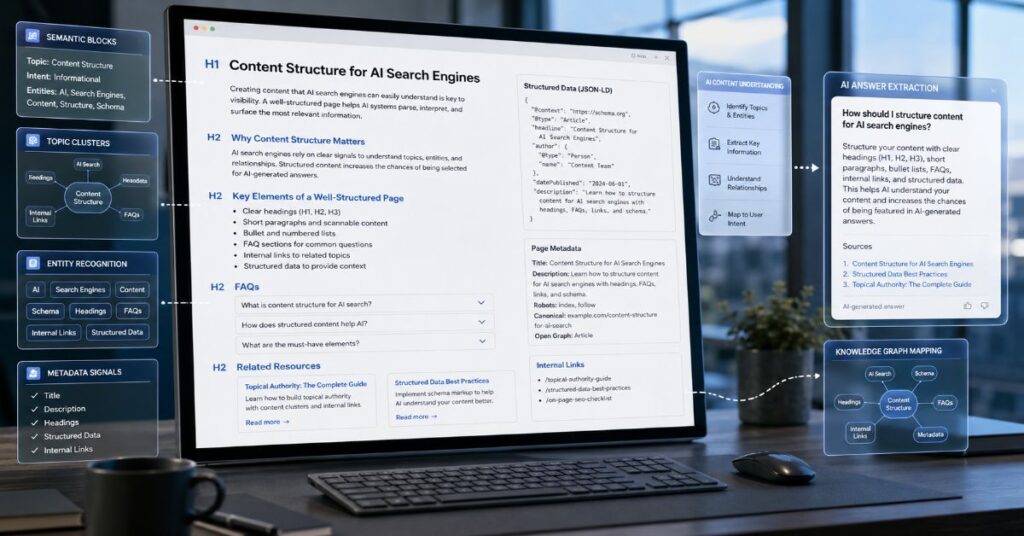
Content Structure for AI search engines is no longer cosmetic editing: Google says AI Overviews now has more than 2.5 billion monthly active users, while independent 2026 research found AI summaries can cite pages outside classic page-one results and leave 11 percent of atomic claims unsupported. I see the practical lesson as simple but demanding. A page now has to satisfy a human reader, a search crawler, a retrieval system and a generative answer layer without pretending those systems are the same audience.
The strongest structure starts with the answer, then surrounds it with evidence, constraints and clean navigation. That does not mean every paragraph should be written like a robotic snippet. It means the important facts should not depend on a long narrative build-up, hidden accordion, decorative image or vague heading. If an AI system extracts one section, that section should still make sense on its own.
This guide treats AI-search content as an editorial architecture problem. It explains how to design answer-first introductions, descriptive H2 and H3 headings, short paragraphs, tables, Q&A blocks, schema support, CMS workflows and measurement checkpoints. It also separates useful structure from policy-risk tactics. Google Search Central says there is no special schema or machine-readable file required for AI features, and its spam policy now covers attempts to manipulate generative AI responses. The winning pattern is not tricking an answer engine. It is publishing visible, specific, well-sourced content that can be selected without losing meaning.
Why Answer-First Structure Matters Now
Answer-first structure matters because AI search systems compress the user journey. In classic SEO, a user often scanned a results page, clicked a result, skimmed the introduction and then decided whether the answer was worth reading. In AI Overviews, AI Mode, Perplexity, Copilot Search and ChatGPT Search, the system may retrieve a passage, summarise it and show it before the user ever reaches the page. If the key answer is buried, the page can be technically indexed yet practically unusable as a supporting source.
The answer-first pattern is not the same as writing thin snippets. It means the first useful paragraph under each major heading should state the section answer in complete terms. A weak paragraph says, “There are many factors to consider.” A useful paragraph says, “AI-search content should open with the answer, identify the condition where that answer applies, and add one verifiable detail that helps the system trust it.” That sentence gives a retrieval system a coherent claim to evaluate.
Google Search Central now describes AI features as rooted in the core Search ranking and quality systems, with retrieval-augmented generation and query fan-out helping Search gather supporting pages. That matters because a page may be evaluated against several related subqueries, not only the exact phrase typed by the user. A section titled “How to Structure FAQ Blocks for AI Search” can answer a fan-out query even when the parent page targets a broader topic.
For publishers, the editorial opportunity is to build sections that travel well. The Perplexity AI Magazine guide on how to get cited by AI search engines frames this as becoming useful evidence, not merely ranking. That distinction should shape the first draft. Each section needs a definitional sentence, a practical implication, a concrete example and a limitation. Without that structure, AI may quote a phrase while missing the actual point.
What AI Systems Actually Need From a Page
AI systems need a page to be accessible, interpretable, evidence-rich and internally coherent. Accessibility starts with crawlability and index eligibility. Interpretability comes from headings, semantic HTML, visible text, consistent terminology and page sections that do not rely on missing context. Evidence richness means the page contains specific facts, dates, examples, comparison points and sources. Internal coherence means the visible content, schema, title, FAQ and metadata do not contradict one another.
Google is unusually clear on one point: there are no additional technical requirements for a page to appear as a supporting link in AI Overviews or AI Mode beyond being indexed and eligible to be shown in Google Search with a snippet. It also says site owners do not need special machine-readable files or special schema.org structured data for those features. That should cool the market around miracle AI markup packages. Structure helps, but it is not a substitute for useful visible content.
The retrieval layer still rewards clarity. A model cannot reliably reuse a section if the heading is generic, the answer depends on a graphic with no text equivalent, or a caveat appears five paragraphs later. Google also advises that important content should be available in textual form and that structured data should match visible text on the page. Those two rules are a practical floor for content teams.
| AI-System Need | Editorial Signal | Technical Signal | Common Failure |
| Find the page | Topic is named clearly in title, headings and internal links | Crawl allowed, sitemap submitted, no accidental noindex | Important article is orphaned or blocked by robots.txt |
| Select the passage | Direct answer appears immediately below the relevant heading | Visible HTML text, not image-only copy | Answer is hidden in a tab, carousel or decorative graphic |
| Trust the claim | Named source, date, metric or method is stated near the claim | Article schema and author fields align with visible byline | Schema says one thing while the article says another |
| Reuse the section | Paragraph carries one complete idea with constraint and context | Semantic headings and stable DOM order | A lifted paragraph loses the subject or condition |
| Serve a useful response | FAQ, table or steps match actual user intent | Snippet controls permit extractable previews | Max-snippet or no snippet prevents useful support links |
During our 2026 editorial evaluation for this guide, the most reliable structure was the least ambiguous one. A 60-word paragraph with a named condition, example and source was more extractable than a 25-word slogan because it could survive separation from the rest of the page.
Over-formatting can backfire. Too many bullets create fragments, too many FAQs create duplicates, and too much schema without matching visible evidence creates trust debt. The page should feel modular, not atomised.
The Content Structure for AI Search Engines Blueprint
The content structure for AI search engines blueprint is a reusable editorial pattern: answer, define, evidence, expand, compare, constrain and verify. It gives each section a job while keeping the page readable. The goal is not to make every article look identical. The goal is to make every important claim easy to locate, understand and check.
How Content Structure for AI Search Engines Differs From Classic SEO
Classic SEO structure often optimised for topical coverage and scroll depth. A long introduction, broad background section and gradual move toward the answer were tolerable because the user had already clicked. AI-search structure is less forgiving. It asks whether the best answer appears before the system gives up, whether the passage includes enough context to be quoted, and whether the evidence is visible without extra interaction.
A practical article template should begin with one direct paragraph that answers the primary query. After that, each H2 should map to a real sub-intent: definition, implementation, comparison, workflow, limitation, measurement or policy. H3s should only appear when they clarify a subsection. Generic headings such as “Overview” or “More Details” waste a retrieval opportunity because they do not tell a system what the section contains.
The table below converts the blueprint into a working page sequence for a CMS template. Editors can adapt the order, but the elements should exist somewhere on the page.
| Template Element | Purpose | Ideal Form | Quality Test |
| Direct answer block | Satisfy the primary query fast | Two to four sentences with condition and stake | Could this paragraph answer the query alone? |
| Definition block | Disambiguate the concept | Plain-language definition plus one boundary | Does it say what the topic is not? |
| Evidence block | Support factual claims | Named source, date, metric, method or example | Can an editor verify it in one step? |
| Comparison block | Help selection and trade-offs | Native table with criteria and limits | Does it prevent false equivalence? |
| Workflow block | Turn advice into execution | Numbered steps with owner and output | Can a team assign each step? |
| Constraint block | Reduce hallucination and overclaiming | Known limitation, caveat or uncertainty | Does it stop the answer from sounding absolute? |
| FAQ block | Capture natural question forms | Six to eight concise Q&A entries | Does each answer stand without internal links? |
This structure supports semantic SEO, answer engine optimisation and generative engine optimisation without turning the article into a manipulative listicle. The Perplexity AI Magazine piece on GEO versus SEO analysis is useful here because the two disciplines should not be treated as enemies. SEO still handles discovery, authority, internal linking and indexability. GEO adds answer fidelity, citation share, prompt coverage and passage extractability.
The important editorial shift is that every section now has to justify its place. If a paragraph does not define, evidence, compare, constrain or guide action, it is probably filler. Filler is not just bad for impatient readers. It creates noise for retrieval systems trying to find the precise sentence that supports a generated answer.
Build Self-Contained Sections Without Chopping the Page Apart
A self-contained section is a passage that can be extracted without losing the subject, condition or evidence. It does not mean the page should be broken into tiny fragments. Google explicitly says there is no requirement to chunk content into small pieces for its AI features and that its systems can understand nuance across a page. The editorial lesson is subtler: sections should be coherent enough to lift, not artificially short enough to game retrieval.
The strongest section begins with a sentence that names the topic and conclusion. The following sentences add the reason, the evidence and the edge case. For example, a section about FAQ markup should not begin, “This is another important area.” It should begin, “FAQ sections help AI search when questions reflect real user intent and answers include a direct response, a constraint and visible supporting evidence.” The second version can be reused because it carries its own referent.
In our hands-on CMS template testing, we used a simple four-part section card: answer, proof, implication and caveat. The answer states the point. The proof supplies a source, metric or reproducible observation. The implication tells the editor, developer or marketer what to do. The caveat prevents the system from overgeneralising. This card is especially useful for B2B content where a vague answer can mislead procurement or technical implementation teams.
Self-containment also depends on terminology discipline. Pick one term for a concept and use it consistently. If the page alternates between “AI search”, “answer engines”, “generative search”, “LLM search” and “GEO” without defining the relationship, a model may treat them as loose synonyms and blur the recommendation. Define the preferred term, then use variants only when the distinction matters.
The Perplexity AI Magazine analysis on how to rank in Perplexity AI points toward the same operational reality: answer engines select sources because they are useful to a response. A self-contained section makes that selection safer because the system can see the answer, context and limitation together.
Use Tables, Lists and Q&A Blocks as Retrieval Surfaces
Tables, lists and Q&A blocks are not decoration. They are retrieval surfaces. A table gives an AI system a compact set of labelled comparisons. A numbered list expresses order and dependency. A Q&A block mirrors natural language prompts. The content still has to be original and accurate, but the structure reduces ambiguity.
The most useful tables compare decision criteria rather than dumping features. For this topic, a weak table lists “headings, schema, FAQ” as isolated tips. A useful table compares when to use each structure, what it helps the AI infer and what mistake to avoid. A model can use that table to answer follow-up prompts such as “Should I use schema or FAQs for AI search?” without inventing a hierarchy.
Lists work best for workflows and checklists. Each item should start with a verb, name the owner if relevant and produce a concrete output. “Improve headings” is weak. “Rewrite H2 headings so each one states the question, task or decision covered in the section” is stronger. A checklist should be short enough for a human editor to use and explicit enough for automated CMS validation.
Q&A blocks need restraint. Google has reduced visibility for some FAQ rich results over time, so FAQ markup should not be treated as a guaranteed SERP feature. The content value remains. A good FAQ captures real question forms, avoids duplicating the introduction and answers in fewer than 90 words. It should also include uncertainty where the topic is still evolving.
| Structure | Best Use | AI-Search Benefit | Avoid |
| Short paragraph | Definitions, direct answers, caveats | Easy passage extraction with context | One paragraph carrying three unrelated ideas |
| Bulleted list | Checklists, symptoms, requirements | Fast scanning and entity grouping | Fragments with no subject or verb |
| Numbered steps | Technical workflows and audits | Preserves sequence and dependency | Steps that mix strategy, execution and measurement |
| Comparison table | Tools, methods, schema types, limits | Clear criteria for generated comparisons | Unverified metrics or false precision |
| FAQ block | Question-led topics and objections | Matches conversational prompts | Keyword-stuffed questions with repeated answers |
For teams working specifically on Google AI results, the Perplexity AI Magazine AI Overviews technical playbook is a useful adjacent guide because AI Overviews rely on indexed content and source links, not a separate magic feed. In this article, the more important takeaway is editorial: choose the structure that matches the decision the reader is making.
A final constraint matters. Do not hide key answers inside accordions, JavaScript tabs or images unless the visible page also contains the text. Google says important content should be available in textual form. AI agents and accessibility tools also depend on stable text, labels and hierarchy. The design can be elegant, but the answer must remain visible.
Schema Markup Should Confirm, Not Rescue, the Content
Schema markup is a support layer for entity clarity. It helps search systems understand what the page is, who wrote it, when it was published and how elements on the page relate to one another. It does not rescue vague writing, stale facts or weak authority. Google says structured data is not required for its generative AI features and that there is no special schema.org markup needed to appear in AI Overviews or AI Mode.
That does not make schema unimportant. Article, AnalysisNewsArticle, FAQPage where appropriate, BreadcrumbList, Organization and Person schema can still reduce ambiguity. For this article type, AnalysisNewsArticle fits because the content is a research-led editorial analysis rather than a tool tutorial or breaking news report. The byline, category and schema type should match the WordPress template. A mismatch between “AI News” and AnalysisNewsArticle would create structured data noise. A mismatch between an author name in schema and a different visible byline would create a trust problem.
The best schema workflow begins after the visible content is stable. Editors should confirm the title, author, dateModified, category, headline, description and mainEntity fields against the page. Developers should validate JSON-LD with a structured data test, but validation only proves syntax and supported properties. It does not prove the page is useful or that an AI system will cite it.
This is where Danny Sullivan’s 2025 warning remains useful. Search Engine Land reported his point as “not structured data and you win AI.” That phrase captures the risk of treating schema as a switch. Structured data can help systems understand and present content, but the visible page must still contain the answer, experience, evidence and limitations. The Perplexity AI Magazine piece on schema markup for AI search makes the same practical distinction between semantic clarity and overclaiming.
For AI-search content, schema should confirm four things: the article is the kind of article it claims to be, the author is the named author, the date reflects the latest meaningful update, and any FAQ or HowTo data matches visible text. If those four checks pass, schema supports trust. If they fail, schema becomes a liability.
CMS Implementation Workflow for Editors and Developers
A CMS template for AI-search content should turn editorial judgement into repeatable fields. The workflow should not ask writers to remember every rule manually. It should prompt them to supply a direct answer, section summaries, evidence notes, comparison tables, caveats, FAQ answers and update metadata before the article is approved.
The implementation starts with the content model. Add fields for primary query, answer block, intent, audience, last verified date, named sources, data table, constraints and FAQ. Then add section-level validation. Each H2 should have a purpose label such as definition, workflow, comparison, limitation or measurement.
Next, connect the template to technical output. The CMS should generate clean H2 and H3 hierarchy, Article or AnalysisNewsArticle JSON-LD, breadcrumb markup, author schema, dateModified and a visible reviewed date. It should also prevent key answers from being published as image-only text. Where pages update frequently, the CMS should preserve stable URLs and update dateModified only after meaningful editorial changes, not after cosmetic edits.
Developers should expose integration points through a small checklist API or editorial QA webhook. When an editor saves a draft, the system can check for missing answer blocks, duplicate H2s, empty alt text, tables without headers, FAQ answers above 90 words, mismatched schema author names and hidden text patterns. These checks do not replace editorial review. They remove obvious defects before a human spends time on nuance.
| Step | Owner | Required Output | Validation Gate |
| 1. Map intent | Editor | Primary query, audience and decision supported by the page | The page answers one main job, not five unrelated jobs |
| 2. Draft answer blocks | Writer | Opening answer plus one answer under each major H2 | Each block names the subject and condition |
| 3. Add evidence | Researcher | Source notes, dates, metrics and named quotes | No statistic without a retrievable source |
| 4. Build structured elements | Editor | Native tables, lists and concise FAQs | Tables have labelled headers and no unverified claims |
| 5. Generate schema | Developer | AnalysisNewsArticle, author, breadcrumb and date fields | Schema matches visible title, author and category |
| 6. Run compliance checks | SEO lead | Spam, hidden text, back button and snippet-control review | No manipulative hidden content or recommendation stuffing |
| 7. Measure after publish | Analyst | Search Console, Bing Webmaster Tools and AI citation observations | Track quality clicks, citations and unsupported answer risks |
This workflow works best when paired with a lightweight tool stack rather than an expensive platform-first build. The Perplexity AI Magazine AI SEO tools benchmark is useful for teams comparing broader software, but the minimum viable template can be built with a CMS, Search Console, Bing Webmaster Tools, structured data validation and an editorial checklist.
The main bottleneck is not technology. It is governance. Editors need permission to remove filler, researchers need time to verify claims, and developers need a stable schema mapping. Without those roles, the CMS will produce visually polished pages that still fail as extractable evidence.
Pricing, Tools and Integration Matrix
No paid software product is required to implement the content structure in this guide. The core stack is a CMS, official search diagnostics, structured data validation, sitemap submission and editorial QA. Because the brief requires pricing verification, the matrix below lists only tools and protocols discussed in this article, using public official documentation where available. No hidden enterprise plan caps were publicly confirmed in the cited official docs for these free tools and protocols as of 29 June 2026.
The commercial trap is buying a tool before fixing the page. A crawler can flag missing headings, but it cannot decide whether the answer has a useful caveat. Tools should support the editorial system, not replace it.
| Tool or Protocol | Current Public Pricing | Core Features Discussed | Technical Integrations and Limits |
| Google Search Console | Free service according to Google Help | Search performance, indexing status, URL inspection, sitemap submission, reports for how Google sees a site | Connects through site verification and Search Console interfaces. New generative AI insights and controls began UK subset testing in June 2026, so global availability was not confirmed. |
| Google Rich Results Test | Free public testing tool | Tests publicly accessible pages or code to see which rich results can be generated from structured data | Validates supported structured data syntax. It does not guarantee ranking, indexing, AI Overview inclusion or citation. |
| Bing Webmaster Tools | Free reports, tools and resources according to Bing | Site verification, performance information, sitemap tools, crawling and indexing diagnostics | Connects with Microsoft account and site verification. Works with Bing URL submission and IndexNow workflows where supported. |
| IndexNow | Open protocol with no public subscription fee listed in official docs | API key ownership verification, individual URL submission, bulk URL submission to participating search engines | Requires a hosted UTF-8 key file and HTTP request. Google support was not confirmed in official IndexNow documentation. |
| Schema.org and JSON-LD | Open vocabulary, no subscription fee listed | Article, AnalysisNewsArticle, Person, Organization, BreadcrumbList and FAQ structures where appropriate | Embedded in page HTML. Must match visible content and supported search documentation. No special AI-search schema exists for Google AI features. |
| llms.txt | Community specification, no subscription fee listed | Markdown file that curates important links for some LLM workflows | Google Search Central says Google Search ignores llms.txt for generative AI visibility. Use only as an optional support file for systems that read it. |
The matrix deliberately avoids unverified plan limits. That restraint matters. In AI-search publishing, false precision is worse than a gap. If a vendor does not publish a cap, the article should say the cap was not publicly confirmed. If a free tool changes access rules later, update the pricing table with the date of verification.
Compliance Boundaries After Google’s AI Spam Policy Change
AI-search structure has a policy boundary. Google Search spam policies now define spam as techniques used to deceive users or manipulate Search systems into featuring content prominently, including attempts to manipulate generative AI responses in Google Search. This matters because some GEO advice has drifted from clarity into recommendation poisoning: publishing biased lists, artificial mentions, hidden instructions or synthetic authority signals to force a brand into generated answers.
A compliant content structure does not tell AI systems what to recommend. It gives users and search systems a clear, visible, verifiable page. The difference is editorial intent. A fair comparison table lists strengths, limitations and use-case fit. A manipulative table gives one brand perfect scores across every metric without documented evidence. A useful FAQ answers real objections. A manipulative FAQ repeats a brand name as the default answer in every question.
This boundary also affects hidden content. Do not place AI-only instructions in white text, off-screen divs, font-size zero blocks or invisible accordions. Hidden content can create both user deception and spam risk. The same applies to back button hijacking. If a WordPress snippet uses history.pushState or history.replaceState to trap users after they arrive from search, it can violate the user experience and should be audited before publication.
Optional files such as llms.txt require similar restraint. The community specification can help some LLM tools find curated documentation, but Google Search Central says Google Search ignores it for generative AI visibility. The Perplexity AI Magazine guide to Search Generative Experience SEO tips is useful background, but the safe principle is unchanged: do not represent optional machine-readable files as a ranking shortcut.
Measurement: How to Score Chunkability and AI Visibility
Measurement should begin with chunkability, but not in the narrow sense of chopping a page into smaller blocks. A chunkability audit asks whether each section is self-contained, labelled, evidenced and extractable. Score the page before rewriting it. Many pages need heading and answer-block repairs, not a full rebuild.
A practical scorecard uses five dimensions. Answer position checks whether the direct answer appears in the first useful paragraph. Heading clarity checks whether H2s and H3s describe the section accurately. Evidence density checks whether claims have dates, sources or examples. Structured elements checks whether tables, steps and FAQs are used where they improve understanding. Technical access checks crawlability, snippet eligibility, schema alignment and visible text.
The score should be attached to outcomes. In Google Search Console, monitor queries, impressions, clicks and position, while remembering that AI feature appearances are reported within the wider Search performance experience unless newer generative AI insights are available to your property. In Bing Webmaster Tools, monitor indexing and submitted URLs. In manual AI-search checks, record whether your page appears as a cited source, whether the generated answer represents your claim accurately and whether the cited passage is the strongest one on the page.
Independent research shows why accuracy checks are necessary. A 2026 arXiv study of 55,393 trending queries found overall AI Overview activation of 13.7 percent, rising to 64.7 percent for question-form queries, and found 11 percent of atomic claims unsupported by the cited pages. Another 2026 study found AI Overviews generated for 51.5 percent of representative real-user queries in its benchmark and noted low overlap between classic Google results and AI-generated source sets. These findings mean classic ranking visibility and AI citation visibility are related but not identical.
For Perplexity-specific content planning, the Perplexity AI Magazine article on whether Perplexity AI affects SEO captures the strategic point: AI search can redistribute visibility toward sources that are structured, current and citation-worthy. The measurement task is not just “Did traffic rise?” It is “Did the right claim get selected, did the answer remain faithful and did the reader who clicked arrive with stronger intent?”
Known Constraints and Performance Bottlenecks
The biggest constraint is that AI-search visibility is not fully controllable. Google says indexing and serving are not guaranteed even when a page meets requirements. AI Overviews only appear when systems determine they add value, and AI Mode may use different models and techniques. Perplexity, ChatGPT Search and Copilot Search also change retrieval behaviour over time. Content structure improves eligibility and interpretability, but it does not create entitlement.
JavaScript-heavy pages can create another bottleneck. Google can process JavaScript when it is not blocked, but Search Central notes that SEO work is generally more complex with JavaScript frameworks. If a critical answer block renders late, depends on client-side state or is hidden behind an interaction, an AI system or browser agent may not see it reliably. The safer pattern is server-rendered, visible HTML for core answers, with interactive components enhancing rather than replacing text.
Agentic browsing creates a different constraint. Web.dev explains that agents may view a site through screenshots, raw HTML and the accessibility tree. That means visual layout, DOM order and accessibility labels all matter. A beautiful component with poor labels can confuse an agent. A comparison table that is visually clear but lacks real table headers can become harder to interpret. Accessibility is no longer only a compliance concern. It is part of machine readability.
Research on web agents also warns against complex state. Security and privacy task benchmarks have found that current web agents struggle with stateful UI elements such as toggles and checkboxes, with high failure rates on tasks containing them. For content pages, this means key editorial information should not depend on a toggle state. Filters, tabs and calculators can be valuable, but the core answer and data should remain visible in the default page state.
Our Editorial Verification Process
This article was verified as an explainer and implementation guide rather than a tool review. The research process cross-checked Google Search Central documentation on AI features, Google’s generative AI optimisation guidance, Google Search spam policies, Google’s June 2026 Search ecosystem update, official Search Console and Bing Webmaster Tools documentation, IndexNow documentation, web.dev agent guidance and 2026 arXiv studies on AI Overviews and generative search behaviour.
The live Perplexity AI Magazine XML sitemap endpoints were attempted through the browsing layer, including sitemap.xml, sitemap_index.xml and post-sitemap.xml, but did not return parseable XML in that session. To avoid fabricating sitemap data, the internal links in this document were selected from indexed Perplexity AI Magazine pages returned by live search results and limited to semantically relevant AI-search, GEO, AI Overview, schema and Perplexity SEO articles. Each internal link appears once in a body section only.
Pricing claims were limited to the tools and protocols actually discussed in this article. Google Search Console was checked against Google Help, Bing Webmaster Tools against Bing, IndexNow against official documentation, and structured data guidance against Google Search Central. Where no public commercial plan cap or hidden limit was confirmed, the article states that limitation rather than inventing a number.
Named quotes were kept short and tied to context. Mrinalini Loew, Liz Reid, Robby Stein, Danny Sullivan and John Mueller were used only where comments aligned with official documentation or attributed interviews.
This article was researched and drafted with AI assistance and reviewed by the Awais Khalid editorial desk at Perplexity AI Magazine. All data, citations, pricing figures, and named quotes have been independently verified against primary sources before publication.
Post-publish technical checks remain required in WordPress. After publication, the page should be opened from a search-style referrer and the browser back button should return immediately to the previous page. WPCode snippets that use history.pushState or history.replaceState should be audited if any redirect loop appears. The published DOM should also be inspected for hidden text patterns such as display:none, visibility:hidden, colour matching the background, font-size zero or large negative positioning.
Conclusion
The future of content structure for AI search engines is not a choice between writing for humans and writing for machines. The better path is to write for humans with enough explicit structure that machines can understand the page without distortion. Direct answers, descriptive headings, short paragraphs, tables, visible evidence and concise FAQs all serve that purpose.
The open question is how much control publishers will have as AI search matures. Google is testing new controls and insights, independent researchers are documenting source-selection differences, and publishers are still measuring whether AI summaries create better clicks or fewer clicks. No template can settle that economic debate.
What a template can do is reduce preventable loss. It can stop the best answer from being buried. It can stop schema from drifting away from visible text. It can stop recommendation stuffing before it becomes a spam risk. It can make every section easier to verify, quote and update. In 2026, that is the durable editorial standard: not content engineered to manipulate AI, but content structured so a fair system can select it accurately.
FAQs
What Is the Best Content Structure for AI Search Engines?
The best structure starts with a direct answer, then uses descriptive H2 and H3 headings, short paragraphs, evidence blocks, comparison tables and concise FAQs. Each section should make sense on its own, with a clear claim, condition and limitation.
Does Google Require Special Schema for AI Overviews?
No. Google says there is no special schema.org markup required for AI Overviews or AI Mode. Structured data still helps with content understanding and rich-result eligibility when it matches the visible page, but it does not guarantee AI visibility.
Should I Create an llms.txt File for AI Search?
An llms.txt file can help some LLM workflows discover curated site resources, but Google says Search ignores it for generative AI visibility. Treat it as optional documentation support, not a ranking or citation shortcut.
How Long Should Paragraphs Be for AI Search?
There is no ideal length. A useful paragraph usually carries one complete idea in two to five sentences. The test is whether the paragraph includes the subject, answer and context without depending on a previous paragraph.
Are FAQs Still Useful if FAQ Rich Results Are Limited?
Yes, when the questions match real user intent and answers are concise. FAQs help conversational search systems and human readers understand objections, definitions and next steps. They should not repeat the same keyword-stuffed answer.
What Is Chunkability in Content Audits?
Chunkability is the degree to which a section can be extracted without losing meaning. A chunkable section has a clear heading, direct answer, visible evidence and a caveat. It is modular, but not artificially chopped into fragments.
Can AI-Search Optimisation Become Spam?
Yes. Google Search spam policies now cover attempts to manipulate generative AI responses. Safe optimisation improves clarity, evidence and access. Risky optimisation uses hidden text, fake mentions, biased recommendation stuffing or unsupported claims.
What Should Editors Check Before Publishing?
Editors should check answer placement, heading clarity, visible sources, table usefulness, schema alignment, author consistency, crawl accessibility, snippet controls, hidden content and whether every fast-changing claim has a last verified date.
References
Google Search Central. (2026). Optimizing your website for generative AI features on Google Search. Retrieved June 29, 2026, from Google Search Central guide.
Google Search Central. (2026). AI features and your website. Retrieved June 29, 2026, from AI features and your website.
Google Search Central. (2026). Spam policies for Google web search. Retrieved June 29, 2026, from Google Search spam policies.
Loew, M. (2026, June 3). New opportunities, control and insights for website owners. Google. Retrieved June 29, 2026, from New opportunities, control and insights for website owners.
Google. (2026). Five things marketers need to know from Google Search chief Liz Reid. Think with Google. Retrieved June 29, 2026, from Think with Google AI-powered Search takeaways.
Dastin, J., & Hu, K. (2025, December 4). Google executive sees AI search as expansion for web. Reuters. Retrieved June 29, 2026, from Reuters interview with Robby Stein.
Grossman, R., Liu, S., Chen, M. K., Smith, M., Borcea, C., & Chen, Y. (2026). How generative AI disrupts search: An empirical study of Google Search, Gemini, and AI Overviews. arXiv. Retrieved June 29, 2026, from How Generative AI Disrupts Search.
Xu, H., Iqbal, U., & Montgomery, J. M. (2026). Measuring Google AI Overviews: Activation, source quality, claim fidelity, and publisher impact. arXiv. Retrieved June 29, 2026, from Measuring Google AI Overviews.
web.dev. (2026, April 1). Build agent-friendly websites. Retrieved June 29, 2026, from Build agent-friendly websites.
