
Central Asia has spent the past two years watching the AI infrastructure investment wave wash through the US, the Gulf states, and Southeast Asia without reaching it. That may be changing.
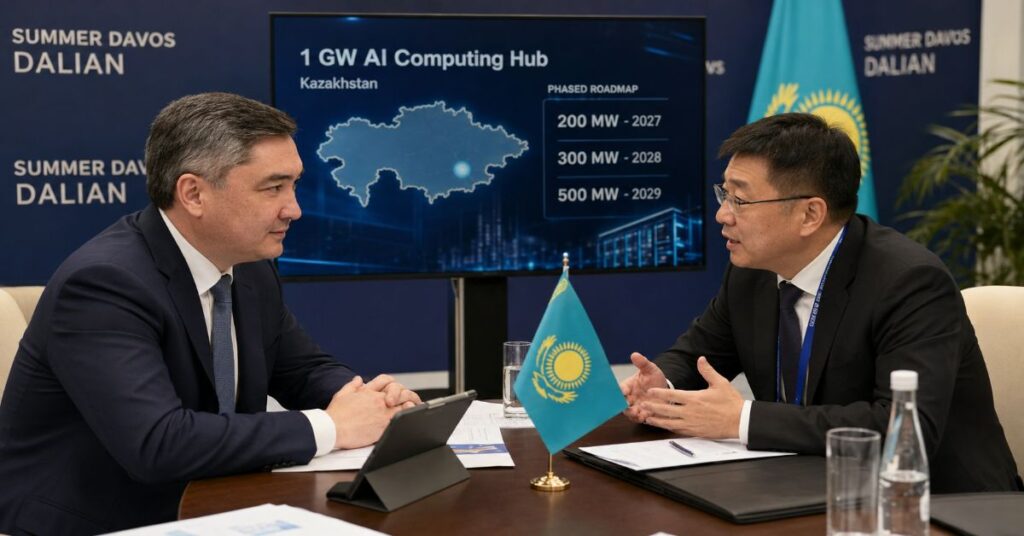
Executives of SuperX AI Technology Limited, a NASDAQ-listed AI data center infrastructure provider, met with Olzhas Bektenov, Prime Minister of Kazakhstan, on the sidelines of the World Economic Forum’s Summer Davos in Dalian on June 23, to discuss a proposed phased construction programme for a 1-gigawatt national intelligent computing centre. Under the proposal, a 200-megawatt cluster would be targeted for completion in 2027, an additional 300 megawatts in 2028, and a further 500-megawatt expansion in 2029 — building to a facility that Kazakhstan envisions as a cross-border computing node bridging Europe and Central Asia, reducing the region’s dependence on foreign computing infrastructure and positioning the country as a digital hub for the broader region.
No binding agreement was signed. What emerged from the meeting was a shared exploration of whether the proposed framework can be translated into concrete deliverables, with the Kazakh side inviting SuperX to conduct local site-selection surveys and both parties discussing the potential establishment of a tripartite joint working group to oversee land use, energy supply, tax policy, and talent development. Whether the meeting produces a signed project or remains a high-level conversation is still to be determined.
Key Developments
- SuperX AI Technology (NASDAQ: SUPX) met with Kazakhstan Prime Minister Olzhas Bektenov on June 23, 2026 at WEF Summer Davos in Dalian to discuss a 1GW AI computing park proposal.
- The phased plan targets a 200MW cluster by 2027, 300MW additional by 2028, and a final 500MW expansion by 2029, positioning the facility as a cross-border Europe-Asia compute node.
- No agreement was signed; Kazakhstan invited SuperX to conduct site-selection surveys and the parties discussed forming a joint working group.
- Kazakhstan has designated 2026 as its Year of Digitalization and AI, and is actively seeking to expand sovereign computing capacity under its Digital Kazakhstan national strategy.
What Happened
According to the official press release, the meeting between SuperX chairman Huang Chenhong and Prime Minister Bektenov focused on a specific project structure: a full-stack AI computing campus including data centre infrastructure, digital systems, server equipment, and power supply infrastructure, built in three phases to reach 1 gigawatt of installed capacity by the end of 2029. SuperX proposed that its existing overseas data center operation model — which it describes as including an Nvidia OEM partnership, liquid cooling and high-voltage direct current solutions, cross-border data compliance frameworks, and manufacturing capacity at domestic and overseas facilities — could be replicated in Kazakhstan to shorten the project’s time-to-production cycle.
The Times of Central Asia’s coverage noted that Kazakhstan has repeatedly identified AI and digitalization as strategic priorities, and that the state investment arm Kazakhstan Invest is actively exploring avenues to expand domestic high-end computing supply. Prime Minister Bektenov acknowledged SuperX’s “world-class intelligent computing operation expertise” and welcomed further coordination with Kazakhstan Invest to evaluate the project’s viability. Huang framed the strategic logic: “Kazakhstan boasts exceptional advantages in geopolitics, energy resources, and foreign investment policies, making it a strong potential anchor in the company’s global computing network.”
The Mechanism: Why Kazakhstan and Why Now
The rationale for siting a gigawatt-scale AI computing hub in Kazakhstan is not primarily about domestic AI demand: Kazakhstan’s population is roughly 20 million, and its domestic AI market is nascent. The strategic logic is geographic and geopolitical. Kazakhstan sits at a unique position in the Eurasian landmass — physically between the European data center market and China’s AI infrastructure complex, but politically sovereign and formally non-aligned in ways that make it, at least in principle, an acceptable location for compute infrastructure to both European companies seeking data sovereignty and Central Asian governments seeking alternatives to either US or Chinese hyperscaler dependence.
The energy-resource dimension is also real. Kazakhstan has the second-largest proven uranium reserves in the world and significant coal, oil, and gas production, giving it the underlying energy availability for power-intensive data centers that many better-connected geographies lack. The country’s relatively low electricity costs — a direct consequence of those domestic energy resources — make a 1-gigawatt AI facility economically competitive with sites in Western Europe or Southeast Asia where electricity is considerably more expensive. The question is whether the physical infrastructure — fibre connectivity, cooling water access, qualified workforce, and construction supply chains — can support a project at the scale SuperX is proposing, in a country that has not previously hosted AI infrastructure at this density.
The Backstory
SuperX AI Technology is a Singapore-headquartered, NASDAQ-listed company that provides end-to-end AI data center infrastructure solutions, including AI servers, direct current systems, liquid cooling solutions, and AI cloud services. The company rebranded from Super X AI Technology in October 2025 and has been expanding its manufacturing and deployment footprint aggressively: it opened a Japan Global Supply Center in early 2026, launched a US AI Inference Cloud Hub, and announced an AI Innovation Centre in Singapore in partnership with ST Telemedia Global Data Centres. The Kazakhstan meeting is part of a pattern of simultaneous geographic expansion into multiple markets, each framed as a node in a global computing network rather than a standalone facility. That expansion mirrors the logic visible in Envision’s Mission Gobi desert data center programme and in the broader wave of AI infrastructure investment in markets outside traditional hyperscaler strongholds that has characterized 2026.
SuperX’s public corporate history includes a significant controversy worth noting. In September 2025, short-seller J Capital Research released a report on Super X AI Technology (before the rebrand) that caused shares to plunge more than 24 percent intraday, and multiple class action investigations were subsequently filed. The company’s market position, its Nvidia OEM credentials, and the legitimacy of its infrastructure claims have all been contested in public. That history does not invalidate the Kazakhstan meeting — a meeting with a head of government at a WEF event is a verifiable fact — but it contextualizes the project’s current status: a proposed framework under discussion between a politically motivated government and a publicly scrutinised company, neither of which has yet committed to a binding project structure.
Reactions
Huang’s public framing of the opportunity, citing Kazakhstan’s geopolitics, energy resources, and investment policies, tracks closely with the language Super X AI Technology has used to describe other geographic expansion opportunities, suggesting the company has a consistent pitch for Central Asian sovereign computing markets rather than a Kazakhstan-specific strategic vision. Prime Minister Bektenov’s response — welcoming further coordination with Kazakhstan Invest — is the diplomatic equivalent of acknowledging the proposal without committing to it, which is appropriate given that no engineering feasibility study, energy availability assessment, or financing structure has yet been disclosed.
The Dispute: Meeting vs. Project
The most important distinction in assessing this announcement is between a meeting and a project. SuperX’s press release is careful to use language like “discussed a proposal,” “feasibility,” and “if realized” throughout, which accurately reflects where the discussions actually stand. But press releases about high-level government meetings at WEF events are also a well-established mechanism for generating investor attention without the obligations that would accompany a formal project announcement, and SuperX has a recent public history of investor scrutiny over how it presents its commercial pipeline. A site-selection survey invitation and a joint working group proposal are meaningful next steps, but they are not a signed agreement, a disclosed energy supply contract, a financing commitment, or a construction timeline.
There is also a broader question about whether Kazakhstan’s Digital Kazakhstan national strategy — and its 2026 Year of Digitalization designation — is generating the kind of regulatory, legal, and infrastructure environment that would actually support a 1-gigawatt AI computing facility on the timeline SuperX is proposing. Building a gigawatt of data center capacity in three years is an extremely aggressive timeline even in markets with established data center supply chains. In Kazakhstan, where the data center sector is nascent, the project would face significant construction, regulatory, and workforce challenges that are not addressed in the meeting announcement. The question that matters more than the headline gigawatt figure is whether SuperX’s first site-selection survey, if it happens, produces a technically feasible 200MW phase-one site that can actually break ground in time to meet the 2027 target. That is the real test of whether this meeting becomes a project.
What Happens Next
The immediate next steps are site-selection surveys and the potential formation of a tripartite joint working group. Both of those activities would represent genuine project progress rather than continued exploration, and either or both could produce a more concrete announcement in the coming weeks or months. The 2027 target for the first 200MW phase is the near-term milestone that will either validate or strain the credibility of the timeline SuperX has proposed. Watch for whether SuperX discloses a Kazakhstan site agreement, an energy supply arrangement, or a financing structure — any of which would signal the project moving from proposal to development, versus remaining a high-profile meeting without a concrete follow-through.
Why It Matters
The SuperX-Kazakhstan discussion is a data point in a broader and genuinely significant trend: the AI infrastructure investment wave of 2025-2026 is beginning to reach Central Asia, a region that has largely been a spectator to the first phase of the AI buildout. Kazakhstan’s geographic position, energy resources, and stated ambition to become a regional digital hub make it a plausible candidate for AI infrastructure investment if the regulatory and project-execution environment can support it. Whether this specific meeting produces a project or not, it reflects the same dynamic that has driven AI data center proposals in the Kazakh steppe, the Mongolian Gobi desert, and high-altitude regions across Central Asia — the combination of cheap land, cheap energy, and geopolitical positioning outside the US-China AI infrastructure corridor is attracting exactly the kind of AI infrastructure capital that would have gone exclusively to established markets just two years ago.
Sources
PRNewswire (SuperX AI Technology); Times of Central Asia; SuperX corporate news page; Yahoo Finance / StockAnalysis.
