
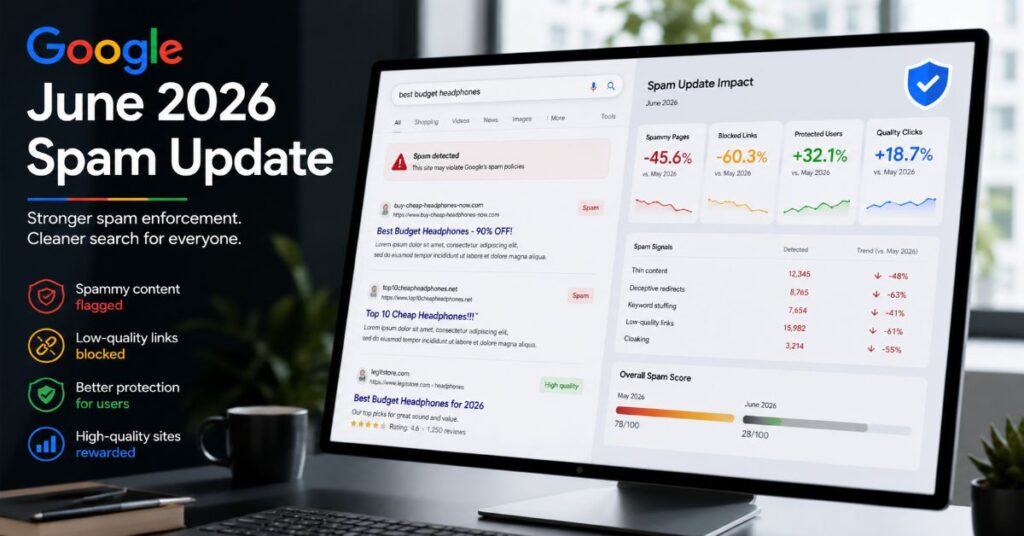
A Google Spam Update can be routine and still reshape your traffic overnight. Google confirmed that the June 2026 rollout is global, covers every language, and may take several days to complete — which means the worst thing an SEO team can do right now is make sweeping changes before the dust settles.
Google’s Search Status Dashboard confirmed the June 2026 spam update went live on June 24, 2026 at 09:00 US/Pacific time. The release note, posted at 09:03 PDT, states the update applies globally and to all languages, with a rollout period of a few days. No companion blog post, no new policy category, no affected-vertical breakdown — just a confirmation and a timeline. What follows is what that means in practice, what it does not mean, and the seven checks that should happen before any major editorial or technical decisions are made.
Key Developments
- Google confirmed the June 2026 spam update began rolling out on June 24, 2026, applying globally across all languages, with a few-day completion window.
- No new spam policy was announced alongside the update — enforcement is against existing policies: cloaking, link manipulation, scaled content abuse, site reputation abuse, and doorway pages.
- AI-generated content is not automatically spam, but content produced at scale to manipulate rankings or AI-generated search responses now sits in an explicitly higher-risk zone.
- The June rollout follows a packed 2026 update sequence: February Discover update, March spam update, March core update, and May core update — making attribution noisy until the rollout fully completes.
What Happened
According to Google’s Search Status Dashboard, the incident opened at 09:00 US/Pacific on June 24 with a release note confirming the June 2026 spam update. The update is described as a global rollout covering all languages, with no new policy guidance attached. Google says it may take a few days to complete, which means early ranking signals during this period should be monitored rather than immediately acted upon. The data below captures what has been confirmed and what each signal means operationally.
| Signal | Verified Detail | Practical Meaning |
| Launch timing | June 24, 2026, 09:00 US/Pacific; release note at 09:03 PDT. | Anchor any traffic analysis to this exact rollout window. |
| Scope | Global, all languages. | Do not limit monitoring to one country or language folder. |
| Rollout length | Google says a few days. | Early movement can reverse before completion — don’t overreact. |
| Policy status | No new guidance attached to the June note. | Audit against existing spam policies, not invented rules. |
| Recovery path | Google’s guidance points sites back to spam policies. | Fix underlying violations and allow systems time to reassess. |
The Mechanism: Spam Update vs Core Update
A spam update and a broad core update are different instruments with different appropriate responses, and conflating them leads to wrong remediation. Google defines spam updates as notable improvements to automated systems that detect search spam, including its AI-based SpamBrain system. Core updates, by contrast, are broad changes to ranking systems that reassess helpful and reliable results across the board. A core update loss can mean a competitor now provides a better answer. A spam update loss points first to policy compliance: cloaking, hacked spam, doorway pages, scaled content abuse, link manipulation, site reputation abuse, scam behaviour, or other deceptive patterns.
The distinction matters for response design. Auditing helpfulness and topical depth is the right response to a core update. Auditing technical compliance — what Googlebot sees versus what users see, link patterns, content scaling practices — is the right response to a spam update. Running the wrong audit wastes time and can lead to unnecessary changes that introduce new problems.
| Comparison Point | June 2026 Spam Update | March 2026 Core Update | Best Response |
| Primary focus | Spam detection and policy compliance. | Broad ranking recalibration for helpful and reliable results. | Match remediation to the update type. |
| Timing | Started June 24, 2026, few-day rollout. | Ran March 27 to April 8, 2026. | Use exact dates before interpreting traffic drops. |
| Likely risk profile | Cloaking, manipulative links, or scaled low-value pages. | Sitewide quality, relevance, usefulness, competitive strength. | Audit spam signals first for June movements. |
| Google guidance | Review spam policies after a spam update. | Wait one full week after completion before deep analysis. | Avoid rushed edits during active rollout. |
The Backstory: A Dense 2026 Update Calendar
The June spam update did not arrive in isolation. Google’s 2026 update history has been unusually compressed: a February Discover update, a March spam update running alongside a separate March core update from March 27 to April 8, and a May core update before this June event. That sequencing creates a real attribution problem for sites that have seen traffic volatility over the past four months. Without careful date-pinned segmentation in Search Console, it becomes difficult to determine whether a June dip is the spam update, a delayed tail from March, or a normal June seasonal pattern.
The update also lands at a moment when Google’s AI search behaviour is evolving rapidly. Google updated its spam policy language in 2024 to include attempts to manipulate generative AI responses in Google Search, which widens the risk zone from traditional blue-link ranking manipulation to AI answer manipulation. Recent research underlines the scale of this shift: one 2026 arXiv study found AI Overviews were generated for 51.5 percent of representative real-user queries in its benchmark, with source overlap below 0.2 average Jaccard similarity across systems. A second study measured 13.7 percent overall AI Overview activation across 55,393 trending queries and found 11.0 percent of atomic claims in those AI Overviews were unsupported by the cited pages. Those numbers are not about the June spam rollout directly, but they show why source quality and claim support now affect search visibility across both traditional and AI-generated results.
Reactions: What Google Has and Has Not Said
Google has not published a companion blog post, query-impact percentage, affected verticals, or examples of pages hit by the June update. According to Google Search Central’s spam update guidance, the recovery path for a spam-related visibility loss is to identify which policies the affected pages may be violating and fix those violations, then allow Google’s systems time to reassess. Google’s Danny Sullivan and Chris Nelson have previously stated that AI use in content production is not automatically against guidelines; the problem is automation used mainly to manipulate rankings, not AI assistance in general. Search Engine Land’s Barry Schwartz characterised spam updates as relevant to sites using manipulative techniques to abuse rankings, which is consistent with the practical risk profile SEO teams should investigate first.
The Dispute: Attribution Is the Hard Part
The core difficulty with spam updates is the same one that makes them stressful: Google does not publish which classifiers fired, which query categories were affected, or which signals tipped pages over the threshold. That opacity means a site can see a significant traffic decline, run a reasonable compliance audit, find nothing obviously wrong, and still have no clear path to recovery because it cannot confirm whether the decline is spam-related at all or a coincidence with the update’s rollout window. The safest approach is to treat any decline with high coincidence to June 24 as a candidate for spam audit, not a confirmed spam hit, and to use Search Console segmentation by date, surface, and directory before drawing conclusions.
A second disputed area is AI-generated content. Google’s policy language says AI-generated content that is useful, accurate, reviewed, and transparent is not at risk. But “reviewed and transparent” is not a binary state, and Google does not publish thresholds for how much human review is sufficient, how much review annotation is required, or how transparency disclosures affect classifier outcomes. Sites using AI production at scale are operating in a policy environment where the rules exist in principle but the enforcement thresholds are opaque — which makes the June spam update’s silence on this dimension more frustrating than reassuring.
7 Checks to Run Before Making Major Changes
The following seven checks represent the practical audit sequence for teams navigating this rollout. The order matters: start with timeline pinning and page-level identification before moving to content quality or technical remediation. Major sitewide changes should wait until the rollout completes and Search Console data stabilises. Running the wrong check first — or making sitewide edits before the data is stable — is how teams end up conflating their own changes with the update’s effects, making it impossible to identify what actually caused the movement they’re trying to diagnose.
A useful framing before starting: not every traffic decline during a spam update rollout is a spam hit. Rollouts cause temporary flux as systems recalibrate, and ranking movement during the first 48-72 hours of a spam update can reverse before the update completes. The goal of these seven checks is to build evidence that either confirms a policy compliance problem or rules one out — not to produce a remediation plan before you know whether you have a problem. Treat the checklist as a diagnostic tool, not a task list.
Match the timeline to ranking drops
Compare Search Console and GA4 data before and after June 24. Segment Web Search, Discover, News, Images, and Video separately — ranking systems affect surfaces differently.
Review pages that lost visibility
Group losses by template, author, topic, language, and section. A pattern in one directory tells a different story than a sitewide decline across unrelated categories.
Test originality and user value
Ask whether the affected pages add reporting, analysis, examples, data, or experience users cannot get from the competing results already ranking. If the honest answer is no, the page is in a risk zone.
Audit scaled AI content
Apply the usefulness-and-intent test: does the AI-assisted page serve users, or exist primarily to capture rankings or influence generative AI responses? Volume is not the problem — volume without review is.
Check link and reputation abuse
Look for paid link patterns, irrelevant outbound links, third-party sections exploiting host authority, and affiliate pages with little independent value added beyond the affiliate relationship itself.
Inspect cloaking, redirects, and hacked spam
Use crawling tools, server logs, rendered HTML comparison, and Search Console security reports to find mismatches between what Googlebot and users see.
Monitor before acting at scale
Build a short daily dashboard for affected directories, top queries, conversions, and index coverage. Avoid mass changes during an active rollout — you cannot separate update effects from your own edits.
Low-Value Content Signals to Watch
Google’s helpful content guidance states its systems are designed to prioritize reliable information created for people, not for search engines. Risk rises when pages exist mainly to catch keywords, repeat publicly available facts, push users through aggressive advertising, hide affiliate intent, or republish third-party content without real editorial control. A concise, focused page can be highly useful; a long page assembled to hit a word count threshold is not. The table below maps the practical low-value indicators most relevant to a spam update context.
One pattern worth watching specifically during this rollout is the relationship between AI content and the scaled-template risk zone. Sites that have been using AI to generate large numbers of topically similar pages — location variants, product variants, keyword variants — may find that individually each page looks acceptable but in aggregate they exhibit the template-and-repetition patterns that spam systems flag as scaled content abuse. Google’s spam policy explicitly covers content generated at scale to rank in search, regardless of whether a human or an AI produced it. The production method is not the issue; the intent and the output quality are.
A second pattern is the overlap between site reputation abuse and the kinds of third-party content sections that have grown common in publishing. Sponsored content hubs, comparison widgets populated by affiliate partners, guest post sections with limited editorial oversight, and programmatic ad units that fill significant above-the-fold space all create situations where the host site’s authority is being used to amplify content it does not directly control. Google’s 2024 update to the site reputation abuse policy targeted exactly this configuration, and spam updates since then have continued to refine detection of it.
| Indicator | What It Looks Like | Safer Fix |
| Commodity summaries | Pages restate widely available facts with no analysis, examples, data, or expertise. | Add original reporting, verified context, and a clear answer to the user’s real task. |
| Scaled templates | Hundreds of near-identical pages swap names, locations, or products without unique value. | Consolidate weak variants and publish only pages with distinct usefulness. |
| Manipulative AI content | Drafts produced at volume to capture rankings or influence AI responses, with little review. | Use AI as production support, then add human verification, sourcing, and accountability. |
| Link manipulation | Paid, irrelevant, exchanged, or disguised links shape the page more than editorial value. | Remove or qualify manipulative links and rebuild pages around user intent. |
| Deceptive presentation | Googlebot sees different content, or users are redirected to unrelated commercial pages. | Align rendered content, server behavior, and user-facing intent. |
AI Content and the New Search Surface
The June rollout is the first spam update since Google explicitly extended its policy language to cover manipulation of generative AI responses, not just traditional blue-link rankings. That policy change, combined with the rapid growth of AI Mode and AI Overviews in Google Search, means spam signals now operate across two surfaces simultaneously: the organic results and the AI-generated answer layer. Publishers focused on how AI-powered platforms are changing content discovery and commerce should understand that the same page-quality signals affecting organic rankings are now also affecting whether a page is cited in AI Overviews. The operational consequence is that low-value content has fewer places to hide than it did 18 months ago.
The practical recommendation for AI-assisted publishing is to build a workflow that makes evidence visible: original sourcing, human review, clear authorship, and a genuine user purpose that can be articulated independently of keyword targeting. A page with transparent authorship, consistent rendered content, clear sources, and a real task it helps users accomplish gives Google’s systems fewer reasons to distrust it under either the spam framework or the helpful-content framework.
What Happens Next
Google has not published a completion timeline beyond the “few days” framing in the release note. Once the update completes, Search Console data typically takes several additional days to fully reflect the new ranking state, which means the earliest point for a reliable post-update analysis is approximately one to two weeks after June 24. The broader trajectory of AI search points toward more frequent spam updates and less public detail on each one, not a step-by-step map. Google is simultaneously developing agentic search experiences that monitor the web continuously for changes, which will make real-time page quality more relevant and make periodic manual audits less sufficient as a primary compliance strategy.
Why It Matters
The June 2026 spam update matters not because it introduces new rules but because it enforces existing ones in an environment where AI-generated content has made scaled, low-value publishing dramatically cheaper to produce and therefore more prevalent. Publishers who treated earlier spam updates as applying to obvious bad actors — link farms, scrapers, doorway pages — now face a policy environment where those same enforcement mechanisms are being applied to high-volume AI publishing programmes that look legitimate from the outside but serve ranking targets rather than user needs. The update is also a reminder that durable search visibility in the AI era requires the same foundations it always has — original content, honest links, clean architecture, clear attribution — applied consistently enough that Google’s systems have no policy-compliant reason to reduce a site’s visibility, regardless of what AI tools were used to produce the content.
Sources
Google Search Status Dashboard (June 2026); Google Search Central (spam policies, helpful content guidance); Search Engine Land (Barry Schwartz); Search Engine Roundtable; arXiv studies on AI Overviews (Grossman et al. 2026; Xu et al. 2026).
