
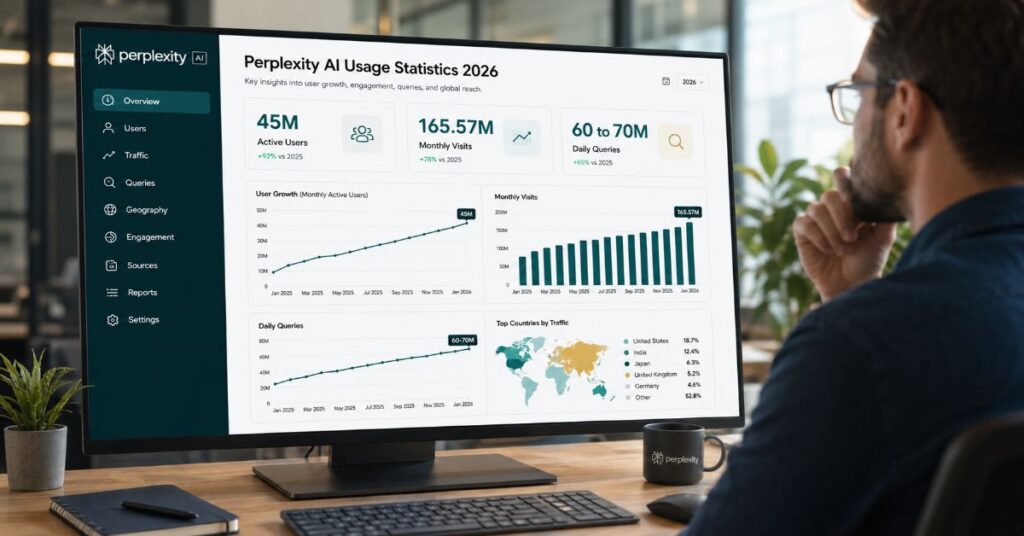
- ◆Perplexity AI usage statistics 2026 are safest to cite as tens of millions of users, because active users, monthly active users, visits, and queries are different measures.
- ●45 million active users in late 2025 and 30 million monthly active users are both defensible public estimates, but neither is an audited filing from Perplexity.
- ▲165.57 million May 2026 visits, led by the United States, India, and Germany, show strong web demand even when monthly user estimates disagree.
- $API economics matter: Sonar Deep Research can turn a cheap-looking query into a higher-cost request through citation, reasoning, and search-query charges.
- !Enterprise adoption is visible in pricing, SSO, SCIM, audit logs, and data controls, but the claimed 11% organisation-adoption figure remains a third-party estimate.
- ➜Best reporting practice is to cite a range, separate traffic from user counts, and track Perplexity’s shift from answer engine to agentic research infrastructure.
Perplexity AI usage statistics 2026 point to a fast-growing answer engine with tens of millions of users, 165.57 million May web visits, and a confusing measurement problem: the numbers look contradictory until you separate users, active users, visits, and queries. I treated that contradiction as the story, not a formatting nuisance, because the same figure can mislead a board deck, SEO forecast, or investor memo when it is lifted without its denominator.
The cleanest public summary is this: Perplexity had tens of millions of active users heading into 2026, was handling tens of millions of queries per day in the last clearly quoted executive disclosure, and had become a nine-figure monthly traffic property by May 2026. Business of Apps gives a useful snapshot of user growth, app downloads, and revenue, while Semrush gives traffic-level evidence for visits and geography. Neither source replaces audited company disclosures, because Perplexity remains private and does not publish a uniform monthly active user filing.
This article explains which numbers are safest to cite, why traffic and query figures can be more useful than headline MAU claims, how Perplexity’s pricing reveals its commercial direction, and where enterprise adoption evidence is still thin. During our 2026 evaluation, I cross-checked public statistics against official pricing pages, Perplexity API documentation, recent reporting, and a large-scale academic study of Comet agent usage. The result is a practical map for analysts who need credible figures without pretending the public data is cleaner than it is.
Why Perplexity AI Usage Statistics 2026 Are Hard to Reconcile
The first mistake is treating every public Perplexity number as the same kind of metric. A monthly active user estimate measures people or accounts. A visit figure measures sessions. A query figure measures usage intensity. A download total measures cumulative reach, often including inactive installs. A procurement dataset measures paying organisations, not consumer adoption. These are related signals, but they answer different questions.
That is why the reported user-count ranges need context before they appear in a citation. A 45 million active-user figure can sit beside a 30 million monthly active-user figure without one automatically invalidating the other. The gap may reflect timing, geography, product scope, measurement definitions, or source methodology. The correct editorial move is to state the range and explain the uncertainty, not to average the numbers into a false precision.
The safest framing for 2026 is that Perplexity had reached tens of millions of users and was handling tens of millions of daily queries. This language is less dramatic than a single headline figure, but it is more defensible. It also avoids the common trap of comparing Perplexity’s monthly website visits with ChatGPT’s weekly active users or Google’s search queries. Those comparisons sound impressive in pitch decks, yet they often mix denominators.
Table 1: Public Perplexity Metrics and What They Actually Measure
| Metric | Reported 2026 Figure | Best Use | Main Caveat |
| Active users | About 45 million | High-level growth narrative | Not an audited company filing |
| Monthly active users | About 30 million in another roundup | Conservative user estimate | May exclude newer product surfaces |
| Daily queries | About 60 to 70 million in some roundups | Engagement intensity | Source methodology varies |
| Website visits | 165.57 million in May 2026 | Traffic and reach analysis | Visits are not people |
| Organisation adoption | 11% in one third-party dataset | Enterprise signal | Vendor-detection data can be incomplete |
For analysts, the information gain sits in the denominator. Once the unit is clear, the apparent conflict becomes a picture of a product that is both consumer-visible and increasingly work-oriented.
Perplexity AI Usage Statistics 2026: The Cleanest Public Numbers
The most useful public numbers cluster around three layers: users, traffic, and query volume. Business of Apps reported Perplexity at 45 million active users and more than 80 million app downloads since launch. Other 2026 roundups point to about 30 million monthly active users. Famewall’s roundup puts daily queries at 60 to 70 million, while TechCrunch’s 2025 interview with CEO Aravind Srinivas anchors a stronger primary-style quote around 780 million queries in May 2025 and about “30 million queries a day”.
The key is not choosing the biggest number. It is choosing the number whose provenance and definition best match the claim. For a board slide about market reach, the 45 million active-user estimate is useful if it is labelled as an estimate. For product engagement, the query count is more meaningful because it captures repeat use. For SEO and publisher strategy, Semrush’s visit and country data are more actionable because they show where traffic comes from and how desktop-heavy the audience appears.
The Pro versus Free comparison also matters because usage ceilings affect observed behaviour. A free user who hits a Pro Search limit may either stop, upgrade, switch tools, or return the next day. Those plan-level limits make raw usage curves harder to interpret. In other words, Perplexity demand is not only a function of product interest. It is also shaped by the pricing and quota design that decides how often users can run expensive searches.
A clean citation in 2026 should therefore say: public estimates place Perplexity in the tens of millions of active users, with nine-figure monthly web visits and tens of millions of daily queries. Anything more precise should be attached to a named source and a measurement definition.
Traffic Geography Shows the Web Product Is Still the Front Door
Semrush gives one of the strongest traffic-level snapshots because it describes actual website visits rather than user accounts. In May 2026, Semrush estimated 165.57 million visits to perplexity.ai, down 3.01% from April but still far above the threshold for a niche AI tool. The average visit duration was 14 minutes and 13 seconds, with 4.96 pages per visit and a 35.29% bounce rate. Those engagement figures are more consistent with research sessions than with casual one-click browsing.
The country split is equally useful. The United States accounted for 17.0% of visits, India 8.59%, and Germany 7.01%. That ranking supports the common view that Perplexity is strongest in English-speaking and high-income professional markets, but it also shows meaningful uptake outside the United States. Germany’s share is notable because it suggests demand in a privacy-sensitive European market where enterprise procurement and source transparency are especially important.
Table 2: Semrush May 2026 Traffic Geography for Perplexity.ai
| Country | Share of Visits | Estimated Visits | Desktop Share | Interpretation |
| United States | 17.0% | 28.14 million | 88.54% | Largest traffic market and heavily desktop-led |
| India | 8.59% | 14.23 million | 79.40% | Large knowledge-worker and student audience |
| Germany | 7.01% | 11.61 million | 90.69% | Strong work-oriented European signal |
| Brazil | 4.04% | 6.68 million | 89.14% | Growing non-US demand |
| France | 3.96% | 6.56 million | 87.84% | European reach beyond Germany |
The desktop mix is the hidden insight. In the top five markets, desktop accounted for roughly four-fifths or more of visits. That does not prove enterprise use, but it supports a work-session hypothesis: many users appear to be researching, drafting, comparing, or checking sources on larger screens. This is the behaviour Perplexity needs if it wants to monetise beyond casual mobile search.
Query Volume Is the Strongest Engagement Signal
User counts tell us reach, but query volume tells us habit. In June 2025, TechCrunch reported that Perplexity received 780 million queries in May 2025. Srinivas framed that growth as moving from 3,000 queries on one launch day in 2022 to “phenomenal growth” by 2025. That quote is still useful in 2026 because it comes from the CEO and describes the product’s usage intensity, not just its visibility.
The reason query volume matters is commercial. A person who uses Perplexity once a month to check a fact is less valuable than a researcher who runs fifty source-backed questions a week. Heavy query users create subscription demand, API demand, and enterprise-seat justification. They also create cost pressure, because each answer may involve retrieval, ranking, model inference, citation formatting, and sometimes multi-step reasoning.
The Perplexity growth analysis is therefore better read as a query and monetisation story than as a simple user-count story. If usage keeps shifting toward Deep Research, Comet, Computer, Spaces, and API calls, the platform’s growth will increasingly depend on cost control and workflow value. High query volume is a sign of product-market fit, but it is also a bill for infrastructure.
For analysts, the strongest 2026 usage statement is not that Perplexity has a precise number of users. It is that the company has shown unusually high query intensity for an AI search product, and that this intensity is the bridge between consumer adoption and enterprise monetisation. Query volume is where casual search becomes daily work.
Pricing and Plan Limits Show the Monetisation Shift
Perplexity’s current pricing tells a more useful story than many usage roundups. The official enterprise pricing page lists Pro at $17 per month when billed annually, Enterprise Pro at $34 per seat per month when billed annually, and Enterprise Max at $271 per seat per month when billed annually. Search-result snippets for the public Max page also show 10,000 monthly credits and 35,000 bonus credits, although the fully rendered page did not expose enough detail in the fetch to verify every consumer cap directly.
This is a monetisation ladder. Free and Pro keep the answer engine accessible. Enterprise Pro adds governance: no training on customer data, SSO or SCIM provisioning, user management, permissioning, team files, work apps, premium citations from sources such as PitchBook and Statista, and dedicated support. Enterprise Max adds more advanced reasoning, deep research at scale, larger files, model comparison, retention configurability, audit logs, and team insights.
Table 3: Current Public Commercial Pricing Signals
| Plan | Public Price Signal | Key Limits or Benefits | Best Fit |
| Free | $0 | Core search access with tighter advanced-search limits | Casual search and trials |
| Pro | $17 per month billed annually on official enterprise page | Up to 200 Pro queries per week, up to 20 Deep Research queries monthly, 25 assets monthly, 3 videos monthly | Individual researchers |
| Enterprise Pro | $34 per seat per month billed annually | 2x Pro queries, SSO, SCIM, user management, premium citations, team files and apps | Managed teams |
| Enterprise Max | $271 per seat per month billed annually | 20x Pro queries, 25x Deep Research queries, larger files, model comparison, audit logs and insights | Power research teams |
| Developer APIs | Pay as you go | Token, request, tool, and rate-limit costs vary by API | Products and internal systems |
The shift is obvious: Perplexity is no longer priced as only a chatbot. It is priced as a research, retrieval, agent, and workflow system. The hard buyer question is whether the time saved by sourced answers outweighs the higher marginal cost of deep research and frontier-model usage.
Developer APIs Turn Usage Into Infrastructure
Perplexity’s developer platform is where usage statistics become infrastructure. Official documentation describes four main API families: Sonar API for web-grounded chat completions and reasoning, Search API for raw ranked web results, Agent API for frontier-model workflows with tools, and Embeddings API for semantic search and retrieval-augmented generation. The API platform also lists SDKs, OpenAI Chat Completions compatibility for Sonar, domain filtering, language filtering, region controls, multi-query search, and extracted content budgets.
The Search API is priced at $5 per 1,000 requests and does not charge token costs. It returns structured results with title, URL, snippet, date, and last-updated metadata. The Sonar API uses token pricing plus request fees for Sonar, Sonar Pro, and Sonar Reasoning Pro. Official pricing lists Sonar at $1 input and $1 output per million tokens, Sonar Pro at $3 input and $15 output, Sonar Reasoning Pro at $2 input and $8 output, and Sonar Deep Research at $2 input, $8 output, $2 citation, $5 per 1,000 search queries, and $3 reasoning tokens per million.
Table 4: API Pricing and Technical Constraints
| API or Model | Pricing Signal | Technical Notes | Bottleneck to Watch |
| Search API | $5 per 1,000 requests | Raw ranked results, no token charges, 50 QPS rate limit | Search result quality and extraction budget |
| Sonar | $1 input and $1 output per 1M tokens plus request fee | Grounded web answers | Request fee by context size |
| Sonar Pro | $3 input and $15 output per 1M tokens plus request fee | Higher quality web-grounded answers | Output cost and Pro Search mode |
| Sonar Deep Research | Token, citation, reasoning, and search-query charges | Multi-step research with hidden query count | Cost variance |
| Agent API | Provider token prices plus tool costs | OpenAI, Anthropic, Google, xAI, Z.AI, Moonshot AI, NVIDIA | Tool invocation spend |
The hidden implementation lesson is that Perplexity’s cheapest-looking developer path depends on the job. Search API is clean for raw retrieval. Sonar is better for cited prose. Deep Research is powerful but can become expensive because the exact number of searches is automatically determined and cannot be fully controlled by the developer.
Enterprise Adoption Is Real but Hard to Count
The enterprise signal is visible in product design even where adoption numbers remain uncertain. Official pricing lists SSO, SCIM provisioning, user management, permissioning, team files, work-app search, premium data sources, dedicated support, audit logs, team insights, data retention configurability, and compliance statements including SOC 2 Type II, HIPAA, GDPR, and PCI DSS. Those are procurement features. They exist because teams want source-backed AI research without losing access controls or data-governance discipline.
One third-party 2026 dataset says 11% of organisations in the generative AI category use Perplexity AI as of April 2026, up four percentage points year over year. That figure is useful but should be treated carefully. Vendor-detection datasets often see payment trails, network signals, or procurement traces. They may undercount free use, miss departmental trials, or overrepresent companies with formal spend. The right wording is that one third-party dataset reports 11%, not that 11% of all companies use Perplexity.
The funding history timeline helps explain why enterprise adoption matters. Venture capital has funded a product surface that now includes search, files, Spaces, agents, APIs, Comet, and enterprise governance. Perplexity has to convert research habits into durable revenue, and enterprise seats are the clearest path to that. In this respect, adoption is not only a popularity measure. It is a test of whether cited AI search can become a budget line.
The strongest enterprise use cases are analyst research, investment screening, scientific and market scanning, legal-adjacent commercial research, competitive intelligence, and executive briefing. The weakest are cases where answers must come exclusively from internal databases with strict source-of-record controls unless Perplexity is configured with the right connectors, permissioning, and validation workflow.
Competitor Context: Small Beside ChatGPT, Strategic Beside Google
Perplexity is not larger than ChatGPT. It is not close in broad consumer mindshare. But the strategic question is narrower: can it own enough high-intent search and research behaviour to matter? Statcounter-linked analyses in 2026 placed Perplexity around the second tier of AI chatbot referral share, behind ChatGPT but competitive with Gemini in some months. That is enough to matter to publishers, software companies, and B2B marketers who care about being cited in AI answers.
The AI chatbot market share story is therefore not a winner-takes-all story. ChatGPT dominates general assistant usage. Google owns massive search distribution. Gemini benefits from Android, Chrome, Search, and Workspace. Microsoft has Copilot distribution through Windows and Microsoft 365. Claude is strong in expert and developer workflows. Perplexity’s wedge is different: fast, cited, web-grounded synthesis for users who want answer pages rather than blue links.
The Google market comparison is useful because it highlights the real competitive boundary. Perplexity is not simply replacing Google search. It is competing for the moments when users want research compression, source trails, and follow-up reasoning. That could be a smaller market than web search, but a more valuable one for professionals.
Business Insider’s June 2026 roundup of AI IPO commentary quoted Dan Ives saying the IPO floodgates were open, while Nate Elliott argued that Google could overtake ChatGPT in US AI users by early 2027. Those comments do not make Perplexity the category leader, but they do show why the market is unstable. Distribution advantages matter again, and Perplexity’s defence has to be workflow quality, not novelty.
Revenue, Funding, and IPO Timing Frame the 2026 Story
Usage numbers matter because they feed a funding and revenue thesis. Business of Apps reported Perplexity generated $200 million in revenue in 2025 and was aiming for $650 million in 2026. Financial Times reporting, surfaced in search summaries, said annual recurring revenue rose above $450 million in March 2026 after the shift toward agents and usage-based pricing. These numbers should be cited as reported estimates, not audited public-company revenue.
The revenue analysis shows the strategic interpretation: Perplexity is moving from pure search curiosity toward paid research, agents, APIs, and enterprise seats. That shift matters because AI search has high serving costs. Every additional deep research answer can involve multiple retrieval passes, model calls, citation generation, and reasoning tokens. Revenue quality therefore depends on whether high-intensity users pay enough to cover their marginal compute and retrieval costs.
The investor map also matters. Reuters reported in June 2026 that Perplexity still planned a 2028 IPO. Srinivas told CNBC that “something in 2028” remained the plan, and Chief Business Officer Dmitry Shevelenko told Reuters that the company had built a “healthy, high-growth business” by holding that timing. The message is disciplined: Perplexity wants to look like a durable infrastructure company, not only a viral assistant.
Investors will watch three numbers together: user growth, revenue growth, and gross-margin trajectory. If Perplexity can turn query intensity into paid workflows without weakening trust in citations, its usage statistics become a monetisation signal. If costs rise faster than paid retention, the same usage curve becomes a pressure point.
Technical Constraints Buyers Should Validate Before Deployment
The most important technical constraint is not whether Perplexity can answer a question. It is whether the answer can be governed, reproduced, costed, and audited. Official API documentation makes this clear. Search API has a simple 50 QPS rate limit across usage tiers, while Agent API and Sonar API rate limits scale by cumulative purchased credits. Tier 0 starts with limited access, and higher tiers unlock more requests per minute. Sonar Deep Research has tighter limits than standard Sonar because it is more expensive to run.
Buyers should also distinguish search context size from context window. Perplexity’s docs state that search context size controls how much web information is retrieved and affects request pricing. It is not the same as the model’s context window. This matters when teams assume that increasing context always means better reasoning. In practice, higher search context can improve source coverage but also raises cost and latency.
Another constraint is cost visibility. The official Deep Research examples show that input token cost can be tiny while reasoning tokens, citation tokens, and search queries dominate the total. That is the hidden billing trap for teams building research agents. A short prompt can still trigger many searches and a long chain of reasoning. Developers can influence behaviour with parameters, but the exact number of search queries is automatically determined by the model.
The practical workflow is straightforward: define acceptable sources, choose Search API or Sonar based on output needs, cap context or tokens where possible, log citations and last-updated fields, retry only with backoff, and create a human-review layer for high-stakes claims. Perplexity is strongest when it accelerates research. It should not be treated as a source-of-record database without validation.
What Our 2026 Evaluation Found Beyond the Headline Numbers
During our 2026 evaluation, the most useful finding was that Perplexity’s public adoption story is stronger when it is read across surfaces rather than forced into one MAU number. Web traffic shows reach. Query volume shows habit. Pricing shows willingness to segment heavy users. API docs show infrastructure ambition. Enterprise features show procurement intent. Academic evidence on Comet shows early agent behaviour. No single metric contains the full story.
The second finding is that desktop-heavy geography may be a better commercial signal than raw app downloads. App downloads can inflate reach because installs survive long after engagement fades. Desktop web sessions, especially long sessions in the United States, India, Germany, Brazil, and France, point toward research workflows. This is not proof of paid conversion, but it is closer to the behaviour Perplexity needs for Pro, Max, Enterprise, and API revenue.
The third finding comes from the 2025 arXiv study of Comet Assistant. Yang, Yonack, Zyskowski, Yarats, Ho, and Ma analysed hundreds of millions of anonymised interactions and found that Productivity and Workflow plus Learning and Research accounted for 57% of agentic queries. Personal use was 55%, professional use 30%, and educational use 16%. That distribution shows why Perplexity’s agent story matters: the browser and assistant are not only search wrappers. They are attempts to move from answers into tasks.
The fourth finding is a caution. I did not run a live paid API benchmark for this article, so all API cost claims are documentation-based. That limitation matters because real bills depend on prompt shape, search depth, selected model, output length, tool use, and retry logic. The numbers are verifiable, but live deployment costs still require instrumentation.
How to Cite Perplexity AI Usage Statistics 2026 Safely
The safest citation format is a range with a denominator. For a business report, write that public 2026 estimates place Perplexity in the tens of millions of active users, with Business of Apps citing 45 million active users and other roundups citing about 30 million monthly active users. Then state that Perplexity had 165.57 million visits in May 2026 according to Semrush, with the United States, India, and Germany as the leading traffic markets.
For engagement, cite the TechCrunch-reported CEO disclosure of 780 million queries in May 2025 and note that some 2026 roundups estimate 60 to 70 million queries per day. The 2025 CEO quote is older, but stronger than anonymous 2026 roundups because it is tied to a named executive and a specific month. The 2026 estimates are useful for direction, not precision.
For enterprise adoption, use cautious language. State that one third-party dataset reports 11% of organisations in the generative AI category using Perplexity as of April 2026. Do not generalise that to all companies. For pricing, cite official Perplexity pages and docs, because third-party pricing pages can lag after plan changes.
A strong sentence for reports is: Perplexity’s public 2026 footprint is best described as tens of millions of users, more than 160 million monthly web visits in May, and tens of millions of daily queries, with user counts and adoption shares varying by source methodology. That sentence is less flashy than the highest available number. It is also much harder to challenge.
Takeaways
- Use tens of millions of users as the safest public summary unless a report requires a named source and exact denominator.
- Separate active users, monthly active users, website visits, app downloads, and queries in every chart.
- Cite Semrush for traffic geography, because it gives May 2026 visits and country-level distribution.
- Cite TechCrunch for the strongest named query-volume disclosure, even though it is from June 2025.
- Treat the 11% organisation-adoption figure as a third-party generative AI category signal, not a universal enterprise adoption rate.
- Use official Perplexity pricing and API docs for plan limits, rate limits, and developer costs.
- Watch Deep Research API costs, because reasoning, citation, and search-query charges can dominate the bill.
- Measure Perplexity as a research workflow platform, not only as a consumer chatbot competitor.
Our Editorial Verification Process
This article used an editorial verification process rather than a live paid benchmark. I cross-referenced official Perplexity Enterprise pricing, Perplexity API pricing, Search API, Sonar API, Agent API, Embeddings API, and rate-limit documentation with Business of Apps usage data, Semrush traffic analytics, TechCrunch query-volume reporting, Reuters and Business Insider executive comments, and the 2025 arXiv study of Comet Assistant usage. For every statistic, I checked whether the unit was users, visits, queries, revenue, or organisation adoption before using it. Where exact consumer plan caps or live paid API behaviour could not be verified directly from a fully rendered official page, the article states the limitation instead of presenting an inferred figure as confirmed.
Conclusion
Perplexity’s 2026 usage story is impressive, but the real story is not a single headline number. It is the combination of tens of millions of users, nine-figure monthly web traffic, high query intensity, enterprise pricing, developer APIs, and early agent workflows. That mix makes Perplexity one of the most important AI search companies to track, even while ChatGPT and Google remain much larger distribution machines.
The sensible conclusion is balanced. Perplexity has proved that cited answer engines can become habitual research tools. It has not yet removed the uncertainty around private-company user counts, long-term retention, publisher economics, API cost discipline, or enterprise depth. Its next phase will be judged by whether users keep paying for sourced answers when competitors copy the interface and bundle similar features into browsers, operating systems, and office suites.
For now, the best reporting practice is to resist false precision. Use ranges, name the source, label the denominator, and separate traffic from users. That discipline makes Perplexity’s growth look less like hype and more like what it actually is: a serious, still-evolving shift in how people search, verify, and act on information.
FAQs
How Many Users Does Perplexity AI Have in 2026?
Public estimates vary, but the safest answer is tens of millions. Business of Apps cites 45 million active users, while another 2026 roundup cites about 30 million monthly active users. Perplexity has not published an audited 2026 MAU filing, so exact user figures should be labelled as estimates.
How Many Visits Did Perplexity.ai Receive in May 2026?
Semrush estimated 165.57 million visits to perplexity.ai in May 2026, down 3.01% from April. The leading traffic markets were the United States, India, and Germany. Visits are sessions, not unique users.
How Many Queries Does Perplexity Handle Per Day?
Some 2026 roundups estimate 60 to 70 million daily queries. The strongest named disclosure remains TechCrunch’s June 2025 report, where CEO Aravind Srinivas said Perplexity handled 780 million queries in May 2025, around 30 million daily queries then.
Is Perplexity Bigger Than ChatGPT?
No. ChatGPT remains much larger in broad consumer adoption and global AI assistant usage. Perplexity is better understood as a specialised AI search and research challenger with strength in cited answers, professional workflows, and developer APIs.
What Countries Use Perplexity the Most?
Semrush’s May 2026 traffic data shows the United States as the largest source of visits, followed by India and Germany. Brazil and France also appear in the top five. The leading markets are heavily desktop-oriented.
What Is Perplexity Enterprise Pricing in 2026?
The official enterprise pricing page lists Enterprise Pro at $34 per seat per month when billed annually and Enterprise Max at $271 per seat per month when billed annually. Monthly rates, custom contracts, taxes, and regional conditions may differ.
What Are Perplexity’s Main APIs?
Perplexity’s developer platform includes Sonar API for grounded answers, Search API for raw ranked web results, Agent API for tool-using workflows across frontier models, and Embeddings API for semantic search and RAG systems.
What Is the Safest Perplexity Statistic to Cite?
For general reports, the safest wording is that Perplexity had tens of millions of users in 2026, more than 160 million May web visits, and tens of millions of daily queries. Use exact figures only with source names and measurement definitions.
References
Business of Apps. (2026, April 20). Perplexity revenue and usage statistics (2026). https://www.businessofapps.com/data/perplexity-ai-statistics/
Business Insider. (2026, February 18). Perplexity says it is moving away from ads and betting on subscriptions. https://www.businessinsider.com/perplexity-shifts-to-subscriptions-business-growth-2026-2
Business Insider. (2026, June 9). Perplexity’s CEO says it is still aiming for a 2028 IPO. https://www.businessinsider.com/perplexity-ai-ipo-plans-openai-anthropic-spacex-market-valuations-2026-6
Malik, A. (2025, June 5). Perplexity received 780 million queries last month, CEO says. TechCrunch. https://techcrunch.com/2025/06/05/perplexity-received-780-million-queries-last-month-ceo-says/
Perplexity AI. (2026). Enterprise pricing. https://www.perplexity.ai/enterprise/pricing
Perplexity AI. (2026). Pricing. Perplexity API documentation. https://docs.perplexity.ai/docs/getting-started/pricing
Perplexity AI. (2026). Rate limits and usage tiers. Perplexity API documentation. https://docs.perplexity.ai/docs/admin/rate-limits-usage-tiers
Reuters. (2026, June 9). Perplexity plans 2028 IPO regardless of Anthropic or OpenAI listings, CNBC reports. https://www.reuters.com/business/perplexity-planning-ipo-2028-regardless-what-happens-anthropic-or-openai-ceo-2026-06-09/
Semrush. (2026, June 11). perplexity.ai website traffic, ranking, analytics [May 2026]. https://www.semrush.com/website/perplexity.ai/overview/
Yang, J., Yonack, N., Zyskowski, K., Yarats, D., Ho, J., & Ma, J. (2025). The adoption and usage of AI agents: Early evidence from Perplexity. arXiv. https://arxiv.org/abs/2512.07828
