
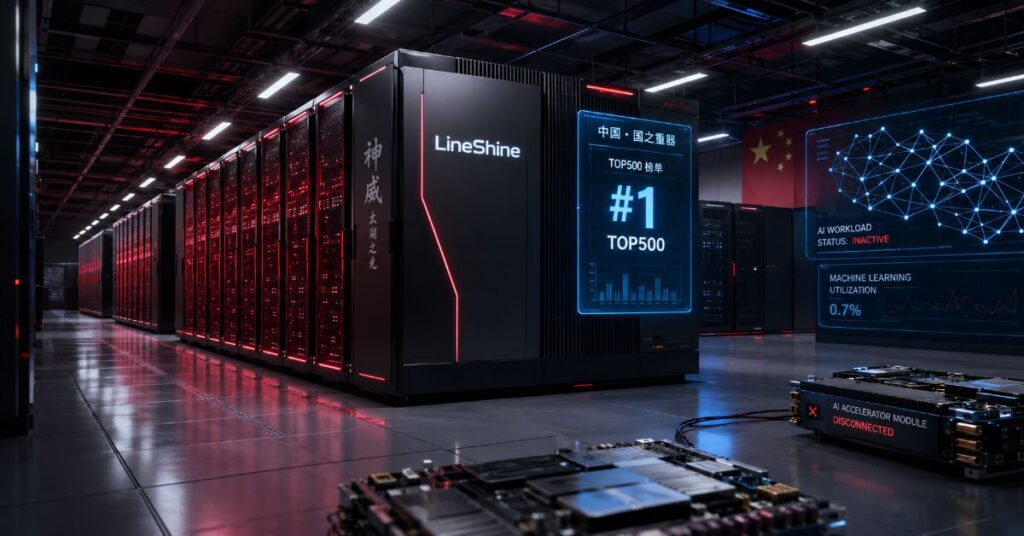
China built the fastest supercomputer in the world using only its own chips. It does not have the fastest computer for AI. Both of those statements are true at the same time, and the gap between them is the most important thing about this week’s supercomputing news.
The June 2026 edition of the TOP500 list, released at the ISC 2026 conference in Hamburg on June 23, shows China’s LineShine system at the National Supercomputing Centre in Shenzhen debuting at number one with 2.198 exaflops of sustained performance on the High Performance Linpack benchmark — more than 20 percent ahead of the US El Capitan system at Lawrence Livermore National Laboratory, which held the top spot since November 2024. It is the first time China has led the TOP500 since Sunway TaihuLight in 2017, and the first time any system has exceeded two exaflops of sustained double-precision performance using CPUs alone, without GPU accelerators.
On a separate benchmark designed to approximate the kind of mixed-precision, sparse-math workloads that AI training actually runs, LineShine ranked fourth. The machine that won the supercomputing rankings was optimized for a different race than the one that matters most in 2026.
Key Developments
- LineShine, installed at the National Supercomputing Centre in Shenzhen and built by the Shenzhen Cloud Computing Center, debuted at No.1 on the June 2026 TOP500 with 2.198 exaflops on HPL — China’s first top ranking since 2017.
- The system is built entirely on domestically designed processors (304-core LX2 chips on the LingKun platform, Armv9 architecture), proprietary LingQi interconnect, and the Kylin operating system — no US hardware components.
- LineShine ranked fourth on the HPL-MxP benchmark, which measures mixed-precision performance approximating AI workloads — the benchmark that most closely reflects AI training performance.
- It is the first system in TOP500 history to sustain more than 2 exaflops using CPUs alone, consuming 42.2 MW of power at 52.07 gigaflops per watt.
What Happened
According to the official TOP500 announcement, LineShine uses a custom architecture built entirely on Chinese components. The system’s 13.79 million CPU cores are organized on 304-core LX2 processors running at 1.55 GHz, built on the Armv9 instruction set architecture, packaged in pairs of compute chiplets with 32 GB of on-package HBM per chip and up to 256 GB of DDR5 external memory. The chips are connected via a proprietary LingQi interconnect and the whole stack runs Kylin OS. LineShine achieved 80 percent of its 2.736 exaflop theoretical peak on the HPL benchmark — a strong efficiency ratio for a first-generation domestic exascale design.
El Capitan, built on AMD EPYC processors and Instinct MI300A accelerators, now holds No. 2 at 1.809 exaflops. Frontier (Oak Ridge, Tennessee) is No. 3 at 1.353 exaflops, and Aurora (Argonne, Illinois) is No. 4 at 1.012 exaflops. Europe’s JUPITER Booster at the Jülich Supercomputing Centre holds No. 5 at exactly 1.000 exaflop, making five exascale systems operational globally for the first time. On the HPL-MxP benchmark, which measures performance on mixed-precision tasks approximating AI workloads, Reuters cited experts who note that LineShine’s fourth-place ranking reflects its CPU-only design’s limits: the 3.6x speedup from full to mixed precision is modest compared to GPU-accelerated systems, which are designed specifically to run the reduced-precision arithmetic that dominates large-scale AI training.
The Mechanism: What HPL Measures and What It Misses
The TOP500 list has been ranked by High Performance Linpack since 1993. HPL measures how fast a system can solve a dense system of linear equations in 64-bit floating-point arithmetic — the kind of computation that dominated scientific simulation for decades, from weather modeling and fluid dynamics to nuclear weapons maintenance. It is a real and meaningful benchmark. It is also increasingly disconnected from the computing that drives the most consequential technological competition in 2026.
AI training — specifically the matrix multiplications underlying large language model training — runs primarily at lower precisions than 64-bit: FP16, BF16, FP8, and increasingly FP4, where GPU architectures provide massive multipliers in effective throughput. A GPU-accelerated system like El Capitan or the private xAI Colossus cluster in Memphis can achieve dramatically higher effective throughput on AI training tasks than the HPL benchmark suggests, because the benchmark does not stress the reduced-precision pathways where modern AI accelerators excel. That is why LineShine ranks fourth on HPL-MxP rather than first: without dedicated AI accelerators, its CPU-only design cannot match GPU clusters on the workloads those clusters were built for.
The Backstory
China first topped the TOP500 in 2010 with the Tianhe-1A, and traded the title back and forth with the US and Japan until 2023, when Chinese supercomputing centres stopped submitting systems to the list. The apparent reason, according to industry analysts, was the chilling effect of successive US export control rounds under both the Trump and Biden administrations: submitting a high-performance system to the TOP500 invites scrutiny of its component supply chain, and Chinese labs uncertain about how that scrutiny would land chose to stay off the list rather than risk highlighting dependencies on hardware that might now be restricted.
LineShine’s submission changes that posture, and does so with a pointed message. The system contains no US hardware whatsoever — no AMD or Intel processors, no Nvidia GPUs, no US memory components. Its LX2 chips, LingQi interconnect, and Kylin operating system are all domestically developed, reflecting years of investment in building a full indigenous compute stack precisely because export controls had identified the dependence on US-designed hardware as a strategic vulnerability. The same export control dynamic also explains why LineShine ran CPUs rather than GPUs: the tools needed to manufacture advanced AI chips at the process nodes that would make GPU accelerators competitive are still subject to US export restrictions, specifically the ASML EUV lithography machines that both TSMC and the Chinese fab SMIC require for sub-7nm production. Nvidia’s own infrastructure partnerships across Asia illustrate the same dependency: the most competitive AI compute in the region still runs on US-designed silicon.
Addison Snell, chief executive of supercomputing analyst firm Intersect360 Research, captured the geopolitical dimension precisely: “I’m not surprised it’s the number one system. What I’m surprised by is that they submitted it and want recognition for it.” The submission is at least partly a political act: China demonstrating to domestic audiences and international partners that export controls are not preventing the development of world-class compute infrastructure, even if — as Snell and others note — HPL top ranking is not the same as AI compute leadership.
Reactions
TOP500 co-founder and Turing Award winner Jack Dongarra, speaking to the South China Morning Post, confirmed the significance of the technical achievement: “This is the first time a computer with only CPUs has reached exascale.” That framing is accurate on the HPL metric, and it is a real engineering accomplishment. But Dongarra’s own HPL-MxP benchmark, which he helped develop precisely to give the TOP500 a metric more relevant to modern workloads, is the one where LineShine falls to fourth — suggesting the co-founder of the ranking list recognizes both what the result means and what it does not.
One analyst, identified in reporting as Goodrich, put the strategic reading more bluntly: “China is hoping to convince the world export controls are useless by hoping we ignore the details.” That interpretation frames the submission as a geopolitical message designed to weaken the case for continued export restrictions, rather than a straightforward scientific achievement pursued on its own terms.
The Dispute: Does the TOP500 Still Measure What Matters?
LineShine’s arrival at No. 1 on a benchmark optimized for 1990s-era scientific computing while placing fourth on the metric that approximates today’s actual AI workloads highlights a structural tension in how supercomputing leadership is defined and communicated publicly. The biggest AI training clusters — SpaceX’s xAI Colossus in Memphis (reportedly 200,000 H100s plus GB200 Blackwell GPUs), Microsoft’s Azure-based compute infrastructure deploying its Maia 200 chip, and Google’s Ironwood TPU pods — are not submitted to the TOP500 at all. Most cloud providers do not compete for list placement because their AI-optimized compute does not map cleanly onto HPL, and because publicizing the scale of their infrastructure creates competitive intelligence problems they prefer to avoid. A study published last year by AI policy researchers found that xAI’s Colossus was already likely more capable than El Capitan for AI-relevant tasks. If that analysis is accurate, LineShine’s HPL-MxP fourth-place ranking understates how large the gap between HPL leadership and actual AI compute capability actually is.
What Happens Next
The next TOP500 update arrives in November 2026. Whether the US responds to LineShine’s debut with a newly submitted system — the government El Capitan and Aurora systems are the most likely candidates for upgrades — or whether the US simply continues to de-emphasize the HPL benchmark as a measure of strategic computing capability, will be one marker of how Washington interprets the geopolitical significance of this result. More practically, watch whether LineShine submits its own results on additional AI-oriented benchmarks that would let outside researchers assess how it performs on tasks closer to real training workloads, rather than only on the HPL metric where its CPU-only design excels.
Why It Matters
LineShine is a significant technical and geopolitical achievement: the world’s first CPU-only exascale system, built entirely on domestic Chinese components, from a country that US export policy has spent four years attempting to lock out of the most advanced compute hardware. That it ranks fourth on AI workloads rather than first is not a footnote — it is the actual story. The systems that lead on AI-relevant benchmarks are those built specifically for the reduced-precision matrix arithmetic that dominates frontier model training, and those systems are still largely GPU-accelerated and still depend, at the cutting edge, on silicon design and manufacturing capabilities that remain concentrated outside China. The gap LineShine was designed to challenge has not closed. But the fact that China built and publicly submitted an exascale system on entirely domestic hardware is evidence that it is closing, and that the broader contest over AI compute sovereignty is being fought on the hardware layer as directly as it is on the model layer.
Sources
TOP500 official list (June 2026); Reuters / Express Tribune; South China Morning Post; Network World; Tom’s Hardware; Technology.org.
