
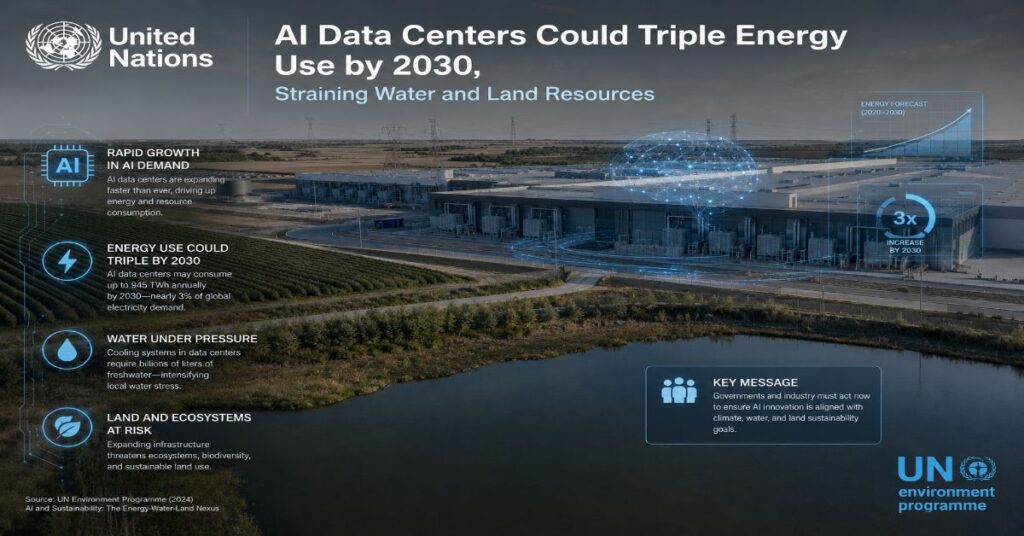
A new report from the United Nations University Institute for Water, Environment and Health (UNU-INWEH), titled “Environmental Cost of AI’s Energy Use: Carbon, Water and Land Footprints” and published in early June 2026, finds that the resource demands of AI infrastructure are on track to nearly triple by 2030 — and that most of this demand comes not from training large models, but from everyday use.
The Headline Numbers
Global data center electricity use was estimated at 448 terawatt-hours (TWh) in 2025, with AI workloads accounting for roughly 20 percent of that total. By 2030, the report projects total data center electricity demand could reach 945 TWh annually, with AI’s share of that rising to around 40 percent. The report describes this as nearly triple the combined annual electricity use of Pakistan, Bangladesh, and Nigeria — countries collectively home to more than 650 million people — and roughly equivalent to the annual residential electricity needs of the 1.3 billion people living in Sub-Saharan Africa.
On water, the report projects an associated footprint of 9.3 trillion liters by 2030, equal to the basic annual domestic water needs of all 1.3 billion people in Sub-Saharan Africa. On land, AI-related electricity infrastructure could require more than 14,500 square kilometers — roughly twice the area of the Jakarta metropolitan region. The report also projects AI infrastructure could generate up to 2.5 million tonnes of e-waste annually by 2030, much of it likely to be handled in lower-income countries with limited safe-disposal capacity.
Inference, Not Training, Is the Main Driver
The report’s central argument is that public discussion of AI’s environmental cost has focused too heavily on the energy required to train large models, while 80 to 90 percent of total AI energy demand actually comes from inference — the billions of everyday queries made once a model is deployed. ChatGPT alone is estimated to process around 2.5 billion prompts per day.
The report quantifies how sharply energy use varies by task. A typical conversational AI query uses roughly 200 times the energy of a basic text classification task. Generating a single AI image can require around 1,450 times that baseline — more than a thousand times the energy of simple text classification, in the report’s framing — while a short AI-generated video can consume as much electricity as 200,000 text classification tasks. To put this in everyday terms, the report estimates that generating one AI image uses enough electricity to power a 10-watt LED bulb for 17 minutes, while a complex AI video could power the same bulb for roughly 42 hours.
The Efficiency Paradox
Perhaps the report’s most counterintuitive finding is what researchers describe as a rebound effect: making AI more efficient may not reduce its overall environmental footprint, and could increase it. Kaveh Madani, director of UNU-INWEH and a report co-author, said that as AI becomes more efficient and affordable, consumption rises — meaning the overall footprint can grow larger than what efficiency gains save.
The report also warns that environmental tradeoffs do not move in the same direction across carbon, water, and land. Lead author Miriam Aczel noted that switching electricity generation from coal to bioenergy can cut carbon emissions by around 70 percent, but increase the associated water footprint more than 30-fold and the land footprint roughly 100-fold — meaning a choice that looks “green” on a carbon basis can shift the burden onto water or land resources instead, often in regions with little say in the decision.
What’s Being Recommended
Report recommendations
- Integrate AI infrastructure planning into broader regional energy, water, and land-use strategies, rather than siting decisions made in isolation.
- Evaluate “green” energy transitions (e.g., coal to bioenergy) across all three footprints — carbon, water, and land — not carbon alone.
- Increase transparency around default settings (model choice, image/video resolution, prompt length) that determine a user’s energy footprint, since these decisions are currently invisible to most users.
- Encourage users and developers to consider whether simpler models or tools can accomplish a given task with a smaller footprint.
Why It Matters
The report reframes the AI environmental debate away from a narrow focus on the carbon cost of training headline models like GPT-4 or GPT-5, toward the cumulative, largely invisible cost of day-to-day usage — a cost that scales with adoption rather than with any single training run. As AI image and video generation tools see rapid growth, the report’s per-task energy multipliers suggest that product design choices and default settings, not just data center efficiency, will significantly shape AI’s resource footprint through 2030.
Sources
United Nations University Institute for Water, Environment and Health (UNU-INWEH); UN News; Time; Business Standard; Futurism; Earth.org.
