
Summary of Major Developments
- MIT News publishes Ferveret feature June 10, 2026: MIT’s official news office published a feature article on June 10, 2026, spotlighting Ferveret — a San Jose, California startup founded in 2021 by MIT nuclear engineering researchers Dr. Reza Azizian and Dr. Matteo Bucci. The publication on MIT News coincides with growing institutional and venture capital attention on Ferveret’s nuclear-inspired Adaptive Phase Cooling technology as a credible solution to the AI data centre cooling crisis. The company is already testing its system with CleanSpark, FuriosaAI, and Switch — three active data centre operators — confirming commercial pilot progress.
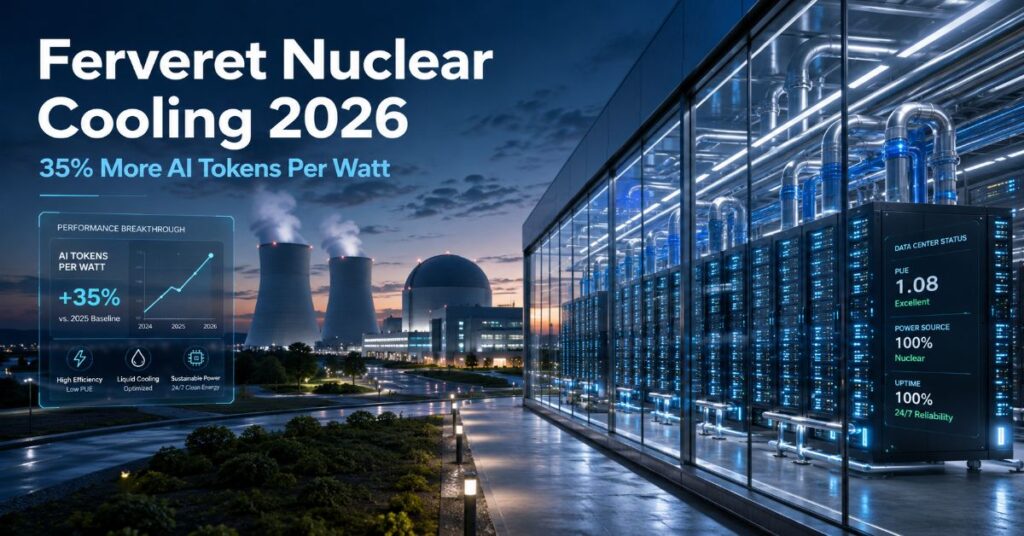
- 15% efficiency gain, 35% more tokens per watt in UCLA study: In a study conducted in collaboration with the Samueli Computer Science Department at the University of California Los Angeles, Ferveret’s Adaptive Phase Cooling solution delivered a 15% improvement in computational power efficiency compared to state-of-the-art liquid cooling solutions. Combined with Ferveret’s power control system for optimising operating conditions, the company reports that data centres can extract 35% more AI tokens from their models with the same amount of power — a direct improvement in the cost per inference for every AI workload running on cooled hardware.
- Zero water consumption — solves AI’s most acute environmental constraint: Unlike conventional air cooling and most liquid cooling systems currently deployed in data centres, Ferveret’s Adaptive Phase Cooling system uses zero water. Data centres currently consume between 1 and 9 million litres of water per day for cooling depending on size and climate — a consumption rate that has drawn regulatory scrutiny and geographic restrictions on data centre construction in water-stressed regions including the western United States, parts of Europe, and the Middle East. Ferveret’s zero-water architecture eliminates this constraint entirely.
Technical Breakdown: How Nuclear Reactor Cooling Works in a Data Centre
The technical foundation of Ferveret’s Adaptive Phase Cooling is subcooled boiling — a heat transfer mechanism used in nuclear reactor thermal management systems. In nuclear reactors, managing heat removal from fuel rods at the extreme temperatures and heat densities involved requires far more efficient heat transfer than air or conventional liquid cooling can achieve. Subcooled boiling produces small bubbles that form at a heated surface, detach from the surface before they can grow into larger vapour pockets, and recondense rapidly in the surrounding cooler liquid. This bubble formation and rapid recondensation cycle dramatically accelerates heat transfer at the chip surface compared to the heat conduction mechanism used in conventional liquid cooling systems.
Ferveret’s Adaptive Phase Cooling applies this principle to AI chip cooling by submerging computer servers in a specialised liquid — not water — that is engineered to optimise the subcooled boiling process at the chip surface. The key differentiator from other liquid immersion cooling systems is bubble size: Ferveret’s system produces significantly smaller bubbles than conventional immersion cooling, which detach more frequently and create a more continuous and efficient heat removal cycle. The smaller bubbles maintain a thinner, more uniform liquid layer at the chip surface, preventing the formation of vapour pockets that insulate the chip from the cooling liquid and reduce thermal performance.
The practical consequences of this improved heat transfer efficiency are threefold. First, chips run at lower temperatures, which reduces thermal degradation and extends hardware lifespan. Second, chips can sustain higher power levels for longer periods — meaning AI accelerators like NVIDIA’s B200 Blackwell GPUs can operate at their maximum rated performance envelopes without throttling, rather than reducing clock speeds to manage heat. Third, the system requires significantly less energy to maintain safe operating temperatures than air or conventional liquid cooling — addressing both the operating cost and carbon footprint dimensions of data centre energy consumption. The company’s LinkedIn profile cites a 96% reduction in cooling costs, 68% reduction in capital costs, and 40% reduction in carbon footprint compared to conventional cooling.
CEO Reza Azizian contextualised the environmental mission at the core of the company’s design: ‘Our goal is to make data centers as sustainable as possible and help them use every single watt of power to generate tokens, which are the most useful outputs. Our system enables the operation of more powerful chips, it helps data centers waste a lot less energy.’ For data centre operators facing power procurement constraints — where electricity availability, not equipment cost, is the binding constraint on AI infrastructure build-out — a 35% improvement in tokens per watt is the equivalent of 35% more AI capacity from the same power contract.
| Cooling Method | Water Consumption | Efficiency vs Baseline | AI Token Throughput | Capital Cost | Operating Cost | Suitable for High-Density AI |
| Air cooling (CRAC/CRAH units) | None | Baseline — ~33% of DC power used for cooling | Baseline | Low | High — electricity-intensive | No — insufficient for >250W/chip |
| Direct Liquid Cooling (cold plates) | Moderate | ~15-20% better than air | Modest improvement | Medium | Medium | Partially — standard for H100/B200 |
| Conventional immersion cooling | None (dielectric fluid) | ~25-30% better than air | Moderate improvement | High | Low-medium | Yes — but large bubble formation limits performance |
| Ferveret Adaptive Phase Cooling | Zero — specialised fluid, no water | 15% better than best liquid cooling | 35% more tokens/watt vs conventional cooling | Medium (68% lower than conventional per Ferveret) | 96% lower than conventional per Ferveret | Yes — designed specifically for AI GPU density |
Commercial and Enterprise Market Impact
The enterprise and hyperscale data centre market’s interest in Ferveret is not primarily environmental — it is economic and capacity-constrained. The binding constraint on AI infrastructure expansion in 2026 is not equipment availability, not capital, and not AI model capability — it is power. Data centres are projecting 9 to 17% of total US electricity consumption by end of decade, and power procurement timelines are measured in years, not months. A technology that delivers 35% more AI tokens from the same power capacity is not an environmental feature — it is a capacity multiplier that operators can deploy immediately without waiting for new power infrastructure.
Ferveret’s commercial pipeline reflects this demand. CleanSpark, FuriosaAI, and Switch — all active data centre operators with real AI workloads — are already testing the Adaptive Phase Cooling system in pilot deployments. The investor base is similarly indicative: TO VC, Aramco Ventures, Cerberus, Y Combinator, Baruch Future Ventures, and Climate Capital represent a combination of infrastructure-focused, energy-sector, and climate technology investors who are positioning for the data centre cooling market as a strategic infrastructure investment alongside AI hardware itself.
“The Ferveret story is the infrastructure version of the AI race. Everyone is focused on which model is most capable. Nobody is talking about the fact that the chip clusters running those models are thermally throttled — they cannot run at maximum performance continuously because conventional cooling cannot remove heat fast enough. Ferveret’s nuclear thermal design solves that constraint. 35% more tokens per watt is not an incremental improvement — it is a new frontier for what dense AI compute can achieve per megawatt.” — Data Centre Infrastructure Analyst, enterprise technology research, June 10, 2026
“Azizian and Bucci spent years on nuclear reactor cooling for a reason: the heat densities in nuclear reactors are orders of magnitude higher than in data centres, and the engineering disciplines required to manage them safely are correspondingly more rigorous. The fact that they have now transferred those techniques to AI chip cooling is not a metaphor — it is a direct application of the most demanding thermal engineering discipline in existence to a commercial infrastructure problem.” — Enterprise Technology Infrastructure Analyst, AI hardware research, June 10, 2026
Frequently Asked Questions
How does Ferveret’s cooling system work?
Ferveret’s Adaptive Phase Cooling (APC) submerges computer servers in a specialised liquid engineered for optimal heat transfer. The system is based on subcooled boiling — a technique from nuclear reactor thermal management — which produces very small bubbles at the chip surface that detach frequently and recondense in the surrounding liquid. This creates a continuous, high-efficiency heat transfer cycle that removes heat more effectively than conventional liquid or air cooling. The system uses zero water — the cooling liquid is a proprietary specialised fluid, not water — and requires significantly less electricity to maintain safe chip temperatures than conventional cooling methods.
What efficiency improvements does Ferveret claim?
Based on a study conducted with UCLA’s Samueli Computer Science Department, Ferveret’s Adaptive Phase Cooling delivers 15% better computational power efficiency compared to state-of-the-art liquid cooling solutions. Combined with Ferveret’s power control system, data centres can extract 35% more AI tokens from their models with the same power input. The company also reports 96% lower cooling costs, 68% lower capital costs, and 40% reduction in carbon footprint compared to conventional cooling infrastructure. These figures are from Ferveret’s own reporting and pilot testing — independent third-party validation at hyperscale is ongoing.
Who founded Ferveret and what is the MIT connection?
Ferveret was founded in 2021 by Dr. Reza Azizian and Dr. Matteo Bucci — both MIT researchers with nuclear engineering backgrounds. Azizian was a former MIT postdoctoral researcher in nuclear engineering; Bucci is MIT’s Esther and Harold E. Edgerton Associate Professor in the Department of Nuclear Science and Engineering. The company emerged from Y Combinator’s 2021 summer batch and is headquartered in San Jose, California. MIT’s news office published a feature on the company’s technology on June 10, 2026.
Sources
MIT News. (2026, June 10). Startup’s nuclear-inspired cooling system could make data centers more sustainable. https://news.mit.edu/2026/nuclear-inspired-cooling-system-ferveret-could-make-data-centers-more-sustainable-0610
Mirage News / MIT. (2026). Nuclear-Inspired Cooling Boosts Data Center Sustainability. https://www.miragenews.com/nuclear-inspired-cooling-boosts-data-center-1689547/
IT Brief / Ferveret. (2026, March 27). Ferveret study says waterless cooling lifts AI efficiency. https://itbrief.com.au/story/ferveret-study-says-waterless-cooling-lifts-ai-efficiency
Street Insider / Business Wire. (2026, March 26). Ferveret Waterless Data Center Cooling Delivers 15% Compute Efficiency Boost. https://www.streetinsider.com/Business+Wire/Ferveret
Ferveret. (2026). About us — company background and mission. https://www.ferveret.com/about-us
