
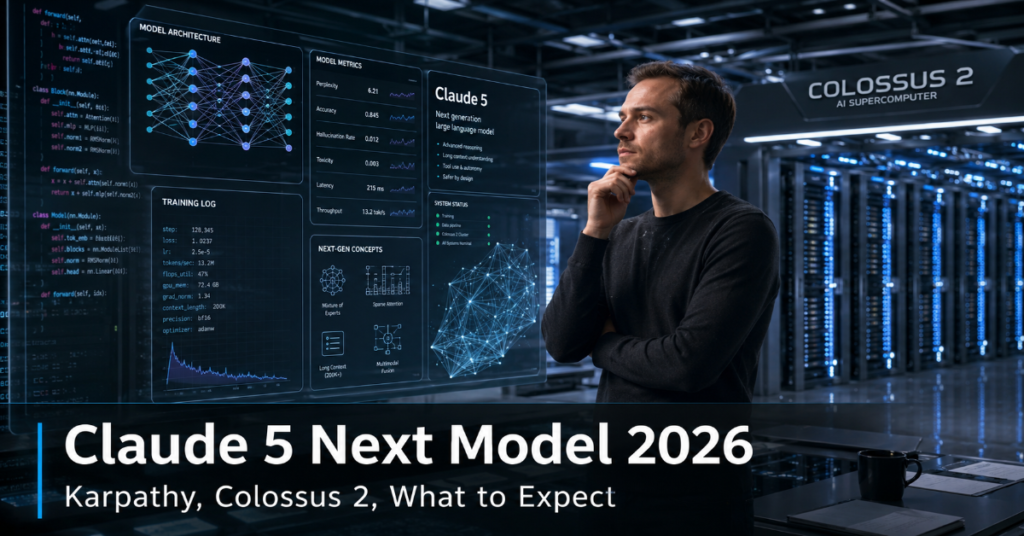
Claude 5 — or whatever Anthropic chooses to call the next generation of its Claude model family — is being built under conditions that have no precedent in the company’s four-year history. The pretraining team now includes Andrej Karpathy, one of the most respected AI researchers in the world and an original OpenAI co-founder, with a specific mandate to build a new team that uses Claude to accelerate pretraining research. The compute infrastructure has expanded to include Colossus 2 in Memphis, equipped with NVIDIA GB200 Blackwell Ultra GPUs that represent a significant performance improvement over the H100s that trained previous Claude generations. The revenue to fund the training run is confirmed: $10.9 billion in Q2 2026 revenue, a 56-cent compute cost ratio, and a $559 million operating profit that, for the first time in Anthropic’s history, means the company can fund frontier model development from its own operations rather than solely from investor capital. What does the next Claude model look like given these unprecedented inputs? The available evidence points to four capability areas where Karpathy’s pretraining mandate, GB200 compute, and Anthropic’s existing research direction converge.
The Karpathy Mandate — Using Claude to Train Claude
The specific role confirmed by Anthropic for Karpathy is building a team focused on using Claude to accelerate pretraining research. This is not research about Claude — it is research where Claude is an active participant in the research process that creates the next Claude. In practical terms, this could mean several things. Claude could be used to generate and evaluate synthetic training data at a scale and quality that human-curated data collection cannot match. It could be used to propose and test modifications to the training pipeline, accelerating the iteration cycle from weeks to days. It could be used to analyse the properties of the training corpus, identifying gaps, biases, or underrepresented domains that human analysis would miss. Or — in the most ambitious interpretation — Claude could be used to generate the research hypotheses that the pretraining team then validates and implements.
The algorithmic bridge analysis of Karpathy’s hire noted that this direction is consistent with what Anthropic co-founder Jack Clark predicted in his newsletter: that there is a likely and near-term future in which AI systems actively contribute to the research process that makes the next version of themselves more capable. Karpathy himself acknowledged this trajectory in late 2025, writing that he thought it would be a sad time for AI researchers as AI began to automate aspects of AI research — then concluded that the right response was not to observe from the outside but to be at the frontier where this is happening. He chose Anthropic. The specific work he is doing — whatever form it takes in practice — is the most direct institutional bet that Anthropic has ever placed on AI-assisted AI development.
“Excited to welcome Andrej to the Pretraining team! He will be focused on using Claude to accelerate pretraining research — one of the most important frontiers in our work.” — Nicholas Joseph, Head of Pretraining, Anthropic, post on X, May 19, 2026
Anthropic’s Compute and Research Infrastructure for the Next Claude
| Resource | Status | Capability | Significance for Next Model |
| Colossus 1 (Memphis) | Operational — leased from SpaceX | 220,000+ GPUs (H100, H200, GB200 mix) | Large-scale parallel training runs at unprecedented throughput |
| Colossus 2 (Memphis) | GB200 scaling through June 2026 | GB200 Blackwell Ultra — next-gen GPU architecture | 40-50% training efficiency improvement over H100 per GPU-hour |
| AWS compute | Long-term agreement | Variable capacity — elastic scaling | Inference serving at $43.6B ARR demand level |
| Google Cloud | Long-term agreement | TPU and GPU access | Redundant training and inference capacity |
| Karpathy pretraining team | Building — started May 19, 2026 | Claude-accelerated pretraining research | Potentially compressed training iteration cycle from weeks to days |
| Q2 2026 operating profit | $559 million (projected) | Self-funding training runs from operations | First training run funded from profits — reduces investor capital dependency |
Four Capability Areas to Watch in the Next Claude
Anthropic’s published research direction, Karpathy’s specific mandate, and the compute architecture coming online through June 2026 together point to four capability areas where the next Claude generation is most likely to advance. The first is reasoning depth at extended context. Claude Opus 4.7 already leads frontier models in creative writing quality and enterprise adoption, but its long-context reasoning — maintaining coherent analytical threads across very long documents or conversation histories — has room to improve. With Colossus 2’s GB200 GPUs offering superior memory bandwidth and the GB200’s extended context window capabilities, the next Claude should demonstrate measurably better reasoning quality across contexts that exceed 200,000 tokens.
The second area is agentic reliability. Claude Code’s 64.3 percent score on SWE-bench Pro is the current enterprise coding benchmark leader, but production agentic deployments reveal failure modes that controlled benchmarks do not capture: the model loses track of its plan partway through a multi-step task, makes a subtle error in an early step that cascades through subsequent steps, or fails to seek clarification at the right moment. The pretraining research direction Karpathy is pursuing — using Claude to improve its own training — could directly address these failure modes by having Claude analyse its own agentic failure cases and generate training data that teaches the next version to handle them better. The third area is multimodal integration. Anthropic’s 3.75 megapixel vision capability in Claude Opus 4.7 is strong but narrower than Gemini Omni’s world model architecture. The next Claude will need a multimodal story that goes beyond text and image understanding toward the kind of integrated visual-reasoning-action capability that enterprise and consumer use cases increasingly demand.
“I think the next few years at the frontier of LLMs will be especially formative. Getting back to R&D — using Claude to accelerate pretraining — is where I want to be.” — Andrej Karpathy, post on X announcing his joining of Anthropic, May 19, 2026
The IPO Timing Question — Will the Next Claude Ship Before or After the Anthropic Public Listing?
Anthropic is targeting an October 2026 IPO at a post-money valuation expected to exceed $900 billion. The question of whether the next major Claude generation ships before or after that public listing is not just a product roadmap question — it is an IPO narrative question. If the next Claude launches before the public S-1 is filed — expected approximately two months before the listing, or around August 2026 — Anthropic can include a new flagship model in its prospectus. If the next Claude launches after the IPO, public market investors have bought shares based on the capabilities of Claude Opus 4.7, and any subsequent model that extends beyond those capabilities either validates the IPO price or creates expectations pressure for the earnings reports that follow.
Anthropic has not confirmed a release timeline for the next Claude generation. The GB200 compute ramp through June 2026 suggests a large training run that cannot complete before June at the earliest. Typical post-training — fine-tuning, safety testing, red-teaming, and deployment preparation — takes two to four months. A June training completion implies an October to December deployment at the earliest, which aligns more closely with an IPO launch than a pre-IPO narrative tool. If Karpathy’s team can compress the iteration cycle using Claude-assisted pretraining research, that timeline could accelerate. But accelerating frontier model training at the GB200 scale Anthropic is running is not a matter of adding more researchers — it is a function of compute time, power delivery, and training stability at scale. The GB200 ramp at Colossus 2 is the gating factor.
Key Takeaways
• The next Claude generation is being built under conditions unprecedented in Anthropic’s history: Andrej Karpathy leading a team that uses Claude to accelerate pretraining research, Colossus 2 GB200 Blackwell Ultra compute ramping through June 2026, and first-ever operating profit ($559M in Q2) funding the training run from company operations rather than solely from investor capital.
• Karpathy’s specific mandate — using Claude to accelerate pretraining research — is the most direct institutional implementation of AI-assisted AI development that any frontier lab has publicly confirmed, potentially compressing the training iteration cycle from weeks to days.
• GB200 Blackwell Ultra GPUs at Colossus 2 offer approximately 40-50% training efficiency improvement per GPU-hour over the H100s used to train previous Claude generations, providing both speed and capability headroom for the next training run.
• Four primary capability areas expected to advance in the next Claude: long-context reasoning quality, agentic reliability (specifically multi-step task failure mode reduction), multimodal integration beyond text and image understanding, and pretraining data quality at scale.
• The timing of the next Claude generation relative to Anthropic’s October 2026 IPO is a narrative question: a pre-IPO launch gives the prospectus a new flagship model; a post-IPO launch creates investor expectation management around what public market buyers received at IPO versus what comes next.
• Chris Rohlf, hired simultaneously with Karpathy for Anthropic’s frontier red team, suggests the next Claude will face more intensive adversarial safety testing than any previous generation — reflecting the lessons of the Mythos vulnerability discovery and the government scrutiny that followed.
Conclusion
The next Claude generation has better raw ingredients than any model Anthropic has ever built. Karpathy brings the research depth to advance pretraining in ways that no other researcher on earth is uniquely positioned to do. GB200 compute provides the infrastructure efficiency to make large training runs faster and more capable per dollar. Q2 profitability provides the financial independence to fund the run without requiring another capital raise. And the competitive pressure from OpenAI’s sub-60-day release cadence and GPT-5.6’s imminent development provides the urgency. What is unknown is whether Karpathy’s Claude-accelerated pretraining approach will deliver the capability advances its proponents believe it can, on a timeline that lands before or around the October IPO. If it does, Anthropic’s S-1 will contain two transformative data points: a company that is profitable and a frontier model that proves the profitability is funding the next capability generation. That is the IPO story that justifies a trillion-dollar valuation. Building it in the next four to five months is the most important deadline in Anthropic’s history.
Frequently Asked Questions
When is the next Claude model coming?
Anthropic has not announced a timeline for the next major Claude generation. Based on the GB200 compute ramp at Colossus 2 through June 2026 and typical post-training timelines of two to four months, the earliest plausible deployment window is October to December 2026 — aligning with Anthropic’s IPO timing rather than preceding it, unless Karpathy’s Claude-accelerated pretraining compresses the iteration cycle significantly.
What will Claude 5 be able to do?
Anthropic has not confirmed a Claude 5 designation or its specific capabilities. Based on the research infrastructure and Karpathy’s mandate, the most likely advances are: improved long-context reasoning quality, better agentic reliability in multi-step tasks, expanded multimodal capability, and training data quality improvements from Claude-assisted pretraining research.
What is Andrej Karpathy doing at Anthropic?
Karpathy is leading a new team on Anthropic’s pretraining staff, focused on using Claude to accelerate pretraining research. This means Claude is an active participant in the research process that creates the next Claude — potentially generating training data, analysing pipeline properties, proposing research hypotheses, or compressing the iteration cycle from weeks to days.
What is Colossus 2 and why does it matter for the next Claude?
Colossus 2 is SpaceX’s second Memphis data centre, operational since January 2026, being scaled with NVIDIA GB200 Blackwell Ultra GPUs through June 2026. GB200 offers approximately 40-50% training efficiency improvement per GPU-hour over the H100s that trained previous Claude generations, providing both speed and capability headroom for larger training runs.
How does Anthropic’s profitability affect the next Claude development?
Anthropic’s projected $559 million Q2 2026 operating profit means, for the first time, the company can fund frontier model training from its own operations rather than solely from investor capital. This reduces the dependency on continuous fundraising and gives Anthropic’s research team more operational independence in the timing and scope of the next training run.
References
TechCrunch. (2026, May 19). OpenAI co-founder Andrej Karpathy joins Anthropic’s pre-training team. https://techcrunch.com/2026/05/19/openai-co-founder-andrej-karpathy-joins-anthropics-pre-training-team/
Amodei, D. (2026, May 21). [Post on X — Colossus 2 GB200 expansion]. https://x.com/danielaamodei
Joseph, N. (2026, May 19). [Post on X — welcoming Karpathy to pretraining team]. https://x.com/nicholasjoseph
Build Fast with AI. (2026, May 21). AI news today — May 22, 2026. https://www.buildfastwithai.com/blogs/ai-news-today-may-22-2026
The Algorithmic Bridge. (2026, May 19). Andrej Karpathy joins Anthropic: What happens next. https://www.thealgorithmicbridge.com/p/andrej-karpathy-joins-anthropic-what
Clark, J. (2026, May 4). Import AI newsletter — AI systems contributing to their own development. https://importai.substack.com
NVIDIA. (2026). GB200 NVL72: Blackwell Ultra architecture technical documentation. NVIDIA Developer. https://developer.nvidia.com/blackwell
