
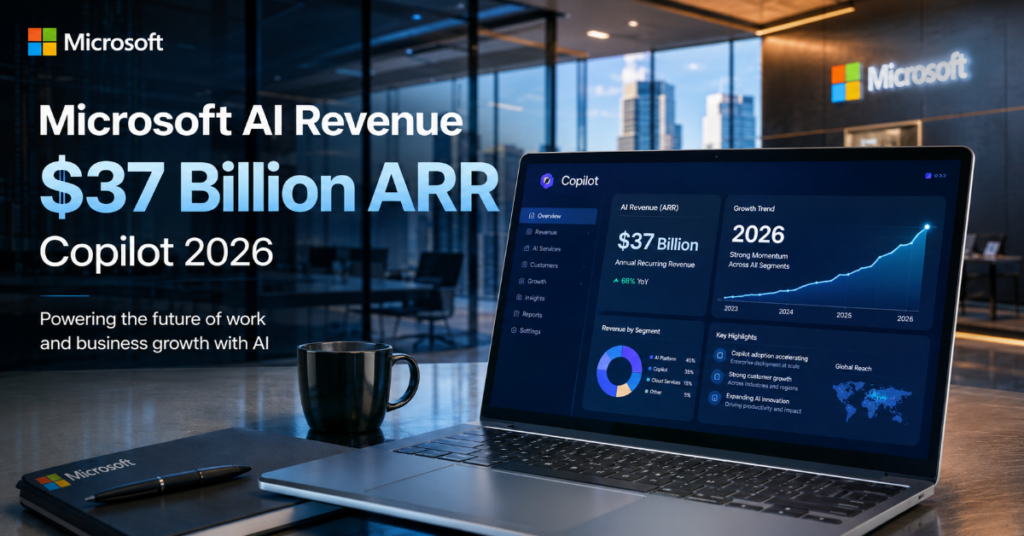
Microsoft’s AI revenue run rate reached $37 billion annually in Q3 fiscal 2026, growing at 123 percent year-over-year — the most significant enterprise AI commercial result disclosed by any technology company in the current cycle. The figure was reported by Microsoft CEO Satya Nadella in the Q3 2026 earnings call alongside total company revenue of $82.9 billion, up 18 percent year-over-year, beating Wall Street’s forecast of $81.39 billion. Net income rose 23 percent to $31.8 billion. Azure cloud services grew 40 percent, driven by AI workloads. Microsoft 365 Copilot passed 20 million paid seats, with weekly Copilot engagement reaching the same level as Outlook — a reference point that suggests AI assistance has become a routine daily tool rather than an experimental feature for a meaningful and growing share of Microsoft’s commercial user base. The Microsoft AI revenue figure — $37 billion ARR — surpasses Anthropic’s $30 billion ARR (as of the March 2026 fundraising disclosure) and trails only Microsoft’s own Azure business in scale within the technology infrastructure category. On May 1, 2026, Microsoft launched Microsoft 365 E7, called the Frontier Suite — its new top-tier enterprise plan at $99 per user per month that bundles Microsoft 365 Copilot, Microsoft Agent 365, the full Entra security suite, and a new work intelligence layer called Work IQ into a single enterprise contract.
The Copilot Seat Milestone — What 20 Million Users Actually Means
Microsoft 365 Copilot passing 20 million paid seats is the clearest commercial validation of enterprise AI adoption that the industry has produced. Each paid Copilot seat is a $30 per user per month incremental charge on top of the existing Microsoft 365 subscription — meaning the 20 million seats represent $600 million in monthly incremental revenue, or $7.2 billion in annualised Copilot seat-specific revenue on top of the underlying Microsoft 365 subscription base. At 20 million seats against Microsoft’s reported commercial user base of several hundred million, penetration remains in the single digits — but the trajectory matters more than the current level. Rajesh Jha, Microsoft’s EVP for Experiences and Devices, described the company’s vision: agents that outnumber humans on the enterprise payroll, with each agent representing a seat revenue opportunity.
The Outlook engagement comparison that Nadella used is the most meaningful benchmark in the earnings call. Outlook is the Microsoft product with the highest daily active usage rate in the enterprise — it is the first application many employees open and the last they close. Reaching Outlook-level weekly engagement means Copilot has crossed from early adopter tool to daily workflow component for its active user base. According to Motley Fool’s May 14 analysis, Microsoft has surpassed 15 million paid Copilot seats generating over $5.4 billion in annual recurring revenue from the software layer alone, with agent-based metered revenue on top. The UC Today reporting confirmed the 20 million figure from the Q3 earnings call — a further 33 percent growth from the 15 million figure just weeks earlier.
“Weekly engagement with Copilot has reached the same level as Outlook. We are focused on delivering cloud and AI infrastructure and solutions that empower every business to optimize their outcomes in the agentic computing era.” — Satya Nadella, CEO, Microsoft, Q3 2026 earnings call
Microsoft AI Business — Key Q3 2026 Metrics
| Metric | Q3 FY2026 Value | Year-on-Year Change | Context |
| Total Microsoft revenue | $82.9 billion | +18% YoY | Beat Wall Street forecast of $81.39B |
| AI business ARR | $37 billion | +123% YoY | Largest enterprise AI revenue run rate disclosed publicly |
| Microsoft 365 Copilot seats | 20 million paid | ~33% growth in weeks (from 15M) | Outlook-level weekly engagement achieved |
| Azure cloud services growth | +40% YoY | Fastest Azure growth rate in several quarters | Driven by AI workloads — OpenAI API and internal AI training |
| Microsoft Cloud revenue | $54.5 billion | +29% YoY | Largest cloud revenue quarter in company history |
| Net income | $31.8 billion | +23% YoY | EPS $4.27 vs $4.06 expected |
| AI capex run rate | $150 billion/year | Largest corporate AI infrastructure commitment | GPUs, land, and multidecade energy deals |
| Copilot Studio agents created | 400,000+ agents | In 3 months by 160,000 organisations | Strong enterprise appetite for AI automation at scale |
Microsoft 365 E7 — The Frontier Suite and What It Means for Enterprise AI Pricing
Microsoft 365 E7, launched May 1, 2026, is the most significant change to enterprise software pricing architecture since Microsoft introduced the E5 suite. E7 bundles Microsoft 365 E5 (productivity and security), Microsoft Entra Suite (identity and access management), Microsoft 365 Copilot (AI in the workflow), and Microsoft Agent 365 (the agent governance control plane) into a single enterprise agreement at $99 per user per month. This creates a pricing structure that is explicitly designed to make the question of whether to add AI to an enterprise agreement redundant: AI is the suite, not an add-on.
Microsoft Agent 365, launched alongside E7, is the agent governance control plane for enterprises building more than five custom AI agents. It combines Microsoft Defender Agent Security Posture Management, Microsoft Entra Conditional Access, and Microsoft Purview content classification into a unified system for observing, governing, and securing AI agents across an organisation — regardless of whether those agents are built on Microsoft platforms, delivered by ecosystem partners (including Anthropic and OpenAI through MCP integrations), or deployed through other channels. The agent governance plane is the element of E7 that most enterprises did not know they needed until they had more than a dozen agents running simultaneously and discovered they had no centralised visibility into what those agents were doing, what data they were accessing, or whether they were complying with the organisation’s security policies.
“The agentic AI enterprise market is projected to reach $9 billion in 2026, and Microsoft is positioning itself as the dominant platform with Copilot Studio, Azure AI Agent Service, and deep integrations across its enterprise software stack. All of those embodied agents are seat opportunities.” — Rajesh Jha, EVP Experiences and Devices, Microsoft, Q3 2026 earnings call
The Copilot Adoption Gap — Why the Numbers Tell Two Stories
The 20 million paid Copilot seats and $37 billion AI ARR are the positive story. The other story is adoption penetration. At 3.3 percent of the Microsoft 365 commercial installed base as of March 2026 analysis from Tech-Insider, the overwhelming majority of Microsoft commercial customers have not paid for Copilot. This is not unusual for a product that launched 18 months ago at $30 per user per month on top of existing subscriptions — enterprise software adoption cycles are measured in years, not months. But it does mean that the 20 million seat milestone, while impressive in absolute terms, represents the early-adopter cohort rather than mainstream enterprise adoption.
The M365 E7 launch at $99 per user per month is designed to close the adoption gap by making the question simpler. Instead of an enterprise IT decision of whether to add $30 per user per month Copilot to an existing E5 subscription, E7 presents the full stack — including Copilot and Agent 365 — as the new enterprise standard. For organisations renewing their Microsoft agreements, the question becomes whether to stay on E5 or upgrade to E7, rather than whether to add Copilot to E5. The bundling strategy shifts Copilot from an opt-in expense to a structural upgrade decision — a classic enterprise software adoption acceleration technique that Microsoft has used successfully since the Office 365 era.
Key Takeaways
• Microsoft’s AI business reached a $37 billion annual revenue run rate in Q3 FY2026, growing at 123 percent year-over-year — the largest enterprise AI revenue figure disclosed by any technology company, surpassing Anthropic’s disclosed ARR and trailing only Microsoft’s Azure business in scale.
• Microsoft 365 Copilot passed 20 million paid seats with weekly engagement at Outlook levels — indicating the transition from early-adopter tool to daily workflow component for its active user base. At $30 per user per month, 20 million seats represent approximately $7.2 billion in annualised seat-specific Copilot revenue.
• Microsoft 365 E7 (the Frontier Suite) launched May 1, 2026 at $99 per user per month, bundling Microsoft 365 E5, Copilot, Microsoft Entra Suite, and Microsoft Agent 365 into a single enterprise contract — structurally shifting Copilot from an optional add-on to the new enterprise standard tier.
• Microsoft Agent 365 is the new agent governance control plane for enterprises with five or more custom AI agents, providing unified visibility, security, and compliance management across all agents regardless of whether they are built on Microsoft, Anthropic, OpenAI, or other platforms.
• Azure cloud services grew 40 percent year-over-year, driven by AI workloads — the fastest Azure growth rate in several quarters, demonstrating that enterprise AI infrastructure investment is converting to cloud revenue at scale.
• Microsoft is spending $150 billion annually on AI infrastructure (GPUs, land, multidecade energy deals) — the largest corporate AI infrastructure commitment in history — while Copilot adoption at 3.3 percent of the commercial installed base indicates significant headroom for continued seat growth.
Conclusion
Microsoft’s Q3 2026 results answer the question that has defined enterprise AI scepticism: does AI generate real revenue, or is it marketing spend? At $37 billion ARR growing at 123 percent, 20 million Copilot seats at Outlook-level engagement, and Azure growing 40 percent on AI demand, the answer is unambiguous. Enterprise AI is a real revenue category, and Microsoft is currently its largest commercial beneficiary. The M365 E7 Frontier Suite launch is the structural bet that consolidates that position: making Copilot and Agent 365 the new standard enterprise tier rather than an optional add-on. The remaining questions are about penetration and profitability at scale. If Microsoft can move Copilot adoption from 3.3 percent to 15 percent of its commercial base over the next two years — following the precedent of how Office 365 adoption grew after its bundling phase — the revenue implications are transformative. The $37 billion ARR would become $150 billion or more in Copilot-specific annual revenue, on top of Azure AI workload revenue that is already growing at 40 percent. That is the trajectory that Microsoft is building toward. The Q3 2026 numbers are the first clear confirmation that the trajectory is real.
Frequently Asked Questions
What is Microsoft’s AI revenue in 2026?
Microsoft’s AI business reached a $37 billion annual revenue run rate in Q3 FY2026, growing at 123 percent year-over-year. This figure includes Copilot seat revenue, Azure AI workload revenue (from OpenAI API and internal AI training), and related AI services. It was disclosed by CEO Satya Nadella in the Q3 2026 earnings call.
How many Copilot users does Microsoft have?
Microsoft 365 Copilot passed 20 million paid seats as reported in the Q3 2026 earnings call. Weekly Copilot engagement has reached the same level as Outlook — suggesting it has become a daily workflow tool rather than an occasional experiment for its active user base. At 3.3 percent of the total commercial installed base, there is significant room for continued growth.
What is Microsoft 365 E7?
Microsoft 365 E7, called the Frontier Suite, launched May 1, 2026 at $99 per user per month. It bundles Microsoft 365 E5 (productivity and security), Microsoft Entra Suite (identity and access), Microsoft 365 Copilot (AI in workflow), and Microsoft Agent 365 (agent governance control plane). E7 structures Copilot as the new enterprise standard tier rather than an optional add-on.
What is Microsoft Agent 365?
Microsoft Agent 365 is the agent governance control plane launched May 1, 2026 as part of M365 E7. It provides a unified system for observing, governing, and securing AI agents across an enterprise organisation — regardless of whether those agents are built on Microsoft platforms or delivered by third parties including Anthropic and OpenAI through MCP integrations.
Is Microsoft’s Copilot adoption high enough to justify the $150B AI investment?
At 3.3 percent of the commercial installed base, Copilot adoption is in early-adopter territory — the $150 billion infrastructure investment is justified only if penetration grows substantially. Microsoft’s E7 bundling strategy is designed to accelerate that growth by making Copilot the new enterprise standard tier. The comparison to Office 365’s adoption curve — which took three to four years to move from early adopter to mainstream — suggests the current penetration level is consistent with a normal enterprise software adoption cycle.
References
UC Today. (2026, May). Microsoft earnings: AI business hits $37B run rate as Copilot passes 20 million seats. https://www.uctoday.com/unified-communications/microsoft-earnings-2026-ai-copilot-enterprise/
Motley Fool. (2026, May 14). The real reason Microsoft just went all-in on AI infrastructure. https://www.fool.com/investing/2026/05/14/the-real-reason-microsoft-just-went-all-in-on-ai-i/
Tech-Insider.org. (2026, April 13). Microsoft AI spending 2026: $150B capex analysis. https://tech-insider.org/microsoft-ai-spending-azure-copilot-2026/
Microsoft. (2026, April 21). Accelerating frontier transformation with Microsoft partners. https://blogs.microsoft.com/blog/2026/04/21/accelerating-frontier-transformation-with-microsoft-partners/
Microsoft Learn. (2026, April). April 2026 announcements — Partner Center. https://learn.microsoft.com/en-us/partner-center/announcements/2026-april
EPC Group. (2026, May). Microsoft Copilot agents: Complete enterprise guide 2026. https://www.epcgroup.net/blog/microsoft-copilot-agents-complete-enterprise-guide-2026
Microsoft Q3 FY2026 Earnings Call. (2026, April/May). Satya Nadella and Amy Hood earnings remarks. Microsoft Investor Relations.
