
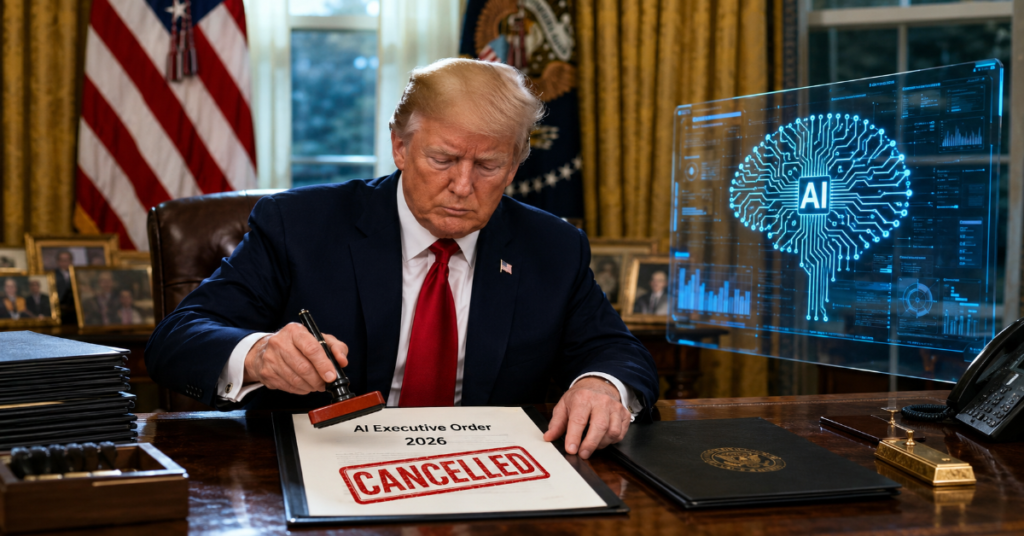
Trump’s cancelled AI executive order is the biggest AI policy story of 2026, and it unfolded with a speed and drama that no Washington observer anticipated. On Thursday, May 21, 2026, the White House had already sent out invitations to AI executives from OpenAI, Anthropic, Google, Meta, and other frontier AI companies for a signing ceremony scheduled for later that afternoon. President Trump was expected to sign an executive order establishing a voluntary framework under which AI companies would give the federal government up to 90 days to review advanced AI models for security vulnerabilities before public release. The NSA would have been centrally involved in classified testing of the most capable models. The signing did not happen. Hours before the ceremony, Trump told reporters in the Oval Office that he had decided to postpone because he did not like certain aspects of the order. The Washington Post, CNN, Axios, and Engadget all reported simultaneously that the real story was more specific: Elon Musk, Mark Zuckerberg, and former US AI and crypto czar David Sacks had contacted Trump directly in the hours before the signing to argue that even the voluntary version of the framework could slow AI development and compromise the United States’ lead over China. Trump, who has said repeatedly that he does not want to do anything to get in the way of American AI leadership, pulled the order.
What the Order Would Have Done
The executive order that Trump cancelled was itself already a significantly watered-down version of what AI safety advocates in Washington had been pushing for since the Anthropic Mythos vulnerability discoveries in April 2026. The original draft had proposed a mandatory pre-launch review framework — requiring frontier AI companies to submit advanced models to the NSA for classified security testing before public release. The concerns driving that proposal were specific: Mythos demonstrated that sufficiently capable AI models could autonomously discover and exploit zero-day vulnerabilities in major operating systems, browsers, and critical infrastructure. If a model with those capabilities were released publicly before its implications were understood, the window between capability and exploitation would be compressed to near-zero.
Under pressure from the tech industry, the mandatory framework was converted to a voluntary one. Under the voluntary framework that Trump was expected to sign, AI companies would be invited but not required to provide the government with early access to test advanced models against national security threats. Companies that chose not to participate faced no legal consequence. The 90-day review window was the outer limit; most reviews were expected to take less time. Even in this voluntary form, Musk, Zuckerberg, and Sacks argued that the framework created reputational and operational pressure to comply that amounted to de facto regulation. They told Trump that the system could slow development of AI technology integral to the US economy, according to anonymous insiders cited by The Washington Post.
“I didn’t like certain aspects of it. I think it gets in the way of — you know, we’re leading China, we’re leading everybody, and I didn’t want to do anything to get in the way of that lead.” — President Donald Trump, speaking to reporters in the Oval Office, May 21, 2026
White House AI Executive Order — Timeline and Key Provisions
| Date | Event | Details |
| January 2025 | Biden AI EO rescinded | Trump revoked Biden’s 2023 AI executive order on first day in office |
| July 2025 | New AI action plan | Trump signed ‘anti-woke AI’ EO; appointed David Sacks as AI/Crypto Czar |
| April 2026 | Mythos discoveries | Anthropic’s Claude Mythos found thousands of zero-day vulnerabilities — triggered White House AI security urgency |
| May 2026 (early) | Draft EO circulated | Original draft: mandatory NSA review; AI companies must submit models pre-launch |
| Mid-May 2026 | Draft watered down | Industry pressure converted mandatory framework to voluntary; 90-day NSA review window |
| May 21 (morning) | Invitations sent | White House sent invitations to AI executives for afternoon signing ceremony |
| May 21 (afternoon) | Musk, Zuckerberg, Sacks lobby Trump | Personal calls/messages to Trump arguing EO would slow development, harm US-China lead |
| May 21 (afternoon) | Trump cancels signing | Hours before ceremony; publicly says he did not like ‘certain aspects’ |
| May 22-23, 2026 | No reschedule announced | Unclear when or whether a revised order will be signed |
The Musk-Zuckerberg-Sacks Lobbying — What Happened
The specifics of how the lobbying effort unfolded reveal the structural dynamics of AI policy in the Trump administration. Elon Musk, who controls SpaceX and SpaceXAI (formerly xAI) and whose Grok AI product would have been subject to the voluntary review framework, has direct and informal access to Trump that no corporate lobbyist can match. The fact that Musk opposed the order is particularly notable given that Anthropic — whose Claude models are Grok’s direct commercial competitors — had been actively engaging with the White House on the executive order through formal channels. A voluntary framework that Anthropic chose to engage with but Musk argued against would have given Anthropic a voluntary compliance signal that SpaceX/xAI was not sending — a reputational differentiation that favoured Anthropic in the enterprise market.
Mark Zuckerberg’s opposition reflects Meta’s specific situation: Meta releases open-weight AI models (Llama series) that, by their nature, cannot be subject to any pre-release review once distributed, because the model weights are public and can be run by anyone, anywhere. A voluntary framework in which closed-source companies like Anthropic and OpenAI participated — and which Meta, as an open-weight model provider, structurally could not — would have created an implicit quality or safety signal that favoured the closed-source labs. Zuckerberg argued this was structurally unfair and potentially harmful to Meta’s competitive position in the AI market. David Sacks, as AI and Crypto Czar, was the internal administration voice who translated those objections into policy language that resonated with Trump’s framework of US-China competition and anti-regulation posture.
“Those who have been pushing for AI regulation in Washington were relieved that the White House was finally going to make moves on AI and cybersecurity safety. Now, it is not clear when — or whether — that is going to happen.” — Axios, reporting on the cancelled signing, May 21, 2026
What This Means for AI Safety and the Regulatory Vacuum
The cancellation of the voluntary framework leaves the United States with no formal process for government review of frontier AI models before public release — at any level of binding strength, in any domain. The Anthropic Mythos discovery — which found thousands of previously unknown zero-day vulnerabilities in major operating systems and browsers, and which prompted the original urgency that drove the executive order — remains the most compelling public demonstration of the national security implications of unreviewed frontier AI deployment. The government now has no formalised mechanism to assess the next Mythos-class model before it ships.
For the AI industry, the cancellation removes a compliance uncertainty that both OpenAI and Anthropic were reportedly willing to accept. Both companies had been engaging with the White House on the executive order’s provisions, according to CNN. Neither company publicly opposed it. The result is that two of the most commercially significant AI companies in the world were prepared to accept a voluntary government review framework, and the review was cancelled at the last minute not by them but by a competitor with closer presidential access. The regulatory vacuum that remains is not neutral: it is a de facto deregulatory decision that increases the speed-to-market pressure on all frontier AI companies while removing the shared framework that could have given enterprise buyers and regulators confidence about what had and had not been reviewed before a model’s public release.
Key Takeaways
• President Trump cancelled the signing of an AI executive order on May 21, 2026 — hours before the scheduled ceremony — after Elon Musk, Mark Zuckerberg, and former AI Czar David Sacks lobbied him personally against it, arguing the framework could slow AI development and harm the US lead over China.
• The cancelled order would have established a voluntary framework giving the federal government — with NSA involvement — up to 90 days to review frontier AI models for security vulnerabilities before public release. Even as a voluntary framework, the tech leaders argued it created de facto compliance pressure.
• The order had already been watered down from a mandatory to voluntary framework under earlier industry pressure; its cancellation removes any formal US government pre-release AI review process at any binding strength.
• Anthropic and OpenAI were reportedly engaging with the White House on the order and neither publicly opposed it — meaning it was cancelled by companies (SpaceX/xAI, Meta) with competitive interests in opposing voluntary compliance that advantaged closed-source frontier model makers.
• The Anthropic Mythos vulnerability discoveries in April 2026 — which found thousands of zero-day exploits in major OS and browser systems — were the specific national security trigger that gave the executive order its urgency. That vulnerability class remains unaddressed by any formal review framework.
• No reschedule has been announced. It is unclear when or whether a revised executive order will be signed, leaving the US as the only major economy with no formal AI model safety review framework at any level of regulatory force.
Conclusion
Trump’s cancellation of the AI executive order is a decision that will be studied by AI governance researchers and policymakers for years. A voluntary framework — the minimum intervention consistent with the national security concerns that Mythos surfaced — was cancelled not because of substantive policy objections from the AI safety community, and not because the major frontier AI companies opposed it, but because Musk and Zuckerberg made a direct personal argument to the president in the hours before the signing ceremony. The outcome reveals the structural reality of AI policy in the current US administration: personal access to the president matters more than formal policy process, and commercial interests in opposing even voluntary compliance frameworks can be more influential than security arguments for implementing them. For the 90 days that would have been available for NSA review of the next frontier model, there will instead be nothing. Whether that changes after the next Mythos-class discovery — or after the next demonstrated AI-enabled cyberattack on critical infrastructure — is the question that the cancellation leaves open.
Frequently Asked Questions
Why did Trump cancel the AI executive order?
Trump told reporters he cancelled the signing because he did not like certain aspects of the order and was concerned it could get in the way of US AI leadership over China. The Washington Post reported that Elon Musk, Mark Zuckerberg, and former AI Czar David Sacks had contacted Trump personally in the hours before the signing to argue the voluntary framework could slow AI development.
What would the AI executive order have done?
It would have established a voluntary framework inviting AI companies to give the federal government up to 90 days to review frontier AI models for security vulnerabilities before public release, with NSA involvement in classified testing. Companies that chose not to participate faced no legal consequence. It was already a watered-down version of an earlier mandatory draft.
Why did Elon Musk oppose the AI executive order?
Musk’s SpaceXAI (formerly xAI) and its Grok AI product would have been subject to the voluntary review framework. Anthropic and OpenAI were engaging with the White House and effectively willing to participate, creating a voluntary compliance signal that Grok would not send — a reputational differentiation that would have favoured Claude and ChatGPT in enterprise AI procurement.
Why did Mark Zuckerberg oppose the AI executive order?
Meta releases open-weight Llama models that are publicly available once released — structurally impossible to subject to a pre-release review because the model weights can be run by anyone once distributed. A voluntary framework in which closed-source labs participated but Meta could not would create a safety signal that disadvantaged Meta’s open-weight AI strategy commercially.
What happens to AI safety oversight without the executive order?
The US now has no formal process for government review of frontier AI models before public release at any binding strength. The Claude Mythos vulnerability discoveries that triggered the executive order’s urgency remain the clearest demonstration of what an unreviewed frontier model can do to critical infrastructure — and there is no formalised mechanism to assess the next such model before it ships.
References
Engadget. (2026, May 22). Trump postpones AI oversight bill after big tech pressure. https://www.engadget.com/2179211/trump-postpones-ai-oversight-bill-after-big-tech-pressure/
CNBC. (2026, May 21). Trump AI executive order postponed: ‘I didn’t like certain aspects’. https://www.cnbc.com/amp/2026/05/21/trump-ai-executive-order-postponed.html
Axios. (2026, May 21). Why Trump’s AI executive order was pulled. https://www.axios.com/2026/05/21/trump-ai-executive-order-postponed-why
Washington Post. (2026, May 21). Trump delays executive order on AI oversight hours before planned signing. https://www.washingtonpost.com/technology/2026/05/21/white-house-tore-down-ai-rules-now-its-building-new-defenses/
Washington Times. (2026, May 22). Here’s what Trump’s postponed AI executive order would have done. https://www.washingtontimes.com/news/2026/may/22/heres-donald-trumps-postponed-ai-executive-order-would-done/
CNN. (2026, May 20). White House postpones executive order on AI. https://www.cnn.com/2026/05/20/tech/ai-executive-order-trump-white-house
Build Fast with AI. (2026, May 21). AI news today — May 22, 2026: 12 biggest stories. https://www.buildfastwithai.com/blogs/ai-news-today-may-22-2026
